Count the openings on a mid-size power station and you land on eight or ten. Two or three AC sockets. A round 12 volt port. A pair of USB-C, a couple of USB-A, and on larger units an Anderson pair bolted to one end. The panel presents them as equals. Behind each opening is a different converter running at a different efficiency. The wrong choice for a given load can cost a third of the runtime on a pack you’ve already paid for. Nothing on the front tells you any of it. A label gives a watt figure beside each opening and stops there, which leaves the owner to work the rest out from a manual or from a meter. Inside the case everything hangs off a single DC bus at pack voltage. Large machines sit somewhere near 51.2 volts. Small ones run 25.6, or 14.4.
From there the exits fall into two families, separated by how much conversion stands behind each one. Deepest of them all is the AC socket. Pack voltage climbs to a high-voltage DC bus, gets chopped into a sine and filtered, then leaves the case at 230 or 120 volts. Each stage takes a cut on the way through. A round port on the front takes the shortest path of the four. Pack voltage drops to a regulated 12 or 13.8 through one buck stage and goes out of the door. That short path explains most of the common uses of the DC 12V port, since anything designed for a car was designed for exactly this rail.
The efficiency ladder, and the stage that must stay awake
Two published numbers settle the ranking. An inverter converts at around 85 percent on typical published figures. Feed its output into a laptop brick and a second conversion begins. United States rules set a floor under that brick: external power supplies rated between 49 and 250 watts have to reach 87 percent in active mode under the Department of Energy’s Level VI standard. Multiply the pair and 74 percent of what left the battery reaches the laptop. Do that job in one step with a buck converter and it clears 90 percent. No sine wave gets manufactured. No brick gets involved. Sixteen points separate the two routes before anything else has been counted. The larger cost hides somewhere else entirely. An AC socket only works while the inverter stage is powered. That stage draws current whether or not anything is plugged into it. Measured idle figures for it run from about 14 watts on a compact unit up to 30 or 40 on a large one. Switch the inverter off on a machine at the top of that range and the draw falls to somewhere between 10 and 20 watts. Set that against a small load and the arithmetic turns ugly fast. Running a 20 watt router through the AC socket of a machine idling at 30 means 50 watts leaving the battery to deliver 20. Move the router onto the 12 volt port and the inverter goes back to sleep.
What a connector standard promises
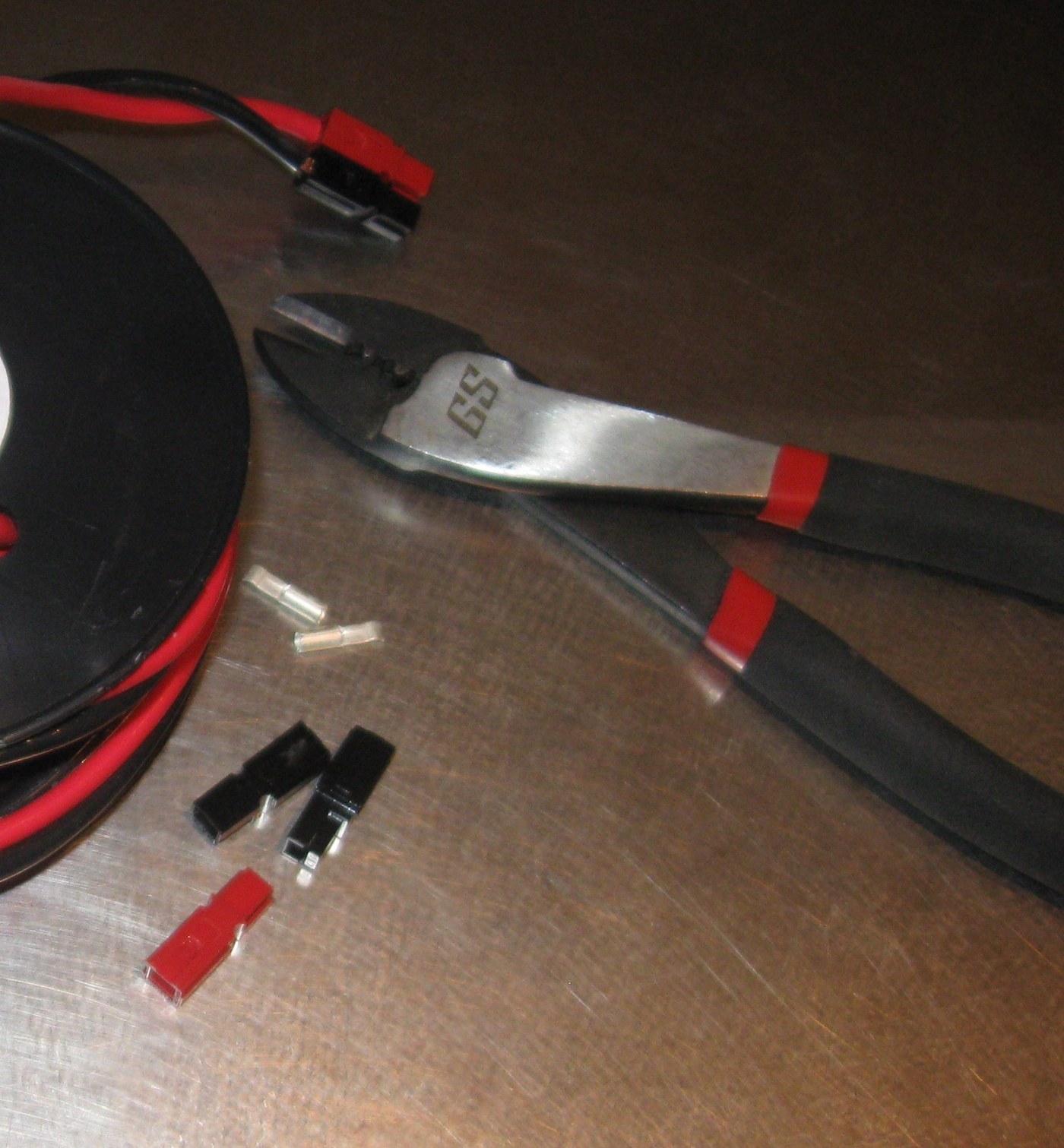
Loose Powerpole housings beside an assembled pair. Red and black shells are the identical moulding, which is what genderless means in practice. Photo by 4dtext, CC BY-SA 3.0.
Every opening on the panel answers to a different document. The round 12 volt port follows SAE J563, a standard written for cigar lighters and later stretched over accessory outlets. It fixes the shape at roughly 21 millimetres across. Between American and European cars there are two variants, a Type A and a Type B running 0.4 millimetres larger. Four tenths of a millimetre is why a plug can feel loose in the wrong socket. AC couplers answer to IEC 60320, where the C13 and C14 pair most stations use carries a rating of 10 amps at 70 degrees. The outlet face is a separate question altogether, since AC output socket types vary across countries with no international agreement standing behind any of them. USB-C answers to the USB Implementers Forum. Negotiation happens in silicon before any current moves, which is a promise none of the older connectors make.
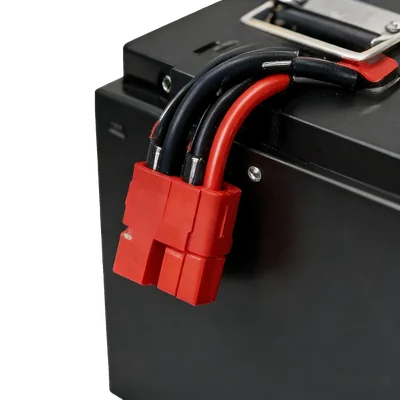
A connector datasheet carries a number most buyers never look at. It says how many times the thing can be plugged in before the contacts stop meeting properly. USB-C is rated at 10,000 mating cycles. Plug something in three times a day and you arrive there in nine years, which is roughly when the rest of the machine gives up anyway. Anderson quotes a figure an order of magnitude higher. The contacts on a Powerpole are rated for 100,000 no-load insertions, which is what happens when a connector gets designed for people who rebuild cables in a field. An AC coupler goes in once and stays there, which is why nobody bothers advertising its cycle count at all. Most connectors come in pairs, one male and one female, and somebody has to stock both halves. Anderson’s Powerpole housings drop the distinction, since two identical parts rotate against each other and mate. The 15, 30 and 45 ampere versions share one plastic housing and differ only in the metal contact pushed into it, which is why a workshop stocks one shell and three inserts. Above that the family keeps going, with single-pole versions rated to 180 amperes and industrial multipole variants reaching 700. Mating is what the makers call cis connectivity: pin one meets pin one, pin two meets pin two, and polarity stops being something anybody has to think about. Up to 55 amps travels through a single pole on wire from 20 down to 10 AWG. One design choice shapes the application scenarios an Anderson connector suits more than any figure on the datasheet, because a field engineer can build any cable in the van out of one bin of parts.
Shape, budget and heat at the opening
Barrel plugs are where this turns serious. A 5.5 by 2.1 millimetre barrel and a 5.5 by 2.5 fit each other well enough to make contact. The voltages behind them are frequently nothing alike. Polarity is the other half of the problem. Centre-positive and centre-negative barrels are physically identical twins. Reverse one and a device gets fed backwards through its own protection. Port keying and reverse insertion protection answers both with shape and with silicon. A moulded trapezoid or a size step refuses the wrong plug outright. Behind that stands a transistor for whatever shape can’t catch. USB ports on a power station share one supply. Four openings on the panel rarely means four independent budgets. Standard Power Delivery tops out at 100 watts, built from 20 volts at 5 amps. The extended range reaches 240. What a station will actually hand over sits below both, since the USB and Type-C port power output cap is set by the converter behind the whole row and then divided across it.
Cables carry a declaration of their own. One rated for 3 amps caps a 5 amp negotiation no matter what either end had in mind. Read a port rating as a promise about temperature rise, measured at one ambient temperature and one airflow. Push a connector to its rating and it warms. Push two neighbouring connectors to their ratings at once and each one warms the other. Behind them is a shared piece of plastic breathing shared air. Continuous use is where this bites. A figure quoted for brief peaks says nothing about an hour, which is the whole subject of heat and derating on high power ports.
Shorts, both directions, and the five volt relic
Drop a spanner across a 12 volt pair and the pack will try to supply whatever the circuit asks for. Iron phosphate cells can push hundreds of amps into a dead short without complaint. Guards run in a cascade. Under 200 microseconds is all a comparator watching the shunt needs to fire the MOSFETs. Slower over-current protection takes 1 to 5 milliseconds. A fuse waits behind both as the one-shot backstop. Each port carries its own version of that chain. The AC side behaves differently again, which is the ground that surge and short circuit protection on ports has to cover. One opening on the panel does a job none of the others manage. A USB-C port on a modern station charges your laptop in the evening and charges the station itself in the morning, through the identical socket and often the identical cable.
Getting that right takes a small negotiation. On USB-C, two configuration channel pins exist to advertise a role. When a port acts as the source it presents a pull-up on those pins. Acting as the sink, it presents a pull-down. Silicon on both ends reads the other side and settles the question before a single watt moves. A dual-role port has to guess first. It toggles between the two states every 75 milliseconds, offering source, then sink, then source again, until the far end answers with the opposite. Plug two dual-role devices together and both sides toggle at once, at which point a randomised process breaks the tie. Seventy-five milliseconds is why a cable sometimes feels like it takes a moment to decide. Nothing’s broken during that pause. Two pieces of silicon are working out which of them is the battery.
USB-A openings survive on power stations for one reason. Everybody owns cables that end in one. What they carry is another matter. A USB 2.0 port supplies 500 milliamps at 5 volts, which comes to 2.5 watts. USB 3.0 lifts that to 900 milliamps. A dedicated charging port under the Battery Charging specification reaches 1,500 milliamps, or 7.5 watts. Set the best of those against a Power Delivery port negotiating 20 volts at 5 amps and the gap is a factor of thirteen. A phone on the USB-A opening of a station whose USB-C port sits idle is a phone charging at a fraction of the speed available two centimetres away.
Pulling a plug under load
Alternating current does its users an enormous favour a hundred times a second. Twice per cycle the waveform passes through zero, and any arc drawn between separating contacts goes out on its own at that instant. Direct current never offers that courtesy. The voltage stays where it is. The arc keeps feeding. It burns on until the gap grows wide enough to break it. That threshold sits lower than most people assume. Arcs appear between separating contacts once source voltage clears roughly 15 volts and current clears about half an amp. A 24 volt pack running a 5 amp load is comfortably inside arc territory. What comes out of it is pitted metal, carbon on the contact face and a slow rise in resistance that nobody notices until something runs hot. Anderson published the honest version of this. Powerpole contacts carry two separate durability numbers. With no load on them the figure runs to 100,000 insertions. Pull the plug at full load and it becomes 250, a ratio of four hundred to one. The connector is a fine piece of engineering either way. Its contact geometry does break an arc cleanly. The datasheet still says what it says.
Order of operations is the whole lesson. Kill the load at a switch, then pull the plug. On a power station that means turning the DC output off from the panel before unplugging a fridge lead, which takes a second and doesn’t cost you anything. No such discipline applies to the AC socket. Zero crossings handle it, which is why nobody has ever been taught to switch off a lamp before unplugging it.
A milliohm is not a small number
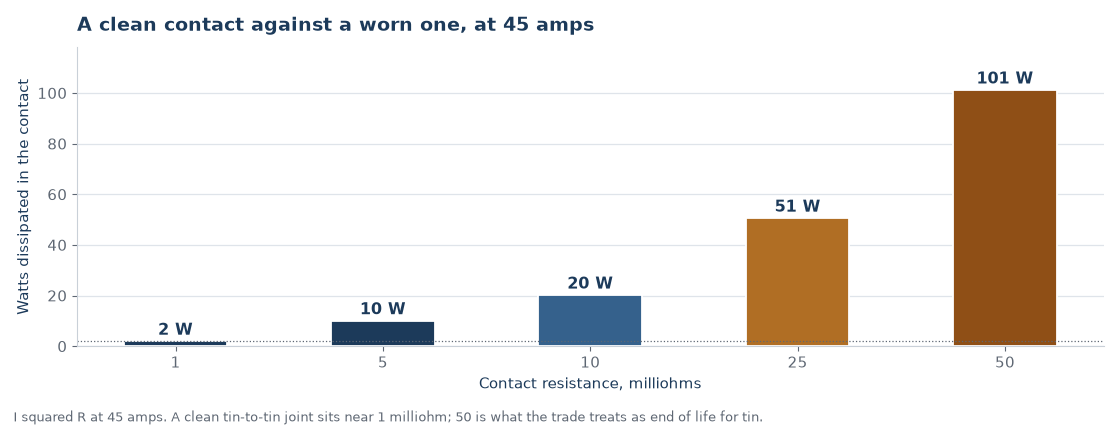
Fretting corrosion walks a joint up this scale across years of service. At the 50 milliohm figure the trade treats as end of life for tin, a 45 amp contact dissipates 101 watts.
Contact resistance gets quoted in milliohms, a unit small enough to ignore right up until you multiply it by current squared. A clean tin-to-tin interface sits around a milliohm. Push 45 amps through that and the contact dissipates two watts inside a piece of metal the size of a fingernail. Two watts in that volume is warm to the touch. Nothing’s wrong yet. Now let the interface degrade. Tin is sensitive to micro-motion, and vibration or thermal cycling grinds oxide debris into the joint, a process the trade calls fretting corrosion. Resistance climbs. At 50 milliohms, which the industry treats as the practical end-of-life limit for tin, that same 45 amp load puts 101 watts into the contact. That’s a soldering iron running inside your connector.
Contact force is what holds the slide off. Tin interfaces are specified to keep more than 2 newtons of normal force at end of life, which is why a plug that wobbles in its socket is a plug on its way to trouble. Plating decides how fast the slide happens. Gold resists fretting far better and costs accordingly. Engineers settle it with a rule of thumb known in the trade as fifty-fifty-fifty: tin is the economical choice as long as you never expect contact resistance to exceed 50 milliohms across the working life of the joint. Above that threshold the 101 watt case comes into reach. Gold stops looking expensive at that point. One rule matters more than the rest: never mate a gold contact against a tin one. The harder gold frets the softer tin, tin transfers onto the gold face, and tin oxide builds up on the surface that was supposed to stay clean. A gold-plated adapter pushed into a tin-plated socket is a slow failure you’ve paid extra for.
Warmth at a plug means resistance where there should be none. The fix is a clean contact, or a new one. More current is never the answer.
Four exits, one laptop
Figures below are for a 1024 watt-hour machine carrying one 60 watt laptop through each of the four doors in turn.
What one 60 watt load costs through each exit
Exit
Conversions
Inverter awake
Drawn from pack
Hours on 1024 Wh
AC socket
Two (inverter, then brick)
Yes, 30 W
111 W
9.2
USB-C PD
One
No
67 W
15.3
12 V round port
One
No
67 W
15.3
Anderson pair
One, or none
No
60 to 67 W
15.3 to 17.1
The Anderson row carries a caveat. It hands over pack voltage more or less as it stands, which suits a load built for that rail and suits nothing else. Feed it something expecting a regulated 12 and you’ve moved the conversion somewhere else.
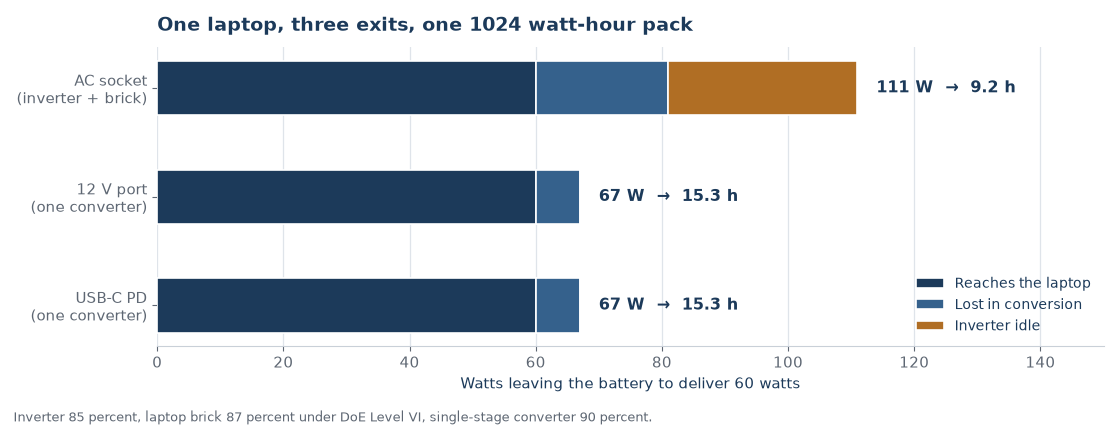
The identical laptop on the identical pack. The AC route spends 30 watts keeping the inverter awake before the laptop draws anything, which is most of the six hour gap.
Take a 60 watt laptop and a 1024 watt-hour pack. Route one leaves through the AC socket. An inverter has to be awake for that, which costs 30 watts on a large machine before the laptop asks for anything. Conversion through the inverter runs near 85 percent, the laptop’s own brick clears 87 under Level VI, and the two multiply out to 74. Delivering 60 watts to the laptop takes 81 watts off the bus, plus the 30 the inverter spends on itself, for 111 watts leaving the battery. A 1024 watt-hour pack lasts 9.2 hours on that arithmetic. Fifty-one of the watts it cost never reach the laptop at all. Route two leaves through the USB-C port. Negotiation settles on 20 volts, one conversion stage runs above 90 percent, and no inverter needs powering at all. Sixty-seven watts leaves the battery to deliver 60. That identical pack now runs 15.3 hours. Six hours separate the two routes on one machine, one battery and one laptop. Route three uses the 12 volt port with a DC-to-DC laptop lead. It lands beside route two at 67 watts and 15.3 hours, since conversion count is the thing that matters and both routes have exactly one. Nothing about the connector shape changes that arithmetic. A round barrel and an oval USB-C opening are equally good doors as long as only one converter stands behind each. None of this appears anywhere on the panel. The socket that looks most ordinary is the one that costs most. The port that looks like an afterthought is the one that stretches an evening into a night. Both DC routes leave the inverter switched off, which is the single decision doing most of the work in that table. Anyone planning a long stretch off grid wants to work out which loads can leave through a DC exit and switch the inverter off for everything else. Plan power allocation across multiple ports that way and a machine behaves like a bigger one.
As the load shrinks, that gap widens. A 10 watt load through the AC socket on a machine idling at 30 spends three quarters of its draw on the inverter alone.
It narrows as the load grows. At 500 watts that 30 watts of idle is 6 percent. What remains is the conversion penalty.
What overload looks like, and what the panel hides
Every port has a plan for the moment you ask too much of it. The plans differ, which is why one machine dims a load politely and the next one drops its whole output. Current-limit circuits generally begin working when output current passes the rating by 10 to 20 percent. What follows is a design choice with four common answers. Constant current, sometimes called fold-forward, holds current at the limit and lets voltage slide towards zero. Take the overload away and normal voltage returns on its own. Fold-back behaves differently past the knee, since current drops to a lower value as voltage falls, which spares the internal devices a great deal of stress. Constant current with shutdown limits first and then gives up altogether once output voltage hits a preset floor, occasionally wanting a power cycle before it comes back. Hiccup mode drops to zero, waits, and tries again on a timer.
Capacitive loads are where fold-back earns its reputation. A device with a large input capacitor looks like a short for the first few milliseconds. A fold-back supply reads that as an overload and settles at reduced current before it ever reaches full voltage. The load never starts. Nothing is faulty, and nothing on the display explains why. Finding out which one you own takes a single experiment. Overload a port on purpose with something you don’t mind stalling, pull the load off, and watch what the panel does next. If it recovers without a button press, you have constant current. Silence until somebody intervenes puts you in one of the other three.
Three figures decide most of what a port row is worth. None of the three is printed anywhere on it. First comes the conversion count between the battery and the device. Second is whether the inverter has to be powered for a given port to work at all. Third is the combined ceiling once several ports run together. A fourth figure matters on any machine carrying an Anderson pair: whether that port is regulated or wired more or less straight to the pack. Regulated means one conversion and a voltage that holds. Wire it more or less straight to the pack and you get no conversion at all, on a rail that slides from about 58 volts down towards 40 as a 16-cell iron phosphate pack empties. Loads built for that range cope with it, which is why anything expecting a fixed rail belongs on the regulated port.
One afternoon with a meter answers all three. Plug one load in at a time, watch what leaves the pack, and write the numbers on a card taped to the case.
Common questions
Is a 100 watt USB-C port enough for a laptop?
For most of them, comfortably. A typical portable machine asks for 45 to 65 watts and a large one for 90 or so, all of it inside the standard profile. The cable deserves more attention than the port, since a lead rated for 3 amps caps the negotiation at 60 watts no matter what either end can do. Anything promising 5 amps carries a marker chip that says so.
Does the Anderson pair matter on a machine I never take apart?
Less than the datasheet implies. The 250 hot-plug figure is a limit for people who unplug under load in the field. A home user who switches the output off first, plugs once and leaves it there will never approach either number. What the pair does buy is a high-current door that costs almost nothing in conversion.
Is the waste in the laptop brick or in the inverter?
In the inverter, by two orders of magnitude. Level VI caps a brick’s no-load draw at 0.21 watts for units above 49 watts. Measured inverter idle on portable stations runs 14 to 40 watts. The brick you were suspicious of spends a fifth of a watt. The stage feeding it spends thirty.
Can the Anderson pair handle a 24 volt device?
The connector can. Powerpole housings in the PP45 size carry a UL rating of 45 amps at 600 volts, which puts 24 volts nowhere near the limit. What decides the answer is the port behind it, since a station regulates that output to whatever rail its designer chose. Read the panel. The connector won’t tell you.
Why does the display show more watts than my device uses?
Most machines report what leaves the pack, which includes conversion loss and any stage that happens to be awake. A 60 watt laptop on the AC socket can read 111 on the display. Nothing’s broken. You’re looking at the true cost of that route.
Which single change saves the most runtime?
Switching the AC output off when nothing needs it. Everything that can run from 12 volts or USB-C should. The inverter stays asleep for the rest. On a long evening that one habit is worth more than the difference between two pack sizes.