Port keying is the set of shapes, sizes and pin layouts that lets a plug enter only the socket meant for it. Reverse insertion protection is the electronic backstop behind the shapes, the circuitry at the input and output stages that absorbs whatever wrong connection geometry missed. A power station’s panel carries both layers at once. Every socket on the face was drawn with some class of mistake in mind: the oval that accepts either orientation and sorts the wiring out in silicon, the barrel sized to one diameter, the trapezoid moulded for one orientation.
Plastic turns away the wrong plug at the doorway, silently, thousands of times over a machine’s life. The mistake that defeats plastic arrives through correct-looking hardware, a lead crimped backwards in a shed, a battery clamp landed on the wrong post; that class belongs to the electronics. Neither layer advertises itself. A buyer reads about inverter watts and pack chemistry; nobody puts keying on a shopping list. Moulded keying survives a decade of sand and boots and never asks for attention.
Direct current is the half of the panel with stakes. Current flows one way, out of the positive terminal and back into the negative. Every chip, capacitor and motor downstream is built around that order. The convention runs deep, red for positive, black for negative, a colour code older than any connector on the machine. Twelve volt gear grew up around vehicles, where the chassis itself is the negative side, one more reason the black lead’s job never changes.
The stakes are concrete. Reversed supply drives current backwards through parts that conduct that direction with almost no resistance; the heat arrives in milliseconds. Polarised capacitors vent. Semiconductor junctions cook. A reversed 12 volt feed at 10 amps dumps 120 watts into the first path that conducts, wherever that happens to run. Repair forums index the failure by smell; the phrase about letting the magic smoke out exists because the failure is exactly that visible.
What a flipped feed does
Unprotected electronics meet reverse voltage the way a valve meets backwards flow. Some parts block, some fail open, one path somewhere carries everything. The electrolytic capacitor is the classic first casualty. Its chemistry is directional, marked by the stripe down the can; reverse bias breaks the oxide layer down in seconds. Silicon follows through its substrate junctions, structures that conduct once reverse supply passes about 0.6 volts, opening paths never sized for current. An ordinary fuse measures current magnitude alone; a modest reverse flow sails under the rating unnoticed for as long as the connection lasts. Boards that survive owe it to sacrificial traces, thin copper necks placed to burn first, a fuse drawn in copper.
The timing removes any chance of reaction. Milliseconds for junctions, seconds for capacitors, a wisp of smoke as the announcement.
The coaxial barrel and its size ladder
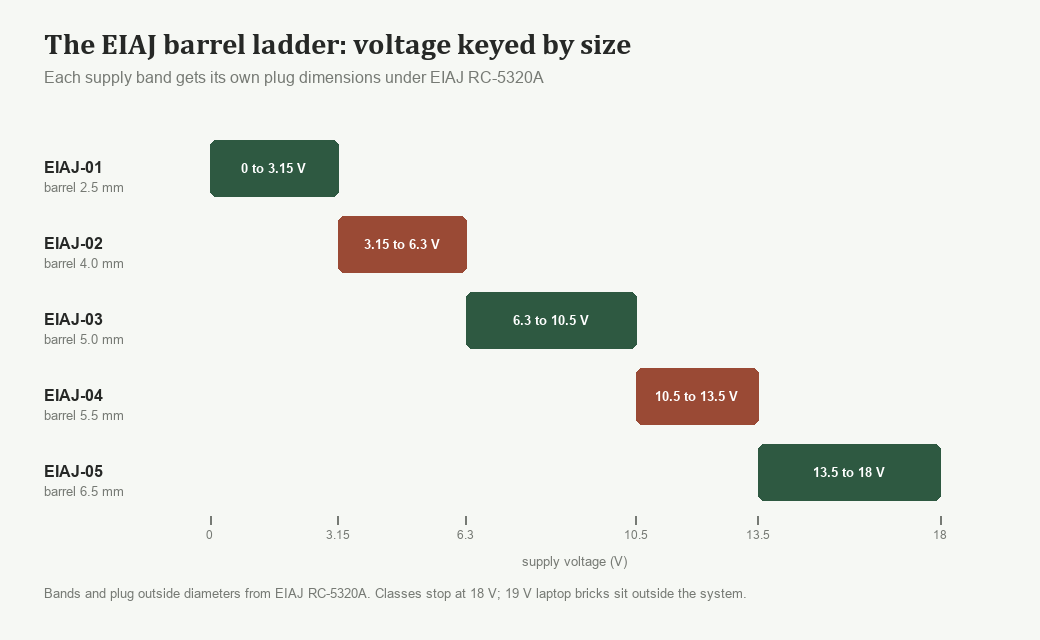
The EIAJ RC-5320A ladder, each voltage band on its own barrel size. The classes stop at 18 volts; 19 volt laptop bricks sit outside the system. Bands and diameters from the standard; figure drawn for scale.
The round DC barrel is the oldest keying scheme on the panel. A centre pin sits inside a sleeve; the plug is a tube around a hole. The geometry admits exactly one arrangement, pin into hole. Rotation changes nothing because the parts are round. Nobody has ever inserted a barrel plug backwards. Inside the jack a leaf spring rides the plug’s sleeve, the wiping contact that keeps small sockets honest through hundreds of insertions. Some sockets add a hidden switch, a contact that opens as the plug seats, the mechanism radios use to drop their internal batteries the moment external power lands. The leaf wears with the plug; a socket gone loose after years of daily insertions answers to a gentle re-tension, the whole repair a screwdriver’s width. The catalogue line for a jack of the size adds one more number, a 5,000 cycle insertion life, the figure behind years of nightly plugging.
Size is the barrel’s real language. The Japanese electronics industry wrote that language into a standard, EIAJ RC-5320A, which assigns each supply voltage band its own plug dimensions: up to 3.15 volts rides a 2.5 millimetre barrel, 10.5 to 13.5 volts rides a 5.5 millimetre barrel with a 3.4 millimetre pin, 13.5 to 18 volts moves up to 6.5 millimetres. A plug from one band meets the wrong dimensions in another band’s socket. Voltage keying by moulding, decades before smart handshakes existed. The ladder shows its age in one detail: the classes stop at 18 volts, written for radios and tape decks, leaving today’s 19 and 20 volt bricks outside the system, one root of the barrel confusion.
The market outside that standard is messier. Two plugs dominate small gear worldwide, both 5.5 millimetres outside, one with a 2.1 millimetre hole and one with a 2.5 millimetre hole; the pin diameter is the entire difference. The pair looks identical from arm’s length. A 2.5 plug drops over a 2.1 pin and wobbles, the contact coming and going with cable movement. The loose fit is the sneaky failure, flickering for months before anyone blames the plug. Mismatch in the other direction announces itself at the doorstep, a 2.1 hole stopping on a 2.5 pin before the sleeve ever seats. CCTV gear answers with threaded locking collars on the 5.5 millimetre barrel, a knurled nut that turns insertion into a screwed joint. Universal adapter tips add their own trap, a tip that seats two ways onto its lead and flips polarity with it; the horseshoe diagram on the brick stops meaning anything past that joint.
Barrel identities on and around a station panel
Plug
Pin / hole
Barrel OD
Voltage band
Common home
EIAJ-02
1.7 mm
4.0 mm
3.15–6.3 V
handheld gear
EIAJ-04
3.4 mm
5.5 mm
10.5–13.5 V
12 V equipment
EIAJ-05
4.4 mm
6.5 mm
13.5–18 V
older laptops
5.5 × 2.1 (market)
2.1 mm
5.5 mm
9–12 V typical
routers, CCTV, station DC out
5.5 × 2.5 (market)
2.5 mm
5.5 mm
12–19 V typical
laptop bricks, radios
Locking barrel
2.1 mm
5.5 mm + thread
12–48 V
CCTV, PoE injectors
Polarity on a barrel is pure convention. The convention varies by industry. Centre positive dominates general electronics. The dot-in-horseshoe diagram printed beside every socket states the wiring; reading it takes three seconds. Guitar pedals built to the Boss standard run centre negative through the identical 5.5 by 2.1 plug, the oldest working proof that geometry promises nothing about the wiring upstream of it.
Stations keep the barrel family deliberately small. A typical panel offers one or two 5.5 millimetre outputs at 12 volts, centre positive, fused inside at 3 to 10 amps; the printed figure beside the socket is the entire specification a matching lead needs. Router at half an amp, dashcam at one, LED string at one more; the fuse upstream sits far above the sum. A heated CPAP hose, five amps with the humidifier working, is the one common load that needs the jack’s fuse rating read first.
Gendered pairs and moulded trapezoids
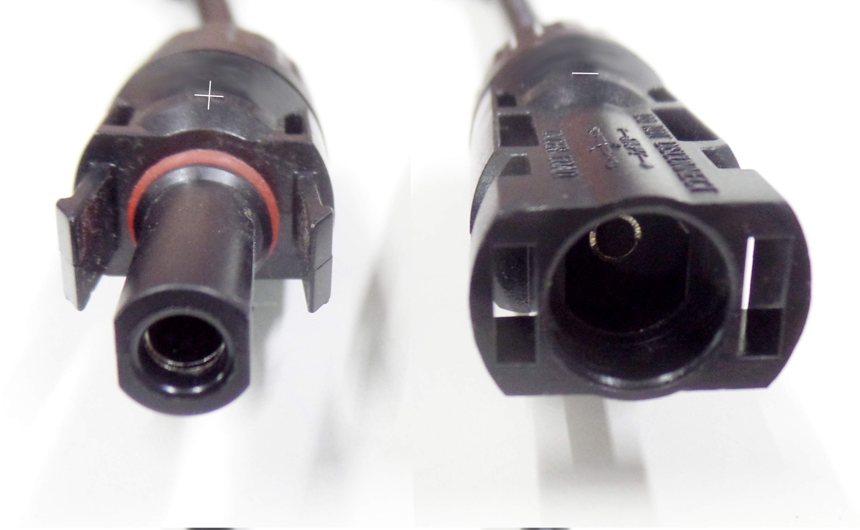
An MC4 pair face on: pin housing on the left, socket housing on the right, locking tabs at the sides. The plus and minus marks moulded into the shell tops are visible at full size. One gender per direction; the pair joins one way. Photo: Olawlor, CC0.
Solar wiring solves polarity with gender. An MC4 pair has a male half and a female half, locking tabs that click, one way to join. Panel leads come moulded from the factory with genders assigned, which chains panels end to end with polarity forced at every joint. The forcing holds exactly as far as factory moulding reaches. A field-crimped extension with swapped cores reverses everything downstream of it. The lock clicks regardless; the click reports mechanical seating alone. Unlocking needs the small MC4 spanner, a plastic fork that releases the tabs, cheap insurance against pliers chewing a live connector. Panels ship with short factory pigtails; any distance beyond them rides on field-made extensions, the joint where the polarity question re-enters. The family’s own ratings run at solar scale, a 30 amp class certified past 1,000 volts DC, numbers from the rooftop world sitting far above anything a portable panel bay asks.
The RC hobby gave batteries the XT60, a yellow trapezoid moulded around two gold-plated 3.5 millimetre bullets. The housing enters one way, corners cut asymmetrically and mirrored in the mating half, with 60 amps moving through a block the size of a thumbnail. The bigger XT90 steps up to 4.5 millimetre bullets in a shell that stays out of XT60 sockets. Bullet contacts mate with a wipe along their whole circumference, which is why the family tolerates hundreds of pack swaps; worn bullets announce themselves with warmth at the shell after heavy draw. Stations wear these on expansion-battery leads and high-current accessories, the joints carrying pack-level current in user hands, sized for gloved fingers in the dark.
The Anderson port runs its own colour-key system, voltage bands segregated by housing colour, written up with the Anderson port itself. Round aviation-style connectors, the threaded metal shells on some expansion ports, key by pin count and a slot in the shell wall; a three-pin plug never seats in a four-pin shell. The threaded collar shrugs off the vibration that works friction fits loose. Every one of these schemes is a moulding decision made years before any user touches the machine.
The oval that needs no key
USB-C walked away from mechanical keying. The oval is rotationally symmetric with duplicate contacts on both rows, four power pins and four grounds sharing the current whichever way the cable lands. A pair of dedicated pins named CC reads orientation the moment the plug seats. The socket wakes cold, offers a whisper of detection voltage, and turns on 5 volts only after the handshake identifies a legitimate device; the newest contracts ride that one oval to 48 volts on the strength of the sequence. The wattage steps and their caps belong with the USB panel. A port full of pocket lint that refuses to charge is the handshake declining to complete, keying still at work with no moving parts. Damaged CC pins read as no device at all, the reason a port sometimes charges through one cable orientation only; flipping the plug lands the request on the intact contact. The keying itself is the CC exchange, finished before power exists to flow the wrong way. The receptacle spec sets mechanical life at 10,000 insertions, sized for a cable that moves every day.
Where reversal enters the system
Moulded connectors have made reversed insertion nearly extinct at the panel face. The mistake now enters through wiring, in four repeatable ways. Bare-wire connections come first: battery clamps, screw terminals on a charge controller, chassis grounds. Red on the wrong post is a two-second slip made at arm’s reach from the station’s car-charging input. Cross-checking costs one look, the red clamp’s lever and the battery’s raised plus moulding in one eyeline before anything conducts. A glance at the meter across the clamps, before the lead’s far end goes anywhere, settles it.
Home-crimped leads come second; a mirrored pair passes every visual inspection ever invented. Third come adapter leads bought loose online, moulding immaculate, wiring following whatever the cheapest factory did that month. A meter across the far end before first use answers in ten seconds; a minus sign on the screen is the entire diagnosis. Fourth, centre-negative gear plugged into centre-positive supplies through a barrel that seats perfectly.
All four arrive through hand wiring. Any lead that did not come sealed deserves one meter check before it touches the station, ten seconds of cost, once in the lead’s life. Sealed factory leads earn a pass on the check; their failure mode is wear at the strain relief. A lead that has started dropping out under a wiggle earns retirement, no meter needed.
The car socket deserves its own line. Trucks, coaches and many marine helms carry the socket unchanged at 24 volts, handing a 12 volt only device double voltage through a perfect mechanical seat; the sticker beside the socket is the only warning anyone gets. Compressor fridges absorb the range, built for 12 and 24 together. Anything built for exactly 12 wants the vehicle checked before the plug lands. The fridge’s own data plate reads 12/24V DC, a two-second confirmation.
The transistor standing guard
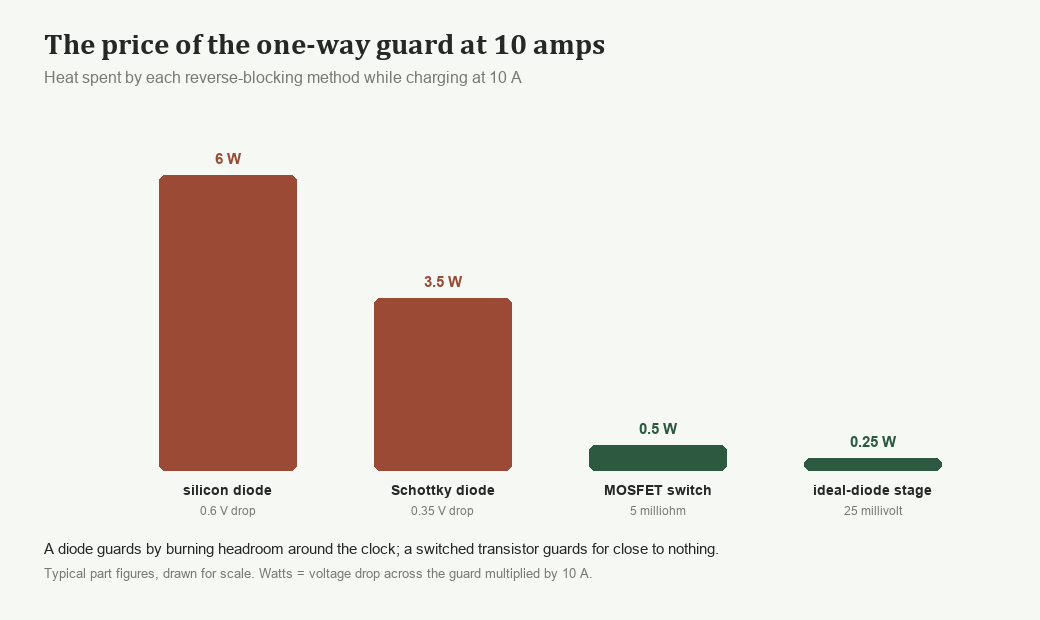
Each bar shows the heat one guarding method spends at 10 amps of charge current. Typical part figures, drawn for scale.
Behind every charging input on a modern station sits a solid-state one-way valve. The old version was a diode, a part that conducts forward and blocks reverse, spending 0.6 volts of headroom around the clock as the price. At 10 amps of charging that drop wastes 6 watts as heat, real money inside a sealed box that pushed designers to a transistor switched on only when the applied polarity is correct. A MOSFET doing that duty drops millivolts at full charge current, close enough to free that every modern input carries one. Stations with dual charge inputs, wall plus solar, run one guard per input; the pair doubles as an ORing stage that hands the load to whichever source stands higher. Back-feed toward the resting input dies at its own guard. Reverse arrives and the transistor stays off, leaving the input an open circuit with nothing to heat.
The behaviour from outside is undramatic. Clamp a car lead backwards onto a battery and the input line reads zero, the app logs an input fault, nothing warms up. Swap the clamps and charging starts as if nothing happened, the auto-restart that better spec sheets name. Recovery specifics vary by brand; some units want the input re-plugged before they resume, a detail the manual settles in one line. The solar input carries the twin of that guard plus a working voltage window, territory that belongs with the MPPT controller; a reversed panel string parks harmlessly against the blocking stage. The block earns its keep at night too, standing between the pack and a dark string that would otherwise drain it backwards. Units that keep fault logs preserve the record; a second-hand listing with a clean input-fault history says the previous bench was careful.
Output sides carry a different worry, current pushed back into the port by charged batteries or capacitive loads; a mirrored one-way stage meets it. The per-port fuse stays the final line behind every socket. The sacrifice runs in designed order, transistor first, fuse second, with hardware damage a distant third.
What shape cannot promise
Nineteen volts through a 12 volt door is the mistake keying never sees. Laptop bricks, router supplies and CCTV supplies share the two common barrel sizes across a spread from 5 to 48 volts. Nothing on the plug face distinguishes a 5 volt brick from a 19 volt one. The drawer holding three black wall adapters is the highest-risk square metre in the house. The brick’s own moulded fine print carries the truth, OUTPUT 19V followed by the solid-over-dashed DC mark; reading that line is the whole defence. PoE injectors already push 48 volts through the familiar 5.5 millimetre barrel, the top of the spread and the loudest argument for labelling every lead.
Tolerance decides the outcome. Tolerance is invisible from outside. A device built for exactly 5 volts meets 12 and dies in silence. Universal laptop bricks with switchable output add a dial that moves the trap between 15 and 19 volts and holds whatever its last borrower chose. The label on the device states its appetite; the fine print on the brick states the supply; the two lines agree on healthy gear. Vehicle electronics carry wide-input converters as a class, 9 to 36 volts on the label, built for the automotive rail’s bad manners.
Aviation-shell connectors repeat the trap at kit scale. Two four-pin shells from different vendors thread together; the pin meanings inside follow each vendor’s private drawing. Expansion-battery links between brands fail here, the reason stacking systems stay brand-locked. Adapters between brand systems exist on marketplaces regardless; each one is a private pinout guessed by a third party, live current through an unverified drawing. The shell standard covers mechanics alone.
The moulded layer filters three things, diameter, orientation and gender. Volts, amps and pin meanings ride through untouched. Labels and meters exist for exactly that gap.
One habit closes the bulk of the gap. A strip of tape on every non-sealed lead, written at the bench the day the lead is made, carrying volts, amps and polarity. The lead outlives the memory of its making by years.
An afternoon at the bench
One real afternoon shows the layers cooperating. The job: outfit a station-based camp kit with three leads, a 5.5 millimetre barrel extension for a 12 volt router, an Anderson pigtail for the fridge circuit, and an MC4 extension to reach a shaded panel bay. Twenty minutes of crimping sit ahead; every keying decision lands at the bench before a connector touches wire. The barrel lead gets centre positive, checked twice against the router’s horseshoe diagram. The Anderson pair gets red-right-tongue-up, matched against the station port. The pigtail runs 8 gauge over two metres to a fused block, 30 amp contacts crimped in four squeezes, the fridge’s 5 amp branch fused at 7.5. The router extension gets 18 gauge, generous for half an amp over three metres. The MC4 extension gets male on the end the panel’s female expects, cores traced by colour before the crimper closes. Then the meter pass: 12.04 volts tip-positive at the barrel’s far end, 13.2 on the Anderson with the station idling, the panel string reading 19 point something open-circuit through the new extension, correct sign on all three. The near-miss of the day sits in the parts drawer the whole time, a 19 volt laptop brick wearing the exact barrel plug the router expects, bought years ago for a machine long gone. It gets a strip of tape reading 19V laptop only and moves to a different drawer. Evening comes and the kit goes live with the station’s display as the last verification layer, input line showing the panel’s contribution, output line stepping up as the router and fridge land, no fault codes, no warm cables. Plugs seated before switches turned, the small sequencing that keeps DC connectors from arcing at make. The morning after reads clean, 3.8 degrees held in the fridge log, zero router drops, 24 percent of the pack spent, every joint in the chain either moulded right at a factory or checked once at a bench. Reverse insertion protection never fired, because the shapes and the meter did their work upstream of it, exactly the order the designers intended.
The session generalises to a rule of thirds. A third of the protection came moulded from factories. A third was wired and verified once at the bench. The electronic third waited behind the ports the whole weekend with nothing to do. Idle is that layer’s best case; careful bench work keeps it idle for years. The bench third is also the cheapest, one meter and one roll of tape against the price of anything the other layers guard. Kits that travel between vehicles earn a fourth habit, one voltage per connector family across the whole box, barrels for 12, XT for pack current, C for everything negotiated.
Reading the protection lines
Spec sheets compress the whole layer into scattered lines. Input sections carry reverse polarity protection as three plain words, sometimes with the recovery spelled out, auto-restart on correct connection. Output sections list per-port fusing. The lines that deserve trust name numbers, an input window in volts, a fuse in amps, a recovery mode; a sheet written that way has an engineering document behind it. A sheet that stays silent on reverse protection usually still has it, the feature costing cents at design time. Recovery is the line to hunt for. Auto-restart carries one concrete meaning, correct the connection and charging resumes with no button pressed and no fuse hunt inside a sealed box.
Absence tells its own story on the accessory side. Loose adapter leads rarely publish polarity at all. The moulded dot-in-horseshoe beside a station’s barrel socket is the one printed promise on the whole panel face; any lead that contradicts a meter loses the argument. Meters earn a spot in the lid of the kit box; the cheapest auto-ranging unit reads polarity as fast as the flagship; one glance at the sign closes the question.
Common questions
Can a power station output plug be inserted the wrong way round?
The moulded families on the panel each admit one arrangement. Barrels take pin-into-sleeve, trapezoid packs take one orientation, Anderson housings take colour-matched mates, USB-C accepts either rotation and sorts direction electronically. Reversal enters through wiring, home-made leads, clamps and loose adapters, ahead of the connector itself.
What happens when a solar panel is connected with reversed polarity?
A blocking stage on the input conducts in one direction only. The reversed string sees an open circuit, the display shows no input or logs a fault; correcting the connection restores charging. The panel takes no damage either; it stops delivering until the wiring is right.
Is a loose barrel plug that fits the socket safe to use?
Fit answers size alone. A 5.5 by 2.5 plug rides loose on a 2.1 millimetre pin; the contact flickers with cable movement. Voltage and polarity ride on the supply behind the plug, invisible at the connector. A meter across the open end settles both in seconds.
Why does USB-C work in both orientations?
The connector is rotationally symmetric and carries duplicate contacts on both rows. Two CC pins detect which way the cable seats, the port routes accordingly; power stays off until that detection completes. Orientation handling moved out of the plastic shell and into the controller chip.
Does keying protect against connecting the wrong voltage?
Only where a size ladder was designed for it, the EIAJ barrel classes being the clean example. The common market barrels, the car socket shared between 12 and 24 volt vehicles, and same-shell aviation connectors all pass the wrong voltage through a correct fit. The printed label and a meter supply the missing protection.