A round car-style socket sits on every station’s output panel, the 21 millimetre opening dashboards have carried since the sixties. Anyone who has owned a car knows it on sight. On a power station it runs as an output: a dedicated converter behind it turns pack voltage into a steady 12 volt rail, and power flows outward only. Charging a station from a vehicle happens at an input, a subject of its own. The shape is pure car heritage; the electronics behind it owe a car almost nothing.
Ten amps is the usual ceiling, 120 watts at nominal voltage, printed beside the opening or in the output row of the spec sheet. Compact units sometimes hold the line at 8 amps; big ones stretch to 15. The shape stays constant across all of them. Next to an inverter’s thousands the figure reads small, sized for loads that read small themselves. Ten amps at twelve volts still feeds a fridge, a router, and lights together, with budget spare.
Car fridges, tyre inflators, CPAP machines, dash cameras, routers on 12 volt bricks, LED camp lighting, cool boxes, vacuum cleaners shaped like thermos flasks: an entire product culture lives on the far end of that socket, decades deep, every item arriving ready-terminated in the matching plug. A power station adopts that whole catalogue in one stroke. No adapters, no new cords. Second-hand markets and truck stops keep the catalogue cheap and everywhere. A household can equip an entire outage kit around this one socket for the price of a single AC appliance.
The port also carries the quietest efficiency story on the panel. Small DC loads served at DC skip the inverter entirely, along with the overhead an idling inverter charges just for being awake. A pack feeding a 12 watt router through this socket spends its watt-hours on the router alone. Small loads with 12 volt cords belong on the 12 volt port. The rest of the case for that rule is a story about idle inverters, told separately.
The regulated rail behind the port
The socket format grew up in vehicles, where the 12 volt rail leads a rough life. Engine off, the rail rides the battery down through 12.6 and toward 11; engine on, the alternator lifts everything to 14 and a half. Every accessory sold for the format learned to live inside that churn. Bulbs were sized for it, motors shrugged at it, electronics grew tolerant input stages to survive it. Twin-USB car adapters of the smartphone decade were engineered around the worst of that swing. That inherited toughness is one reason the catalogue survives decades of reuse. The 12 on the label always named a family of gear, loosely tied to any meter reading.
A power station rebuilds the rail from scratch. Its DC-DC stage takes whatever the lithium pack offers and holds the output near one figure, commonly in the low thirteens, from a full pack to an empty one. The figure at minute one is the figure at hour thirty. Load changes barely dent it. Pack decline never reaches it. Ripple stays small enough for radios and cameras, the gear fussiest about its feed. The held figure is a design constant, end to end. The stage producing it comes from the buck-converter family that runs the USB ports, sized bigger and tuned for one job.
Steadiness pays off first in the loads that watch their own supply. Compressor fridges ship with a low-voltage guard, a setting that watches for a sagging feed and cuts the compressor to protect whatever battery is upstream. A station’s rail hands the guard nothing to act on. The guard arms, watches a flat 13-and-a-bit for three days, and stands down untouched. Mystery midnight shutdowns, a staple of fridge forums, trace back to sagging vehicle feeds in thread after thread. Guard settings can stay on their factory defaults for the same reason. Nothing on a held rail ever walks the voltage down to where the settings live.
A multimeter across the port reads 13.2 to 13.6 on many machines. Factory intent puts the figure there. Lead-acid vehicle systems float in exactly that band, so the accessory world was built to drink it happily. A “12 volt” port holding 13.4 is a healthy port speaking its native dialect. Meter checks belong at the plug end of a suspect cord in any case; the port end almost always reads to spec. Cheap plug-in panel meters read a tenth high or low besides; the trend they show matters more than the digit. Meters clipped at the appliance end of a long lead tell the richer story, the cable’s drop appearing as the gap between the two readings.
Small change piles up elsewhere. LED lighting holds one brightness through the whole evening. Fans hold one note. Dash cameras go whole seasons without a reboot. Twelve volt gear on a regulated rail lives the easiest life it will ever live, and lasts accordingly. Repair shops see the difference in the gear that comes back years late for its first visit.
Two formats in the round port family
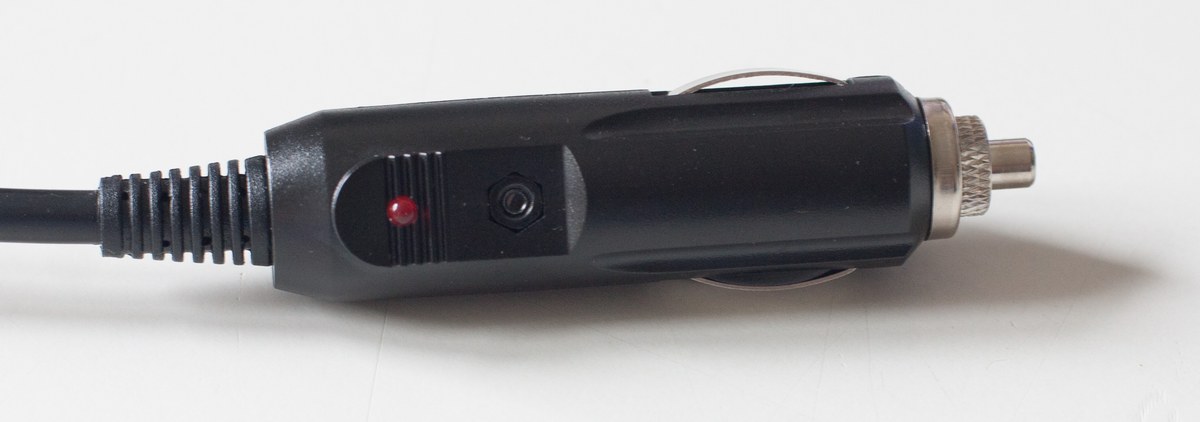
The senior 12 volt plug format up close: sprung centre tip behind a knurled nose, two side spring leaves, a red indicator lamp on the body. The knurled nose unscrews; a small glass fuse commonly lives directly behind it. Photo: Nicolas Herrmann, CC BY-SA 4.0.
The cigarette-style barrel is the senior format. Contact rides on a sprung tip and two side leaves, a mechanism that tolerates vibration by design and rewards a firm, full seat into the socket. Plugs left half-seated meet the current through a sliver of metal. A sliver asked for ten amps runs warm. Marine-grade sockets with threaded collars exist for rough duty, holding the seat by force. The format’s whole reputation for flakiness traces to loose seating and undersized plugs; a quality plug pressed home carries its rating without drama for years. Plug quality shows in the tip spring and the leaf stiffness, felt as a firm push at insertion. Bargain-bin plugs give themselves away in the wrist. Sockets wear as well, a decade of insertions easing the grip; a plug that rocks visibly in a worn socket has found the true cause of its flicker.
Beside the big barrel, many stations add small coaxial DC outputs, the 5.5 millimetre barrels the electronics world knows as 5521 and 5525. Ratings sit near 3 to 5 amps each, sized for routers, modems, cameras, and small screens. Centre-positive wiring is the near-universal convention on stations, matching the symbol printed beside the port: a dot inside a broken circle, plus sign on the dot. Ten seconds with that symbol and the appliance label settles polarity before the first connection, the one check the small barrels ever ask for. Tip sizes matter as much as polarity: 2.1 and 2.5 millimetre centre pins look identical at arm’s length. A loose-feeling barrel that works intermittently is usually the wrong one of the two. Adapter tips between the two sizes exist and solve the mismatch for pennies.
The compressor fridge, flagship load
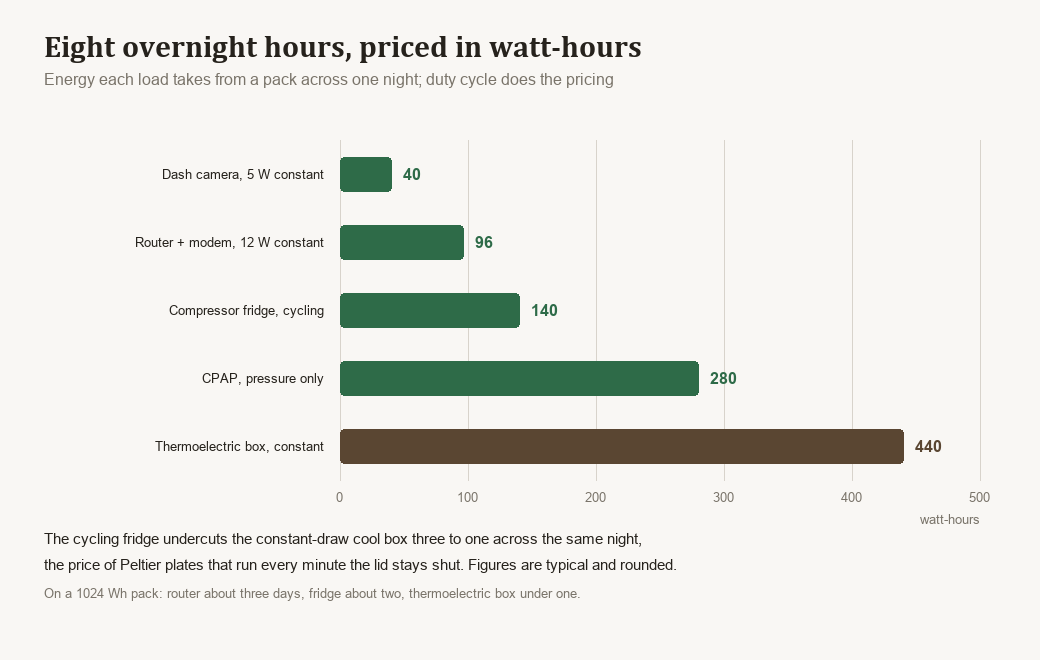
Eight overnight hours priced in watt-hours. Duty cycle does the pricing: the cycling compressor fridge undercuts the constant-draw thermoelectric box three to one across the same night. Typical, rounded figures.
One appliance justifies this port by itself. A 12 volt compressor fridge, the 40 to 60 litre box that lives in vans and on campsites, draws 45 to 60 watts with its compressor running and nothing at all between runs. Duty cycle does the real accounting: a third of the time running in mild weather, more in heat, less at night. Lid seals and shade shift the split as much as the thermostat setting does. Averaged out, a healthy fridge asks a pack for 15 to 25 watts around the clock, refrigeration for the power budget of a light bulb. Pre-chilling on mains before departure trims the first day’s duty by a visible slice. Freezer duty roughly doubles the figures; a dual-zone box splits the difference.
Follow one fridge through one summer day on a 1024 watt-hour station and the numbers tell the whole story. Six in the morning, cabin cool, the compressor runs seven minutes in every twenty-five: the display shows 50 watts during a run, zero between, the average loafing near 16. Ten o’clock, sun on the van, duty climbs toward a third, the hourly cost toward 18 watt-hours. The display makes the physics visible in real time, watts flicking between 50 and zero, the average column doing the only arithmetic anyone needs. Lunch swings the lid a dozen times and every opening buys a compressor run to pay the warm air back; the afternoon hour reads 25 watt-hours, the priciest of the day. A towel over the lid through the afternoon peak, an old field trick, shaves the priciest hour by a watt or two. Evening cools the metal, duty slides back below a quarter; the overnight eight hours cost barely 130 watt-hours all told. The screen’s daily total lands near 420 watt-hours, four tenths of the pack, two and a bit days of cold from one charge with margin for the phone shelf. Nothing in that day tripped a guard, sagged a rail, or asked for a thought. That box, across that day, quietly profited from its supply: a steady 13.4 at the plug keeps compressor starts crisp, each start a shade shorter, each shorter start a shade cheaper, a small compounding discount unique to the regulated rail. The ledger is what a flagship load looks like, real work at small numbers, free of events. Morning six rolls around again with the pack reading 58 percent, the milk at four degrees, the compressor midway through its quietest hour of the whole cycle, set to repeat the entire unremarkable performance for another two days before the socket asks for a recharge.
Direct DC service is the fridge’s second advantage. Its cord ends in the cigarette plug, the port matches it pin for pin, the pack pays for compression alone. The habit generalises: a fridge with a 12 volt cord plugs into the 12 volt port first, the AC brick staying packed. The inverter’s idle appetite belongs to another ledger; the fridge leaves it asleep. One cord fewer in the drawer, one conversion stage fewer in the chain, one habit locked in. Fridge manuals bury matching advice in their power chapters, DC cord listed first for battery supplies.
One hundred twenty watts, worked as a ledger
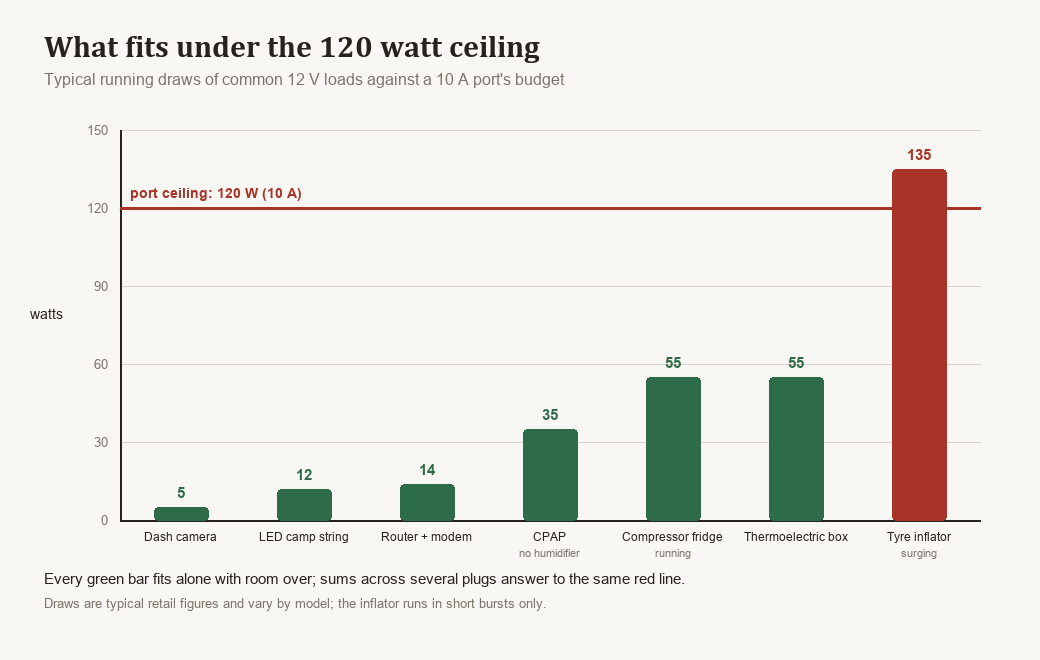
Common 12 volt loads against a 10 amp port’s 120 watt budget. Green bars fit alone with room over; the surging inflator crosses the line on many ports. Draws are typical retail figures; the figure is illustrative.
Every plan for this port is one sum against one ceiling. Take a plausible evening: the fridge averaging 18 watts, a router at 12 keeping the house online, a dash camera at 5 topping its battery, a CPAP waiting for bedtime at 35. Added up, 70 watts; the ten amp port carries the lot with a third of its budget spare. Swap the CPAP for a 130 watt tyre inflator and the sum crosses the line; the inflator waits its turn or takes the port alone for its two loud minutes. The arithmetic never gets harder than that: draws in watts, added, held under 120. Margins behave like margins anywhere: loads near the ceiling deserve the port to themselves; the sum gets re-run whenever a new plug joins the evening. The ledger method transfers straight to every other output row on the machine.
The rest of the twelve volt household
CPAP machines made this port famous in the outage years. A machine breathing all night on pressure alone draws 30 to 40 watts, 280-odd watt-hours per eight hour night, three nights on a mid-size pack. The heated humidifier is the piece that changes everything: warming water all night doubles the draw on many machines. A cold passover setup, or the humidifier switched off for the duration of an outage, stretches one pack across the better part of a week of sleep. Sleep clinics hand out that advice with the machine; the port just makes it practical. Battery-backed nights also skip the machine’s own mains brick, one less warm box beside the bed. Pressure-only nights read their 280 watt-hours with a steadiness no other appliance matches.
Routers and modems turn the small barrels into an internet lifeline. The pair together draws 10 to 18 watts on nearly every home setup. A 1024 watt-hour pack carries 12 watts for close to three days. Grid down, fibre up, the house stays online from a box in the hallway. Remote workers have run whole storm weeks this way, the station recharging from a car or panel by day, the router never noticing any of it. Matching the barrel size and centre polarity once, then labelling the cord, turns the setup into a thirty-second drill for the next outage. Fibre terminals and mesh nodes join at matching barrel sizes, a second and third line on the label check.
Lighting rounds out the light-duty family. A string of 12 volt LED camp lights draws 5 to 15 watts for a bright site, evenings of light per charge on any pack in the range. Amp draw this small leaves the budget untouched. Thin festoon cable is the real limit, dimming the far end of long runs. Warm plug, bright start, dim tail: the string itself reports the wiring. Twelve volt strip lighting stuck under van cabinets runs on identical maths, metres of glow for single-digit watts.
The thermoelectric cool box sits in the same aisle as the compressor fridge and deserves its own line in any honest ledger. Peltier plates run whenever the box is on, a constant 40 to 60 watts with no duty cycle to soften it. A small fan on the hot side runs the whole time as well, part of the same constant bill. The chemistry behind them runs at about a quarter of the efficiency of compressor refrigeration, holding roughly 20 degrees below ambient at best. Twenty below a 35 degree afternoon still reads warm inside the box, a second surprise in its own right. Eight summer hours cost such a box around 440 watt-hours. The box was born for day trips fed by a running vehicle. Overnight on battery power, that constant draw is the port’s classic surprise. The table prices an August night in both boxes.
Common 12 V loads on a 1024 Wh pack (typical draws, ~90% conversion allowed)
Load
Typical draw
Duty pattern
8-hour cost
Runtime on 1024 Wh
Dash camera
5 W
constant
40 Wh
~7 days
Router + modem
12 W
constant
96 Wh
~3 days
Compressor fridge
50 W running
~35% duty
~140 Wh
~2.2 days
CPAP, pressure only
35 W
constant in sleep
~280 Wh
~3 nights
Thermoelectric box
55 W
constant
~440 Wh
~17 hours
Tyre inflator
100–135 W
2–4 min bursts
~5 Wh per tyre
hundreds of tyres
Inflators and 12 volt vacuums work the port in bursts. A tyre inflator surges past 100 watts and flirts with the ceiling on many models, two to four loud minutes per tyre, a trivial number of watt-hours despite the drama. Ports that cut out mid-inflation are enforcing their amp limit against the surge, nothing more. The amp row in the spec sheet says in advance which inflators fit which sockets. Burst loads spend almost nothing from the pack. The only number they stress is the ceiling itself. Two tyres a month cost less energy than one hour of the router. Keeping the inflator’s own lead short matters doubly; burst loads punish thin cable hardest.
Cable discipline at twelve volts
Low voltage makes every ohm expensive. At ten amps, a tenth of an ohm across a thin extension eats a full volt; a volt is eight percent of this rail. Low voltage makes the same ohm ten times as expensive as mains voltage makes it. That is the whole physics of a rule every van owner learns: 12 volt runs stay short and thick. Symptoms of a starved run read clearly once known. A fridge that clicks, tries to start, and retries every few seconds is drinking through a straw; an inflator that winds up slowly shares the cause. The cure is never a setting. Shorter lead, heavier gauge, straight into the port. Gauge charts put numbers on the rule: ten amps over three metres wants two and a half square millimetres of copper, twice the length twice the copper. Coiled extension drums add insult, resistance plus heat concentrated in the coil. A metre trimmed off a lead does the work of a gauge step up.
A cool plug tip after an hour of fridge duty is the entire cable test, passed.
When the output cuts out
Overload protection on this port acts fast and resets on its own. Electronic limiting backs the socket on modern stations: cross the amp ceiling and the output drops, wait a few seconds or toggle the DC button and it returns. The cutoff guards the converter stage first and the wiring after it, in the order the current meets them. The pattern diagnoses itself. A port that cuts out the instant one specific appliance starts is reporting that appliance’s surge. The evening ledger says which line item crossed the sum. Resets cost nothing; a glance at the display before replugging costs three seconds and names the culprit. Chronic tripping with no single culprit usually points at the shared family budget in the output row.
A dead appliance on a live port has one classic cause with a five-minute fix. The nose of nearly every cigarette-style plug unscrews; inside sits a small glass fuse, five amps on light gear, ten or fifteen on heavy. Vibration cracks them, age dulls them, surges pop them quietly. A dollar-store assortment of glass fuses fixes the majority of “the fridge died” evenings without a tool. Checking the plug tip comes before suspecting the appliance, the cord, or the port, in that order of likelihood and price. Identical fuse sizes live inside 12 volt splitters and extension leads, one more place a dead circuit hides a two-minute fix.
Heat at the plug deserves equally early attention. A loose or worn plug builds resistance right at the contact leaves. Ten amps through a bad contact makes a warm handle inside minutes. Reseating firmly, bending the side leaves gently outward, or retiring a worn plug ends the warmth. Dielectric grease on the tip, an old trailer trick, slows the wear on both sides. Plug bodies are consumables; the port behind them outlives a drawer full.
The output row’s fine print carries one last quiet rule. On many machines the cigarette socket and the small barrels draw from one internal 12 volt stage, a shared budget of 10 or 13 amps printed once for the group. Heavier DC appetites, the double-fridge and equipment-rack cases, have the Anderson connector as their own subject, the USB family likewise. Three openings, one printed promise.
Running native where native exists
A simple sorting rule gets the whole benefit of this port. Any appliance that ships with a 12 volt cord earns a first look at that cord: fridge, CPAP, router, camera, lights all arrive wired for DC. Native service spares the inverter, spares the double conversion, and leaves the AC sockets free for the loads that have no other home. The check costs one glance at a plug and pays in hours of runtime. The check takes longest the first time; after that the household’s DC gear sorts itself by memory.
Van and boat life runs its whole cold chain and lighting from this socket. Outage households run medicine and internet on it, loads where quiet hours count for more than big watts. Campsites hang lights, pumps, and cameras off it and let the inverter sleep through whole weekends. App usage graphs on off-grid units log more hours on the 12 volt rail than on every AC socket combined.
The 12 volt port never headlines a spec sheet, and its work happens in the small hours anyway: a compressor cycling at three in the morning, a router light steady through a storm, a CPAP holding pressure until daybreak, all of it on a socket drawing less than a reading lamp. By morning the display has barely moved.
Common questions
Why does the 12V port measure 13.4 volts?
The port runs a regulated rail held in the low thirteens, the band vehicle electrics float in, so every 12 volt accessory is built for it. The reading is design behaviour on a healthy unit. The figure sits inside every 12 volt accessory’s design range. Voltage holds there from full pack to empty, one of the port’s main advantages over a vehicle socket.
Can a 12V fridge run overnight on this port?
Comfortably. A compressor fridge averages 15 to 25 watts across its duty cycle, near 140 watt-hours in eight hours, a modest slice of any mid-size pack. The regulated rail also keeps the fridge’s low-voltage guard from ever tripping. Thermoelectric cool boxes are the exception. Their constant draw runs about three times a fridge’s night energy, holding a shallower cold besides, near 20 degrees under ambient at best.
What fails first when a 12V appliance goes dead?
The glass fuse inside the plug’s screw-off nose, in the wide majority of cases. Unscrew the tip, hold the fuse to the light, and swap it from a spare assortment if the wire inside is broken. Loose seating in the socket is the second suspect, the appliance itself a distant third.