Derating is the reduction applied to a port’s printed current rating as the conditions around it leave the cool bench where that rating was measured. On a W-class or L-class station the heaviest sockets gather onto one panel, the Anderson feed, the high-current DC stage, the big AC outlets. That panel warms under load. That moulded figure beside each socket assumes a cool, still, single-port world. Derating is the arithmetic that turns the catalogue number into the current a port holds where it genuinely sits.
The rating and the derating answer two questions. Rating names the current a port carries at a reference temperature with nothing drawing beside it. Derating is the honest reduction of that figure, the fraction left after a warm afternoon, a bundled loom, a neighbour pulling its own heavy load. High-power ports feel the effect hardest, because heat climbs with the square of current and the big ports carry the big currents.
The stakes live in the plastic. Every degree the contact climbs passes first into the housing gripping it. That housing softens far below the melting point of the copper it holds. A port pushed past its derated current gives no clean cutoff. It warms, discolours, loosens its grip, and drifts toward a failure slow enough to smell before anything visible happens.
Where the watts turn into heat
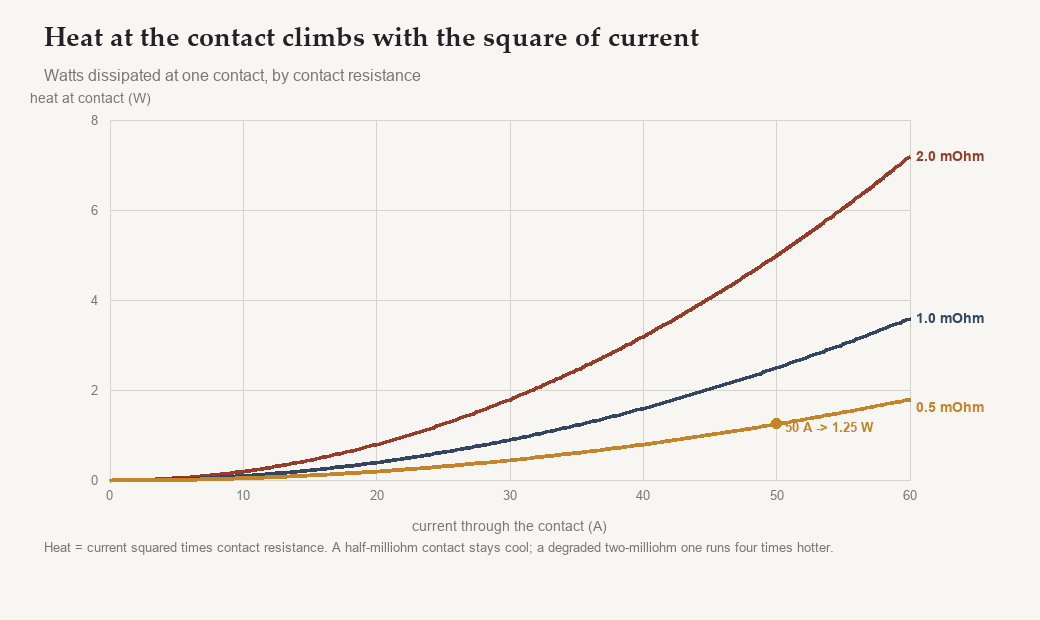
Heat at a single contact rises with the square of current. A half-milliohm contact sheds 1.25 watts at 50 amps; a degraded two-milliohm one sheds four times that at the same current. Drawn for scale.
Heat begins at the contact resistance. High-power connectors aim for a figure under one milliohm, a tenth of what a tired cigarette socket shows, the whole reason the heavy families exist. Two metal faces pressed together touch only across their high points, a true contact area smaller than the shiny metal suggests. That constriction funnels every amp through a resistance measured in milliohms. Power lost to heat follows the square of the current. Half a milliohm sheds a quarter of a watt at 25 amps and a full watt at 50, the whole of it concentrated in a junction the size of a fingernail. Concentration matters more than the total. One watt spread across a room warms nothing; one watt inside a contact patch a few square millimetres wide lifts that spot tens of degrees.
This square law drives the entire derating question. Doubling the current quadruples the heat at that same junction. A contact untroubled at 20 amps meets four times the heating at 40. That ignored ceiling arrives quickly under a heavy load. Wire feeding the port obeys the identical square, warming along its whole length as the contact warms at a point. A five-metre run of 8-gauge cable holds close to 20 milliohms round trip. A 40-amp load through that resistance spends over 30 watts of heating in the wire alone, dwarfing the contact’s share and moving the hot spot away from the connector entirely.
The rating is a temperature-rise promise
A port’s current rating is a temperature-rise figure wearing an amp label. That number names the current lifting the contact a fixed amount above the air around it, commonly 30 degrees. A connector’s rated amps are a thermal figure with no hard wall behind them, the ground the Anderson port’s own rating stands on. An SB50 marked 50 amps reaches its 30-degree rise at 50 amps in reference air, no more. Read the other way, the figure is a permission the port grants only in cool still air, good for 50 amps in that condition and silent everywhere else. It falls silent on the current the port holds where the air does neither.
Reference air is the buried term. Connector ratings assume an ambient near 20 to 25 degrees, the temperature of a test lab. That assumption rides invisibly inside every printed amp figure on the panel. It stops being true the moment the machine works a hot garage, a sealed vehicle, or a sunlit deck.
Housing sets the real ceiling. Nylon and its filled variants, the usual connector plastics, hold their shape to somewhere near 105 degrees and lose it above that. Plastic decides the limit, reached long before the copper inside feels any strain. A design keeps the contact comfortably under the housing’s number across every ambient the machine is rated to see. The margin is a deliberate choice. A maker who caps the contact at 85, a full 20 below the housing’s 105, leaves room for the surprises of a real install, the sun on a black case, a blocked vent, a neighbour port working harder than planned.
Arithmetic settles it in one subtraction. A contact rising 30 degrees in 25-degree air lands at 55, with 50 degrees of headroom below a 105-degree housing. The identical current in 45-degree air puts the contact at 75, the headroom halved. Push the ambient to 65 and those amps reach 95, a hair under the plastic. Any bundling that lifts the rise beyond 30 degrees crosses the line into damage. The current never changed; the room around it did, that single shift governing the whole result.
Reference conditions rarely hold on a working station. A machine earning its high-power ports runs them at a work site in summer, inside a van, beside its own warm inverter, exactly the settings that erase the cool still bench the rating assumed. Derating restores honesty to the number by naming the current that keeps the 30-degree rise landing somewhere safe. None of this appears on the socket. The moulded amp figure carries the best case. The derated current lives on a chart in the manual or in the head of whoever sized the build.
The derating curve
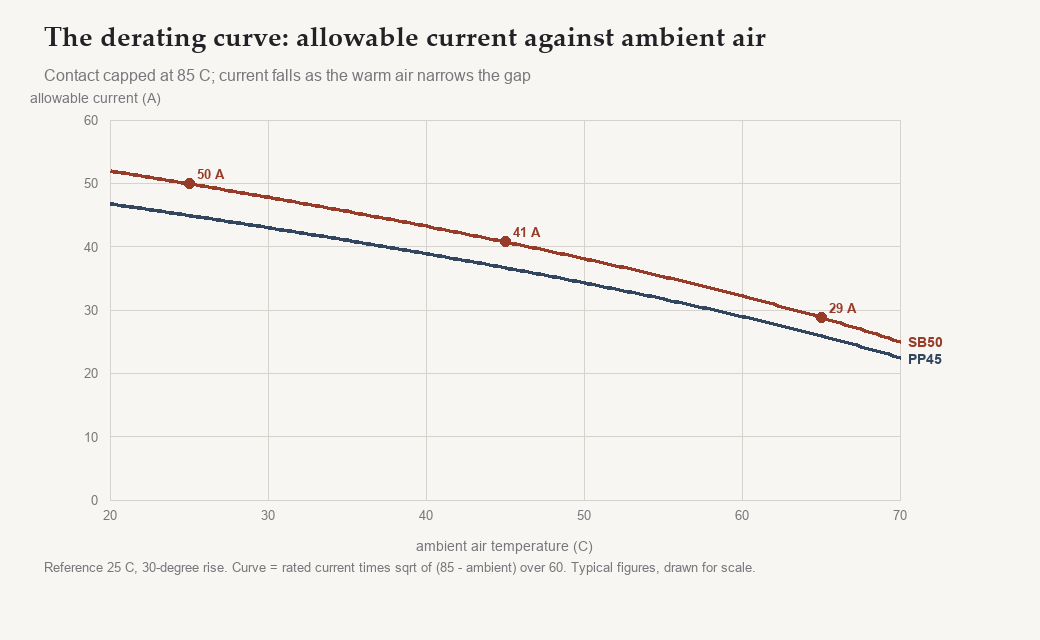
Allowable current against ambient air for two high-power families, the contact capped at 85 degrees. An SB50 holds 50 amps at 25 degrees, 41 at 45, and 29 at 65. Curve follows the square root of the remaining headroom; typical figures, drawn for scale.
Allowable current falls along a predictable curve as the air warms. The contact may climb to a fixed cap, set by the housing. The current has to shrink as the ambient eats the gap between room temperature and that cap. This relationship follows a square root, because heating tracks current squared. Half the headroom means roughly seven-tenths of the current. The square root falls out of the physics directly. Heat scales with current squared, temperature rise scales with heat. The current that fits a given rise then scales with the square root of the headroom that rise is allowed to fill.
Worked figures show the shape. Cap a 50-amp port’s contact at 85 degrees and the full 50 amps holds in 25-degree air, the whole 60-degree gap available for the rise. Warm the air to 35 and the gap narrows to 50 degrees, the allowable current easing to about 46 amps. Warm it to 45 and the gap is 40 degrees, the current down near 41. Push to 55 and 35 amps is the ceiling; reach 65 and the figure falls close to 29, the port now holding barely more than half its badge. Each step costs current the load never sees returned. No fault attends the loss, only air. A concrete van build makes the numbers real. A fridge compressor and an inverter share a rear panel that idles at 30 degrees in spring and bakes to 55 on a July afternoon behind glass. The Anderson feed rated 50 amps at the bench holds 46 in spring and 35 by high summer, a 30-percent swing driven by the season alone. A builder who sized the feed at 45 amps for the fridge and a winch discovers the winch tripping the thermal cutback on the hottest day of the year, exactly as the derated figure for that ambient predicts. Cold air widens the gap to the cap and hands the port current back, the quiet bonus a summer-only spec never mentions. A build sized for its hottest expected day carries margin every cooler day of the year. The lesson repeats at every current level. A 30-amp port and a 100-amp port trace the identical curve shape, each losing an equal fraction of its badge as the air warms toward the cap, the arithmetic scaling cleanly from a small DC socket to a battery-bank feed. One number anchors the whole family: a contact capped at 85 degrees and referenced at 25 holds its full badge at the bench, seven-tenths of it at 55-degree ambient, and half of it as the air approaches 70, a curve to keep in the head of anyone who wires heavy loads for a living.
Derating a 50 A high-power port as the panel warms (contact capped at 85 C, referenced at 25 C)
Ambient air
Headroom to cap
Derating factor
Allowable current
Contact at that current
25 C
60 C
1.00
50 A
85 C
35 C
50 C
0.91
46 A
85 C
45 C
40 C
0.82
41 A
85 C
55 C
30 C
0.71
35 A
85 C
65 C
20 C
0.58
29 A
85 C
Names on connectors often quote the best case. That 60 in XT60 is a peak figure measured on heavy wire in open air. Continuous duty sits well below it, closer to 35 or 40 amps on the wire a station commonly fits. The honest specification lists a continuous rating beside the ambient it assumes. A machine built with care prints both.
Manufacturers publish the curve as a derating chart, current against ambient, one line per connector family. Reading it takes a moment and settles the sizing for a whole build. A port asked to run near its rating on a hot day wants either a bigger connector or a cooler location, both decisions made off the chart before any cable gets crimped. A builder who skips the chart discovers the derating the slow way, through a connector that runs hot in July after a comfortable spring, the derating landing on time for anyone who skipped the chart.
The wire is half the port
Cable feeding a high-power port derates on the identical logic. A thin wire behind a big connector is the true weak link, because the rated amps follow the smallest part of the chain. Copper carries more current in open air than bundled inside a loom, where the strands heat each other; a single 8-gauge conductor in free air holds around 70 amps, that conductor grouped in conduit only 50. Its own insulation rating of 60, 75, or 90 degrees sets how hard the wire may be pushed before the jacket suffers. A port fed by wire chosen for the free-air number, then bundled into a tidy loom, meets its limit at the wire long before the contact complains. This fix is boring and total. Choose the wire for the bundled figure, step up a gauge for a hot run. The connector regains the headroom its rating assumed.
Neighbours share the heat
Ports side by side warm one another. Load every socket at once and the panel runs hotter than any single rating predicts, each contact adding its watts to a shared pocket of air. The derating that applies to one port deepens when its neighbours work too. Two ports at 40 amps each in still air can push their shared pocket past what either would see alone, the sum of their watts warming the air both of them breathe. Bundled cables behind the panel repeat it, every loaded strand lifting the temperature of the loom around it.
The inverter is the loudest neighbour of all. High-power AC conversion sheds real heat through the inverter case. Any DC port mounted on that panel breathes it whether the port draws current or not. A build that runs the inverter flat out under a heavy DC load on the shared panel stacks two heat sources into one derating sum. Spreading the load in time, kettle now and compressor later, keeps the panel cooler than firing everything at once. Staggering costs nothing and buys real margin. Held below its full heat load at every moment, the panel never reaches the ambient its worst-case derating assumed.
Airflow decides how far the neighbours reach. In open air a panel sheds its heat and the ports stay near their rated curves. Enclosure changes the picture, a cabinet or a van wall trapping the warmth so every port derates deeper as the shared air climbs, the physics that pushes bundled wire below its free-air number. One small fan changes the picture entirely, sweeping the shared warmth away and lifting every port back toward its open-air curve, the reason high-power stations carry active cooling on the heavy stages. The fan’s own draw is trivial against the current it protects, a few watts spent guarding hundreds, the cheapest insurance on the whole panel.
Continuous against brief
Rated current usually means continuous, held until the temperatures settle. A short burst rides on thermal mass, drawing a current no all-day load could match. The contact and its wire own a thermal mass that takes minutes to heat through. A two-minute kettle rides that mass, pulling a current no hour-long load could sustain. Heat needs time to arrive, and a brief load finishes ahead of it. Thermal time constants for a heavy connector run to several minutes. The honest question for any load becomes its duration against that clock. Only a load that outlasts the clock meets the steady rating in full.
Simple sequencing follows from that. A compressor cycling for hours wants a current comfortably inside the derated figure, since it runs long enough to reach full temperature. Pulling a hard surge for seconds, a tool may sit above the continuous rating, its burst gone before the contact climbs. Matching the load’s duration to the port’s thermal patience keeps a build honest without a meter. The display’s own power line confirms the steady figure once the surge passes. Drawing 45 running amps behind a 120-amp start, the compressor is the textbook case. The port sizes to the 45, the surge passing in under a second, gone before the contact registers the spike. Motor starts draw three to six times running current for a fraction of a second, a load the thermal mass swallows whole.
Thermal runaway, the quiet danger
Heat feeds on itself at a failing contact. Resistance in a metal junction climbs as it warms. A hot contact then dissipates more watts at a fixed current, driving the temperature higher again. A healthy connection sits far from the tipping point and stays stable for years. Vibration or oxidation nudges a connection toward that point, starting the loop that ends in a melted housing. The tipping point is sharp. Below the tipping point a contact self-limits, its heat leaking away as fast as it arrives. Past that point the heat outruns the escape, the temperature climbing until something gives.
Oxidation is the usual first cause. Arcing on insertion, or corroding in a damp footwell, a contact grows a resistive film that lifts its heat at every amp. Silver plating on a quality high-power contact resists that film. Insertion wipes the metal clean on the way in. Both features earn their cost precisely on the ports carrying the heavy currents. A tin-plated bargain contact skips both defences, growing its oxide film in a season of damp and lifting its own resistance with every week of service.
Looseness is the second path to trouble. Working free under vibration, a connector loses contact pressure and shrinks its true contact area, raising its resistance exactly where the current runs highest. Locking housings and detented latches exist for this reason on the high-power families, holding the pressure that keeps the resistance low across thousands of road miles. The spring behind a good high-power contact holds its force for the life of the connector, the pressure that keeps a joint from loosening into the runaway loop.
The runaway announces itself before it finishes. Entering the loop, a contact discolours brown, then black, and gives off a faint hot-plastic smell. Under load a growing voltage drop reports that trouble to anyone who checks. Catching it at the smell stage costs a new connector. Missing it costs the socket and whatever the melted housing shorts on the way down. The economics favour the early catch by a wide margin. A connector costs the price of a coffee; the panel it sits in, plus the load it was feeding, cost a great deal more.
Reading the heat on the panel
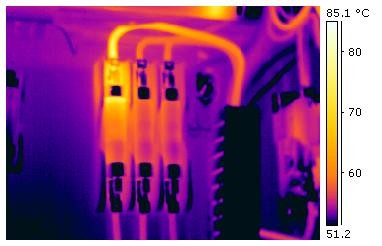
An infrared thermogram of an industrial terminal block under load. The bright terminals reach the 85.1-degree top of the scale bar; their neighbours sit near 51, and the hot joints are the ones drifting toward failure. Photo: US CPSC, CC BY-SA 3.0. Colour scale and temperature figures are the camera’s own overlay.
Panel temperature reads to a hand and a meter. Run inside its derated figure, a high-power connector sits barely warm after an hour. Warmth past the point of comfortable touch, roughly 50 degrees, marks a port near or past its limit. The back of a hand near each loaded socket is a five-second survey a build repays. The hand reads relative heat well. A port markedly warmer than its neighbours doing similar work is the one to meter, the outlier the fingers find before the numbers confirm it.
A meter sharpens the reading further. Voltage lost across a connector under load equals its resistance times the current. A clip on each side of a loaded contact turns that heat into a number. Good high-power joints drop a few hundredths of a volt. A drop climbing over tenths, or rising visit to visit, names a contact entering the runaway loop, caught at the stage a new connector still fixes cheaply. A drop of 30 millivolts at 40 amps points to a milliohm of resistance, healthy for a heavy contact. The same port reading 120 millivolts has tripled its resistance and its heat, the reading that calls for a fresh connector before the next long unattended job.
The machine keeps its own watch. A W-class or L-class station carries temperature sensors on its heavy stages and trims output when a port or the inverter runs hot, the firmware applying its own derating in real time. A port that fades under a sustained heavy load on a hot day is often the machine protecting itself in place of a fault. The behaviour belongs to the physics the derating curve describes.
Discolouration is the slow record. Run hot for months, a socket carries a brown halo around its contacts, a stain that reports a history of heat no meter caught in the moment. A used machine wears its thermal past on the panel. A clean set of contacts on a high-power station says its previous owner sized the loads with room to spare.
Thermal imaging makes the whole panel legible at once. Cheap clip-on cameras show the loaded ports glowing against the cool housing, the hot contact standing out in exactly the way the industrial thermogram reveals a failing fuse block. A single frame under load finds the port working hardest, the survey a careful installer runs before trusting a build to a long unattended job. The industrial thermogram makes the point at larger scale. A bright terminal against cool neighbours, the reading climbing toward a housing’s limit, is a fault caught by a camera that a hand on a live panel could never safely find.
Planning around the heat
High-power thermal planning reduces to four moves made before a cable is cut. Size the connector well above the steady load. The derated figure on a warm day then still clears the current. Choose wire for the bundled ampacity, the free-air number being a lab convenience a tidy loom never delivers.
Placement and timing finish the plan. Mount the heavy ports where air reaches them, away from the inverter’s warm case. Spread the big loads across time in place of firing them together onto one shared panel. A build that budgets a little thermal headroom on every high-power port runs cool, quiet, and free of the slow brown failure for the life of the machine.
Common questions
Why does a 50 amp port not deliver 50 amps on a hot day?
The 50-amp rating assumes cool reference air near 25 degrees and a 30-degree contact rise, landing the contact at 55. On a 45-degree day that same current would push the contact past its safe figure. The allowable current drops to hold the temperature down, roughly 41 amps for a housing capped near 85 degrees.
Does the connector or the wire fail first?
Whichever carries the smaller margin. A big connector on thin wire fails at the wire; a thin contact on heavy cable fails at the contact. The rated current of the whole run follows its weakest part, which is why a port fed by undersized wire never reaches its printed figure.
What are the warning signs of an overheating high-power port?
Warmth past comfortable touch after an hour, roughly 50 degrees; a brown or black stain around the contacts; a faint hot-plastic smell; and a voltage drop across the contact that grows visit to visit. Any one of these marks a port to rewire before it reaches runaway.
Can a station’s ports be run continuously at their rated current?
At reference temperature with airflow, yes; on a warm day, in a bundle, or beside a hot inverter, no. Rated current is a continuous figure at cool reference conditions. Real installations warm the ports. A steady load wants sizing to the derated current for the working ambient. The printed maximum belongs to the bench.