Under a rubber cap on the front of W and L class stations sits a squarish socket with two flat silver contacts, wider than anything else on the DC panel. That is the Anderson port, the heavy door on the low-voltage side. It hands out 12 volts at three to five times the round socket’s current, through a connector built to hold that flow for hours and stay cool. On many units the port idles under its lid for much of the year, then carries the whole trip once the fridge kit comes out. Loads that outgrew the small round socket are what it exists for.
Direction deserves one line before anything else. On W and L class stations the Anderson port is an output. The arrow or label printed beside the port settles what a given socket does, because a few machines on the market use the identical connector shape for their solar input. Everything below assumes power flowing out. The cap’s underside usually names the family and the amps, the first place to look on an unfamiliar machine.
Why the shape exists at all
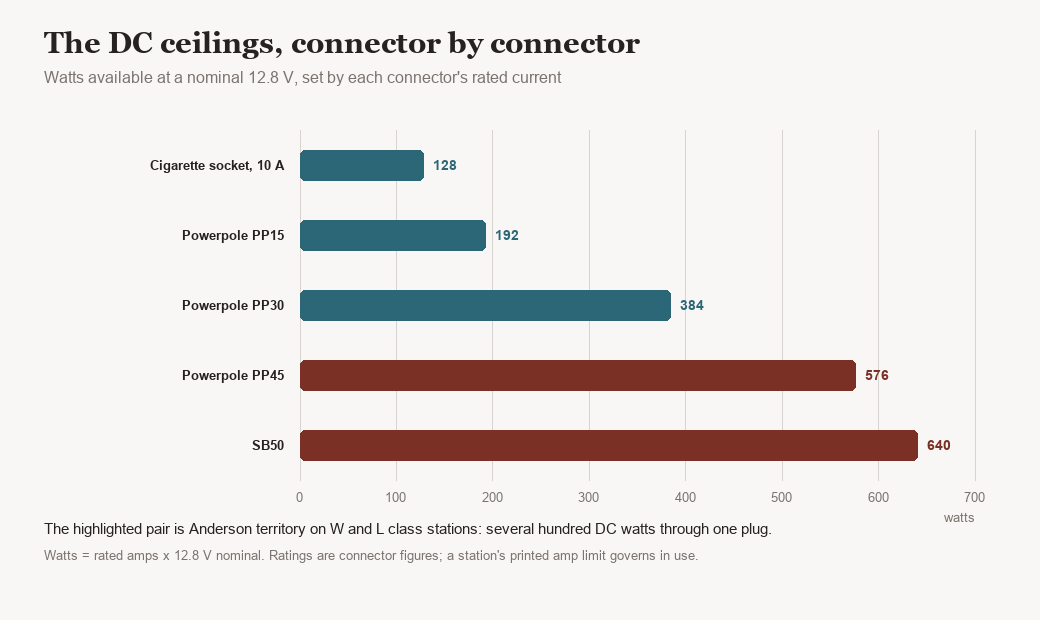
Watts available at a nominal 12.8 volts, connector by connector. The highlighted pair is Anderson territory on W and L class stations. Connector ratings shown; a station’s own printed amp limit governs in use.
The cigarette socket tops out near 10 amps, about 120 watts at 12 volts. That ceiling comes from its construction: a sprung centre tip and two side leaves gripping a smooth barrel; the contact area amounts to a few square millimetres. The design dates from a dashboard lighter coil and was never meant as a power connector. Every van owner who has run one warm knows where its limits sit. Fuse ratings inside those plugs run 10 or 15 amps for the same reason; the format itself is the limit, whatever the load wants.
An Anderson connector carries current through a different geometry. Two broad, flat, silver-plated contacts press against each other across their full faces, held by leaf springs, wiping clean against each other with every insertion. Silver oxide conducts, the quiet reason silver plating suits a connector that lives outdoors; the wipe plus the chemistry keeps resistance flat across years of mating cycles. Contact resistance lands in the fraction-of-a-milliohm range. At 30 amps, a half-milliohm joint drops about 15 millivolts and dissipates half a watt; the connector stays cool at currents that would cook a sprung barrel. Heat is the whole ballgame in connector ratings; a datasheet current is a temperature-rise figure in disguise, the amps at which the contact warms a fixed number of degrees over ambient. The flat contact starts that race further back.
That geometry is what lets a 12 volt port grow past the size of a night light. A PP45 pair moves up to 45 amps, 576 watts at a nominal 12.8 volts. An SB50 moves 50 amps and 640 watts. The barrel geometry cannot scale to those numbers; pressing a bigger spring against a bigger tube multiplies the same small contact patch. Flat-on-flat is the geometry that scales. Those are AC-appliance numbers flowing through a palm-sized DC plug. They arrive without an inverter in the path, which spares the round trip up to 230 volts and back down.
Voltage stability matters as much as the ceiling. Compressor fridges, radios, and diesel heater controllers all watch their supply voltage. Some shut down when it sags. A fat contact plus the heavy cable it crimps to holds the voltage at the load close to the voltage at the station. The loads downstream see a stiff supply, which is half of what people are buying when they buy the port. Numbers make the point. A five metre lead of 8 gauge wire runs about 20 milliohms out and back; at 10 amps the cable drops a fifth of a volt and the connector itself a hundredth. The load sees nearly the source voltage, compressor starts included.
The last piece is mechanical. Dovetailed side by side and stacked, a red-black 12 volt pair travels as one block that cannot be plugged half-in. Insertion wipes the contacts clean of oxide. There is no thread to cross and no latch to snap off. The connector survives thousands of cycles of field handling. It was designed for forklift and telecom service first; camping gear inherited an industrial part. SB blocks began life as forklift battery connectors, sized for charge currents in the hundreds of amps and thousands of connect cycles a year. Telecom rooms adopted the family for the same reasons, rack batteries swapped hot by technicians in a hurry. The camping version of that duty is light work.
Powerpole and SB, the two families
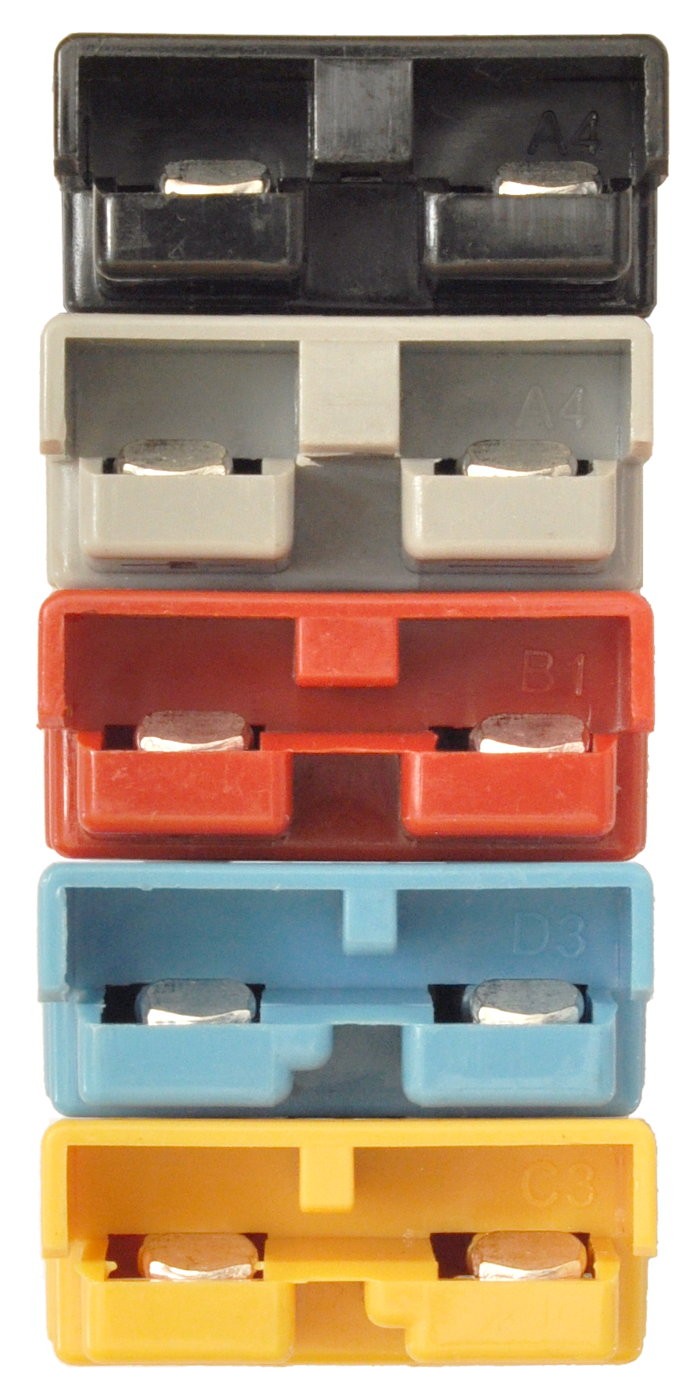
Colour keying on SB50 blocks, made visible: black, grey, red, blue and yellow housings each carry their keying notches in a different position, with the key code (A4, B1, D3, C3) moulded into the shell. Same size, same flat silver contacts, mechanically unable to cross-mate. Photo: Malvineous, CC BY-SA 4.0.
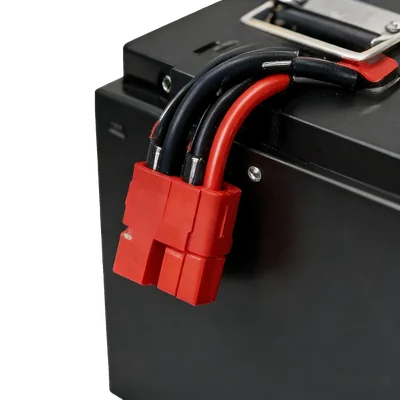
Anderson is the company; the connectors on stations come from two of its families. The small modular one is the Powerpole, the red-and-black pair a few centimetres across. Its trick is that the 15, 30 and 45 amp versions share one plastic housing and differ only in the metal contact inside. A PP15 on thin wire mates with a PP45 on heavy wire without complaint. The rating of the connection follows the smaller contact and the thinner wire inside. In practice that means one crimper and one housing stock cover a whole kit: 15 amp contacts on accessory leads, 45 amp contacts on the feed, every plug in the drawer able to mate with every other. The 30 amp contact is the workhorse in station pigtails, matched to 12 gauge leads; 45s appear where a maker expects fridge-pair or charger duty.
The SB family is the single-piece block, moulded as one housing that carries both contacts. SB50 is the size found on stations and camper wiring; SB120 and SB175 run winches and machinery. SB housings are keyed by colour: grey mates with grey, red with red, blue with blue. The mechanical keying keeps a 12 volt grey plug out of a 36 volt blue socket on a forklift charger. Colour on an SB is a voltage label enforced in plastic. Camper leads and station pigtails arrive grey almost without exception, the colour that market settled on.
Stations carry one or the other depending on class. A Powerpole pair suits gear that hops between radio kits and small panels. An SB50 suits a single heavy feed to a vehicle installation. Both do the same job at these power levels. The rest of a person’s gear usually casts the deciding vote. Mixed fleets bridge with a short jumper, PP pair on one end and SB50 on the other, a lead every van shop sells ready-made. Labels beat memory across a mixed kit; a strip of tape naming volts and amps outlives anyone’s recall of what a grey block feeds.
The connector family on and around stations (typical figures at 12.8 V nominal)
Connector
Rated current
Wire it takes
Watts at 12.8 V
Note
Cigarette socket
10 A
fixed leads
~128 W
legacy plugs, fuse in the tip
Powerpole PP15
15 A
20–16 AWG
~192 W
accessory leads
Powerpole PP30
30 A
16–12 AWG
~384 W
the common station pigtail
Powerpole PP45
45 A
14–10 AWG
~576 W
fridge-pair and charger duty
SB50
50 A
12–6 AWG
~640 W
one-piece block, colour-keyed
What runs off it
The compressor fridge pair is the load that sends people to this port. One 50 litre fridge-freezer averages 40 to 60 watts through a warm day. Two of them, a fridge and a dedicated freezer, run 80 to 120 sustained with compressor starts on top. A long weekend of that duty wants thick copper the whole way. Fed through an Anderson on 8 gauge wire, the pair sees full voltage at every start. Starts are the test that matters: a compressor pulls three to five times its run current for under a second, and a supply that sags through that second is what invites the guard to trip. The low-voltage guard never trips on this feed. Drawer systems and fridge slides in utes wire the same way, one heavy feed running forward, the fridge riding wherever the load space wants it. Runs of four to six metres are routine in those layouts, the distance the heavy gauge exists to cover.
Van and camper distribution is the second big case. One Anderson feed runs from the station to a fused distribution block. The block fans out to lights, sockets, a water pump, a heater controller, USB outlets. The Anderson-to-fuse-block pattern, a copy of how camper electrics are already laid out, turns the station into the house battery of a small van build with no rewiring of the van. Unplug one connector and the whole house side lifts out with the station. The pattern scales from a two-way block with a pair of loads up to an eight-way busbar build, on identical wiring grammar. Swap-in weekends come with it: the same van block accepts a friend’s station, any brand, so long as the pigtail family matches. Rental and loaner stations slot into the same builds for the same reason.
DC-to-DC charging rides the same port. A battery-to-battery charger pulling 20 to 30 amps tops up a trailer battery or a second pack from the station’s supply, a job flatly past the round socket’s ceiling. The charger holds its current for hours at a time; hours at full current are exactly the duty the flat-contact design was rated for. Heavy 12 volt tools sit here too: air compressors above the tyre-inflator class, winch remotes, high-output lighting rigs for a work site or a film shoot. Field camera departments run the same pattern, one station feeding a cart of chargers and monitors through a fused strip, with no inverter fan to stand beside a live microphone.
Amateur radio leans on the plug for standardisation first and wattage second. A 100 watt HF transceiver draws about 20 amps on transmit, inside Powerpole territory and past the comfortable range of anything else on the DC panel.
Two identical halves
An Anderson connector has no male and no female; the two mating halves are identical. Wikipedia’s word for it is hermaphroditic. Any cable end fitting any other of the family means extensions chain without adapters and a supply lead doubles as a charge lead. The box of gendered spares never gets bought. One shape covers every role a cable can play. Stock shrinks to one crimper, one bag of housings, one habit. Loan a lead, keep a lead; nothing about it has a wrong end.
The ham radio connection
Amateur radio standardised on the Powerpole years ago. The emergency services within the hobby, ARES, RACES and WICEN among them, adopted it as the common 12 volt connector. On that standard any operator’s radio plugs into any other operator’s supply at a field site, no adapter hunt. Distribution strips with six or eight Powerpole outlets are standard shack furniture. A power station wearing the same connector drops into that ecosystem as one more supply, which is exactly how clubs use them at Field Day and at emergency exercises. Transmit duty is the sizing detail. Digital modes hold the full 20 amps for a whole transmission, the hardest case the port meets, covered by the rating with margin to spare. Club distribution boxes add per-outlet fuses and a master switch, the same block-and-branches grammar a van build uses.
The standardisation logic runs on the genderless design. A battery can source power or soak it up. A connector that never declares current direction lets one plug standard cover radios, supplies, batteries and chargers alike. That is the property the emergency groups were buying. The same property lets one station charge a drained field battery in the morning and run from a full one at night through one unchanged lead.
A weekend on one feed
Voltage lost across the connector contact alone. The sprung-barrel line climbs to a 0.3 volt loss at its 15 amp ceiling and stops where its rating does; the flat silver contact gives up 0.03 volts at 45 amps. Typical figures, drawn for scale; cable losses add on top.
Watch the port work through an ordinary van weekend. Friday evening, one SB50 lead runs from the station to the van’s six-way fuse block, one plug insertion for the whole house. The fridge and freezer pair settles into its cycle, 90-odd watts when a compressor runs. The diesel heater fires at ten. Its glow plug pulls a hard 8 amps for ninety seconds before dropping to a half-amp hum, and the fridge compressor happens to start in the same window. The block still reads 13.1 volts, because 8 gauge cable and half a milliohm of contact do not notice 20 amps. The heater’s controller, the fussiest voltage-watcher in the van, boots without a flicker. Nothing resets, nothing chirps. Saturday runs lights, a diagnosis laptop for the van’s own electrics, a compressor topping the tyres, phone charging off the block’s USB pair, the radio on through the afternoon. Twenty amps flow whenever the operator holds the key down; the fuse block’s voltage dips a tenth and settles. The heaviest coincidence of the weekend stacks the heater start on a fridge start on the air compressor, 35 amps for a few seconds. The SB50 carries it the way a motorway carries three cars; the weekend’s worst case still leaves fifteen amps of headroom. Sunday morning the station reads 41 percent, the arithmetic of two days of real living. The display’s DC output line has spent the weekend wandering between 15 and 350 watts without one event to remember. Packing up is one thumb under the connector body and a straight pull. The van keeps its fuse block and wiring; the station rides home to charge; the next trip starts by pushing two identical halves back together. That is the whole experience the port sells: one thick, boring, dependable feed under everything, sized far above any combination of starts and surges.
Vibration is the one field condition to engineer for. Powerpoles hold by friction alone, and a washboard road can walk a loose pair apart over hours. Retention clips and roll pins exist for exactly this; installers in rough country fit them as a matter of course. SB housings grip harder, one reason vehicle installs lean that way.
Crimping decides more reliability than any other choice. A properly crimped contact grips the wire in a gas-tight joint that survives years of flexing. Soldered joints wick stiffness up the strands. The wire eventually fatigues right where the solder ends, a failure vehicle wiring standards have documented for decades. A bargain crimper on a 45 amp circuit costs more than it saves. Ratcheting crimpers with the correct die close to a calibrated depth and release only when the joint is made, the feature that separates them from pliers. Two crimps, a tug test, and a look at the wire entry cover quality control for a lead built at home. The retention spring inside the housing holds each contact at a set depth; a contact seated a millimetre short shows up later as heat under load, the fault the tug test exists to catch.
Cable gauge has to match the contact. A 45 amp contact crimped to thin lamp wire makes a connector rated by its weakest part, the wire. Ratings stack downward: housing, contact, crimp, cable. The smallest number wins. A workable bench habit is one grade of wire per current class, 8 gauge for feeds and 14 for branches, so a glance at the copper says the rating. Anyone building leads writes the ampacity of the finished cable on the sleeve, because a year later nothing about its outside says what is inside.
Weather sits last. The standard housings sit open at the back. Wet weather calls for a drip loop, a position under cover, or the sealed marine variants built for wetter duty. Overland builds sometimes pot the back of a fixed socket in silicone up to the mating face, a half-seal against spray that still lets the halves part. Tinned marine cable resists the green corrosion bare copper grows in damp footwells, a cheap upgrade on any lead that lives outdoors.
Assembly and the one trap
Powerpole housings arrive loose and dovetail together. The dovetails permit several arrangements. The one trap in the whole system is assembling a red-black pair mirrored relative to the gear it must mate with, at which point the connectors refuse to seat, or worse, seat with polarity crossed on a non-standard pair. The amateur radio world settled a convention decades ago, red on the right with the contact tongue up. Nearly all commercial gear follows it. One sentence covers the practical rule: match the arrangement on the station’s own port before crimping anything, and check red-to-red alignment on first insertion.
Polarity itself stays honest after that. The housings only mate aligned, colour against colour. A correctly assembled pair cannot reverse. The five-minute check at the workbench buys years of blind plugging-in at night, in rain, in gloves.
First assembly is also the moment to load the roll pin or clip if the install will vibrate, since retrofitting one into a wired loom is fiddly work. Pins drop into a moulded channel between the dovetails and lock the pair against working loose; clips do the same job from the outside. Everything about the system rewards deciding at the bench.
None of this needs special tooling past the crimper. The contacts push into the housing by hand and click over a spring; a misloaded contact backs out with a small screwdriver. Repair in the field is realistic, which is one more reason expedition and radio people trust the family. A spare pair of housings and four contacts ride in a glovebox and weigh nothing.
Adapters and the limits they carry
Adapters bridge the port to older gear. An Anderson-to-cigarette-socket pigtail lets legacy plugs ride the heavy feed. Each such adapter carries the old socket’s ten amp ceiling along with it, whatever shape sits on the end. Ring-terminal leads go the other way, putting an Anderson on gear that arrived with bare lugs: a compressor, a fixed radio, an old spotlight. Ten minutes of crimping folds legacy kit into the same one-plug system. The pigtail kit that ships in many boxes covers the first two of those jobs on day one.
Anderson-to-ring-terminal leads, Anderson extension cables, and Y-splitters fill out the kit. Splitters divide the port’s current budget across their legs. A fuse block remains the better version of the same idea, one fuse per branch.
A station also splits its total output across every port at once, one budget per port family under the battery’s total.
Reading the spec row
On a spec sheet the port reads as a line like: DC output, Anderson, 12.8 V, 30 A max. The connector name says the shape, the amps say the ceiling. Multiplying the two gives the honest watt figure, 384 in that example. Ratings differ machine to machine inside one brand, which leaves the printed row to settle it every time. A row that names PP45 or SB50 with no amp figure still hides a ceiling, set by the station’s internal fusing. The connector name carries shape information only. Sometimes a second number rides the row, a per-port fuse rating. Replacing that fuse with a bigger one strips the wiring behind it of its protection.
Fusing behind the port is the station’s business. Every branch wired after it wants its own fuse sized to its own cable, the same discipline as any vehicle circuit. The port’s amp rating protects the connector itself.
Shortlist the port whenever the DC loads stop being gadgets: a fridge pair, a van build, a radio kit, a second battery to keep charged. Everything lighter lives happily on the round socket and the USB panel. Bigger loads, when they arrive, land on the Anderson.
Common questions
What is the Anderson port on a power station for?
High-current 12 volt DC. It feeds loads past the cigarette socket’s 10 amp ceiling: fridge-freezer pairs, van distribution blocks, DC-to-DC battery chargers, 100 watt radio transceivers. Ratings run 30 to 50 amps depending on the unit, several hundred watts of DC without touching the inverter.
Are Powerpole and SB the same connector?
Two families from the same company. Powerpoles are small modular housings that dovetail together, with 15, 30 and 45 amp contacts sharing one shell size. SB connectors are one-piece blocks, SB50 and up, keyed by colour so different voltages cannot cross-mate. Stations ship with one or the other; adapters between the two are common.
Will any Anderson plug fit any Anderson port?
Within a family and size, yes. Gender never enters it, since both halves are identical. Across families, no; a Powerpole pair does not mate with an SB50 block. SB colours only mate with themselves. Check the family, the size, and the red-black arrangement against the station’s port once, at the bench.
What cable should go on an Anderson lead?
Cable matched to the current, 8 gauge for a 40-plus amp feed, thinner only for lighter branches, each contact crimped; solder has no place on a lead that flexes. The finished lead is rated by its thinnest part. Writing the ampacity on the cable sleeve at build time saves guessing later.