The AC sockets on a power station copy the wall standard of the country the unit was built to be sold in. A unit built for the American market carries American three-prong faces at 120 volts. The same rule stamps every market’s version with its own wall standard, recessed Schuko faces at 230 on the German one among them. Shape and voltage travel together as one package, set at the factory, unchangeable afterward. The socket row is the one part of a power station that behaves like a piece of national infrastructure: fixed, regional, permanent. The faces on the panel outlive every revision a model receives, frozen by market certification on day one.
That single fact settles more buying questions than any other on the spec sheet. A power station is a wall that travels, carrying its home country’s wall wherever it goes. Every appliance plugged into it meets the same shape, the same voltage, and the same frequency it would have met in a house back in the unit’s home market. Nothing about crossing a border changes what comes out of those sockets. Owners moving between countries carry that wall along, for better on their own gear, with homework attached for anything bought locally.
The faces themselves raise every question that matters: which shapes exist, which markets ship which, what voltage stands behind each shape, and what the whole bundle means for buying, importing, and traveling with a unit. Watt allocation across ports, protection behaviour, and the DC side stand apart as subjects of their own.
Why the world’s walls disagree
Wall sockets grew up separately in each country through the early twentieth century, long before anyone imagined the gear would cross borders in suitcases. Grids picked voltages first. Plug shapes followed, each national committee solving safety its own way: some put shutters in the socket, some put the fuse in the plug, some recessed the whole face so fingers never reach a live pin. By the time international standards bodies arrived, every shape had a hundred million homes behind it. The shapes stayed. A century of proposals to standardise the world’s sockets all met the same costing: a rewiring of civilisation. Power stations inherit the map as it stands.
Travelers inherit the naming system the IEC maintains as a guide of letter designations: Type A and B for the flat-blade American family, Type C and F for the round-pin European family, Type G for the British rectangular three-pin, Type I for the slanted Australian pair. The letters name the shape only. Voltage and frequency ride separately from the letters. Two shapes can share a voltage. One shape can span two voltages, Type A across Japan’s 100 and America’s 120 among them. Letter, volts, and hertz always deserve three separate reads.
The five faces stations ship with
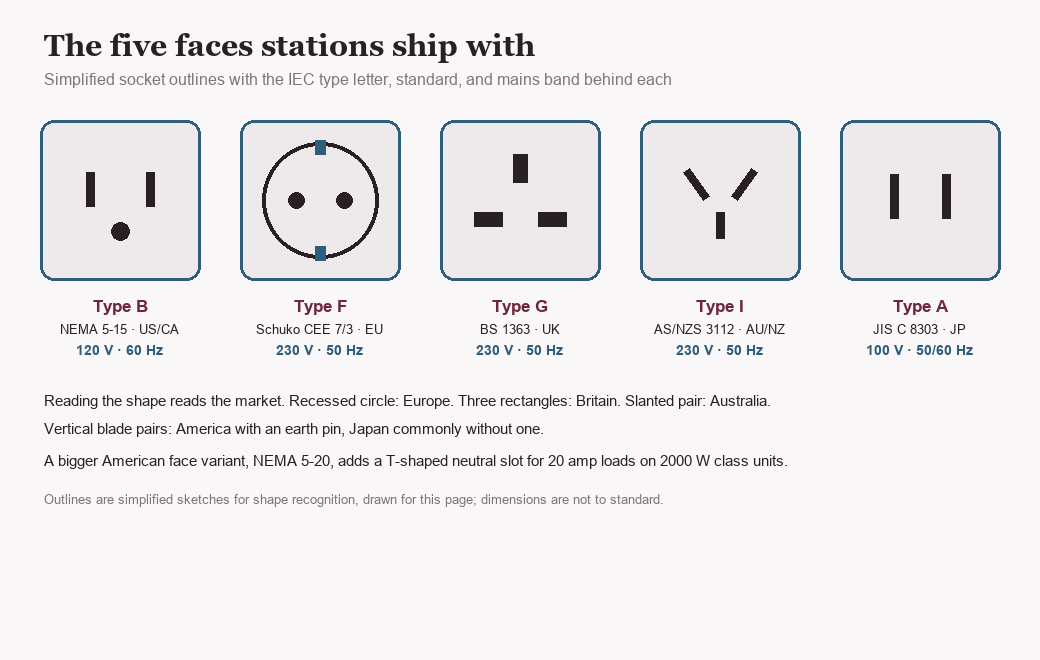
The five faces on station panels worldwide, drawn as simplified outlines for shape recognition: the IEC letter, the national standard, and the mains band under each. The outlines are fresh sketches made for shape recognition; proportions indicative, dimensions not to standard.
American-market units carry NEMA faces, Type B in the letter system: two flat blades and a round earth pin at 120 volts. Small and mid units use the 15 amp face, NEMA 5-15. Bigger units move to NEMA 5-20, the same face with a T-shaped neutral slot that accepts 15 and 20 amp plugs alike. The T-slot is load arithmetic made visible: 2000 watts at 120 volts is 16.7 amps, past what a 15 amp face is rated to carry, so any American unit with a 2000 watt inverter needs at least one 20 amp face to deliver its own headline through a single cord. Spotting the T-slot on a listing photo is the quick check that a big unit’s paper watts reach a real socket.
European-market units carry the Schuko face, Type F: a circular recess with two round holes and earthing clips along the sides. The recess is the safety story. A plug sits half-swallowed before its pins reach anything live. Earth clips along the recess make contact ahead of the pins themselves. Behind the face sits 230 volts, with the socket rated at 16 amps, which is why one ordinary-looking Schuko face can serve a full 3000 watt load. Higher voltage moves the same power at less current, the quiet arithmetic under every 230 volt market’s thinner cords and smaller faces.
British-market units carry BS 1363, Type G: three stout rectangular pins, shutters over the line and neutral holes, and a fuse inside every plug. The fuse-in-plug arrangement means each appliance cord protects itself at 3 or 13 amps, a layer carried entirely by the cords themselves. Shutters stay closed until an earth pin opens them, so nothing enters a British face without the full three-pin handshake. Station panels inherit the bulk along with the safety; the pins alone explain the size of a British plug in the hand.
Australian and New Zealand units carry Type I, two slanted flat blades over an earth pin at 230 volts, rated 10 amps as standard. Japanese units carry Type A, two vertical blades with no earth pin on the common face, at 100 volts, the lowest mains voltage in wide use. Japan splits its grid between 50 and 60 hertz by region as well, a wrinkle of its own. Both markets print the same lesson in different ink: the face, the volts, and the local rules arrive as one sealed bundle. Stations for smaller markets follow the same pattern with their own faces, Swiss, Italian, and South African types among them, each bundled to its own grid.
What a travel adapter changes
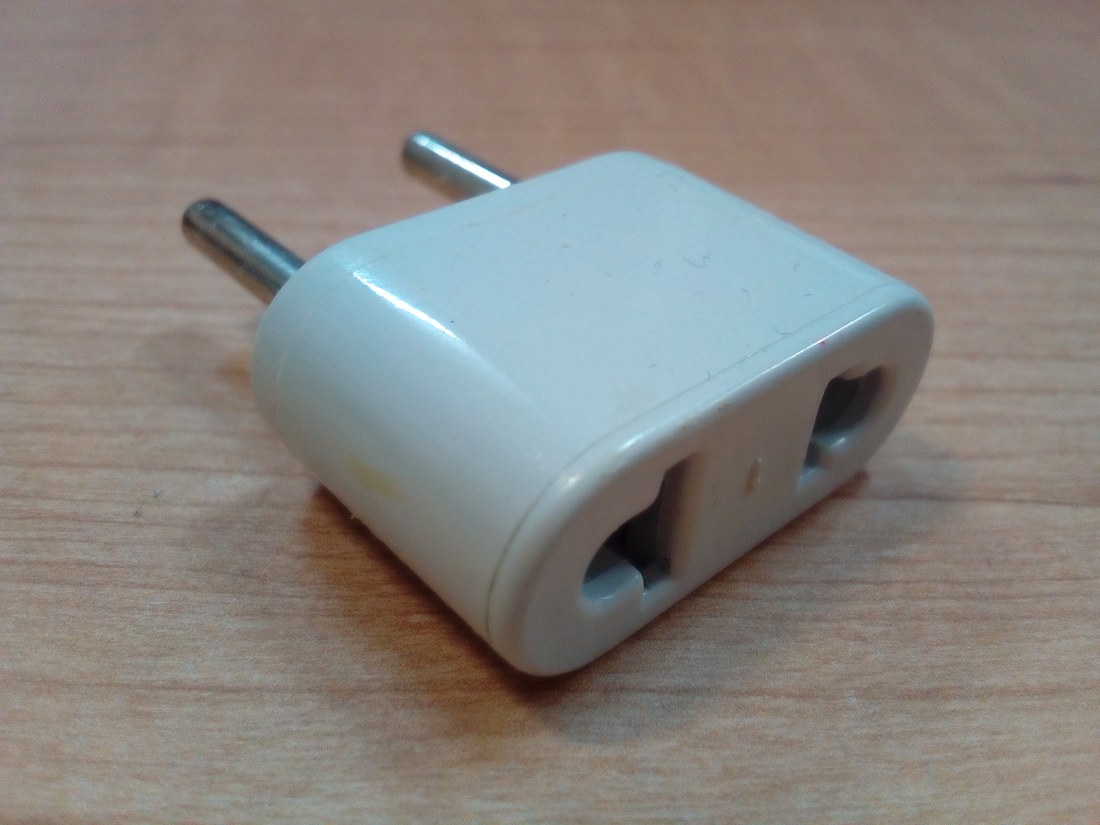
The adapter law in one object: round European-style pins on one end, American flat-blade slots on the face, and nothing electrical inside. Voltage passes through this device unchanged. The photographed piece carries no earth path at all, the exact type best left in the drawer for three-prong loads. Photo: Fructibus, CC0.
A travel adapter is a shape converter only: pins of one standard in, pins of another standard out, the voltage riding through untouched. Fitted to a power station’s socket, it lets a foreign plug seat mechanically. It converts nothing electrical. A 230 volt Schuko face wearing an American-shaped adapter is still a 230 volt face, now able to seat 120 volt plugs above a voltage their appliances never met. The adapter law settles half of all cross-border questions: shape is the negotiable half, a few dollars at any airport kiosk. Voltage is the permanent half. Devices that claim to convert voltage in a travel-plug format top out near a couple of hundred watts, kettle-class sockets far beyond them.
The voltage standing behind the pins
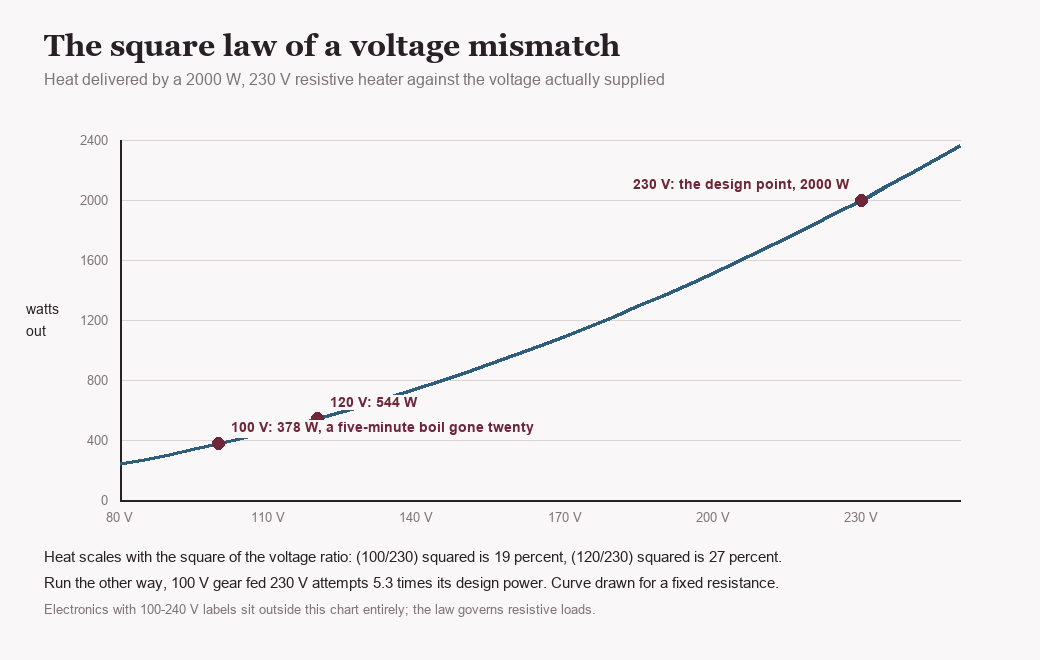
The square law drawn out for a 2000 watt, 230 volt resistive heater. Supplied 100 volts it delivers 378 watts; supplied 120, about 544. The curve assumes fixed resistance and is illustrative; wide-input electronics marked 100-240 V sit outside it entirely.
The world’s mains cluster in two bands. Japan and the Americas run 100 to 127 volts. Europe, Africa, Australia, and much of Asia run 220 to 240. A power station’s inverter is built for its home band and holds it: the shape on the panel announces the voltage behind it the way a flag announces a country. Reading the shape reads the voltage nine times in ten; the label supplies the tenth. The tenth case is mostly Type A, the one shape straddling two voltages an ocean apart.
Resistive appliances obey a square law that decides every mismatch. Power delivered scales with the square of the voltage ratio. A 2000 watt heater built for 230 volts, fed 120, delivers 27 percent of its heat, about 540 watts. Fed 100, it delivers 19 percent. The same square works ruinously in reverse: gear built for 100 volts, fed 230, tries to run at more than five times its design power. The square law is why the two directions of mismatch carry such different price tags.
Watch the law work through one grey import, a 100 volt Japanese-market station landed in a Berlin flat. The laptop charger goes in first and works without complaint; its own label reads 100-240 volts, 50-60 hertz, the wide-input badge of nearly all modern electronics, indifferent to which wall feeds it. The electric kettle goes in next. The kettle, a 2000 watt design for 230 volts, draws only about 380 on this supply: the water warms, eventually, a four minute boil stretched toward twenty, the kettle healthy by every test except the clock. A 1200 watt microwave on the same sockets tells the same story at lower stakes, its transformer humming low, its plate turning, its reheat running triple time. A hair clipper with a small synchronous motor hums at the wrong pitch and barely turns, mains-frequency gear lost without its designed volts and hertz. Run the import the other way and the arithmetic hardens. Picture the neighbour’s German-market station, 230 volts behind Schuko faces, hosting a 120 volt blender carried over from Chicago through a shape adapter: three point seven times design power, smoke inside a minute, motor windings gone with it. The smoke cost that flat a blender and taught it the label habit inside one afternoon. Every one of those outcomes was printed on the equipment before the first plug went in: on the station’s socket shape, on the appliance’s input label, in the two-line arithmetic of the square law. Bad luck plays no part in any of it. The whole outcome sat legible in advance, which is the entire case for reading shapes and labels before cords. The Berlin flat keeps the Japanese unit in the end, married to a shelf of 100-240 volt electronics it serves perfectly well, the kettle retired to decoration. Grey imports find their level as laptop-and-phone machines, whatever wattage the box once promised.
The input label is the sorting key for everything with a cord. Gear marked 100-240 volts runs on any station on earth through nothing more than a shape adapter; that covers phone bricks, laptop chargers, camera chargers, and nearly every USB power supply made this century. Switch-mode design earned that width; the input stage rectifies first and cares little what voltage arrives. Gear marked with a single voltage belongs to a single band. The label sits moulded into the brick or printed near the cord entry, one glance, settled.
Motors and heaters fill the single-voltage camp. Kettles, toasters, hair dryers, fans, fridges, and nearly every kitchen machine carry one design voltage, printed in one line. Dual-rated exceptions exist, travel kettles and shavers among them, their labels saying so plainly. Absent that marking, a single-voltage appliance and a foreign-band station make a pairing the square law has already priced.
Frequency and the dual-voltage case
Frequency belongs to the market as well, 50 or 60 hertz. No socket changes it. Clocks and motors care; switching is its own subject.
Dual-voltage stations exist as well, machines that offer both 120 and 230 from one chassis, their inner workings a subject of their own. The socket faces still follow the sold-in market. Even a dual-voltage unit ships wearing one country’s shapes, the adapter law governing everything plugged into it abroad. Even on a dual-band machine, the sales region sets the shapes.
The earth pin on a floating output
Four of the five common faces carry an earth path. On a power station that path does a quieter job than it does in a house. The bond that ties earth to neutral in a house’s panel, the highway fault current rides home on, has no counterpart inside a station. The inverter output floats, its neutral tied to nothing, the earth pins tied to the chassis alone. The earth pins on the panel connect appliance earth to station chassis and to each other, and stop there.
A three-light outlet tester pushed into a station’s socket reports the arrangement honestly: open ground, two of the tester’s three lights. First-time testers read it as a defect and start drafting the return email. Support desks field the open-ground question weekly, in every market, from owners holding working machines. The reading is the normal signature of a floating output, printed in the manual of nearly every maker. The unit behind it is working exactly as designed.
Floating output carries its own safety logic. With no bond between live conductors and earth, a person touching one output conductor and the ground stands outside any complete circuit; the first fault creates no return path. It is a different protection style from a house’s, complete on its own terms. The station’s own electronics watch for overload and short circuit on top, protection with rules of its own.
The exception arrives with fixed installations. Feeding a building’s transfer switch, or any wiring that expects a bonded neutral, can call for a bonding plug that makes the earth-neutral tie externally. That corner belongs to electricians and the station’s manual, in that order. Makers that support bonded use sell the plug as an accessory; silence in the manual means the answer is no. Portable use, cords into sockets, never needs it.
What portable use does need is intact earth paths. Three-prong appliance cords keep their third pin. Adapters in the chain keep the earth contact connected through. The cheap two-blade adapter that drops the earth pin stays in the drawer. The floating design covers one class of accident. Intact earth paths handle the rest, at the cost of nothing more than leaving cords unmodified.
Strips and adapters in daily use
A local power strip is the cleanest multiplier for a station’s sockets. One strip in the station’s own plug standard turns one face into four or six, keeps every earth pin connected, and adds a cord’s length of placement freedom. The strip’s rating has to cover the load it gathers, 10 or 13 or 15 amps printed on its back, the same reading discipline every other label gets. British strips carry their own plug fuse, one more layer in that market’s chain.
Adapters earn a quality check before they earn trust. A loose adapter holds pins by friction alone; a high-watt load through a loose joint builds heat exactly where nobody watches for it. Kettle-class loads deserve solid one-piece adapters with a firm grip. Universal multi-way cubes belong with phone chargers and little else. Warm plastic after ten minutes is the field test that matters. Cold pins after an hour of kettle duty mark an adapter that has earned a permanent place in the kit.
Stacking runs in one direction only. Strip into station, adapters onto the strip’s sockets as needed: one layer of shape conversion, close to the appliance. Adapter-onto-adapter towers wobble, arc, and concentrate resistance at the worst point in the chain. The watt arithmetic across everything plugged in at once is allocation’s own question. Shape conversion follows one rule: a single layer.
Buying across markets
A grey import carries its home market on its face forever. The attractive price on a foreign-market listing buys sockets that fit nothing in the destination house and a voltage band that may match nothing either, a combination no accessory repairs outright. Adapters fix the shape problem only. One rung up sits the transformer, sized to re-band a 2000 watt output at a meaningful fraction of the station’s own cost and weight. The discount rarely survives the arithmetic. Warranty service follows the market as well; a unit sold for one region often travels poorly through another region’s support channels.
Certification marks are the forensic read on any listing. UL or ETL marks a unit built for North America. PSE marks Japan. CE and UKCA mark the European and British markets, RCM the Australian one. The marks sit on the rating label beside the electrical figures, photographed or omitted in every online listing. They name the intended market more reliably than the listing text around them. A seller’s photos with the wrong marks for the buyer’s country close the question early.
Socket photographs settle the rest. Every legitimate listing shows the output panel. Counting faces and reading shapes takes seconds against the table below. Recessed round wells read as Europe, rectangles as Britain, slants as Australia, vertical blade pairs as America or Japan, with the volts trailing each shape. Model numbers help as well, many makers appending region letters to the same base model. On an honest listing the letters agree with the marks and the faces. Disagreement anywhere in that triangle is the signal to walk.
The five station-market socket standards at a glance
Market
IEC type
Standard
Socket rating
Mains
Faces per panel, typical
US / Canada
B
NEMA 5-15, 5-20 on big units
15 A / 20 A
120 V · 60 Hz
4–6
Europe
F
Schuko CEE 7/3
16 A
230 V · 50 Hz
2–3
UK
G
BS 1363, fuse in every plug
13 A
230 V · 50 Hz
2–3
Australia / NZ
I
AS/NZS 3112
10 A
230 V · 50 Hz
2–4
Japan
A
JIS C 8303
15 A
100 V · 50/60 Hz
3–6
Travel with a station stays on the easy side of all of it. The unit keeps its home voltage in every country, so the owner’s own appliances, bought in the same market, plug in abroad exactly as they did at home. A campervan crossing three borders in a week runs the same kettle off the same socket at every stop. Shape adapters cover any borrowed or local gear, subject to the input-label check. Importing owns the hard cases. A traveler with matched gear meets none of them.
Panel space and socket count
Socket standards spend panel space at different rates. A British face with its shutters and stout pins swallows roughly the area of two American faces. A Schuko recess digs volume as well as area. Output panels answer with different face counts for the same chassis, market by market; the counts column in the table above carries the spread. Socket count across versions of one model is packaging, the same inverter behind different national faces. Spec sheets list the counts per region for exactly this reason. Watt figures stay identical from region to region; face count is the one line that moves.
Spacing matters as much as count. Power bricks and timer plugs overhang their sockets, and a row of faces set tight goes half-unusable under two wall-warts. Panels that angle faces sideways or spread them wide trade a printed face or two for working room under real plugs. A short strip solves what a crowded panel cannot, at the cost of one more thing in the kit. Panel layouts reward one habit: big bricks on the end sockets, slim plugs in the middle rows.
Reading the AC line in a listing
The AC row of a spec sheet compresses the whole subject into one line: 2× AC 230 V, 50 Hz, 2000 W total, pure sine. Two faces, European band, European frequency, a shared watt budget across both sockets, and an inverter claim that is a story of its own. The shared total is the number newcomers miss. Two sockets never mean two full loads; the split across them is allocation’s own question.
Read in order of permanence: shape first, voltage second, frequency third, count and total last. The first three are unchangeable facts about the unit’s market. The last two are design choices inside it. A buyer who clears the first three lines never meets the expensive mistakes; the last two only size convenience. Five seconds of order beats an afternoon of returns paperwork.
The same order works in reverse on any secondhand or clearance unit with a vague listing. One clear photo of the output panel answers shape and usually count; the rating label answers band, frequency, and market marks. Five facts from two photographs, before a single question to the seller.
The socket as the market’s signature
All of it folds into one habit: treat the AC face as the unit’s passport. It names the home market, the voltage band, the frequency, the certification regime, and the appliances that were always meant to plug in. The socket row alone places the machine in the world.
Checked at purchase, the signature never needs checking again. The faces on the panel outlast firmware, batteries, and fashion, fixed from the factory floor to the recycling yard. Sixty seconds with the socket row and the input labels of the household’s own gear settles a station’s whole cross-border story in advance. The passport metaphor holds to the end: a machine crosses any border it likes and keeps one citizenship, printed on its faces.
Common questions
Can a plug adapter make a foreign power station work at home?
An adapter reshapes pins and changes nothing electrical. A 100 or 120 volt station stays at its voltage behind any adapter, and a 230 volt one likewise. Appliances marked 100-240 volts work either way; single-voltage appliances follow the square law; the direction of the mismatch sets the size of the damage.
Why does an outlet tester show open ground on my power station?
Station inverter outputs float, with no internal bond between neutral and earth, so a three-light tester reports open ground by design. The reading is normal and documented by nearly every maker. The earth pins still connect appliance earth to the chassis and to each other.
Which sockets does a European-market unit carry?
Recessed Schuko faces, Type F in the IEC letter guide, at 230 volts and 50 hertz, commonly two or three of them rated 16 amps each. British-market versions of the same machines carry fused-plug BS 1363 faces at the same voltage.
Can a Japanese 100 volt appliance run on a 230 volt station?
Only through the label check. Gear marked 100-240 volts runs anywhere with a shape adapter. Single-voltage 100 volt gear on 230 tries to run at over five times its design power and fails fast. The one honest workaround is a transformer sized for the load, priced in money and weight together.
Do more AC sockets mean more output power?
No. Every face shares the inverter’s one total, printed as the watt figure on the AC row. The watt total carries the capability. Count decides how many cords fit at once, nothing more; the split across simultaneous loads is a question of its own.