A station’s panel invites plugging everything in at once: a kettle on the AC socket, a fridge on the 12 volt port, a laptop on USB-C, a phone beside it. Whether the machine can feed all of that together is the allocation question. The printed specs answer it less directly than buyers expect. A 2000 watt unit is not a machine that hands out 2000 watts to whoever asks. It is a set of separate supplies with separate ceilings, sharing one battery underneath. The shares take ten minutes to learn, the price of never meeting a dark socket at dinner.
Three layers of limits stack up inside. Each port carries its own cap, the printed per-port figures of the 12 volt, USB, and Anderson groups. Above the ports, each family of ports draws from a supply stage with a budget of its own. Above everything sits the battery’s willingness to discharge, the ceiling the whole machine answers to. Allocation is how a real load walks through those three layers.
The reassuring part comes early. The layers mostly stay out of each other’s way. Loads split across different families barely interact. The everyday mix of a kitchen appliance plus a fridge plus some electronics runs with room to spare on a mid-size unit. The interesting cases, the trims and the trips, live at the edges. In a family kit the edge is nearly always a heating element or a motor start.
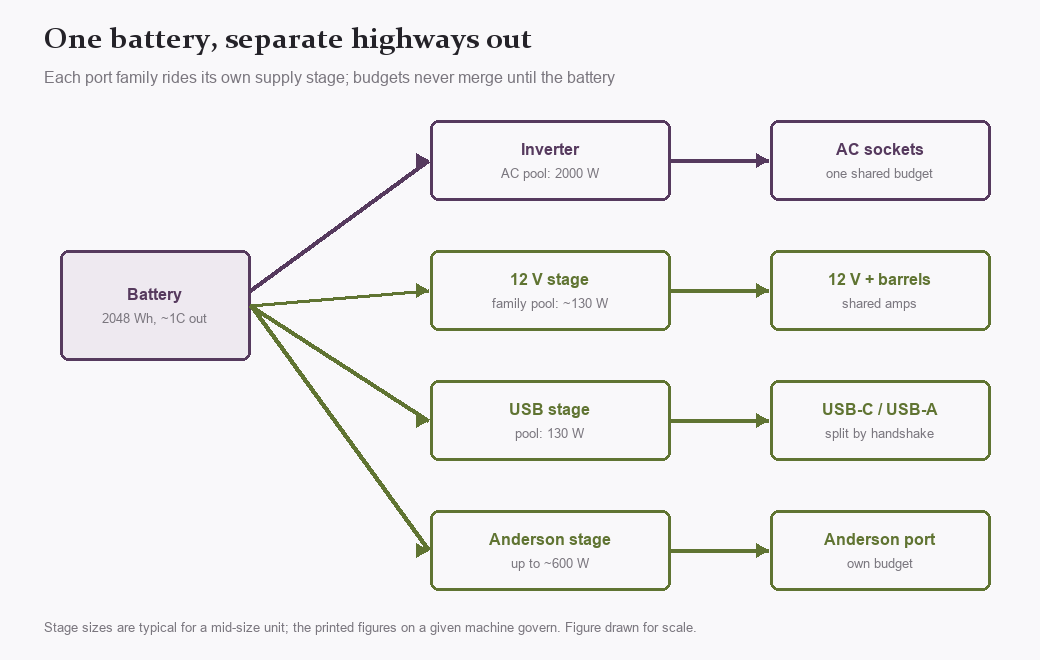
Two highways out of one battery
One battery behind four separate supplies. Only the inverter makes AC; the DC stages run beside it, so DC watts add on top of the AC figure. Stage sizes typical of a mid-size unit; the printed figures on a given machine govern. Diagram drawn for scale.
AC and DC leave the battery on separate highways, the fact that organises everything else. The inverter takes battery power and builds mains voltage for the AC sockets; that is one road. The DC ports, the 12 volt socket and the Anderson and the USB panel, each run off their own converter stages wired straight to the battery; those are other roads entirely. The 2000 watts printed on the front describes the inverter alone. It says nothing about the DC side. Each DC family carries its own stage size: around 120 to 160 watts behind the 12 volt group, 100 to 200 behind the USB panel, several hundred behind an Anderson where one is fitted. Small supplies, sized to their ports, running in parallel with the big one.
The consequence surprises people pleasantly. A machine rated 2000 watts can deliver 2000 through the AC sockets and feed the DC ports on top, both at once, because the DC watts never pass through the inverter. A fridge on the 12 volt port costs the AC budget nothing. A laptop on USB-C costs it nothing either. The marketing habit of printing one big number hides a machine that is genuinely wider than the number. A 2000 watt unit with loaded DC ports is honestly moving 2200-odd watts, a fact the display confirms and the front panel never mentions.
The separation reaches down into the hardware. An inverter is a heavy stage with its own transformer, its own cooling, its own protection. The DC converters are small buck stages, kin to the ones running the USB ports, each with its own current limit. They share the battery terminals and nothing else. One side can fault, restart, or switch off with the other side running straight through the event. Repairs follow that boundary. A failed inverter takes the AC sockets with it and leaves a working DC machine behind, which is why second-hand units sometimes sell as DC-only survivors.
Efficiency splits there as well. AC watts carry the inverter’s conversion cost, a slice lost to heat on every appliance. DC watts skip that toll, which is the standing reason the fridge belongs on the 12 volt port. Allocation starts before any budget maths, with the choice of which highway each load rides. One family of gear gets no choice, since anything with only a mains plug rides the inverter, overhead included, the case for buying the 12 volt version of whatever lives on the machine full-time.
The ceiling above all of it
The battery sets the grand total. A lithium pack tolerates discharge up to a current its chemistry and BMS allow. The common shorthand for that ceiling is the C-rate: a 1C rate discharges the entire battery in one hour, so a 2048 watt-hour pack at 1C is moving roughly 2000 watts. Everything the machine outputs, AC and DC together plus its own overhead, adds up against that figure. Overhead counts in the sum. The inverter’s conversion slice and the idle draws ride one battery, so the pack drains a shade faster than the output line alone predicts.
On the common sizes the grand ceiling sits at or above the inverter figure, so it hides. A 2048 watt-hour unit with a 2000 watt inverter reaches the battery’s comfort zone only with the AC side flat out and the DC side loaded on top, a corner of the map ordinary use never visits. Small packs paired with big inverters live closer to the line, so compact high-power units lean on surge tricks and firmware caps. A 512 watt-hour pack behind a 1200 watt inverter runs at 2.3C flat out, hard work for any chemistry. Units built that way hold the full figure for minutes at a time and guard the pack with temperature and time limits underneath. The layer exists on every machine; the question is only how much headroom separates it from daily life.
How the AC sockets share
Every AC socket draws from the one inverter, so the printed AC figure is a shared pool. Three sockets on a 2000 watt unit offer 2000 watts between them, in any split the loads happen to ask for. One kettle can take nearly all of it. Six phone chargers can sip from it together. The sockets are taps on one tank. The tank is the number that governs. Extension strips change the face count without touching the tank, the socket-count arithmetic again. A strip full of chargers still answers to the one inverter figure, through any number of faces.
Loads add plainly on that side. A 1500 watt kettle beside a 400 watt rice cooker asks for 1900, inside the pool with a sliver spare. Add a 300 watt blender and the sum crosses 2200; the inverter carries brief excursions on its surge margin. A sum that stays high trips the AC side off. The arithmetic never gets subtler than addition. A pencil and the appliance labels settle any planned menu in a minute. Sequencing is the free fix on tight menus. Boil first, cook second, and the pool only ever meets one heat appliance at a time.
Surge belongs to that shared pool as well. The inverter’s peak rating, commonly double the continuous figure, exists for motor starts and compressor kicks. One appliance’s start can occupy the entire margin for its half-second. Two motors starting in one instant is the classic mystery trip on a panel that looked comfortably loaded. Staggering heavy starts by a few seconds costs nothing and removes the coincidence. Fridges make the habit easy, since their starts wander in time; tools and pumps start when the trigger says, which puts the stagger in the operator’s hands.
Big sockets change none of it. A 20 amp socket on an American unit widens the door for one cord, a socket-standards detail; the pool behind every door stays the same size. Trip behaviour and reset steps are protection territory. For allocation, the AC side is a single budget wearing several faces.
The inverter also spends a little on itself. Holding mains voltage ready costs idle watts whether anything draws or not, an overhead of its own with one habit attached. An AC side switched off spends nothing, so the switch is part of allocation too.
The one live instrument
The output line on the display adds the whole allocation up in real time. Every port, every family, every layer lands in that single watt figure. Watching it as loads switch on turns the abstract budgets into a moving number. A plan drawn on paper gets checked against it in seconds. App-connected units break that figure out per family. The sum on the main screen stays the instrument that matters, one number, live, for the whole machine. Units charging and discharging at once show input and output lines side by side; the pack’s net movement is one subtraction away, the read that settles whether solar is keeping up with the evening.
The DC side keeps its own books
The 12 volt family runs on its own stage with its own budget, commonly 10 to 13 amps across the cigarette socket and the barrel plugs together, a fine-print figure from the 12 volt story. Loads inside the family share that small pool the way AC loads share the big one. A fridge plus a dash camera plus a lighting string is the working example, 8-odd amps of the 10 available, comfortable until someone adds an inflator. The family trips as a family. Cross its shared amps with the inflator running and every small load on the group drops together, then returns together after the reset.
The Anderson port, where fitted, rides its own heavier stage at 25 to 50 amps and holds its budget apart from the small DC family. A fridge pair on the Anderson leaves the cigarette-socket pool untouched for the small loads. Builders lean on that separation, heavy feed on its own stage, housekeeping loads on theirs, so no single appliance can starve the rest of the DC side. The same layout keeps voltage clean, since heavy draw on one stage leaves the other stage’s rail untouched. USB runs as a third pool with its own arithmetic. Port families are separate purses. The machine only merges them at the battery.
An AC overload shuts the inverter down. Ten seconds later the fridge on the 12 volt port has not noticed.
How the USB pool splits
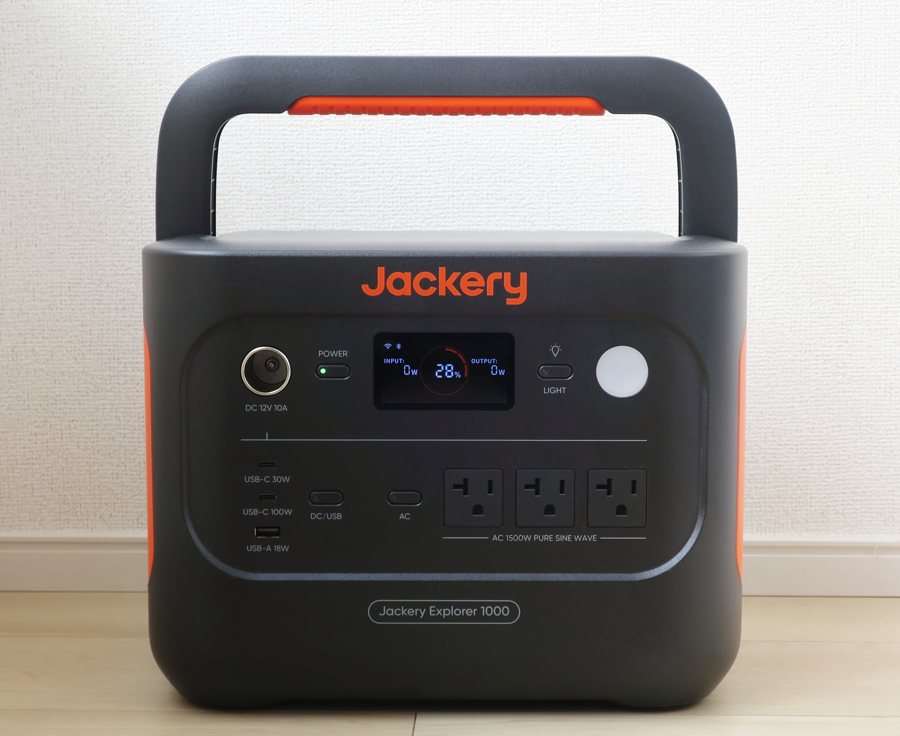
The budgets in print on a shop-shelf machine: 30 and 100 watt contracts on the USB-C pair, 18 on the A port, 10 amps at the 12 volt socket, one 1500 watt figure shared across all three AC sockets, input and output lines side by side on the display. Photo: Qurren, CC BY-SA 4.0.
USB allocation happens once, at plug-in. Each USB-C port negotiates a power contract the moment a cable seats. The contracts draw from the family’s shared budget, the mechanism behind the fine print that reads 100 watts alone or 65 plus 45 with two devices. Contract sizes follow the fixed PD steps, the voltage ladder from the USB story, so the pool splits in coarse chunks. A contract sets a ceiling only. The port reserves the wattage and the device draws what it chooses under it. The display shows the live draw; the contract stays invisible.
Plug order can decide who gets the big contract. A laptop arriving first on an empty pool negotiates the full 100 and keeps it; a phone arriving second takes what remains. Reverse the order and the phone may hold a contract sized for a phone, leaving the laptop the larger share. The contracts persist until something unplugs, so the fix for a bad split is mechanical: pull both, plug the hungry device first. Powered USB hubs muddy the water, presenting one negotiation for many downstream devices; a heavy laptop does better on its own port than behind a hub. A legacy A-to-C lead caps the handshake near 15 watts too, the quiet reason a fast phone sometimes charges at a crawl on the wrong cable. The negotiation also reruns after any firmware restart, so a machine that rebooted overnight can hand out different contracts by morning.
Renegotiation also triggers on its own when a device sleeps or finishes charging, so the pool drifts toward sensible splits over time. The drift is slow. Anyone watching the display after a replug sees the new contract land inside a second, which makes the pull-and-replug habit the fast path whenever the laptop is starving.
USB-A ports sip small fixed amounts and barely dent the pool. The budget drama on the USB side is a two-device affair, the laptop and whichever fast-charging phone shares the panel with it. Everything else rounds to noise. Wireless charging pads, where fitted, draw from the family budget too, at 10 or 15 watts, one more small contract on the pile.
An evening, fully loaded
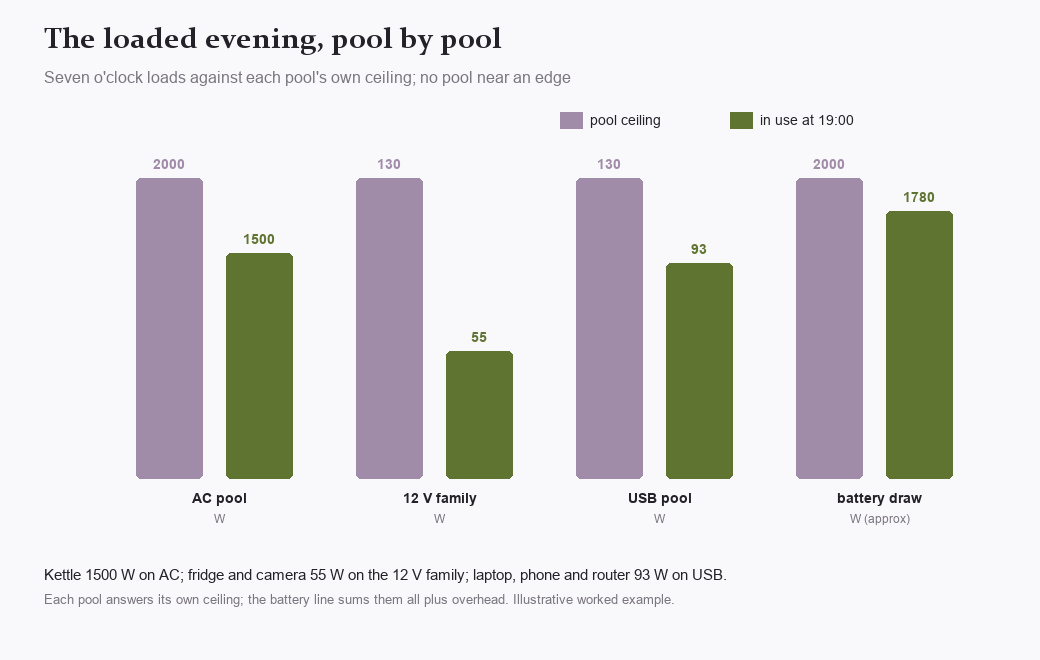
The seven o’clock ledger from the loaded evening: each pool against its own ceiling. The battery line sums every pool plus overhead and stays under its 1C mark. Worked example, drawn for scale.
Walk one loaded evening through all three layers. A 2048 watt-hour unit runs a camp kitchen: at seven, the 1500 watt kettle goes on for tea, the compressor fridge hums on the 12 volt port at its usual 45, a laptop draws 65 through USB-C, a router 10 beside it, phone at 18 on the second C port. The display’s output line reads a little over 1700, the inverter carrying 1500 of it and spending its own conversion slice, the DC stages carrying the rest straight off the battery. No budget anywhere is close. The AC pool holds 500 in reserve, the 12 volt family is a quarter used, the USB pool sits at 83 of its 130. The battery is discharging under 1C with margin. The kettle clicks off at four minutes and the line falls to 240. At eight the rice cooker takes the kettle’s place at 400. A second phone joins USB. Still nothing anywhere approaches an edge. At nine someone borrows the panel for a 1900 watt space heater with the rice cooker still on; the AC sum crosses 2300, the inverter rides its surge margin for a few seconds and trips the AC side dark. The fridge keeps cycling. The laptop keeps charging. The router never blinks. The 12 volt family and the USB pool ran through the whole event on their own stages, exactly as the hardware promised. Resetting the AC side takes one button once the heater has moved to a wall socket. The evening resumes exactly where it left off. By morning the pack reads 34 percent, tea and rice and twelve hours of electronics accounted for, with the only incident of the night filed under arithmetic, no fault anywhere in it. The whole night, read back, used every rule once: separate highways, one shared AC pool, small pools keeping their own books, and a battery that never came close to noticing.
The lesson generalises into the planning habit of budgeting each layer against its own ceiling, on paper, before the trip. Sums inside every pool mean a quiet panel. One pool oversubscribed means one side of the machine down, with the other sides indifferent. Written once on the lid of the kit box, the three ceilings turn every future trip’s planning into filling three blanks.
Overheads, switches, and quiet losses
Each enabled side spends standing watts. An idling inverter burns its overhead around the clock; the DC stages burn far less; the display and radios sip their own trickle. Numbers give it scale. Fifteen idle watts across a ten hour night is 150 watt-hours, seven percent of a mid-size pack, spent on holding a socket ready that fed nothing. That arithmetic belongs to the idle-consumption story. Allocation touches it in one place. Sides that are off spend zero, so the AC switch is a budget decision, made twice a day. Units with app control make the switch remote, the difference between walking to the machine at midnight and tapping a phone from the sleeping bag.
Auto-off timers embody that decision in firmware. Many units drop an unused AC side after a set idle period, a default that saves overnight users from their own forgetfulness. The same default occasionally surprises someone running a load too small for the sensor to count as a load. The threshold sits in the settings. Knowing it exists converts the surprise into a feature. CPAP owners meet the sharp edge of it. A night set to a gentler pressure can dip the draw under the sensor’s line and go dark at 2 a.m. Checking the threshold against the lightest load in the house is five-minute insurance.
Fans follow load. A heavily loaded inverter runs its cooling, a lightly loaded one stays silent, so the same 200 watts costs slightly less energy on the DC side than through the inverter, overhead counted. High combined loads on hot days can pull thermal limits into play.
Self-use rounds out the ledger. The display, the app radio, the BMS itself draw single-digit watts continuously, visible as the output line refusing to read zero on an idle machine. None of it is a fault. Ready electronics cost watts even at rest.
None of the quiet losses change the allocation rules. They shave the totals, a few percent here and a standing handful of watts there, the reason measured runtimes land under paper runtimes. Planning with a tenth of margin absorbs all of it, matching the allowance the charging arithmetic uses on the way in.
Planning on paper
The whole business compresses into a three-column exercise. List the AC loads and sum them against the inverter figure. List the 12 volt family against its amps, the Anderson against its own, USB against the pool. A plan where every column clears its ceiling runs without a single trim, whatever the combination, because the layers hold apart.
The evening plan against the worked unit’s ceilings
Pool
Ceiling
Loads in the plan
Sum
Margin
AC sockets, shared
2000 W continuous, 4000 W surge
kettle 1500 W
1500 W
500 W
12 V family
10 A shared, ~130 W
fridge 45 W, camera 10 W
55 W
75 W
USB pool
130 W stage, split by contract
laptop 65 W, phone 18 W, router 10 W
93 W
37 W
Anderson port
own stage, ~600 W
none in the plan
0 W
600 W
Battery layer
2048 Wh at ~1C, ~2000 W
every pool plus overhead
~1780 W
~220 W
The battery line gets one extra check for heavy plans: total watts against roughly the pack’s watt-hours, the 1C shorthand. Under it, the plan is safe from the grand ceiling too. The battery check matters on exactly two occasions: an all-electric kitchen running flat out, and a small pack asked to behave like a big one. Put numbers on the kitchen case. An 1800 watt ring plus an 800 watt oven totals 2600, past the 1C line of a 2048 watt-hour pack even where the inverter itself could carry it. Camp kitchens, work sites, and outage setups all pass or fail on the same three columns and one sum. The exercise takes five minutes with the appliance labels.
The output line then audits the plan on day one. Switch loads on in the planned combination, read the number, compare it to the paper sum. Agreement inside ten percent means the plan and the machine understand each other. Disagreement points somewhere specific, a label that overstates, a device drawing surge where the paper said steady, or a pool already carrying something forgotten.
What the spec sheet promises
A spec sheet quotes the layers separately. Reading it that way removes the ambiguity from the big number. Inverter watts describe the AC pool. DC amps per family describe the small pools. USB watts describe the handshake budget. No single line adds them, because no single load ever meets the sum; each load meets exactly one pool plus the battery behind everything. Comparing machines gets easier read this way too, since two units with one headline number can differ by triple on the DC stages behind it.
The one figure a sheet rarely prints is the grand total the machine can move at once. The omission is honest. The answer is the battery’s discharge ceiling. The pools rarely let a user assemble a load that reaches it. A buyer who checks that each pool covers its intended loads has done the whole allocation homework a purchase needs. The check runs in minutes against a packing list. Kettle and cooker against the inverter figure, fridge against the DC amps, laptop against the USB pool. The machine then either fits the household or names the port that falls short.
Common questions
Can a station output AC and DC at the same time?
Yes. The two barely interact. The inverter feeds the AC sockets; separate converter stages feed the 12 volt, Anderson and USB ports straight from the battery. A 2000 watt unit can run 2000 watts of AC with the DC ports loaded on top, since DC watts never pass through the inverter.
Do three AC sockets mean three times the power?
No. Every AC socket draws from the one inverter pool, in any split the loads request. The printed inverter figure is the total across all of them. Surge margin pools across them identically, which is why two motors starting together can trip a panel that looked comfortable.
Why does an AC shutdown leave the fridge running?
The sides fail separately by design. An AC overload trips the inverter alone; the DC converters run on, wired to the battery through their own stages. Clear the AC overload, press the reset, and the two sides are back to sharing nothing but the battery.
Why does my laptop charge slowly when a phone shares the USB panel?
The USB pool splits by handshake at plug-in. The split persists until something unplugs. A phone that negotiated first can hold a large contract, leaving the laptop the remainder. Unplug both and reconnect the laptop first; the new handshake hands it the bigger share.