Stand a power station on a site for twelve months and count what attacks it. Rain and spray. Airborne grit. Salt, if the coast is anywhere near. Ultraviolet light every clear day. Vibration from the truck that brought it. A drop onto concrete. Heat in August, frost in January, condensation on the mornings in between.
Nine separate hazards, give or take. The panel carries a rating that speaks to two of them, and that’s the whole of it.
Only two of them appear in the code printed on the box. Most of the rest do have a standard behind them, published by a body whose name never reaches the packaging.
What the two digits promise, and what they don’t
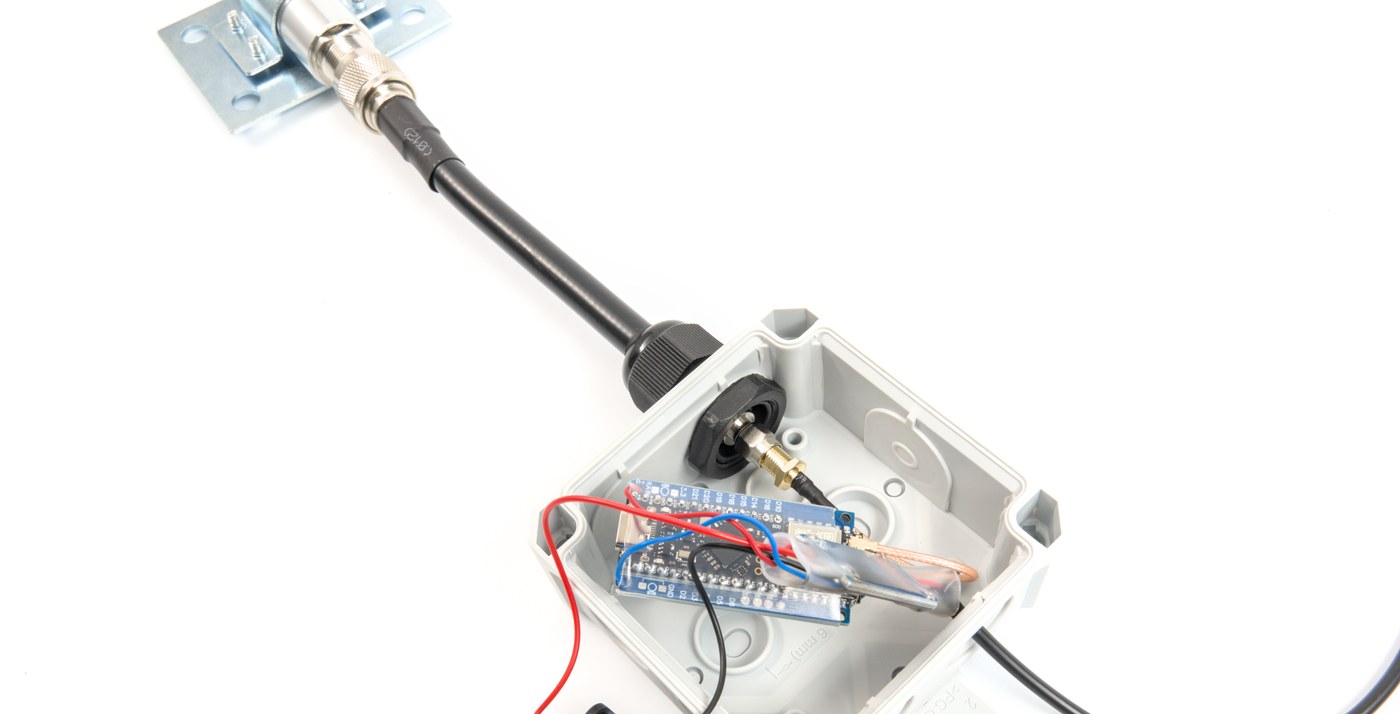
The hole that has to stay open, and the gland that closes it again. Ingress ratings are earned or lost at entries like this one. Photo by -stk, CC BY-SA 4.0.
IP54 is a code from IEC 60529 with exactly two fields. The first digit ranks protection against solid objects, the second against water. Five means dust-protected: dust may enter without reaching a quantity that interferes. Four means splashing water from any direction. Read as written, the code is a narrow promise. Nothing in those two digits addresses salt, sunlight, impact, vibration or temperature. The narrowness is not a flaw in the standard. IEC 60529 was written to answer two questions and it answers them precisely, with defined nozzle rates, defined durations and a defined dust chamber. The test method is where a dust and moisture proof sealing structure earns those two digits. Trouble starts when a buyer reads the code as a general fitness certificate. It’s a measurement of two things, taken on a new sample, in a laboratory, on a machine that wasn’t even switched on. Impact has its own standard, and almost nobody quotes it on a consumer specification sheet. IEC 62262 grades an enclosure from IK00 to IK10 by the energy it survives.
Put numbers on the top of that scale. IK08 means 5 joules, delivered by a 1.7 kilogram mass falling 300 millimetres. IK10 means 20 joules, from 5 kilograms falling 400 millimetres. Four times the energy separates two ratings that sit two steps apart. Impact and ingress are independent of each other, which is why a case can hold an excellent IP code and still crack when a scaffold pole lands on it. That independence leaves vibration and drop resistance in the internal support to a completely separate body of work, inside a case whose IP code says nothing about any of it. North America runs a parallel system. NEMA enclosure types cover that ground in different words. The words reach further. Type 4X is the interesting one. On top of the dust and water performance, it demands corrosion resistance. That test is no formality: published comparisons describe more than 1,200 hours of exposure to moist air carrying carbon dioxide and sulfur dioxide. Types 3 and 3R add an external icing test. Type 3 also requires a gasket aging test, which measures the seal at the age when it actually has to work. None of that appears in an IP code. Stated plainly in one published comparison: NEMA 4X includes corrosion resistance testing that IP66 does not cover. That source also records an IP66 installation that failed inside eighteen months in salt air.
That failure mode is the reason tolerance of a coastal salt spray environment gets measured on its own clock. A machine can pass every water test written and still lose its fasteners to chloride in under two years.
Sealing and cooling pull opposite ways
Every watt a power station wastes turns into heat inside the case, and that heat has to leave. A vented machine lets air do the work. Air enters cool at one end, picks up heat from the transformer and the switching devices, and leaves warm at the other. Convection through moving air is the cheapest cooling anybody has ever built. Seal the case to keep grit and water out and that path closes. Heat now has to conduct through the walls and radiate off the outside surface, which is a far slower business. Industrial practice tells the story: enclosures that must stay sealed against contaminants get fitted with heat exchangers or air conditioners, because passive walls alone cannot shift the load. Internal circulating fans buy some of it back. Moving air against the inside surface lifts the effective transfer coefficient into the region of 10 to 15 watts per square metre per kelvin, without anybody opening a single hole. None of this makes the sealed machine worse. It makes the sealed machine a different design, with a lower continuous rating for the identical silicon inside. A manufacturer choosing IP65 over IP54 accepts a thermal penalty and pays for it somewhere, usually in the continuous watts printed on the box or in the temperature at which the machine starts backing off. Anyone comparing two units on ingress rating alone has compared one number and ignored the one it was traded against. The compromise leaves a signature on any specification sheet. A high ingress figure beside a modest continuous rating usually means the designer chose sealing. Reverse the two and airflow won. Neither choice is wrong. Only one of them suits a machine that spends its life in a dusty yard, and only the other suits one working hard in a hot shed.
The backing off has its own page. Power derating under high temperature is where that trade gets settled in practice, on a staircase the firmware walks down as the internal sensors climb. Ventilation runs on a spectrum. Most portable machines sit somewhere in the middle of it, with filtered intakes and an ingress rating that records where the designer landed. Dust gets treated as a mechanical nuisance. Its first effect is thermal. On a heatsink, a layer of fine dust works as an insulating blanket. A partially blocked intake mesh cuts airflow, which raises internal temperature, which brings the derating staircase forward. The machine’s quieter about it than you’d expect, since nothing has failed and no alarm has any reason to fire.
Working out protection for a dust and high wind environment means accepting that a filter fine enough to stop the grit is also fine enough to choke the airflow. That trade has no clean answer, only a maintenance interval. Take a machine up a mountain and the cooling gets worse before anything else does. Air density falls by roughly 1 percent for every 100 metres of elevation, taking convective cooling capacity down with it. IEEE and IEC equipment standards both treat 1,000 metres as the ceiling for an undated rating. Above that point a rule of thumb of 1 percent per 100 metres applies. Above 2,000 metres a further thermal allowance of one degree per 305 metres gets applied. A unit rated for 2,000 watts at sea level is a smaller machine at 3,000 metres, on a spec sheet that never mentions elevation.
Sunlight, plastic and metal
Ultraviolet light does its damage without any single event to notice. Case plastics take the damage. Inside standard ABS sits a butadiene rubber phase that oxidises under sunlight, and once that phase goes the material loses toughness before it loses its looks. Polycarbonate yellows. Formulate a grade for outdoor service and it carries hindered amine light stabilisers and ultraviolet absorbers, which push accelerated performance out to around 2,000 hours in a QUV chamber. Two thousand QUV hours corresponds roughly to five to seven years of outdoor exposure in a temperate climate. Coated polycarbonate stretches service life from the two to five years an uncoated sheet manages to somewhere between ten and fifteen. One 2023 study put untreated sheet at 12 percent tensile strength lost per year in subtropical conditions.
Park a machine in permanent shade and you buy back most of that clock, which is why long term outdoor storage protection talks about parking as much as it talks about charge level. Left in the sun, a case ages on QUV time whether or not anybody switches it on.
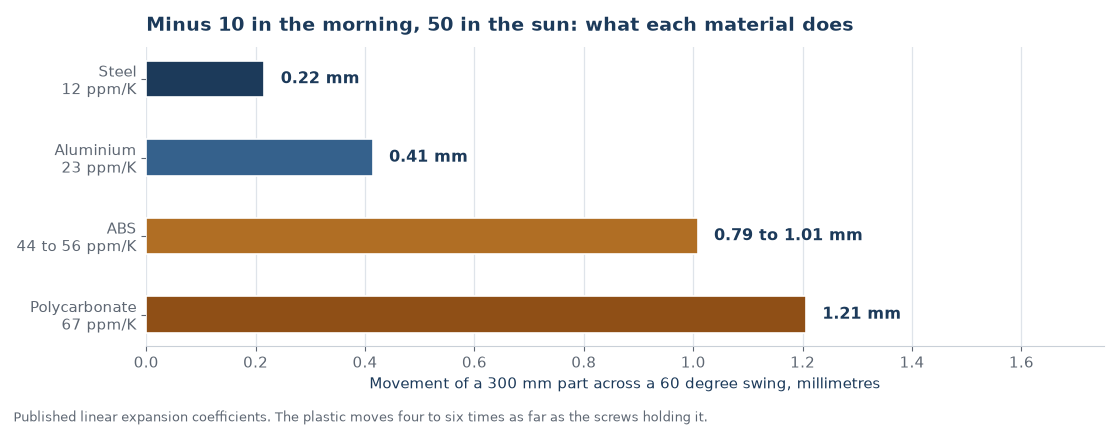
One 300 millimetre panel, one ordinary day from frost to afternoon sun. The polycarbonate travels about a millimetre further than the steel holding it down.
A case is never one material. Polymer panels, metal fasteners, an aluminium heatsink and a rubber seal all meet one afternoon of weather and respond to it at different rates. The coefficients tell you how differently. Steel expands at roughly 12 parts per million per degree. Aluminium runs near 23. ABS lands somewhere between 44 and 56, and polycarbonate reaches about 67, which puts the plastic between four and six times more mobile than the screws holding it. Work an example. A 300 millimetre polycarbonate panel taken from a frosty morning at minus 10 degrees to 50 degrees in afternoon sun crosses a 60 degree swing, which moves it about 1.2 millimetres. Steel screws through that panel move 0.22. Something has to absorb the remaining millimetre, every single day.
Designers handle it with slotted holes, oversized clearances and fasteners that do not clamp the plastic hard. Get it wrong and the failure arrives as a hairline crack at a screw boss, usually after a couple of seasons, on a machine that never took an impact of any kind. The IK scale would rate that case perfectly. Nothing hit it.
A seal is a spring that forgets
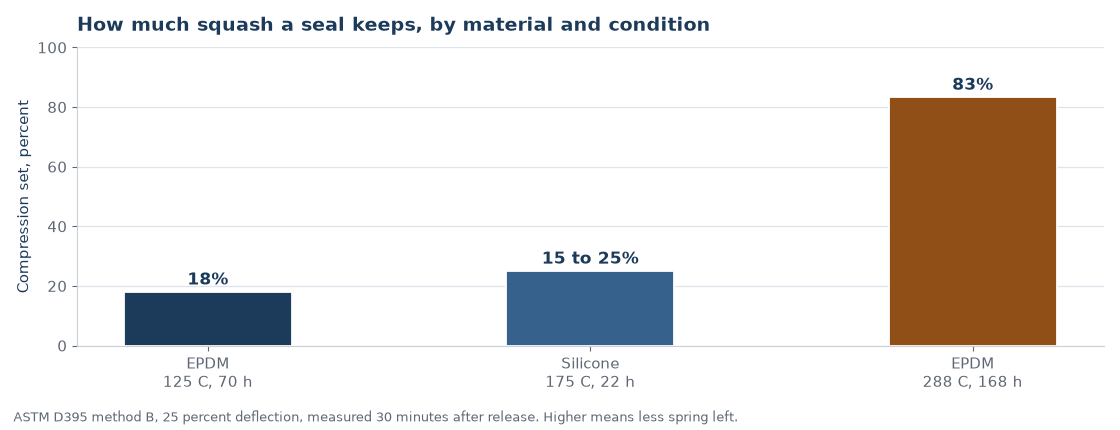
What a seal keeps of its squash after the load comes off. EPDM holds up well at 125 degrees and collapses once conditions get extreme, which is the shape of every gasket aging curve.
Gaskets fail slowly, by a mechanism with its own name and its own number.
Compression set measures how much of the squash an elastomer keeps after the load comes off. A seal works by pushing back against its groove. Lose that push and water arrives, on a machine whose IP code was earned years earlier by a seal that no longer exists in that condition. ASTM D395 puts numbers on it. The common test squashes a sample 25 percent, holds it at somewhere between 70 and 150 degrees for 22 hours, releases it, and measures what fails to come back after 30 minutes. EPDM, the usual choice for outdoor weather sealing, shows around 18 percent compression set after 70 hours at 125 degrees. Push the conditions far enough and the figure runs away: the identical material reaches 83 percent after 168 hours at 288 degrees. Post-cured silicone lands at 15 to 25 percent under a 175 degree, 22 hour test.
Daily thermal cycling is what does this to a power station. Each hot afternoon presses the seal a little further into its groove. Each cold night asks it to spring back. NEMA Type 3 includes a gasket aging test for exactly this reason, run on elastomer that has already been heat-aged. Sealing keeps outside water out. It also traps whatever was in the air on the day the case was closed. Air carries water as vapour, and how much it can hold falls sharply as it cools. Take air at 30 degrees carrying 9 grams of water per cubic metre. Cool that same air to 10 degrees and it reaches saturation. Cool it any further and the surplus has to go somewhere, which means onto the coldest surface available. Inside a sealed machine, that surface is usually a circuit board. Nothing has leaked. The dew point of the trapped air was fixed at the moment the case was closed, and cooling never removes moisture from a sealed volume. All it does is bring surfaces down to meet the water already present.
Because of that, assembly humidity ends up as a design parameter, and manufacturers care what the factory air was doing that day. It also explains the small membrane vents fitted to sealed equipment. Those equalise vapour and pressure without letting liquid water through. Their existence is the reason a genuinely sealed case is rarer than the marketing suggests.
Cold sets limits the case never mentions
Temperature is where this turns counter-intuitive. A machine keeps more than one window open. Their edges sit in different places. Charging stops at zero degrees on iron phosphate cells, because lithium arriving at a cold anode plates onto the surface as metal in place of entering the graphite. Discharging carries on well below that, with reduced capacity and a lower voltage under load. An owner sees a machine that’ll run a lamp happily and won’t accept charge, reads it as a fault, and is looking at correct behaviour. Where those edges actually sit gets settled by the operating temperature range and its derating, the one specification here that changes what a machine will do today. The rest govern how long it lasts. Machines built for cold climates carry heaters. The energy has to come from somewhere. Heating from the pack itself is the honest arrangement and the expensive one, since every watt-hour spent warming cells is a watt-hour unavailable later. Heating from the incoming charger spares the reserve. It only works when a charger happens to be connected. A preheating strategy for a cold start decides which arrangement a machine uses and how long the wait runs before charge current flows. Twenty minutes of warm-up on a cold morning is a normal figure.
The tests behind the numbers
Temperature, vibration and shock all have proper standards. None of them lives inside an IP code. IEC 60068 is the series that covers them, split into lettered tests. Test Ab handles cold. Test Bb covers dry heat on an unpowered sample, over a span running from 30 degrees upward and durations from 2 hours out to 1,000. Test Cab is damp heat held steady, typically 40 degrees at 93 percent relative humidity, run for anything from 4 days to 56. Mechanical hazards get their own letters. Test Fc sweeps vibration from 10 hertz to 500, sometimes to 2,000, at accelerations between 0.5 and 20 g, which is where resonances in a badly braced pack show themselves. Test Ea delivers shock as a half-sine pulse between 15 and 100 g, lasting anywhere from half a millisecond to thirty.
A manufacturer who has run these can name them. Ask which parts of IEC 60068 a machine has been through and the answer separates the companies that tested from the companies that specified. Nothing obliges a portable power station to carry any of it, which is exactly why asking is worth the trouble. Every figure quoted so far came out of a chamber. Chambers simplify. An IP test uses clean water at a defined rate on a machine that is not running. Salt spray chambers use a continuous fog at a fixed concentration, which no coastline ever produces. Dust chambers use talc of a controlled particle size. QUV cabinets run one wavelength band at one intensity with a fixed wet cycle.
Real environments combine what the chambers separate. Grit arrives with wind that drives it into seals that ultraviolet light has already made brittle, on a machine that is running warm, in air that carries salt. A specification sheet lists these hazards on separate lines because that is how they were tested, never because that is how they arrive.
Two protections that undo each other
Almost every defence listed so far costs something on another front. A tighter seal closes the airflow path, which lowers the continuous rating. A filter fine enough to stop grit is fine enough to choke the intake. A heater that lets a pack charge in winter draws its energy from the pack it is warming. Shade protects the case from ultraviolet and takes the solar panel out of the sun along with it. Rubber mounts that absorb vibration let the pack move further during a drop. None of these has a clean answer. Every one of them is a position on a slider, chosen by an engineer who knew which hazard the machine would meet most often. The IP digits describe what water does to the machine. They say nothing about what water does to the operator. Most portable machines leave the factory with a floating neutral, where neither output conductor is referenced to earth. Wet ground under a person holding one conductor does not complete a circuit, since the other conductor connects to nothing that person is touching. The arrangement is deliberate. Read safe operation in rain and snow for where the hazard actually sits once extension leads and metal tools enter the picture. The case rating was never the safety boundary.
Eleven rows, two digits
Eleven hazards, five standards bodies, one code on the box.
What covers which hazard on an outdoor power station
Hazard
Standard that covers it
The figure behind it
Solid ingress
IEC 60529, first digit
5 = dust-protected
Water ingress
IEC 60529, second digit
4 = splashing from any direction
Impact
IEC 62262
IK08 = 5 J, IK10 = 20 J
Corrosion
NEMA 4X
1,200 h in moist CO2 and SO2
External icing
NEMA 3, 3R, 4
icing test, pass or fail
Seal ageing
NEMA Type 3
gasket aging test
Ultraviolet
ISO 4892, never an enclosure code
2,000 h QUV = 5 to 7 years
Vibration
IEC 60068-2-6, test Fc
10 to 500 Hz, 0.5 to 20 g
Shock and drop
IEC 60068-2-27, test Ea
half-sine 15 to 100 g
Damp heat
IEC 60068-2-78, test Cab
40 C at 93 percent RH, 4 to 56 days
Operating temperature
Manufacturer’s own window
no enclosure code touches it
Every row has a standard behind it. Nine of the eleven sit outside the code printed on the box, which is the point: IP54 answers two lines of an eleven-line question. One rating cannot be read without the environment it will meet. Near salt water, corrosion outranks everything. An IP figure on its own won’t tell you what you need. On a dusty site, the intake design and the cleaning interval matter more than the second digit. In a hot climate, the ventilation compromise decides the continuous rating, which is the number you will actually feel. Somewhere cold, the charging cutoff decides whether the machine works at all in the morning. Ask a manufacturer which of those rows it tested, and for what. The honest ones answer with test names and hours. The rest quote an IP code and change the subject, which is an answer too.
Common questions
Does a higher IP number always mean a better machine outdoors?
Not on its own. A tighter seal closes the airflow path, which lowers what the machine can deliver continuously before it starts derating. IP65 over IP54 buys ingress protection and costs cooling. Which one matters depends on whether your problem is water or heat.
What does the 4 in IP54 actually let through?
Splashing water from any direction, tested with clean water at a defined rate on a machine that is not running. It says nothing about jets, immersion, or what happens when that water arrives carrying salt, or lands on a machine under load.
Why is there no IK number on my power station?
Because consumer specification sheets rarely carry one. IEC 62262 exists and grades impact from IK00 to IK10, where IK10 means surviving 20 joules from a 5 kilogram mass dropped 400 millimetres. Ask for the figure if the machine will live on a building site.
How long before sunlight matters?
Outdoor-grade plastics carry stabilisers rated around 2,000 hours of accelerated QUV exposure, which maps to roughly five to seven years of temperate outdoor life. Untreated material goes faster, at something like 12 percent of tensile strength a year in subtropical conditions. Shade costs nothing and beats both.
Does elevation really change the rating?
It changes the cooling. For every 100 metres of height, air thins by about 1 percent. Both IEEE and IEC treat 1,000 metres as the point beyond which derating applies, at roughly 1 percent per 100 metres. A machine working hard at 3,000 metres has perhaps a fifth less thermal headroom than the box implies.