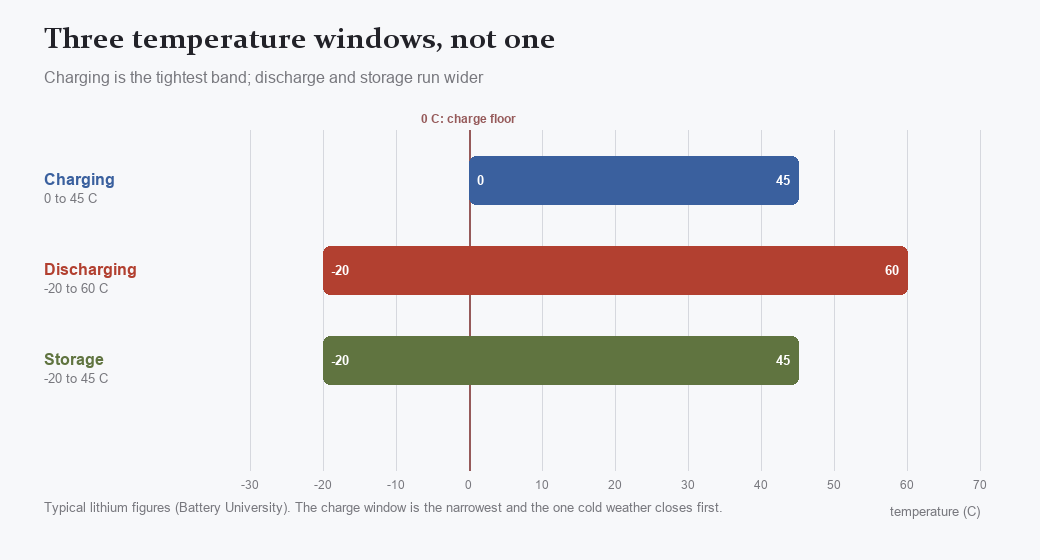
Three windows on one temperature axis. Charging spans the narrowest band, 0 to 45 degrees; discharge and storage run wider. The line at 0 is the charge floor cold weather closes first. Typical lithium figures from Battery University.
A power station carries more than one temperature range, and the difference between them catches out almost every first-time owner. The charging range runs far tighter than the discharging range on every lithium machine sold. A datasheet that prints a single friendly figure is quoting the generous window.
The two windows come straight from the chemistry. By Battery University’s figures a common lithium cell charges only between 0 and 45 degrees. Its discharge band runs far wider, from minus 20 all the way to plus 60. A unit sitting in a minus-10 tent runs a lamp through the night and then refuses the solar panel at first light. Nothing about that machine is broken.
Cold-weather planning turns on the charge number. A camper who reads only the minus-20 discharge figure packs a machine that dies each morning with a full solar array pointed at a pack that will not take a watt. On a real sheet the block reads something like 0 to 40 for charging, minus 20 to 40 for discharging, minus 20 to 45 for storage.
What sets the printed number
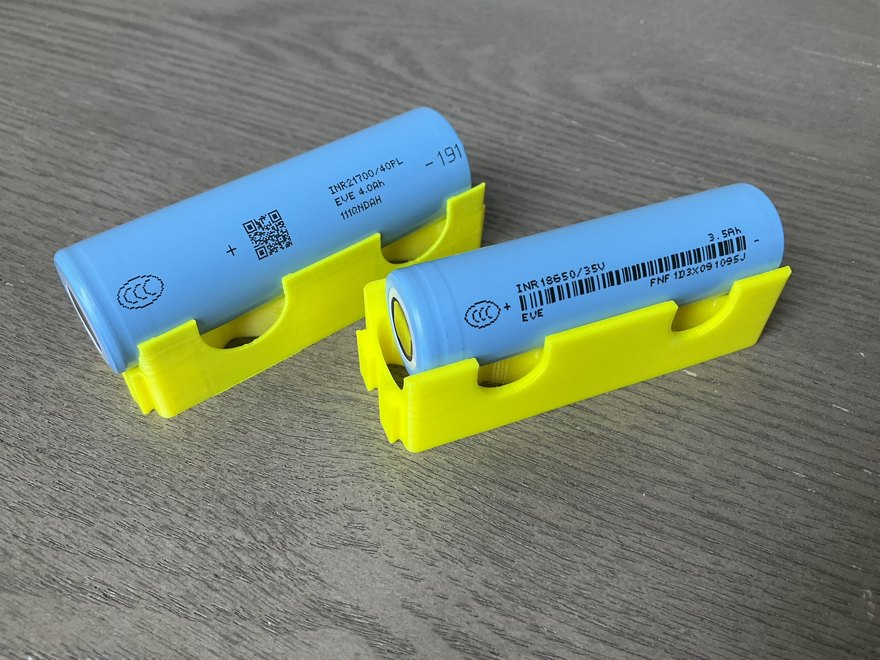
The cells that keep the two thermometers. A 21700 and an 18650 cylindrical cell, marked INR21700/40FL 4.0Ah and INR18650/35V 3.5Ah. The graphite anode inside sets the freezing charge limit that every lithium chemistry shares. Photo: Sevenethics, CC0.
Cells draw the sharpest limits among a boxful of parts that each carry a range of their own. A liquid-crystal display slows and then blanks as it nears minus 20, the electrolytic capacitors in the inverter shed capacitance in deep cold, the case plastics turning brittle enough to split under a knock that summer would shrug off. Whichever part surrenders first prints the rating. On the typical machine the battery’s charge window sets the cold-end number, the screen a close runner-up. Seals and adhesives cast their own votes at the hot end, softening and creeping where the cells still hold. Component grade decides the margins, industrial-temperature parts holding curves that consumer-grade silicon abandons, one of the quiet differences between a machine priced for work sites and its look-alike. Ratings also assume sea-level air; thin mountain air carries heat away less ably, one more quiet subtraction at altitude.
A datasheet rarely offers one temperature figure. It offers three or four, a charging range, a discharging range, a storage range, sometimes a humidity line alongside. Two machines wearing one badge wattage can print different windows, the packs inside them built around different targets. The windows also move with the machine’s own cooling, a unit with a stronger fan holding its full output deeper into a hot afternoon than a sealed sibling.
The temperature windows a lithium station keeps (typical figures)
Window
Typical range
What sets it
What happens past it
Charging
0 to 45 C
lithium plating below 0; cell aging above 45
charge circuit blocked cold, capped hot
Discharging
−20 to 60 C
electrolyte and resistance cold; cell stability hot
runtime falls cold; output cut hot
Storage
−20 to 45 C
no current flows to strain a cell
fastest aging when full and hot
Best storage
15 to 25 C, ~50% charge
aging chemistry idles slowest
capacity kept longest
The cold that forbids charging
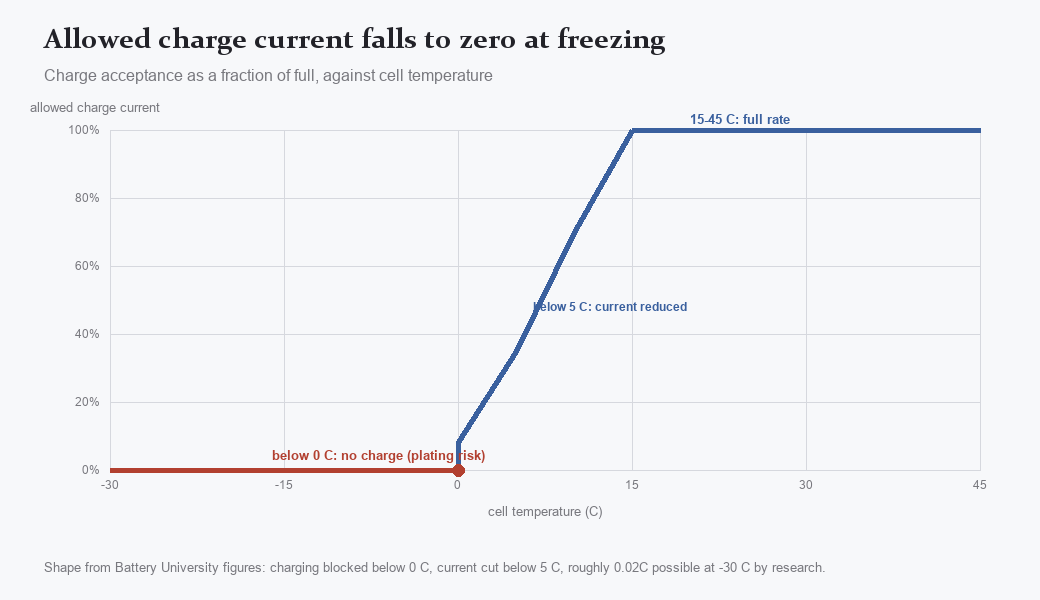
Charge acceptance against cell temperature. Below freezing the allowed current is zero; it climbs through the single-digit cold and reaches full rate around 15 degrees. Shape from Battery University figures; the exact curve varies by pack.
Forcing current into a lithium cell below freezing does something a warm cell never does. Charging works by sliding lithium ions into the graphite layers of the anode, a process the cold slows to a crawl. When the current arrives faster than the chilled anode can absorb, the surplus lithium has nowhere to go and deposits on the surface as metal. Plating, the industry calls it. Graphite holds lithium by intercalation, ions sliding flat between its atomic sheets into berths that leave the metal’s structure alone. Cold slows the acceptance far more than it slows the current a charger pushes. Each deposit of plated metal seeds the next, a fault that compounds every time a frozen pack meets a charger.
That deposited lithium does not slide back into the chemistry on the next discharge. Every sub-freezing charge shaves a permanent sliver off the pack’s capacity. Plated lithium grows in fine needle-like spikes called dendrites. One that reaches across to the opposite electrode punches a hole in the separator and shorts the cell from the inside. A pack charged cold enough times becomes a fire risk. A dendrite short grows inside the cell, past every sensor and every port fuse, the reason the freezing block is drawn so strictly. The freezing rule binds every lithium chemistry alike, plating on a sub-zero charge being a property of the graphite anode they share. A cell opened after repeated cold charging shows the plating as a dull grey film across the anode face, the diagnostic photograph in every study of the failure.
Because the harm hides inside the cell and adds up over time, the rule is a hard block written into the firmware. A station’s battery management system reads a temperature sensor pressed against the cells and opens the charge circuit the instant that reading drops below zero. Placement of that sensor decides how well the block tracks the cells, since a probe on the casing lags the core by degrees. A sensor buried among the cells reads the temperature that matters, which is part of why the freezing block on a well-built pack errs a degree or two toward caution. Sun can pour onto the solar panel at a frozen dawn and the pack will accept nothing, the input line holding at zero watts until the cells climb above freezing on their own. A ski trip lives or dies on this line, a machine that discharges to minus 20 still refusing the panel at minus 5. The refusal shows on the display as an input icon with no watts behind it, the moment that sends a first-time winter user hunting for a broken panel.
The block does not switch on sharply at the freezing mark. Charge acceptance falls off well above it, since the anode grows reluctant as it cools even in the safe band. Reference figures already trim the allowable charge current once the cell drops to 5 degrees. By minus 30 the safe rate drops to 0.02C, a trickle that would need fifty hours to fill an empty pack. A machine advertised as charging in the cold is charging at that trickle. Silicon and other anodes shift the numbers and remain rare in portable packs for now. A handful of premium units carry a heater that lifts the cells into the normal window first, turning those fifty hours back into three or four. The rest hold the charge circuit shut and wait for the pack to climb above zero on the sun’s warmth or the day’s. A pack riding a heated cabin on the drive out reaches its window before the campsite does, the cheapest preheat available. Twenty minutes of sun on a dark case can add the last degree or two the sensor needs, the panel warming the machine before the machine accepts the panel.
The cold that only slows discharging
Pulling energy out of a cold cell breaks no chemical rule, which is why the discharge floor sits twenty degrees below the charge floor. What the cold takes on the way out, it later gives back in full. The electrolyte grows thicker as the temperature falls, the lithium ions drift through it more slowly, the cell’s internal resistance rising with the chill. A load that saw 3.2 volts at room temperature meets a sagging 3.0 under an identical draw at minus 15, the runtime shrinking as a fifth or more of the pack seems to disappear. The sag deepens with the draw, showing soonest under the heaviest loads. A cold cell under heavy load can dip below the low-voltage cutout early, the gauge calling an early empty well ahead of the true state of charge, the reading recovering the moment the load eases and the voltage rebounds. A short rest between heavy pulls buys back visible capacity in hard cold, the pack settling to a truer state of charge each time the current drops.
None of that vanished capacity is gone for real. Bring the pack back to room temperature and the electrolyte thins, the resistance falls, and the full rated amp-hours read on the gauge once more. A cell near full strength at 25 degrees holds roughly nine-tenths of it at freezing. By minus 20 the figure sits closer to seven-tenths, every point of it returning as the pack warms. The retention curve runs steeper for high-drain loads than gentle ones, heavy current dragging the sagging voltage to the cutout sooner. Gauges that estimate by voltage mislead furthest in the cold, percentage figures leaping upward as the pack warms.
A fridge that ran twelve hours in summer might manage eight on a hard winter night, the pack reading empty earlier than its watt-hours promise. Warmed indoors the next day, that unit returns to its full figure with nothing lost. A pack kept in the sleeping area overnight starts the day warmer than one left in the awning and hands back an hour of the lost runtime.
The machine makes its own weather
The pack lives at its own internal temperature under load, apart from the air around it. Current driven through the cells’ internal resistance turns part of itself into heat. Working hard, a pack warms several degrees above the air surrounding it. Discharging in a cold garage, a unit lifts its own cell temperature as it runs, the reason a machine that felt sluggish at first light limbers up under a steady load an hour later. On a 40-degree afternoon a heavy load stacks its own warmth onto a pack already near the ceiling. The internal temperature that triggers the derating climbs above the reading on any wall thermometer. Enclosure makes the stacking worse, since a sealed case with poor airflow traps the heat the pack generates. Shut inside a cabinet, a given machine derates sooner than one standing in open shade at the identical air temperature. A pack rated to 45 degrees can reach its internal cutout on a 38-degree day under a punishing load in a closed box. Airflow around the case buys real margin at the hot end, a hand’s width of clearance and a shaded spot doing more for sustained output than the printed number suggests. Indoors after a frozen night, the lag works against the charger. Brought inside, a cold machine needs time for its core to reach the charge window through to the center, a large pack lagging the room by half an hour or more, the surface deceiving a hand into judging it thawed hours ahead of the center the charge sensor watches. A machine stored overnight in the vehicle starts the morning at the night’s lowest temperature and holds it well into the day unless brought somewhere warmer. Standing a frozen unit in a warm room for an hour before expecting a charge is the habit that avoids a puzzling refusal at the socket.
The hot end both windows share
Heat closes both windows from one side, each at its own mark. Charging gives up first, its acceptance commonly capped at 45 degrees and refused outright above 50. Discharging pushes on to 60 on the reference chart, since a warm cell handing out current sits under less strain than a warm cell being forced to swallow it. The electronics carry a hot limit of their own, the inverter’s transistors and capacitors rated to a ceiling near 60 to 70 degrees, high enough that the cells reach their limit first on the common machine. At the band’s edge good firmware gives ground before it quits, trimming the ceiling in stages as the internal temperature climbs, a unit that carries 2000 watts in spring holding perhaps 1500 in a heatwave, the surplus heat never made because the surplus power never flows. A lull that lets the pack cool hands the headroom back.
On many units the fan climbs ahead of the trim, an audible warning arriving before the numbers move. Warmth speeds the side reactions that age a cell, thickening the film on the electrodes that steals capacity across months and years. The rate roughly doubles for every ten degrees above room temperature. A pack worked and stored at 40 wears out several times faster than one kept near 25. The film in question is the solid-electrolyte interphase, a passivating skin on the anode that grows a little with every cycle and faster in heat. A station run hard through a 45-degree afternoon takes no sudden harm. It spends that afternoon burning through its calendar life at a multiple of the normal rate.
Push past the discharge ceiling and the slow tax turns into an acute risk. Above about 60 degrees a cell begins to lose the internal stability that keeps its layers inert. The reactions that release heat start to feed on the heat they release. That runaway is the failure mode behind every lithium fire. The BMS trims output as the cells warm and then cuts it entirely well before the danger band. Lithium-iron-phosphate holds its composure far higher than the nickel chemistries, its thermal runaway onset up near 270 degrees, far above the 150 to 200 of a typical NMC cell, part of why the heavier phosphate packs dominate stations sold for hot climates. Tripped hot, a guard will not restore until the pack cools several degrees below the cutout, the hysteresis that stops a machine flickering on and off at the exact threshold.
Baking in a sealed car boot through a summer, a machine sits under a slower version of the hot-end threat. Frozen in a winter shed, the same machine merely waits for warmth. A desert job turns on this end, output falling well before the cutout arrives. Shade drops the effective ambient by ten degrees or more against a body left in sun, the cheapest derating relief a site offers. A closed car cabin in summer sun runs 20 to 30 degrees above the street, the harshest ordinary environment a machine meets and the strongest argument against parking a working pack in one.
Derating shows on the panel as a smaller number, one mistaken too easily for an error.
Storage, the widest window with a catch
Doing nothing, a machine tolerates a broader range than one at work, since no current flows to plate an anode or to drive a cell toward runaway. Storage limits commonly run from minus 20 to 45 degrees. A pack left in a freezing shed across a winter takes no harm from the cold on its own, provided nothing attempts to charge it while it sits below zero. Disconnect switches or storage modes on many units cut the standby drain to near zero for a long parking, the setting to find in the manual before a season away. A note taped to the case with the parked date and charge level saves the spring guesswork about what the winter cost.
The catch lives in the charge level and the calendar. Held near half charge in a cool spot, somewhere around 15 to 25 degrees, a lithium pack keeps longest, the aging chemistry idling at its slowest. Storage aging answers to two dials at once, the temperature and the charge level, both turned down together for the longest life. Parked full in the heat of a loft, a pack loses capacity quickest of every combination. A pack sitting full is under more chemical stress than one at half. Heat multiplies that stress well beyond a simple sum. A unit headed into a hot summer of storage wants its charge drawn down toward half and a cooler corner found. Deep cold storage asks nothing beyond a warmup before the next charge. A quarterly top-up covers the pack’s self-discharge in storage, a few percent a month that would otherwise drift the state of charge toward empty. Half charge also leaves headroom in both directions, room to absorb a trickle of solar in a bright shed, room to feed a sudden need without a top-up first.
A unit riding a car through the seasons answers to the storage range against both extremes the cabin reaches.
Common questions
Why does cold stop the charging and leave the running alone?
The two have different limits. Discharging asks nothing chemically harmful of a cold cell. It continues down to around minus 20 degrees. Charging a sub-freezing cell plates metallic lithium on the anode, causing permanent damage. The battery management system blocks it below zero. By design, a pack at minus 10 keeps a lamp burning and holds the solar input shut.
Is it safe to charge a lithium power station below freezing?
No, and the machine gives no choice in the matter. Charging below 0 degrees plates lithium metal inside the cell, stripping capacity for good and raising the risk of an internal short over time. Stations hold the charge circuit shut until the pack warms above zero. A few models add a heater to warm the cells first; the rest just wait for a thaw.
How much runtime do I lose in the cold?
A fifth or more of usable capacity can seem to vanish in hard cold as internal resistance rises and voltage sags under load, a temporary loss. Warming the pack back to room temperature returns the full capacity, nothing having been damaged, only slowed for the duration of the chill.
What does the machine do on a scorching day?
It derates. The inverter trims its maximum output to hold the cells inside their safe band, a unit rated 2000 watts delivering less at the peak of a heatwave. The reduced figure is protection wearing the look of a fault. Sustained heat also ages the cells faster, roughly doubling the aging rate for every ten degrees above room temperature.
What temperature suits a power station in storage?
Cool and near half charge. Around 15 to 25 degrees at 50 percent charge idles the aging chemistry at its slowest. A full pack kept hot loses capacity fastest of all. Deep cold does no harm on its own, as long as nothing attempts to charge the pack while it sits below freezing.