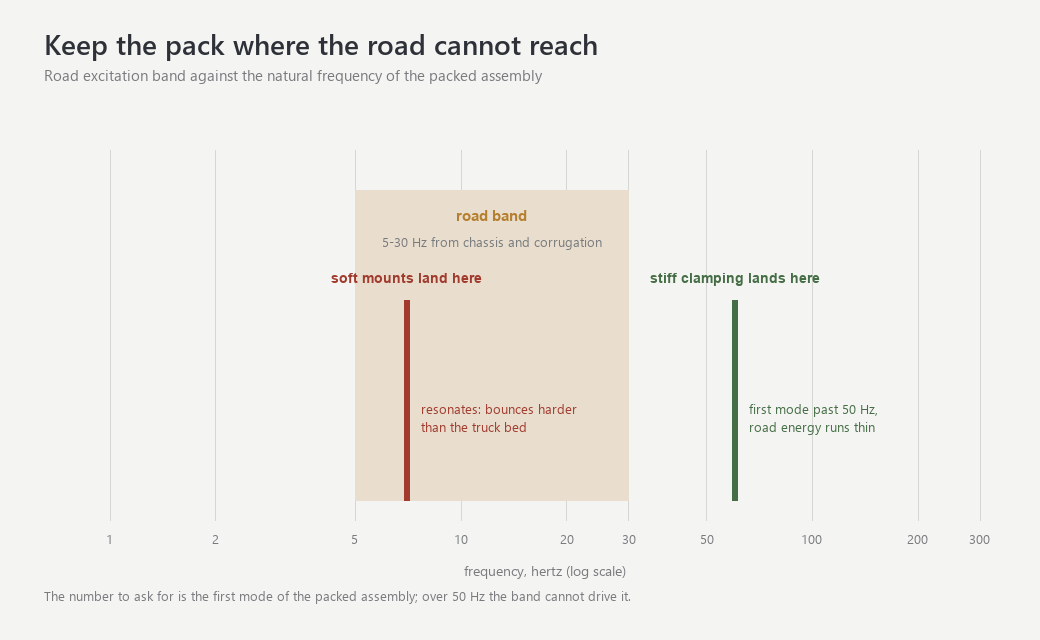
The design target on one axis. Stiff clamping parks the packed assembly’s first mode past 50 hertz, above the 5-to-30-hertz band a chassis feeds; the red line marks where soft mounts land it.
The internal support in a power station is the set of clamps, cradles, pads and anchors that holds the cell block and the electronics rigid through road shaking and keeps them in one piece through a fall. Ten and more kilograms of cells ride inside the case. The W-series class of machine lives on truck beds, boat decks and site floors; the L-series stacks travel in vans between jobs. A leaf-sprung flatbed hands its load 2 to 8 hertz of body bounce, washboard gravel adds 10 to 30, an idling engine hums past 100; at highway pace, corrugations arrive thirty a second. Boat decks add the slam of chop, single hits reading closer to small drops. A W-class case carries 25 to 40 kilograms all told; at 2 g of washboard the support hardware is holding an 80-kilogram push, twice a passenger, thousands of times a day.
Mechanical damage arrives on two clocks. Vibration works slowly, millions of small flexes at a few g apiece. A drop works once, hundreds of g for a few milliseconds. The two clocks also meet in one place, the crack a drop starts and vibration then grows. Site generators met the shaking half a century ago with rubber feet and lock-down kits; battery packs run the approach with rules tightened to match, live conductors riding where a generator carried castings.
Each clock leaves its own wreckage. Shaking cracks solder joints and cell tab welds first, hairline fractures that lift internal resistance long before anything rattles; busbar bolts back off a fraction of a turn and start to heat, oxide growing in the gap; connector pins walk out of their housings a millimetre a month; screws that left the factory tight arrive at the next inspection loose, thread by thread. The BMS sees that side before any ear does, cell-group resistances spreading apart in the monthly log. A drop leaves cracked case corners, bent cell stacks, a BMS board torn at its mounting holes, a display shifted off its bezel and leaking light at one edge; stacked modules add connectors half-seated after a shift in transit. Fatigue leaves polished, ring-marked fracture faces a loupe picks out.
Joints carry the fatigue
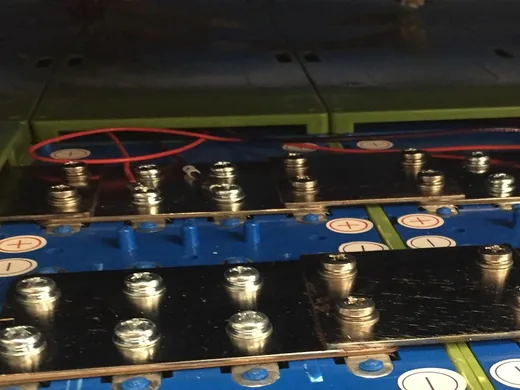
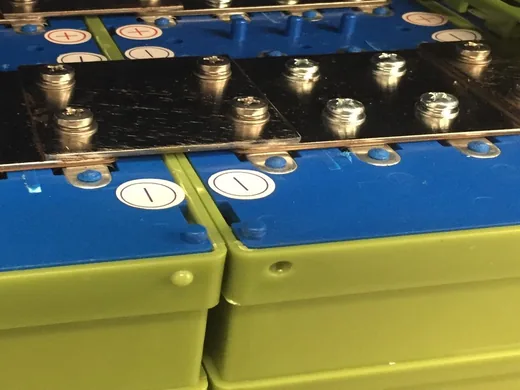
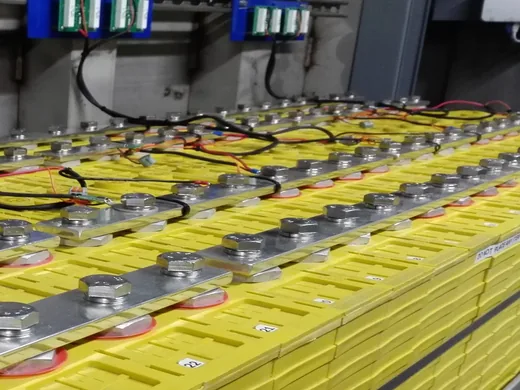
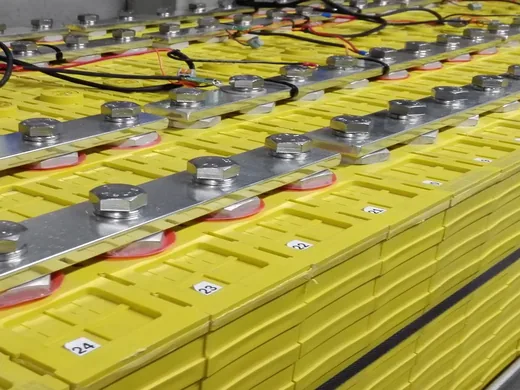
Metal that bends a little and often eventually cracks, the cracking stress sitting far below the one-pull breaking load. The smallest metal in the machine bends first. A cell tab is a strip of nickel or aluminium a tenth to a fifth of a millimetre thick; the weld that ties it to the busbar is smaller still, an ultrasonic spot the size of this o, strong in shear, weak in peel, the loading the clamp geometry rules out. Aluminium spends fatigue budget on any flex, no matter how small the stress; the design goal is zero relative motion. Left free to flex with each bump, a tab collects cycles at the road’s own rate; thirty hertz of corrugation is a hundred thousand flexes an hour, the million-cycle mark falling inside a working week. UN 38.3, the lithium transport standard, shakes every certified battery across exactly that territory, a logarithmic sweep from 7 to 200 hertz and back in 15 minutes, twelve passes per axis on three axes, nine hours in all, displacement held at 0.8 millimetres between 18 hertz and the g-cap. Packs over 12 kilograms cap at 2 g on the sweep; the cap for lighter packs sits four times higher, a heavier mass already carrying more punch at the same g. Pass criteria run to no leakage, no venting, no fire and no voltage loss, and samples tear down afterwards for weld inspection against the drawings. The crack that follows shows up as a cell group reading a few milliohms above its neighbours, the rise doubling under load current as the crack opens with heat.
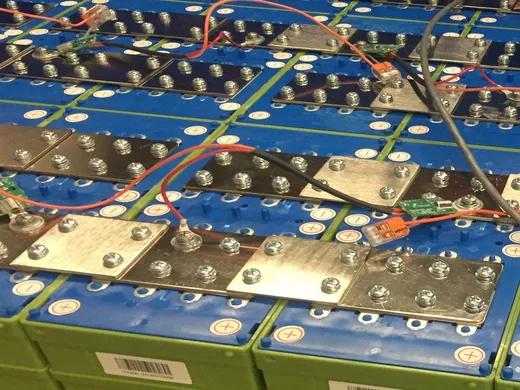
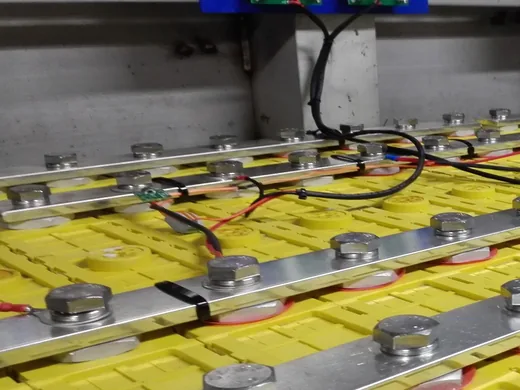
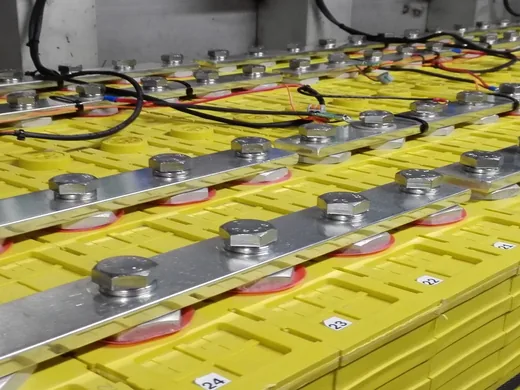
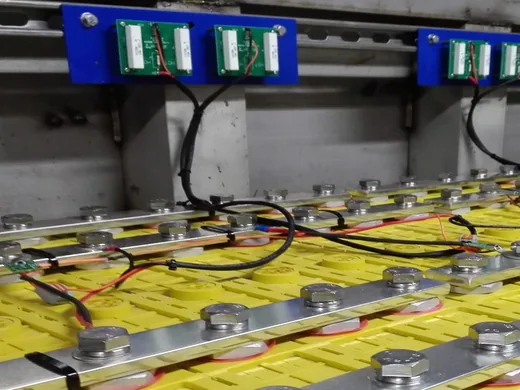
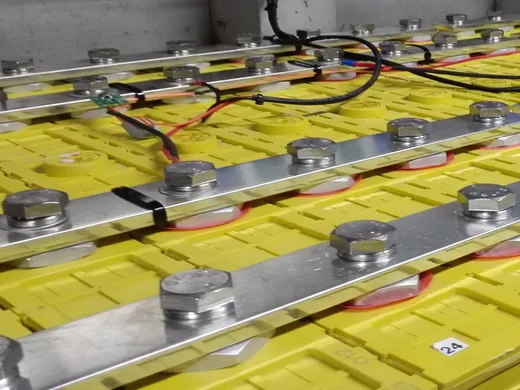
Cell groups clamped to move as one body, cells and busbars together, put their welds on holiday; the flexing happens where the designer parks it, in a deliberate S-bend of the busbar that works as a strain loop, a wide flat conductor bent to absorb the small motion that clamping can’t erase. Laminated flexible links, thin copper leaves stacked loose, bend a hundred times more willingly than the solid bar they replace; the stiff runs stay bolted and hand every millimetre of the dance to the leaves. Heavy cables between the pack and the inverter follow the rule, a finger of slack tied down at both ends, the bend soaking up movement that would otherwise work the lugs. Copper work-hardens as it flexes, stiffening on the way to cracking; a lug quiet for two years can open in a month once the hardening turns over.
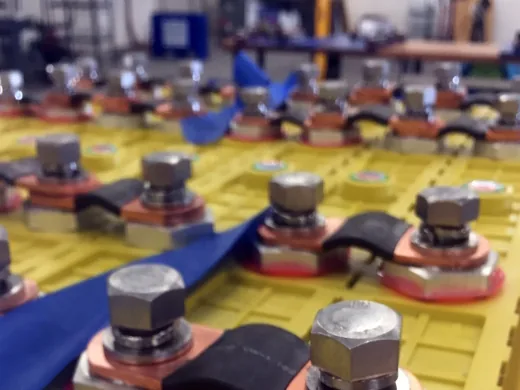
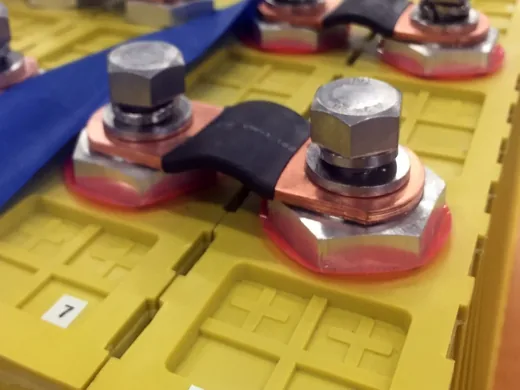
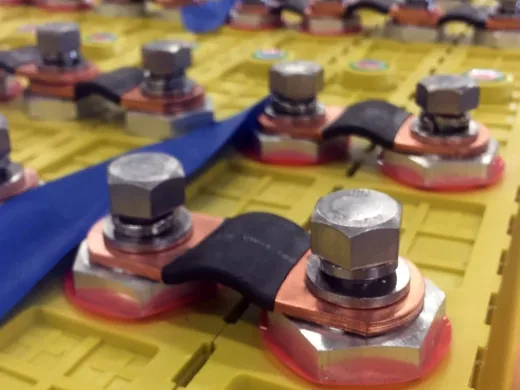
Bolted joints fight vibration with preload and memory. A bolt stretched to its proper torque behaves as a spring holding the joint shut; thread-locking compound and serrated washers keep the stretch from unwinding one micro-slip at a time, wedge-lock pairs taking over on the premium current paths. An M6 busbar bolt runs to a spec near 8 to 10 newton-metres, wrench-clicked on the line; fuse blocks and busbars share the stripe habit on the DC side, any joint over 20 amps repaying the paint. Production lines paint witness marks across bolt heads on the big current paths; the paint costs pennies a joint. A sheared stripe reads at arm’s length. Re-torque intervals on site equipment run yearly. A quarter turn of recovered torque at that check is normal settling; finger-loose is the finding that stops the day.
The soft-mount mistake
A chainsaw’s rubber buffer, soft isolation in its right home, a hand shielded from an engine’s buzz at the weight class where softness works. Photo: Emrys2, CC SA 1.0.
Support that works clamps the mass stiffly enough to push the assembly’s natural frequency well above the 5-to-30-hertz band a chassis delivers, out where road energy runs thin. Any spring-and-mass pair keeps a natural frequency. A floppy rubber mount under everything lands it at a handful of hertz, square inside the band the vehicle feeds; driven at its own frequency, the pack bounces harder than the truck bed underneath, the mount working as an amplifier at that frequency. The rubber that remains in such a build is thin, firm and there to spread contact stress, a gasket for force; durometer numbers tell the two rubbers apart in any catalogue; load-spreading pads read 60 Shore A and up, twice the hardness of the isolation grades. Isolation by softness belongs to instruments weighing grams, shipping crates using the trick correctly with centimetres of foam under almost nothing. A 30-kilogram pack would need a mattress-deep cushion for that kind of isolation; the cushion would let it walk the load bay. The first mode lands past 50 hertz by design, twice the top of the road band. Aftermarket gel pads sold for tool boxes sit squarely in the trap, sized around the grams of a drill; under the kilograms of a battery they tune the pack straight into the road band. The number to ask a maker for is the first mode of the packed assembly. Shaker time prices the design loop besides, a full certification sweep costing a working day per axis on a rented table; first modes get found with the bench mallet first.
How the pack is held
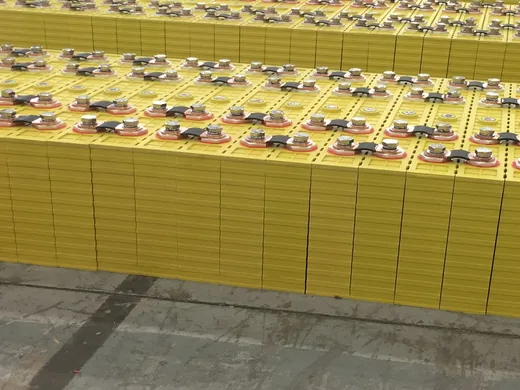
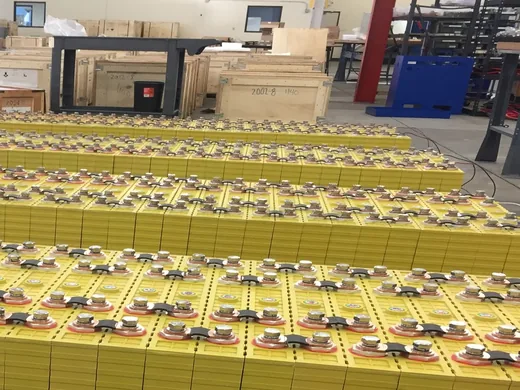
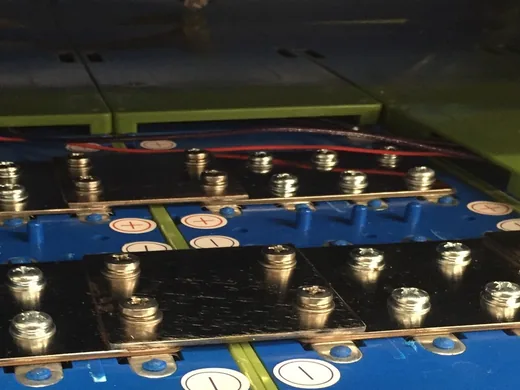
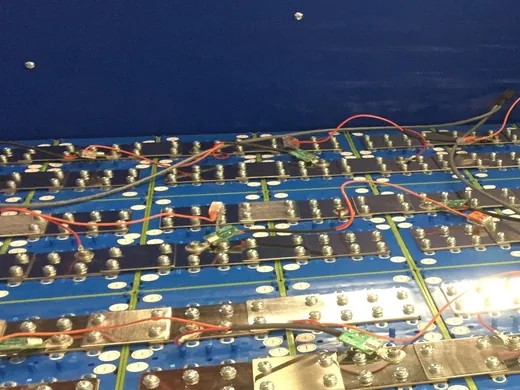
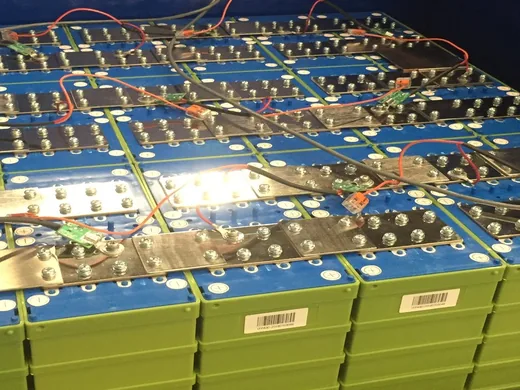
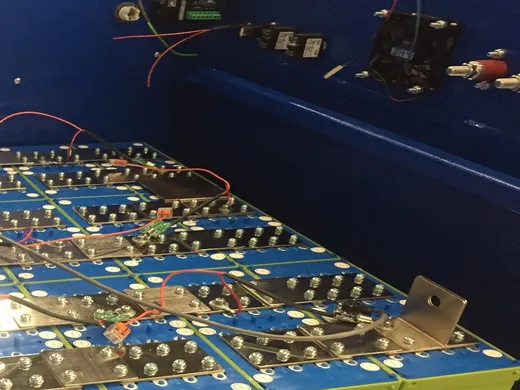
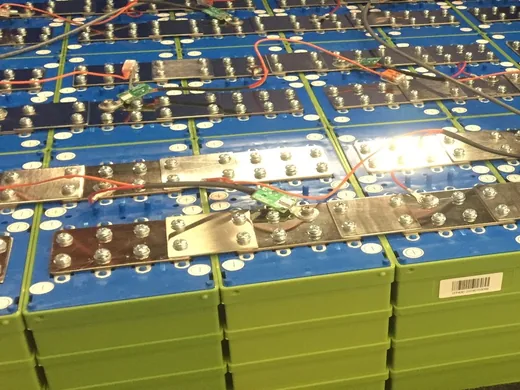
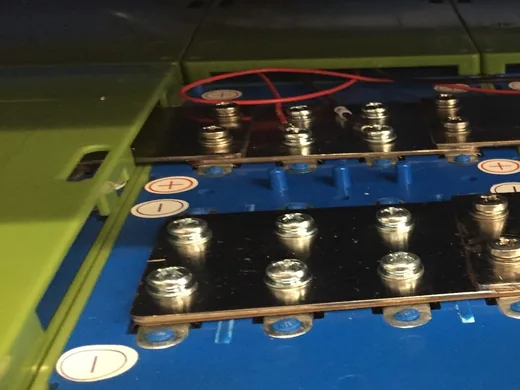
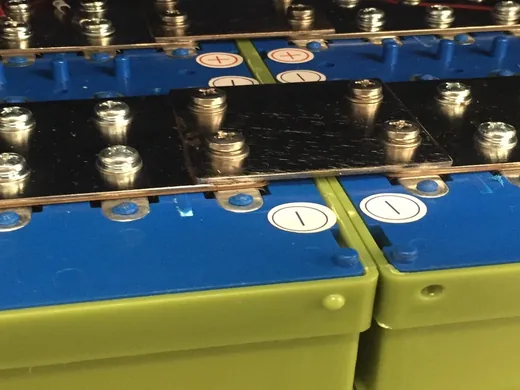
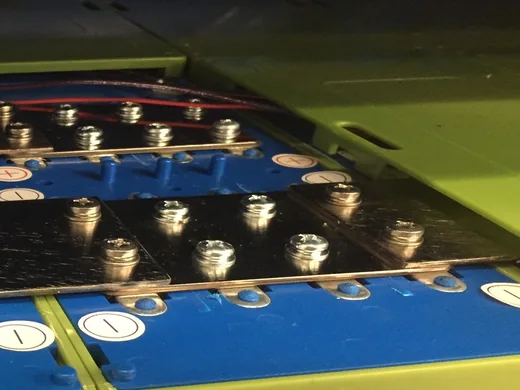
Prismatic cells stack between rigid end plates, steel a few millimetres thick or glass-filled nylon moulded to the cell face, pulled together by straps or through-rods into a single pre-compressed brick; the preload is set to outlast cell swelling, holding faces flat against each other across years of cycling, clamp force running to tonnes across the stack on the big prismatics. Between plate and cell face sits a millimetre of micro-cellular foam sheet, evening the clamp across the whole face; hard spots on a cell wall are their own slow damage. Straps come as steel bands or woven composite, tensioned and crimped; through-rod builds drill the plates and let four bolts carry the tonnes, torqued in a cross pattern, evenness ruling here as at the parting line. Compression stops individual cells from breathing apart under shock and turns forty loose parts into one stiff body with one predictable natural frequency. That brick sits in a cradle moulded into the case floor, ribs and pockets keyed into the block against sliding, firm elastomer pads at the contact faces spreading load into the plastic. Cradle pockets grip the block low, under its centre of gravity; a block held only at the top would lever its mounts on each sway. Pads stay firm and thin, spreading stress at zero added bounce. End plates carry threaded bosses for the hold-down bolts, the load path running steel to steel from case floor to plate without pinching a cell anywhere; the bolts sit loaded in shear, the direction they hold best. On a shaker table the sum reads as one number, the frequency where the assembly first sings. Design reviews chase that number upward until it clears the road band with margin. A rubber mallet with an accelerometer repeats the measurement in a minute on any bench.
Around the block, clearances are deliberate. A finger of space to walls that flex on impact stays empty or padded, filled only where a pad can compress; anything stiffer than a pad stays clear of the span. Walls flex millimetres by design, crumple stroke banked for the corner day, the block staying clear of them mid-flight. The finger of space doubles as the access a service driver needs.
Cylindrical-cell packs swap the end plates for a welded holder grid, hundreds of 18650 or 21700 cells each located top and bottom, the grid doing what brick compression does elsewhere. Grid cells double as bond surfaces on glued packs, adhesive laid in beads with gaps left for heat to move, the cured array reading as one plate. Grid nylon carries glass fill for stiffness; the bare polymer creeps under cell weight through a summer.
On the heavy stackable systems each module carries its own captive frame. Stack interlocks add alignment pins that take the shear a cornering van applies and leave the electrical connectors floating free of any structural duty. A tall tower rides bolted to a floor; otherwise it travels split, module by module in its own box. Pins wear brass on steel, the sacrificial pair; a wobbly stack asks for new pins first, the cheap part.
Potting compound fills the gaps around boards and small assemblies on the harshest builds, circuit and support becoming one solid piece. Potting prices itself in kilograms of resin and in a unit nobody can repair, the reason it stays on the industrial side of the range; some builds pot the lower third of the electronics alone, the compromise that keeps service alive.
Small parts, separate anchors
A plain friction fit works itself loose under months of road vibration. Automotive-grade housings answer with a moulded latch plus a secondary lock, a wedge that stops the latch from backing off; pin retention on that class of part is specified in tens of newtons per pin. Fretting is the connector’s slow death under vibration, plating rubbed through by years of micro-sliding; the secondary lock exists to stop the sliding. Dielectric grease slows it further on serviceable joints, a smear displacing the oxygen the micro-wear feeds on; fretting leaves red-brown dust around steel joints, powdered iron marking where a fastener has been micro-sliding. Wiring looms tie down at hand-span spacing, each cable tie an anchor that keeps a metre of copper from swinging as a pendulum on the joints at its ends; grommets guard the looms where they cross metal edges. A worn cable jacket shows copper a season before the copper parts.
Circuit boards crack at their screws when the span between supports is long enough to flex. Boards in the W-class carry mounting points a palm apart and heavy components parked next to anchors; a transformer in the middle of an unsupported span works as a hammer on every bump. Display modules and the front-panel sockets get their own sub-frames, the parts a drop reaches first tied to the structure that can take it; a panel-mount socket spreads plug torque into the frame, a lead yanked sideways levering steel before it levers solder. Six screws on a palm-sized board is the vibration-duty norm. Daughter boards ride screws besides their connectors, the socket left with no mass to carry; heavy electrolytic capacitors get a dab of structural glue at the base, the tallest parts on a board being the first to lever their pads.
Falling onto concrete
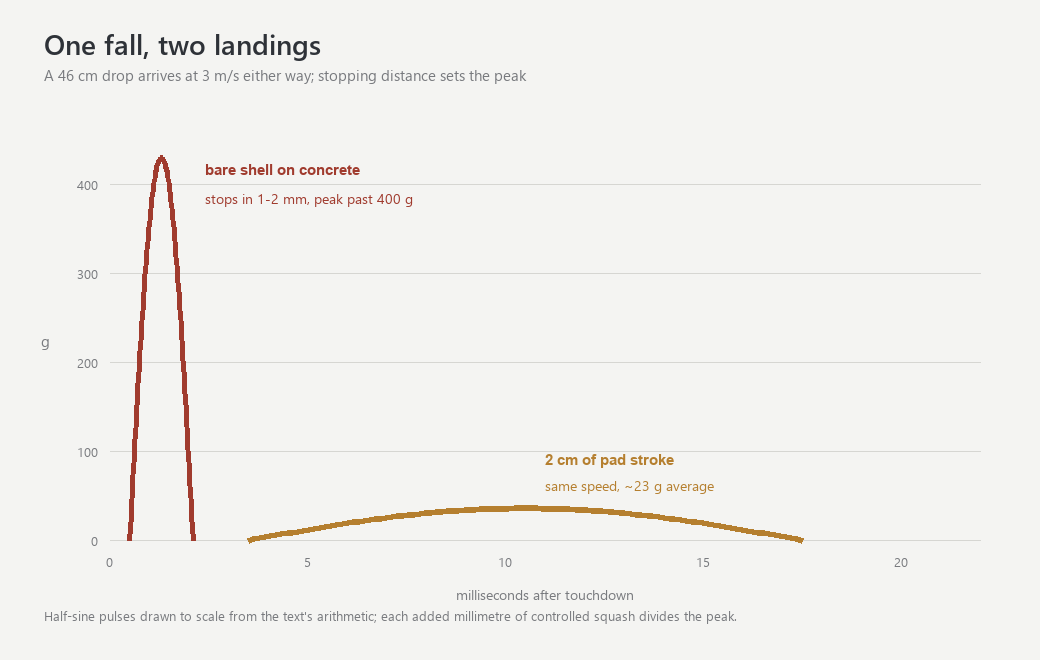
The 46-centimetre fall drawn as two landings. Two centimetres of pad stroke turn a 400-g spike into a 23-g average; stopping distance sets the peak.
A case slipping off a tailgate at 46 centimetres meets the ground at 3 metres a second; on a 30-kilogram unit that is about 135 joules arriving at once, the energy of a full sledgehammer swing. Stopped across the 2 centimetres a compressed pad allows, the cells inside feel an average near 23 g, a hard knock a clamped block shrugs off. Doubling the height to a metre lifts the landing to 4.4 metres a second and the energy to a shade over double. Handle height on the W-class sits near 90 centimetres, a slip from the grip already carrying twice the tailgate energy. Stopped by bare plastic on concrete, the same 3 metres a second dies in a millimetre or two. Deceleration climbs toward 400 g and past it, the regime where boards tear at their screws and stacks bend. Every added millimetre of controlled squash divides the peak, the reason corner bumpers and internal pads buy protection out of proportion to their size. The US bicycle-helmet standard runs this exact sum on a rig, headforms dropped 2 metres onto a flat anvil with a pass mark under 300 g, centimetres of foam doing the dividing there too.
Certification puts its own numbers on the impact side. UN 38.3 finishes with a shock table, 150 g half-sine pulses of 6 milliseconds for small cells, 50 g across 11 milliseconds for packs, three per direction across six directions, eighteen in all. ISTA 3A, the courier protocol, drops a boxed unit under 32 kilograms nine times, 46 centimetres for eight of them and 91 once, corners and edges before faces, the machine expected to work afterwards with the packaging sacrificed; nine drops model a courier’s worst week. Development labs run stricter private versions, bare units onto steel, the results feeding rib thickness before tooling locks; change the cell generation and the pack re-tests. Neither rig recreates a working life. Engineering margins above the standard, doubled anchor counts and internal test bars with added g, exist for the years the rigs compress into hours; the owner’s version costs nothing: keep the original box, a certified crumple package on a shelf for the next move.
Certification rigs beside the road they stand in for (field row shows typical figures)
Test
Method
Severity
Duration
UN 38.3 T3 vibration
log sweep 7-200-7 Hz, 15 min a pass, 12 passes, 3 axes
to 8 g under 12 kg; to 2 g above
9 h
UN 38.3 T4 shock
half-sine pulses, 3 per direction, 6 directions
150 g / 6 ms small; 50 g / 11 ms large
18 pulses
ISTA 3A parcel
free-fall onto rigid surface, corners and edges before faces
46 cm ×8, 91 cm ×1, boxed, under 32 kg
9 drops
Corrugated road, 60 km/h
continuous excitation at the deck
1 to 2 g near 30 Hz
hours a day
Corners concentrate the blow of a landing, the whole footprint’s share poured into one point. Parcel protocols aim their first drops at corners on that logic. Case ribs thicken in the corner webs on the same logic, doubled stiffness at a few grams each.
Site-grade shells add separate rubber corner boots, replaceable after the fall that used them. A corner that hit hard enough to matter usually prints a white stress mark in the plastic first. A dropped corner that still latches can hide a cracked rib; a firm press on each corner, feeling for new give, settles it. On sealed builds the service leak test doubles as the crack finder. A cracked corner also opens the sealing question.
Riding strapped down
A unit strapped so case and deck move together sees the road as filtered by the suspension, a few g of well-damped sway; loose in a load bay, that machine writes its own drop test at each pothole, centimetres of free flight ending on a steel floor, dozens of small impacts an hour. Soft lashings, rope and bungee, creep by millimetres that grow into centimetres of slack inside two hours. Ratchet webbing holds its length, click-stop teeth doing the holding. Ratchet straps run over the case body, clear of handles and port covers, with the pull spread by the packaging foam or a folded blanket where the strap crosses an edge; a folded moving blanket under the base gives back the crumple centimetre the tight strap takes away. Two straps crossed beat one over the middle; four tie-downs make the case part of the vehicle. Anchor points spaced wider than the case beat anchors underneath it, the spread adding down-force to the pull. Webbing tags print a working load limit cut to one-third of the breaking strength, the 3-to-1 rule the cargo trade runs on; transport rules want that tag legible on any securement gear. A strap tagged at the case weight already holds triple it in reserve. Straps pull down and slightly outward, the geometry that loads anchors in their strong direction; fresh webbing settles in the first ten minutes of driving and gives back a click of tension at the next stop. A cargo net over the loose gear nearby finishes the job, tools kept from turning into hammers against the case under braking. Deck rings rated in tonnes sell for single-digit money at any chandlery.
Rock the strapped case by hand before driving off; nothing inside should answer. A new rattle that appears mid-season is a fastener asking for a screwdriver, still a ten-minute job at that stage. Straps re-route off any port cover they crossed at the next stop; a unit rebooting on rough tracks is showing the loose joint from the electrical side.
Common questions
My power station fell about a metre. Is it broken?
Work through it on the bench, off grid power. Look over the case for cracks, the corners first. Listen during a gentle tilt for loose parts. Run a small load and watch for restarts; check the app for new fault entries. A unit that passes all four checks after a carpeted or grassy fall usually took no lasting harm; grass spreads the identical 3-metre-a-second landing across soft ground, the gentle end of the chart. Corners take paint scars honestly, a scuff with no crack under it staying cosmetic. A landing on a corner on concrete deserves a service inspection whatever the display shows; note the fall height and the surface for the ticket, the two numbers that set the triage.
Will daily driving on rough roads wear a power station out?
Strapped down, a vehicle-mounted unit lives inside its design envelope; the certification sweep runs 7 to 200 hertz for nine hours and the internal clamping is built for years of that band. Loose in the load bay, the machine takes a small drop at each pothole. The strap matters more than the road; corrugated tracks at crawl speed shake less than sealed roads at highway pace, frequency riding on speed.
Should I add my own foam padding inside the vehicle?
Under and around the case, firm padding helps spread strap pressure and adds crumple distance for the bad day. Soft thick cushions under a heavy unit let the mass bounce; the pack oscillates on that foam at exactly the frequencies the road supplies. Firm and thin beats soft and deep; closed-cell EVA sheet around 10 millimetres is the right kind of firm. A strap over the factory pad set beats loose blocks wedged around the case.
Something rattles inside after a knock. Keep using it?
A new internal rattle is a part that has come loose. A loose conductor near live terminals is the one mechanical fault that can escalate electrically. Power the unit down and have it opened by service before the next heavy use; strap it for that ride too, since a loose part shipping loose repeats the injury.
Is it safer to transport the unit lying down or standing up?
Follow the handle-and-foot geometry: the factory orientation, feet down, keeps the cell block loaded the way its cradle expects and the vents clear. A clamped brick takes load best along its clamp axis, exactly the direction feet-down travel presses; upside-down transport hangs the block on its bolts, a loading outside the cradle drawings. Whichever way it travels, strap it down; a strapped unit rides safer in any orientation.