Power derating under high temperature is a power station giving ground in a fixed order. Fans answer first, spending a few watts on airflow ahead of any sacrifice. Charge current tapers away second. The inverter’s ceiling walks down third, and a complete shutdown stands last of all. The whole ladder spans roughly 20 internal degrees on a 2-kilowatt class unit, first fan to final cutout.
The order follows plain cost. Moving air costs a few watts of fan power. A slower charge costs time that rarely matters by nightfall, the pack full before anyone checks. The output cap is the first cut a user feels. Shutdown sits behind it as the move of last resort, built so the smallest loads outlive the largest. The exact rungs vary by maker; the order almost never does. The levers all sit in firmware.
Hot silicon wastes more of every watt
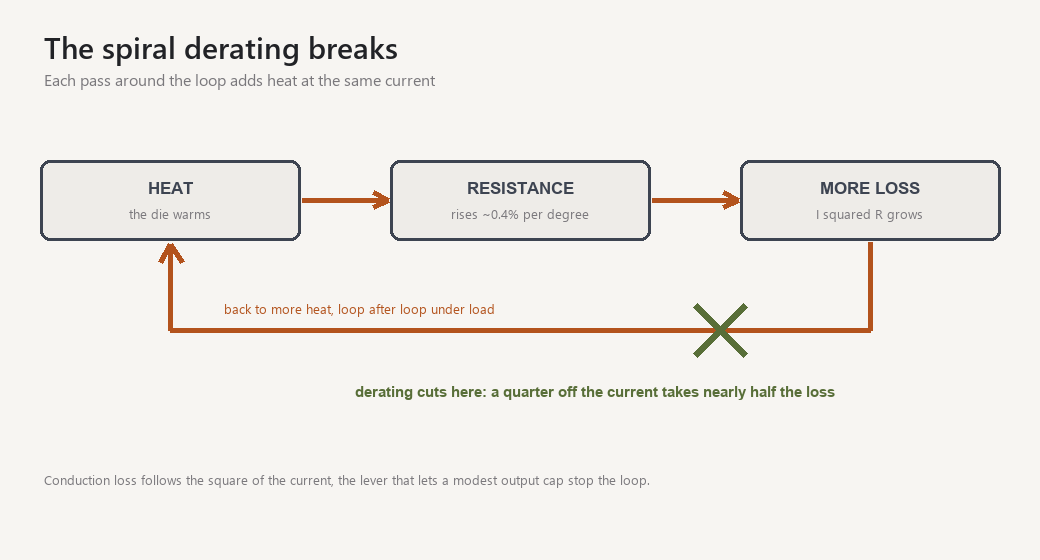
The loop a hot power stage runs. Warmer silicon carries more resistance, the added loss warming it again at the same current. A quarter off the load takes nearly half the conduction loss out of the loop.
Inside the inverter, the transistors that chop battery current into a mains waveform lose a slice of every watt as heat, the toll of their on-state resistance. That resistance moves with temperature. A power MOSFET conducts worse as its die warms, the on-resistance climbing steadily with junction temperature until, near the rated ceiling, it can stand half again above its room-temperature figure. The cause sits in the crystal itself. A warmer lattice shakes harder. Electrons crossing it meet more collisions on the way. Junction temperature runs well above anything a probe can touch; between the die and the sensor stand solder, tab, insulator and heatsink, each step shaving degrees off what the firmware can know. Junction ratings sit near 150 degrees, a shade higher on industrial-grade parts. The firmware’s stage limits sit 80-odd degrees below those ceilings.
The copper shares the habit. Metal resistivity rises with temperature, copper’s by about 0.4 percent per degree. A transformer winding running 50 degrees above the room carries a fifth more resistance than it held at rest. That climb continues through every joint and busbar downstream, the arithmetic already priced at the connectors by the port-heat rules. Cell resistance eases as a pack warms, ion movement quickening inside the electrolyte. All of it exits through the case. A passive surface sheds only a handful of watts per square metre for each degree it runs above the air.
Loss follows the square of the current. Heat lifts the resistance, which adds heat of its own at the same current. A 2000-watt unit at 90 percent efficiency turns 200 watts into heat inside a case the size of a picnic cooler, a soldering iron’s output. Efficiency itself dips a point or two as the die warms. Trimming output by a quarter cuts the conduction loss by nearly half. Firmware is the light half of a cooling budget that would otherwise be paid in kilograms of aluminium.
Where the machine takes its temperature
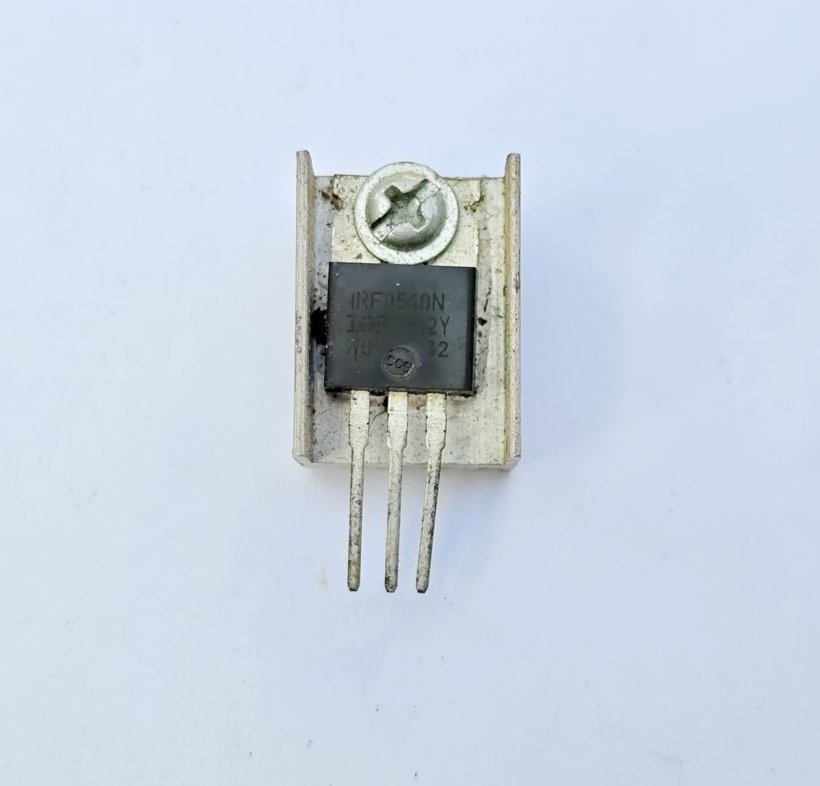
The part the ladder protects. An IRF9540N power MOSFET bolted to an aluminium heatsink; on-resistance in parts of this family climbs with die temperature, the guarded reading taken millimetres away on the sink. Photo: Suyash Dwivedi, CC BY-SA 4.0, cropped.
A station takes its temperature in several places at once, half a dozen separate readings on a mid-size unit, more on a stackable system. Thermistor beads ride the cell groups inside the pack, seated against the middle of the block where heat from every neighbouring cell collects. Packs carry more than one bead to keep a single warm corner from hiding. The inverter’s power stage carries its own sensor on the heatsink, an IC or a bead bolted where the transistor tabs land, millimetres from the hottest solder in the machine. Bigger machines add one at the transformer and another sampling the incoming air at the intake grille. The transformer’s probe guards the slowest-cooling mass in the box, windings wrapped in their own insulation.
Each guard answers its own sensor. Firmware ranks the readings and acts on whichever runs closest to its limit, the reason two identical units in one room can derate minutes apart. A displayed temperature, where a unit offers one, is a single member of that committee. Some firmware reads the intake sensor as a forecast, trimming early on a hot draught ahead of any internal confirmation. A failed thermistor shows as a stuck extreme on the app. Event logs on app-connected units time-stamp each stage change.
Down the staircase
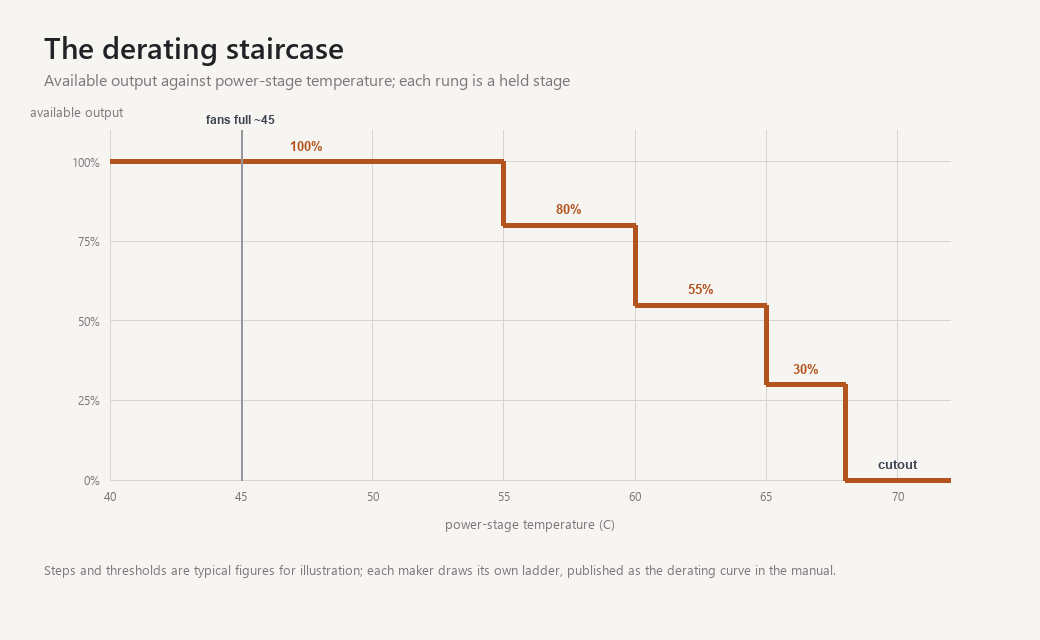
The ladder drawn as steps. Output holds full to the mid-50s at the power stage, then walks down rung by rung to the cutout. Steps and thresholds are typical figures for scale; each maker publishes its own as the derating curve in the manual.
The descent runs in steps. Each trim shrinks the heat being made until the cooling holds the new level. The machine sits at that stage until the balance breaks again, in either direction. Every stage carries a dwell, a minimum stay of seconds to minutes that keeps the ladder from chattering when a reading hovers at its threshold; a capped ceiling holds for whole minutes after a cloud crosses the sun. Three to five output stages cover the run on a typical unit.
The rungs land at familiar places on the common machine, drawn a few degrees apart. Fans reach full speed around 45 degrees at the power stage. Charge current starts folding back as the pack passes its own mark near 40. The output ceiling begins walking down around 55 at the silicon. A full cutout waits near 65 to 70. The pack’s 60-degree discharge limit stands behind everything, an ease of maximum discharge current beginning above 50 on many packs. Manuals print the whole shape as a derating curve, full output flat to a knee near 40 or 45 ambient with a straight fall beyond it. The continuous rating on the badge assumes the knee’s left side. Two machines wearing one badge can carry knees ten degrees apart. Reading the knee against the destination beats reading the badge for anything bound for a tin shed or a van.
The rungs of a typical ladder (internal readings; each maker draws its own)
Stage
Trigger reading
What changes
What the display shows
Fans to full
~45 C at the power stage
airflow spends a few watts ahead of any cut
numbers unchanged, noise arrives
Charge taper
~40 C at the pack
input folds back in steps, half-rate then quarter-rate
input watts sag, no icon
Output cap
~55 C at the silicon
ceiling walks down 3 to 5 stages, near 80, 55, 30 percent
maximum reading below the badge
Cutout
65 to 70 C
AC output stops; DC circuits ride on
the temperature icon, the named event
Recovery
readings falling
rungs restore in reverse, 5 to 10 shaded minutes a stage
ceiling lifts stage by stage
A unit capped at 60 percent of its badge still runs the fridge, the lights, the router, the whole quiet end of a household, since the cap works as a lowered trip line and dims nothing. Output voltage never sags; a 1200-watt grill under a 1400-watt ceiling runs exactly as it ran in spring. A capped AC side also says nothing to the DC circuits; the 12-volt fridge crosses the whole afternoon unbothered. One 2000-watt hour delivered as two 1000-watt hours makes half the conduction heat in the silicon for identical work.
Each stage wears its own face on the display. Fan noise arrives with unchanged numbers. The input figure sags during a charge taper with no icon beside it. A capped ceiling shows as a maximum reading lower than the badge. The final stage posts the temperature icon brands reserve for the event. App screens on some units print the active ceiling as its own field.
The quietest retreat
One casualty never appears on any readout. Surge headroom, the margin an inverter holds above its continuous figure for motor starts, rides on the ceiling that derating walks down through the afternoon. A compressor asks for three to six times its running current at every start, in any weather. The plate on its side prints the figure as locked-rotor amps, the number to divide into a summer ceiling. A start needing 2400 watts of instant reach can meet a stage willing to give 1900. Hot silicon gives up part of its pulse rating on top, the short overload it tolerates shrinking with die temperature. The trip that follows reads as a mystery on the panel. It clears in seconds and returns at the next start until the load list changes, a rhythm easy to mistake for a failing appliance. Inverter-driven fridges with soft-start compressors shave the multiple to under two. Sizing motor loads against the derated figure, the summer number, keeps the mystery off the panel altogether.
Charging bows out early
The charger stands first in line for a cut because a slower charge injures nothing. An afternoon taper that halves a 500-watt input for three hours defers three-quarters of a kilowatt-hour of energy, a deficit one cool evening hour erases. Mains charging answers the pack sensor exactly as solar does.
Above roughly 40 degrees at the cells, charge current folds back the way it does in the cold band, the BMS walking the amps down in coarse steps as the pack climbs, half-rate and quarter-rate rungs on many designs. Past the charge window’s 45-degree lid the process closes entirely. The industry formalised the shape years ago in the JEITA charging guideline, stepped charge zones by temperature. On cooling the steps retrace.
Input watts sag on the display with no icon and no message. Solar owners read the sag as a passing cloud. One look at the pack temperature in the app settles the question. Half an hour of shade often restores more input than an hour spent re-angling the panels.
Passthrough makes the hardest hour of the retreat on any machine that allows it. Charging and discharging at once run the charger and the inverter together, two converters spending their losses inside one case: a 500-watt charge leg adds its 40-odd watts of conversion heat to the inverter’s 150. Manuals that warn against summer passthrough are pricing exactly that stack. Units parked in permanent passthrough as house backup spend every hot afternoon in it, the strongest case for keeping such a machine in the coolest room available. Dropping the charge leg through the heaviest load hour is the working answer.
The sun that feeds the array also heats the case, which parks the day’s best charging in the morning hours. Full summer sun lands about a kilowatt on each square metre it strikes. A dark case lid the size of a tea tray soaks up 80-odd watts of it. Shade removes the whole figure, a pale case or a draped cloth returning a share of it unabsorbed. Any cloth trick drapes the lid alone, clear of every vent. An eight o’clock charging start banks its watt-hours cool.
Dust, clearance, and the fans
Fans hold a ladder of their own, still, then low, then full, keyed to the power-stage probe. Small units run fanless below a set load, a silent envelope of a few hundred watts that ends the moment the stage warms. The first breath of the fan on a quiet evening marks the load that crossed it. App-connected units that report fan speed hand that reading to a phone.
Dust rewrites the ladder from below. Filmed over, a heatsink sheds heat badly and asks for more airflow at every stage. A machine humming at rest is wearing a season of grit. One vacuum pass across the intakes at the turn of each season restores the old curve. Open grilles on the common machine make that seasonal pass the entire maintenance schedule. A fan that has died folds every rung downward at once, cutouts arriving under loads the badge covers; the cure is a replacement fan.
Air enters one face and leaves another. Furniture pressed against either throttles the pair. A palm of open space around every vent holds the intake near the true ambient; the exhaust side needs the same courtesy, since a unit backed into a corner rebreathes its own output within minutes. Ten centimetres of free wall behind the exhaust face restores near-open-air numbers in a still room. A light breeze across the fins outperforms any still interior, the reason the shaded windward side of a vehicle beats its lee on a working day. Altitude thins the coolant itself. Air sheds about a tenth of its density with every kilometre climbed. Fans move volume, handing the heatsink less mass for identical heat. Datasheets answer with an altitude clause, commonly a one-percent trim for every hundred metres past the first thousand or two.
Climbing back
Recovery runs on minutes, the pace of thermal mass. Once tripped, a power stage sheds heat through the metal that soaked it up, falling out of its cap in five to ten shaded minutes. Rung by rung the ladder restores as the readings drop. The pack trails the silicon on the way down, kilograms of cells against grams of die, putting full charge current at the back of the queue on the hottest days. Pulling the load during a cooldown shortens it; the pack stops making the heat it still holds. Cooling runs fastest where the gap to ambient stands widest, the first shaded minutes doing half the work. On the display, the restored ceiling is the go signal for the heavy load. A few models latch the final stage until a button acknowledges it, a design that puts a human eye on the cause before power returns to a possibly blocked or sun-baked machine.
A fan still turning after the output cuts is the cool-down finishing its work.
A hot afternoon, timed
One logged afternoon puts numbers on the whole ladder. A 2-kilowatt-hour unit works a market stall through 36-degree shade, parked in sun at the stall’s edge, running a drinks fridge at 90 watts steady and a 1200-watt contact grill through the lunch rush, a solar array feeding 500 watts of charge behind it all through the midday window. The load list rides one extension lead to the counter, the array flat on the stall roof. At noon the app shows the pack at 39 degrees and 58 percent full, the power stage at 44, the fans turning on low.
At 12.10 the power-stage probe reads 48 and the fans go to full. The stage settles at 52 by 12.25. By 12.40 the input figure has sagged from 500 to 260 under a clear sky, the pack past 41 and tapering its own charge; the stall owner blames haze and re-angles a panel that answers with the identical number. The output ceiling posts 1400 at 13.15 with the stage at 56 and the pack at 44, the app printing the active ceiling beside the badge. The grill and fridge carry on beneath the cap untouched, the numbers on their plugs unchanged, 1290 watts moving under a 1400-watt lid. At 13.30 a blender joins for the lemonade run, its 900-watt motor asking for close to triple that on the first spin, a surge the capped stage cannot source. Its overload trip lands on a machine whose badge reads twice the running load, the fridge riding through the reset on its own DC circuit. Moved behind the counter into shade at 13.40, the unit keeps the fridge and drops the rest, the input paused, the fans at full, the pack cresting at 46 on its own stored heat. By 13.50 the hum is the loudest thing at the stall, 90 watts out and everything else waiting. The stage reads 49 by 14.10 and the ceiling lifts back to the badge; the pack turns downward two minutes later, the slower of the two bodies, the pack at 45 on the app beside the stage’s 49. Charge current walks back up to the array’s full 500 by 14.30, the state of charge climbing off its 55 percent floor toward the evening’s 70. By the afternoon rush the grill returns on a restored ceiling, the badge figure back on the display, the fans easing to low.
In the evening the log reads as a list of rungs with time-stamps, fan full at 12.10, charge taper at 12.38, output cap at 13.14, overload at 13.31, restore at 14.09. The day’s peak internal reading, 58 at the stage, files beside the trip entry. Tomorrow’s version of that afternoon starts with the unit behind the counter from the first sale, a spare tablecloth over the case at noon, and the grill’s heavy hour booked against a full ceiling.
Common questions
Why does my power station deliver less on a hot day?
Hot electronics waste more of every watt. On-resistance in the transistors and windings rises with temperature, turning a larger slice of the load into heat. The firmware trims output to keep the power stage and the cells inside their limits. The full figure returns on its own as the internal temperature falls.
At what temperature does derating start?
The triggers watch internal readings, well above the air outside. Fans commonly hit full speed around 45 degrees at the power stage, charge current tapers once the pack passes about 40, and output caps arrive in the 50s. Direct sun and a sealed corner can carry the internals to those numbers on a day the forecast calls mild.
Does derating shorten runtime or harm the machine?
It protects the machine. The pack’s stored energy stays untouched. Derating lowers the rate of delivery. A heavy load may need to wait or shrink; the watt-hours remain in the pack for whenever they are drawn. Heat itself ages cells over time; the cap is the mechanism that limits exactly that exposure.
How do I get full power back sooner?
Shade the case, clear a palm of space at every vent, drop the load, and pause charging for a few minutes. Recovery follows the internal temperature down on a scale of minutes, the fans running the whole way. The ceiling lifts in stages as the readings fall.