Preheating moves a frozen lithium pack back over its charging floor with heat made on purpose, spent into the cells until the charge may begin. Every charge circuit carries that floor, zero degrees at the cells on the common design, a few degrees higher on cautious ones. It’s there to keep cells clear of metal plating, the one fault a warm afternoon won’t undo. Below the line the charger holds its current at nothing and waits. The reading that rules the wait is the cell bead’s, a temperature trailing the weather by hours inside a closed case.
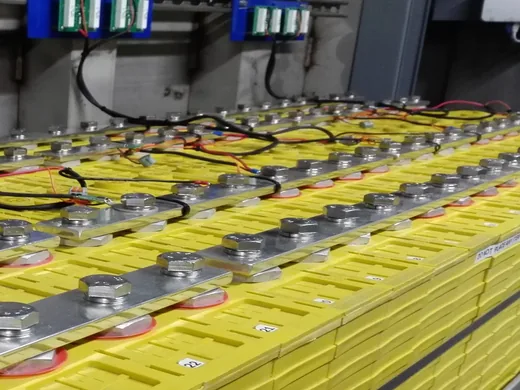
The rulebook is lopsided in the owner’s favour: spending power stays allowed down to minus 20 on the ordinary datasheet, 20 degrees below the charging floor. Self-heating designs just spend a slice on themselves. Thin resistive films glued between the cell groups draw current from the cells they warm, a loop that needs nothing from outside. The films are sized well inside the discharge rating, drawing at a twentieth of C and less. On the coldest packs the BMS warms in pulses, seconds of draw between rests, holding cell strain under the cold-discharge line.
Not every model carries the films. Spec sheets flag the fitted ones with a self-heating line low in the electrical table, commonly phrased as a second charging range that opens at minus 20 with the heater at work. The hardware behind the line weighs a few hundred grams and borrows its power electronics from the charger. Specialty cells rated to accept a reduced charge at minus 10 sit in Battery University’s low-temperature charging note; industrial fleets are where they show up. Everything else warms up the slower way, on borrowed heat: a heated room, a running car, sun on a dark case.
Four places heat can come from
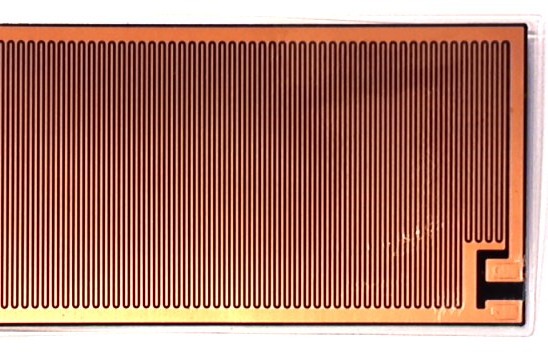
A flexible heater of the self-regulating kind, its serpentine track printed on a bendable substrate. Films of this family sit glued between cell groups; their resistance climbs as they warm, choking the current back on its own. Photo: Liljewalch, CC BY-SA 4.0, cropped.
Mains power outranks every other source when a socket is in reach. A charger asked to fill a frozen pack routes its first watts to the films alone. During that stage the machine draws steady power from the wall with the battery gauge parked at its old number. The machine is fine; the watts are arriving as temperature. A unit wired to a 2000-watt circuit still pulls its 200 and no more during the warm-up, the charger’s full appetite arriving behind the gate. Mains-fed films run bigger than their self-heat cousins, 200 to 300 watts on 2-kilowatt-hour machines, since wall power owes the reserve nothing. Firmware treats the warm-up as part of the charge itself, one button and one sequence, the films retiring the moment the cells take over. First light wakes the array, the films take its opening 100 watts, the cells commonly cross the gate near the point the input curve steepens toward midday. A car’s 12-volt outlet feeds the films on the move, engine warmth easing the boot air around the case on top; draw through that socket stays inside the plug’s 10-amp comfort, 100 to 120 watts of film.
With no source at hand the pack heats itself. The BMS pulls discharge current out of the pack and into the films, drawn through a channel rated to minus 20. Published self-heating packs put real numbers on the loop: a 1.3-kilowatt-hour pack carries a 100-watt pad set, the 2.5-kilowatt-hour size steps up to 150 watts. Cold thickens the electrolyte and lifts internal resistance. That stiffness feeds the warm-up: a cold cell pushing current through its own raised resistance makes heat inside the casing, on top of what the films deliver. Films cut from positive-temperature-coefficient stock regulate themselves. Their resistance climbs as they warm and chokes the current back; no controller sits in that loop. The steepest stock multiplies its resistance several times over between freezing and 60 degrees. A film crossing 40 degrees has already throttled itself to a fraction of its cold draw. Below a floor of charge the firmware refuses to open a self-heat, a line published designs draw in the 10-to-20-percent band. Spending the last of the reserve on warmth would leave nothing to bank afterwards. Owners up north keep winter packs above half; that leaves the day’s work covered on top of any warm-up.
From button press to full current
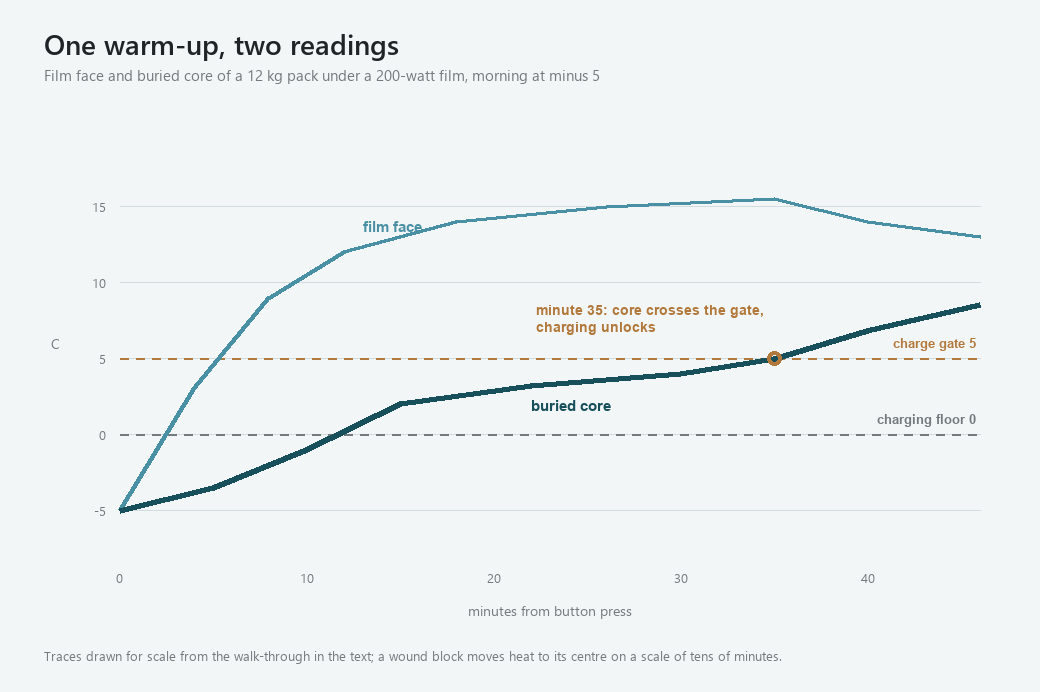
Film face and buried core through one 200-watt warm-up. The core crosses the 5-degree gate near minute 35, the point where charging unlocks. Traces drawn for scale from the walk-through in the text.
Plugged in and asked to charge on a morning at minus 8, the machine reads its buried pack bead at minus 5, refuses the cells, and posts a snowflake beside a heater glyph, the app labelling the stage a warm-up on newer screens. Input settles at 200 watts, every one of them bound for the films; the charge percentage sits pinned at 62, the wall meter counting away beneath it. Fans hold silent through a warm-up, the case quieter than under any load; from the outside it doesn’t look like anything is happening. Warmth moves through the pack as a front. Film faces climb into double figures early, then hand their heat to centimetres of wound electrode a layer at a time; a second bead near the block’s edge runs 4 degrees ahead of the buried one all the way up, the spread firmware watches to catch a lopsided warm-up. A hand on the case top meets the first mildness once that front has crossed the block and begun escaping, past the halfway mark of the wait. On the app’s little graph the buried bead is the slow line, minus 5 giving way to 2, then 4, the final approach crawling in tenths of a degree. At the 5-degree mark the snowflake drops and a trickle of charge current steps in near a fifth of full rate. Current through cold cells heats layer on layer where no film reaches; the steps walk up through quarter, half and three-quarter rate. Input climbs off 200 toward the high 400s, the charger folding the film budget back into charge current. The plain 500-watt charging screen a mild day would have shown at the first press arrives 44 minutes after the button, about 140 watt-hours of wall power behind it.
The gate sits at 5 degrees on many designs, above the floor itself. Self-heating packs on the market run the heaters from below 5 degrees and hold them on until the cells reach 10, a wider margin still. The margin covers both the slow fade of plating risk above freezing and the tolerance of a degree or two in the bead. The soft start behind the gate follows the stepped cold-band rates every lithium charger keeps, half rate below 10 degrees on a common map, three-quarters to 15, full above. Nothing about the gate is user-set. A pack that drifts back under 5 mid-charge sees its current step back down the ladder. Gate values sit a degree or two apart across brands, a line in the charging spec on the models that print it.
Films press on the outside of a cell block; the governing bead sits buried at its centre. A wound cell moves heat across its layers tens of times slower than along them, the rolled construction working as its own insulation. A 280-amp-hour prismatic cell weighs 5.4 kilograms on its published sheet. The bead on its skin answers for mass it cannot see directly. Designs wait on the buried reading; a film face at 10 degrees proves nothing about a core still short of the floor. Stacked systems warm bank by bank, the controller sequencing films to keep the total draw inside the charger’s budget. A 300-watt-hour picnic unit carries under two kilograms of cells and warms in a corner of the time.
A warm-up can also stall. Heat leaves the case as fast as the films add it once the gap to the outside air grows wide; at some depth of cold a 200-watt film holds a pack at 1 or 2 degrees, the gate out of reach. A 5-metre-per-second wind roughly doubles what a bare case loses beside still air. Firmware won’t chase it forever; after thirty to sixty minutes it gives up and writes the fault to the log. Standing the case on a crate behind a windbreak commonly carries the retry over the gate; cardboard taped up works as the windbreak on an exposed tailgate.
An interrupted warm-up keeps its progress. Heat already delivered lives in the mass of the cells, draining away over an hour and more. Restarted inside the half hour, the attempt resumes close to where the block left off. Firmware doesn’t keep a saved state for it.
The arithmetic of a warm-up
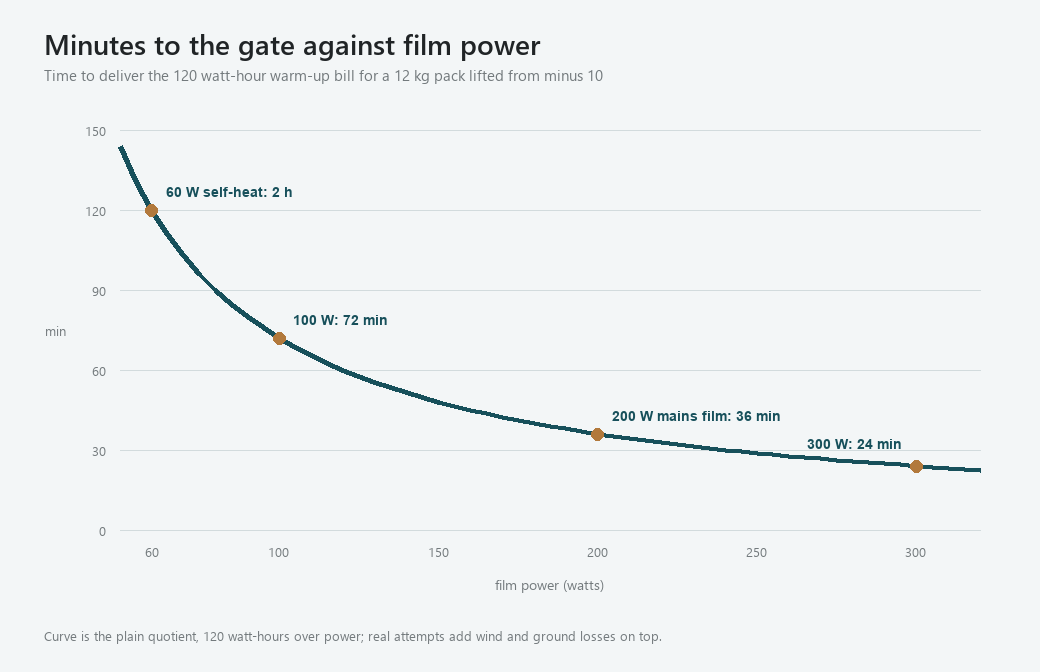
Minutes to the gate against film power for the 120 watt-hour bill of a 12-kilogram pack. The curve is the plain quotient; wind and ground losses stretch real attempts.
Twelve kilograms of cells is what a 2-kilowatt-hour station carries, give or take. Laboratory measurements put lithium cells at 800 to 1100 joules per kilogram per degree, the bulk of results settling near 1000, a shelf between water’s 4200 and steel’s 500. The plain heat equation, mass times specific heat times the rise, prices a lift from minus 10 to plus 5 at 180 kilojoules, an even 50 watt-hours. The films themselves convert at close to unity, resistance heating wasting nothing to speak of. Casework, busbars and losses along the way roughly double the bill; 100 to 120 watt-hours, measured at the pack, covers a real warm-up of that depth. Set against the pack it serves, the spend runs five or six percent of a full charge. Makers that print the figure at all quote a five-to-ten-percent band in the printed specs. A stacked 5-kilowatt-hour bank warms on two and a half times the budget. A 200-watt film clears the job in a bit over half an hour, 100 watts in twice that, 60 watts of self-heating in closer to two hours. Wind bends those times upward hardest at the low-power end, where a small film barely outruns the loss. Makers publish waits that line up with the sums: 30 to 60 minutes from minus 10 and 70 to 100 minutes from minus 20 on a 1.3-kilowatt-hour self-heating pack, 100 to 150 minutes from deep cold on the 2.5-kilowatt-hour size. A start from minus 20 asks for a 25-degree climb, two-thirds more energy than the minus-10 case. Set beside the 40-watt trickle a frozen pack accepts raw, a finished warm-up opens the full 500-watt rate. The heater gets its money back inside twenty minutes of the faster charge.
Where the heat has to reach
A socket spends grid energy and leaves the state of charge alone, the cheapest watt-hours on the list. Grid electricity prices the warm-up in fractions of a cent. Morning array output makes a close second on machines that route it to the films, power the frozen pack couldn’t bank anyway. Self-heating belongs to the situations with nothing else on offer. Warmth borrowed from a room or a vehicle runs on time alone. Reserve spent on a dawn warm-up comes back through the panels by ten on an off-grid morning.
Case plastics live below 70 degrees, cell faces below 45, the number the hot end of the charge window itself guards. A hair dryer parked against the shell, a heat gun, a stove top or an open oven all cross those lines in minutes, on a patch of surface the internal sensors may not even carry. Room air does the job with zero drama; twenty degrees can’t deliver seventy, no matter how long it tries. Park the machine a hand’s width from a radiator and give the block’s centre its hours. A dry hot-water bottle under the case stays inside the safe band on its own, 50-degree water sitting well short of the 70-degree line. Radiant heat from a wood stove obeys distance squared; doubling the gap quarters what lands on the case. A point-and-read thermometer settles any doubt about a warm patch in seconds. Sun through a windscreen counts as gentle heat, the glass spreading it across the case.
Choosing between the routes turns on three numbers, the power on hand, the depth of cold, and the time of day.
Warm-up routes for a 12-kilogram pack from minus 10, timed against the 100-to-120-watt-hour bill (typical figures)
Route
Power into heat
Time to the gate
Cost to the pack
Mains-fed film
150 to 300 W
25 to 45 min
none (wall power)
Solar-fed film
100 to 200 W by light
40 to 70 min
none (morning output)
Self-heating
60 to 100 W
1.5 to 2 h
5 to 10 percent of charge
Indoor rest
room air, passive
2 to 4 h
none
Running vehicle
12-volt film plus cabin warmth
1 to 2 h
none (fuel already burning)
A case set straight onto snow feeds it heat by conduction, melting its own cold sink into place under the machine; every gram of melt swallows a third of a kilojoule, latent heat that returns nothing. A board, a crate or a foam pad under the base cuts the path; a pallet does the job on site, the air gap under the boards beating any solid sheet. Two bricks under the corners lift the case onto still air in a pinch. Snow shovelled clear beats snow compacted flat, meltwater against the base stealing fastest of all.
Keeping warmth that is already there
A machine that sleeps indoors walks out the door already warm. Twelve kilograms of cells leaving the house at 20 degrees hold about 50 watt-hours of warmth above the charging gate, twenty-odd minutes of film time. An overnight charge in the house, the machine carried out with the gear at dawn, covers the ordinary winter day with no film ever switched on. Owners charging indoors at night for cheap tariff windows collect the thermal head start free on top. A van parked with the unit inside beats a tent porch by ten degrees on a January night. A night in a car boot leaves the machine several degrees ahead by morning. Twenty minutes of cabin heater before departure puts another ten into the load space for the price of idling. Machines in steady use rarely cool to the floor. A steady 300-watt load leaves 20 to 30 watts inside the case as conversion loss; that trickle heater runs the whole shift. Delivery crews do this at scale; the stations going over the tailgate at eight are still holding bedroom temperature.
Three centimetres of foam wall cut the heat leaving a warm pack to a small fraction of the bare-case figure, turning a two-hour reserve into the better part of a day. A blanket wrapped over a preheating case keeps borrowed and film heat in; pull it clear of the vents the moment charging begins, since fans that stayed idle through the warm-up start moving air with the current. Wool and sleeping-bag fill hold more of that heat than a cotton throw. A foil emergency blanket over the outside adds a windproof skin at the weight of a few grams. A warm pack boxed with its own charger gains a second small heater, the brick’s idle losses now working inside the walls. A 2-litre bottle of 50-degree tap water boxed beside the pack carries close to 70 watt-hours of heat. That’s a film’s entire run, done with a kettle. Foam picnic coolers fit mid-size stations with room to spare, and their shape leaves the vent faces open on its own. One foam box does double duty, slowing a January cool-down and flattening the after-sunset plunge that catches gear left on open truck beds.
A winter routine that spends less
Deep cold rewrites the plan around avoidance. At minus 25 and beyond, film warm-ups run long, stall often, and spend a tenth of the reserve per attempt; past two hours much of the film’s output is standing still against the leak. The working answer is to quit fighting the weather and charge indoors. Butane stoves and cabin heaters make any hut a mains-grade preheat; a pot of water kept near boil holds refills for the hot-water-bottle route all day. Expedition users run that split for weeks at a time, the cabin hours doing all the charging. The half-full winter floor from the self-heat rule keeps the day and its warm-ups covered. Lead time counts for more than power at those depths.
Milder winters are a timing game. Midday holds the warmest air and the strongest sun inside one two-hour window; a charge scheduled there may need no preheat at all on a pack that worked through the morning. Frost still sitting on the panel glass at nine argues for the later slot on its own. An hour of discharge before the charge does that priming on machines without films, the load’s conversion loss standing in for the heater. The array’s best output lands just when the cells sit nearest the gate.
A vehicle-mounted unit rides a 12-volt feed all day, films first when needed, charge behind them. Loads run off the pack through the drive keep it warmer still. Fleet installs wire the feed through the ignition, the films barred from draining a parked starter battery. Nights ask one decision, cab or cargo bay. The cab’s residual warmth wins the morning by an hour of preheating time.
The machines that never need it
The test isn’t complicated: what temperature is the pack at the moment the charger goes in? A station that discharges on a frozen job site all day and rides home to a heated garage every night charges warm its working life. A garage that merely keeps frost out, holding 5 or 8 degrees, already keeps every charge above the gate. That rule takes in backup units living indoors beside their loads, apartment balconies in mild climates, and any routine pairing outdoor work with indoor charging. An unheated stairwell commonly holds above zero and sits on the exempt side too. Three questions settle it: where the charging socket lives, when the charge usually runs, and how cold that spot runs in January.
Charging outdoors from panels or a generator through freezing weeks is the picture that justifies the self-heating line on the spec sheet. Ice fishing, high-country photography, unheated site cabins and winter vanlife all charge where they stand; site-hire fleets often charge in unheated containers. A machine bought without the films for that duty spends every January morning on borrowed-heat workarounds. Second-hand listings rarely print the line at all; the maker’s model listing settles it in a search box. The premium for the films runs to a small slice of the machine price on current ranges.
Common questions
Can I warm a power station with a heater or a hair dryer?
Distance and time make outside heat safe. Warm room air, a car interior and a bottle of hot tap water beside the case all stay inside limits that a hair dryer, a heat gun or a stove top breaks within minutes. A closed car in winter sun reaches 15 degrees by mid-morning. Cell faces top out at 45 degrees for charging; keep anything warmer than a hand comfortably away from the shell.
How long does preheating take?
Plan on 30 to 60 minutes from minus 10, the window makers themselves publish for 100-watt heater packs, and 70 to 100 minutes from minus 20. Self-heating on the smaller pad sets runs nearer two hours. Wind and a snow footing stretch the figure; mains-fed warm-ups on 300-watt films shave it toward twenty minutes. The wait tracks the block’s centre; the display releases the charge once the buried sensor crosses the gate, commonly near 5 degrees.
How much battery does self-heating use?
A warm-up from minus 10 costs roughly 100 to 120 watt-hours on a 2-kilowatt-hour unit, about one part in twenty of a full charge. Deeper cold costs more and can double the figure. Charging from mains or solar sidesteps the draw entirely, since the films then run on outside power. Cells running the films see a shallow discharge only, well inside their rating.
My machine has no self-heating. What works?
Plenty works, none of it fancy: warmth borrowed from somewhere else. Charge indoors overnight and carry the machine out in the morning; its own thermal mass covers hours of cold. An hour of cabin heat in a car does the film’s job on a pack of that size. A foam box, a blanket over the case and a board under it hold cell temperature above the charging floor for a long working day. Crack any box open the moment charging begins.
Is it safe to use the battery below zero without preheating?
Discharge carries its own rating, around minus 20 on common packs. A cold pack delivers fewer watt-hours until it warms back up. Preheating is for the charge side only. A frozen pack offered a charger draws nothing until its gate clears.