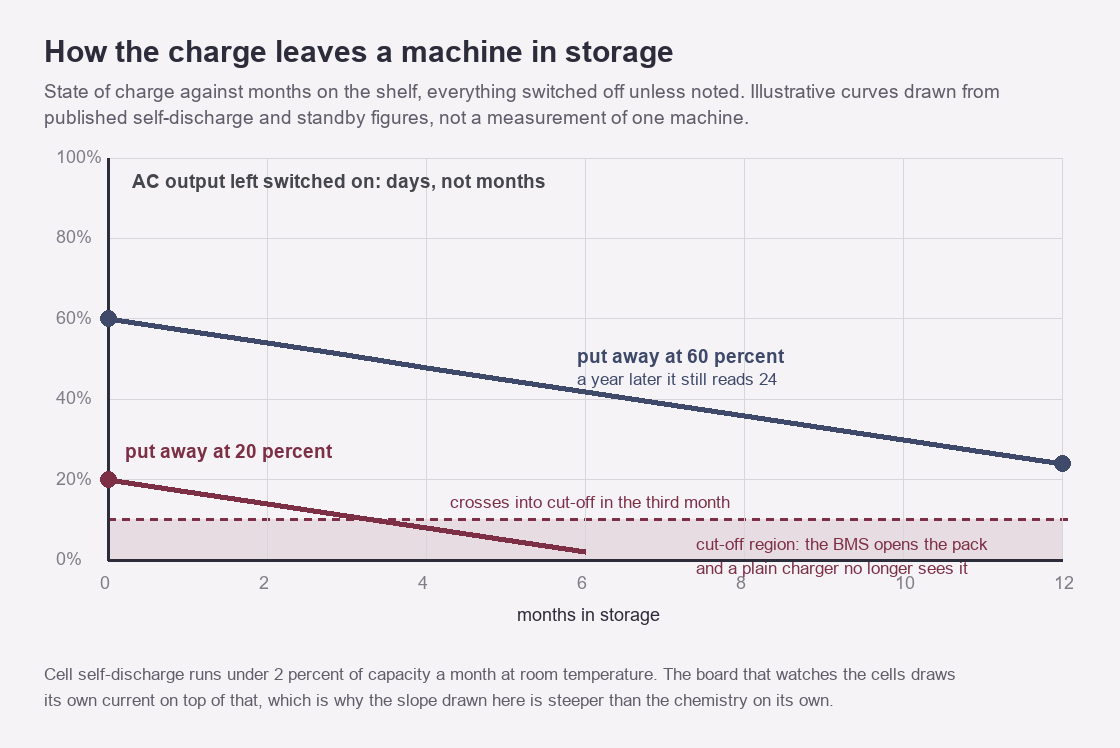
Charge against months on the shelf. Illustrative lines drawn from published self-discharge and standby figures, not a measurement of one machine. The shaded strip marks where a battery management board opens the pack and a plain charger stops seeing it.
Long term outdoor storage protection is what you do to a power station that’s going to sit outside, unused, for a season or more. Cells leak charge on their own. So does the board that watches them, at a rate of its own. Shut a unit in a garden shed in October and it can read something else entirely by March.
On paper, lithium iron phosphate cells lose under two percent of capacity a month at room temperature, low enough that chemistry on its own would let a pack doze for years. The board is the problem. It never fully switches off. Even shut down it keeps reading cell voltages, holds the output devices in a known state and answers a wireless radio if the machine carries one. Double that figure and you’re about right for a machine that’s genuinely off, three to four points a month.
Leave the AC output switched on and an idle inverter keeps drawing whether or not anything is plugged in. Measured idle figures land around 5 to 15 watts on a 1 kWh machine, 10 to 20 watts behind a 1000 watt inverter and 20 to 40 behind a 2000 watt one. One 3.8 kWh unit was measured pulling over 70 watts just to stay switched on. A well-behaved 4 kWh machine tested at 12. Do the division. Fifteen watts empties a 1 kWh pack in under three days. Many machines carry an eco setting that drops the inverter after a stretch with no load, on a timer you set in the menu. Switch it on before walking away. On some units the power button only kills the display. Radio, sensing and the charge controller stay live underneath at a lower rate. The manual will tell you which one you’ve got.
The number to leave on the display
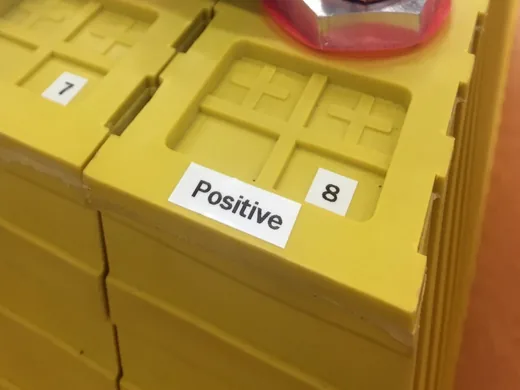
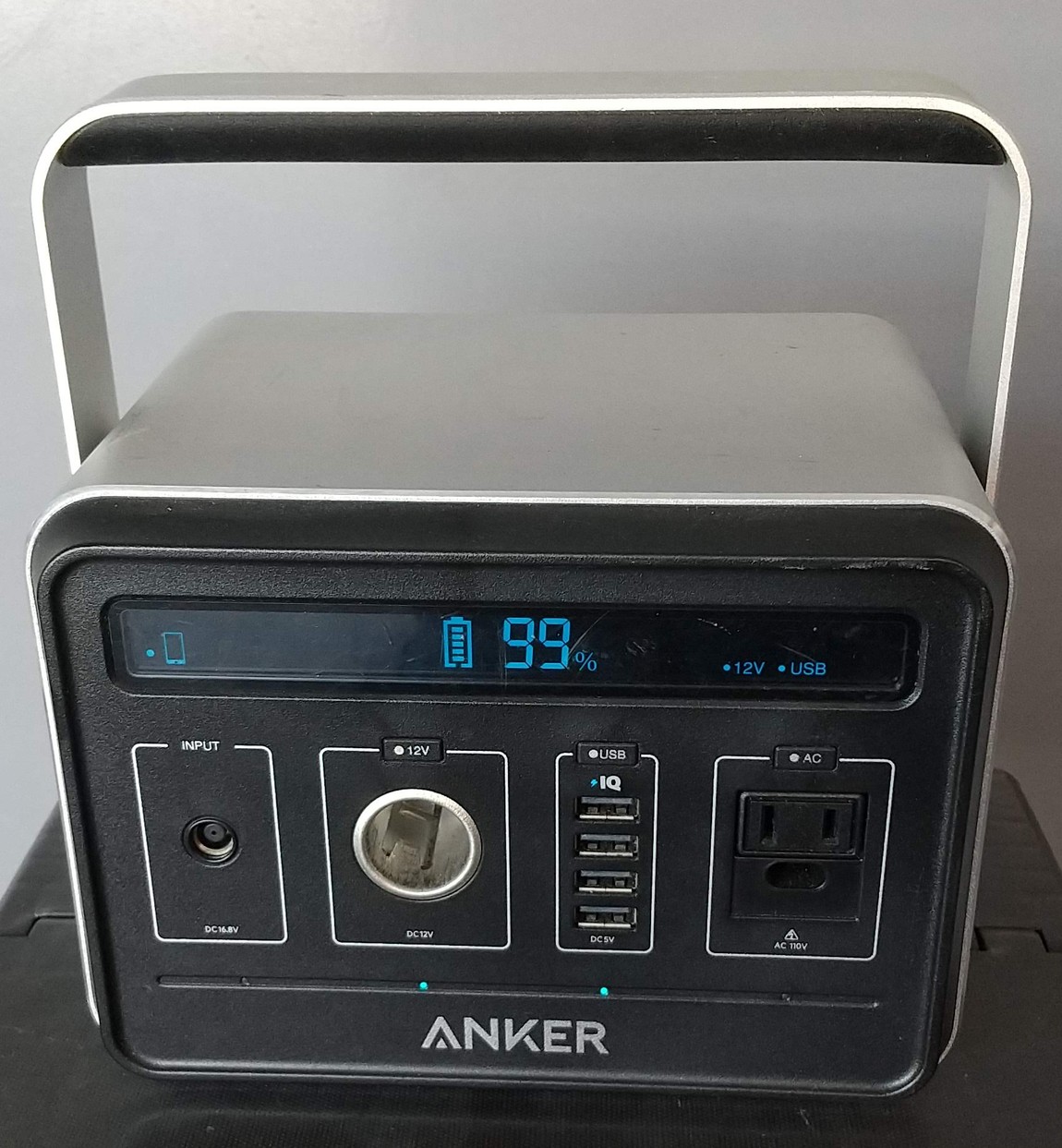
A machine reading 99 on the panel. Fine on the morning of a trip. Left on that number through a winter, the pack spends every one of those months at the voltage that costs it the most. Photo: CyberOyaji, CC BY-SA 4.0.
Storage charge is the one setting you pick and then don’t touch for months. Hold a lithium cell at full charge and it sits at its highest voltage, where the slow side reactions that eat capacity run fastest. A pack left full for a year at room temperature gives back roughly 80 percent of what it held. Take the storage charge down to 40 percent and that year costs about four points. The lab answer is 40 to 60 percent. Anywhere in there is fine. Regulators arrive at the same place from the safety side. From 1 January 2026 the IATA dangerous goods rules require lithium batteries packed with equipment above 2.7 watt-hours, and battery-powered vehicles above 100 watt-hours, to fly at no more than 30 percent of rated capacity. A machine that turns up from the factory reading low was shipped that way on purpose. Makers aim higher than the lab figure when they publish one at all. Jackery tells owners to hold a station between 50 and 80 percent with a check every one to three months. Bluetti asks for 50 to 70 percent, stored between zero and 25 degrees, with a look every three months and a top-up to 50 or 60 whenever the pack falls under 30. EcoFlow’s number is 60 percent, with a run down to 30 every three months and back up again.
What makes that number hard to trust is the chemistry itself. An iron phosphate curve stays flat almost the whole way and sits near 3.2 volts a cell from a quarter full right through to nine tenths. The percentage on the display comes from a running count of amp-hours in and out.
There is no margin left in a pack put away nearly flat. Three or four points a month walks it into the cut-off region before spring. Where does the full-charge habit come from? Lead-acid genuinely wanted a full plate on the shelf.
Hitting a middling number takes a little planning, since a station charges to whatever it was told and then stops. Run a kettle or a work light for twenty minutes and you’re down from full. Machines with an app take a chosen percentage as a stop point. Trust the reading only so far. Coulomb counting drifts across months with no full charge to recalibrate it. A display showing 55 in November can be a real 45 by March. One full charge followed by one deep run under load resets the count. Both belong on the last visit before storage. Charge level and temperature multiply.
Capacity a lithium-ion pack still returns after a year in storage, by temperature and by the charge left in it. Published figures for lithium-ion; the 60 degree row covers three months rather than a year.
Storage temperature
Left at 40 percent charge
Left at 100 percent charge
0 °C (32 °F)
98 percent recoverable
94 percent recoverable
25 °C (77 °F)
96 percent recoverable
80 percent recoverable
40 °C (104 °F)
85 percent recoverable
65 percent recoverable
60 °C (140 °F)
75 percent after three months
60 percent after three months
When a stored pack reaches the floor
In an unheated shed in October, a machine goes away reading 20 percent. Its owner figured a battery left alone stays roughly where you left it. By the turn of the year the display is close to zero. The pack keeps sinking past that, because zero on a screen is a calibrated guess sitting well above the bottom of the chemistry. Somewhere near 2.2 to 2.5 volts a cell the management board opens the pack to protect it. Opening the circuit does not stop the board drawing its own small current. Sleep mode pulls that down to something like 80 to 350 microamps. An awake board runs nearer 600. Microamps sound harmless. The pack they are emptying has nothing left to give. Cell voltage keeps sliding underneath the protection with nothing left to stop it. Battery University puts the hard limit at two volts a cell, past which a recharged cell can turn unstable. Below that mark copper from the current collector begins dissolving into the electrolyte. On any later charge it plates back out as metal in places it has no business being. That is the mechanism behind internal shorts in over-discharged cells. What does the owner meet in March? The charger goes in and nothing happens. No light comes on and no fan starts. Plenty of chargers won’t start into a pack reading far below its nominal voltage, since a charger can’t tell a sleeping pack from a shorted one. Try pulling everything off it for a quarter of an hour first. On plenty of boards that clears the protection latch. After that you’re into low-current work. Put a bench supply near a tenth of the pack’s amp-hour rating and hold it there until the cells climb back over roughly 2.8 volts. The normal charger takes over from there. In the field, paralleling a healthy pack of matched voltage onto the flat one achieves it, at whatever current the two settle on between them. Makers who expect this failure supply a wake button or a dedicated charger for it. Published recovery times run from a couple of hours for a mild case out to a day and a half for one taken right down. It comes back holding less than it went in with. Cells taken all the way to negative voltage don’t come back. Letting a battery flatten itself in a shed counts as your doing. The exclusion usually sits beside the storage instruction in the manual.
Where it sits outdoors, and what that costs
Chemists use a rule of thumb where every ten degrees roughly doubles the reaction rate. Around 15 degrees is the temperature usually named for storing lithium. Run the doubling rule forward and a shelf at 35 degrees ages a pack in six months about as far as a shelf at 25 takes a year to manage. Against a shaded north wall in a hot state, a case can live cooler than one sealed into a loft in a mild one.
The loft is the trap. Uninsulated and badly ventilated, one runs 40 to 60 Fahrenheit degrees above outside air, which puts a typical summer loft at 120 to 150 Fahrenheit, or 49 to 66 in Celsius. Hot regions push past 160. A shed with air moving through it tracks much closer to the outdoor temperature. The sealed metal box in full sun is the one to worry about. Concrete floors and cellar walls hold the previous season’s temperature and smooth the daily swing. A garage floor against an inside wall is one of the better spots a household has. Raise the machine off the slab on a pallet or a shelf to keep it clear of standing water and of the cold damp a slab holds well into spring.
Cars are the worst store available and the one people reach for first. Interior air in a car parked in the sun has been measured up to about 70 degrees, with dashboards approaching 100. Park a pack in a boot for July and it sits at temperatures where a year of storage takes a third of the capacity out of a full battery. It collects that bill in weeks. Work vans are the same story all year round, since the van is out every day and the machine never comes indoors.
A lithium pack sitting near freezing point loses barely anything across a year. Storage windows narrow as the storage period lengthens. Manufacturer pages put general storage at 0 to 35 degrees, with best performance between 15 and 35. Cell datasheets add a second line for duration. A month tolerates roughly minus 30 to 60. A year wants zero to 35. A cold pack mustn’t be charged until it has warmed. Carry a machine from a frozen shed into a heated kitchen and water condenses inside its case. Bring it in, leave it sealed and let it reach room temperature before opening anything or plugging anything in.
A dry outbuilding with a lock on it beats a convenient corner in the open, since theft takes a machine as completely as a flat pack does and an unattended box on a boat deck or a site compound stays visible for six months at a stretch. On top of that come the bills from salt air and blown grit.
The solar panel left plugged in
Leaving a panel connected through the storage months sounds like free maintenance. It isn’t. An MPPT input tops the pack back up on every sunny day and holds the machine at full charge for the whole season. Each morning the controller wakes to hunt for the maximum power point. Electronics that should be asleep end up working a daily shift.
As emergency backup, you keep it high on purpose and pay the ageing bill with your eyes open.
What a season outdoors does to the shell
ABS chalks and turns brittle quickly in direct sun. Polycarbonate holds its clarity for something like five to seven years without a protective coating and yellows a good deal sooner under hard exposure, inside a year or two in moderate sun and inside months where it’s fierce. Sheet makers co-extrude ultraviolet absorbers into the surface layer, which buys a panel years of extra service on identical resin underneath. Nothing on the case tells you which one you’ve got. The parts that fail first are the ones that get handled: port flaps, latches, the carry handle and the display window. Throw a tarpaulin over it and the problem goes away at no cost.
A machine that isn’t running has no warm electronics keeping dew off its insides. Every day the case breathes out warm air and pulls cooler air back in through whatever vent or gasket path exists. Moisture rides in with it, a gram at a time. Water that condenses inside stays there through the cold hours. Keep it under cover and off cold concrete, cap the ports that came with caps and drop silica gel in with it. The packaging trade works in 26 gram units and reckons on at least 1.2 of them for every cubic foot of enclosed air. Dry gel takes up around a third of its own weight in water. Contacts left open through a wet winter come back with a dull film that a dry cloth takes off.
Because their incisors never stop growing, mice and rats gnaw constantly. Cable insulation gets chewed whether or not there’s anything edible nearby. Modern wiring jackets often use soy-based plasticiser, which upgrades a cable from available to appetising. A quiet, dry, unattended box in an outbuilding is exactly the sort of hole a nest wants. What turns up in spring is a chewed DC lead, bedding in the fan duct or droppings across the panel. Keeping feed and birdseed out of that building does more than any repellent. Traps set nearby handle the rest. Vents have to stay clear, which rules out blocking them off.
Coming back every three months
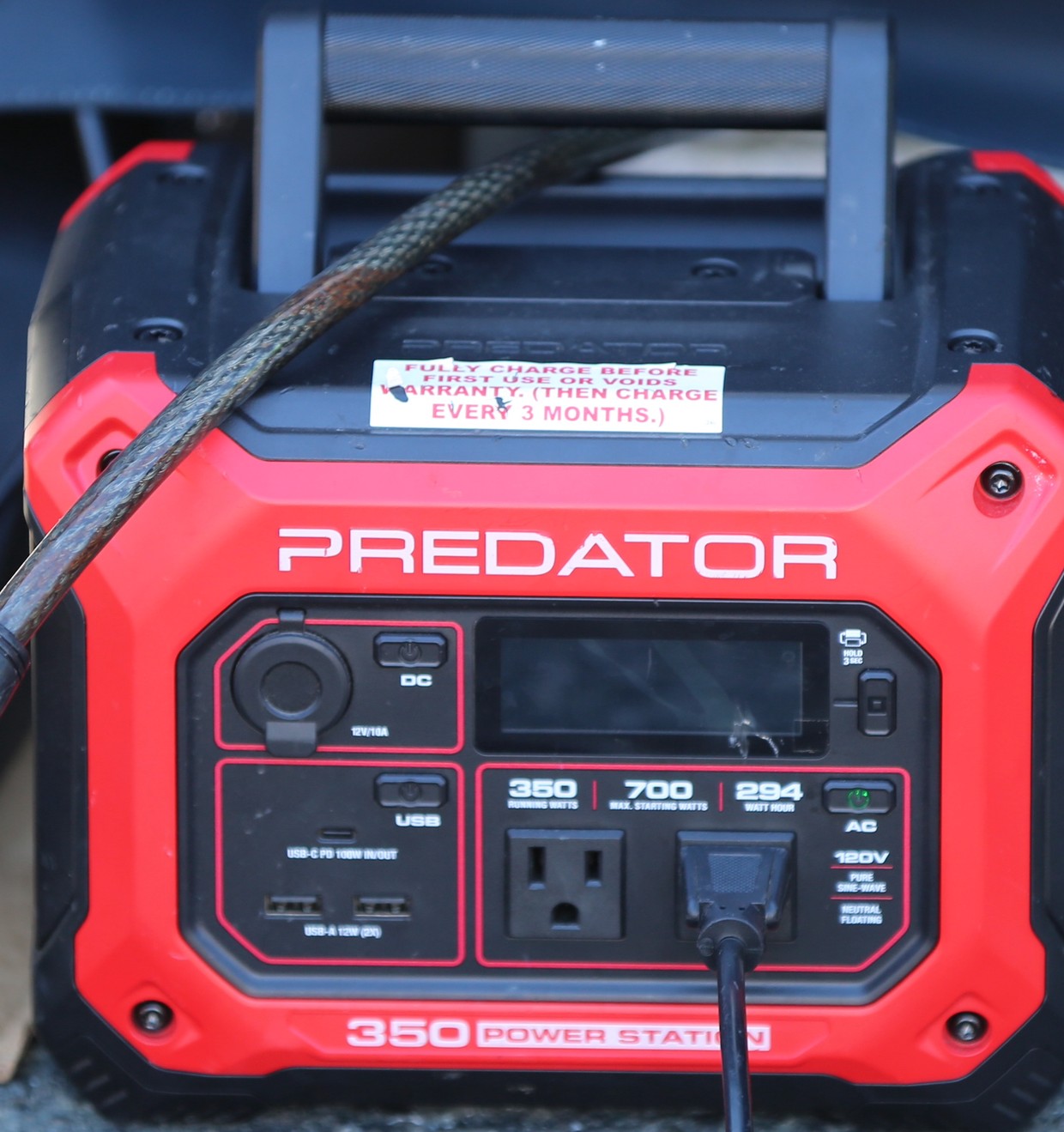
The storage rule printed on the case at the factory: fully charge before first use or the warranty is void, then charge every three months. The panel below it reads 350 running watts, 700 starting watts and 294 watt hours. Photo: TaurusEmerald, CC BY-SA 4.0.
Quarterly is the interval makers keep landing on. Look at the machine in the photograph: the instruction sits on a factory sticker across the top of its case, with the warranty attached to it. Three months is short enough that a pack starting from the middle of its range never approaches the cut-off, even allowing for a hot site and an older board drawing more than it should.
Makers write for the customer who forgets. Full charge is what survives a forgotten year. The sticker asks for exactly that. The capacity cost of that lands on the owner. Anyone who does keep the calendar can take the gentler number.
The visit itself takes ten minutes. Read the display and write the number down somewhere you’ll still have it, since two or three readings turn into a drain rate. Sixty percent in September reading 53 in December is a machine losing 2.3 points a month, which projects to a comfortable 32 by the following September. Top the pack back up into the storage band. Then comes the walk around the case: chew marks, water tracks, a sagging tarpaulin, a port cover that has worked loose. Lift the machine slightly to check nothing is pooling underneath it.
Three cases want checking monthly: hot sites, older machines and anything you put away lower than you meant to. So does any unit that dropped further than the last visit predicted. A machine losing charge faster than roughly four points a month has something awake inside it.
The day it goes back to work
Bring the machine indoors and leave it closed until it reaches room temperature, which handles the condensation and the cold-charging lockout in one wait. Then go over it properly: cable jackets, port covers, the AC outlet faces, the fan grilles and anything a rodent or a winter might have got at. Only after that does the charger go in. Give it a full charge and watch that the current comes up normally and the fan runs when it should. That charge does more than fill the pack. Passive balancing only fires near the top, once a cell reaches something like 3.5 to 3.6 volts. A resistor then bleeds the high cell at 50 to 100 milliamps. Even in daily use that window lasts 30 to 60 minutes a charge. A machine parked at 60 percent for six months never once reached that window. Its cells have been drifting apart the whole time with nothing able to pull them back. That is the hidden cost of a mid-range storage number. The quarterly full charge matters for more than the percentage it puts back. A machine that charges at half its usual rate, or trips out part way, is telling you something before you’ve connected a single load.
Then run it down once under a known load. The watt-hours it gives back show what the storage months took.
Common questions
What charge should a power station be left at for six months?
Leave it somewhere between 40 and 60 percent on the display, in a cool place. That band keeps the cells off the voltage that ages them. It also leaves enough room that three or four points a month can’t reach the cut-off before your next visit. If your machine has an app, set it to stop at the number you want.
Can a power station be stored in an unheated garage over winter?
Yes. A cold garage is one of the better places for it, since cold storage costs a lithium pack almost nothing in capacity and a concrete floor against an inside wall holds a steady temperature through the season. Keep the machine up off the slab. Let it warm to room temperature indoors before charging it, because charging a pack below freezing is what causes lasting damage. Discharging in the cold is fine. Capacity that goes missing at low temperature comes back once the pack warms up.
Does leaving a solar panel connected keep the battery healthy during storage?
No. An MPPT input tops the pack back to full on every sunny day and keeps it at the state of charge that ages it fastest. The charge controller also works a daily shift when it should be asleep. Disconnect the panel, set the storage number by hand and come back on a schedule.
What happens if a stored power station goes completely flat?
Near 2.2 to 2.5 volts a cell, the management board opens the pack to protect it. Its own small current keeps pulling the cells down after that. An ordinary charger often won’t start into a pack that far below nominal voltage. Disconnecting everything for fifteen minutes clears the protection latch on many boards. Past that you need a low-current supply, patience and the acceptance that some capacity is gone for good. Cells taken to negative voltage are finished.