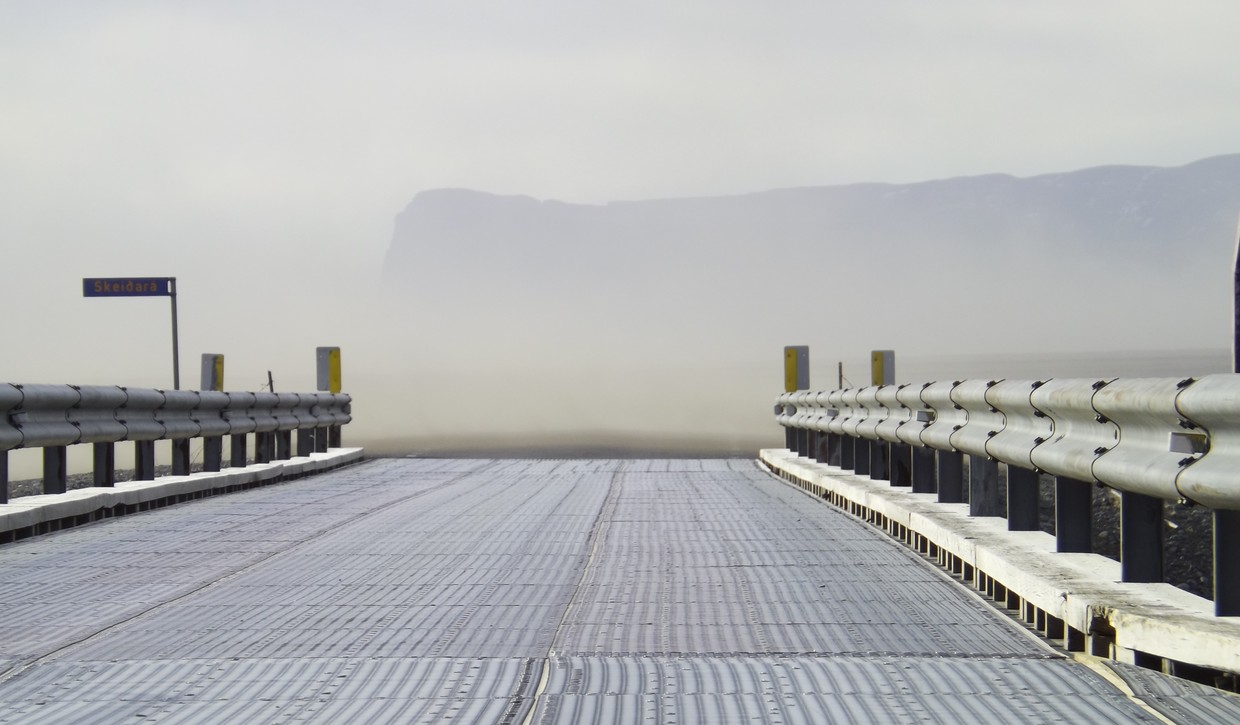
Blowing dust crossing a road bridge. Wind at this strength carries the coarse grades along the surface and holds the fine ones in suspension for hours after it drops. Photo: Michael Coghlan, CC BY 2.0.
Dust and high wind protection is the hardware and the habits that keep airborne grit out of a machine’s air path and keep the case itself from moving. The moving half is the one you can put a number on. Dynamic pressure in pascals comes out as 0.613 times the square of wind speed in metres per second. Force is that pressure multiplied by the area facing the wind. A W-series case presents something like 0.16 square metres side-on. The 18 metres per second that MIL-STD-810 uses for its blowing sand procedure sits inside the range these numbers cover.
Run the arithmetic and the machine itself looks safe. At 20 metres per second, a strong gale, dynamic pressure reaches 245 pascals. The push on that case works out near 39 newtons, about 4 kilograms. Take the wind to 30 metres per second and the push reaches 88 newtons. Even at 40 metres per second it stays around 157 newtons, roughly 16 kilograms on a case weighing twice that or more. A machine sitting flat on the ground isn’t going anywhere.
Now put a tarpaulin over it. Two square metres of cover at 30 metres per second collects 1104 newtons, which is 113 kilograms trying to lift and drag. The cover is the sail. The machine underneath is only what it’s tied to. Loose covers, cardboard, empty crates and site boards all behave this way. Wind damage on open sites usually arrives by that route.
Anchor the cover at every edge, or take it off. Put the machine low and behind something solid. Keep cables off the ground where wind can whip them, since a flailing lead damages its own connector long before anything else gives.
Wind pressure and the resulting push, worked from 0.613 times velocity squared. Machine area taken as 0.16 square metres side-on, cover area as 2 square metres.
Wind speed
Dynamic pressure
Push on the case
Push on a 2 m² cover
10 m/s (36 km/h)
61 Pa
10 N (1 kg)
123 N (13 kg)
20 m/s (72 km/h)
245 Pa
39 N (4 kg)
490 N (50 kg)
30 m/s (108 km/h)
552 Pa
88 N (9 kg)
1104 N (113 kg)
40 m/s (144 km/h)
981 Pa
157 N (16 kg)
1962 N (200 kg)
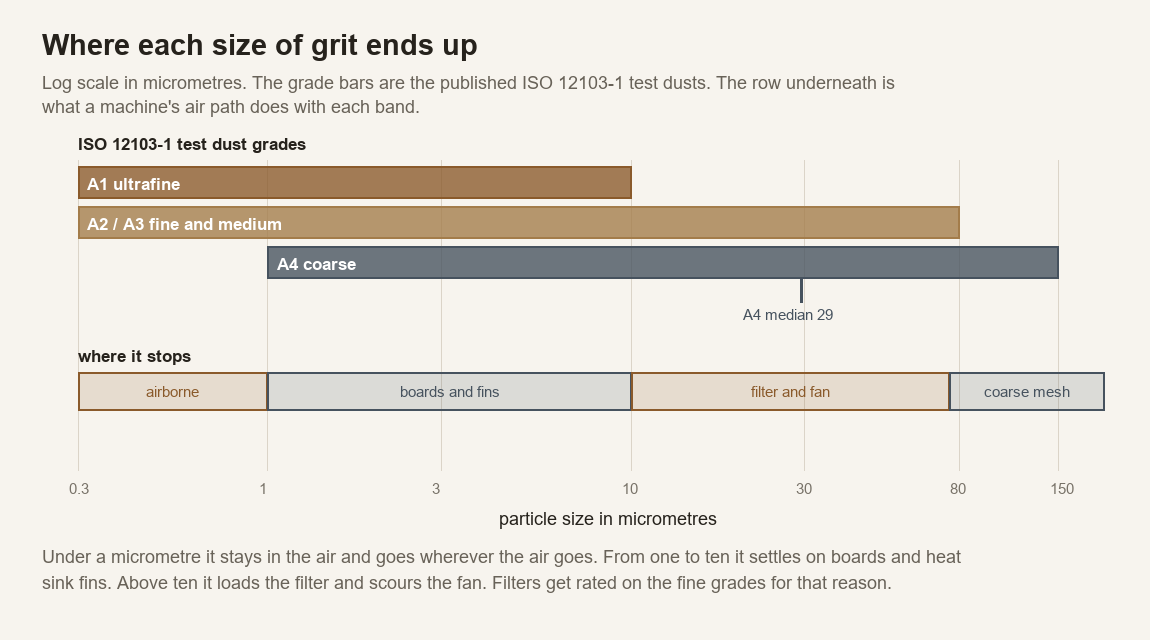
Grit sorted by size
Grade boundaries here are the published ISO 12103-1 test dusts. The row underneath maps each band to the place it comes to rest inside a machine.
Both halves matter on a W-series unit, since that class of machine works on open sites where nothing shelters it. Grit is not one substance with one behaviour. Sort it by size and it separates into bands that do completely different damage.
The filtration industry standardised those bands decades ago. ISO 12103-1 defines test dusts milled from Arizona desert sand, mostly silicon dioxide, in grades that filter makers buy by the kilogram. A1 ultrafine runs 0 to 10 micrometres. A2 fine spans 0 to 80 with a twin-peaked distribution around 4 and 20. A4 coarse covers 1 to 150, with a median grain of 29 micrometres and a tenth of its mass above 94. Military testing draws the line at the same place from the other direction. MIL-STD-810 Method 510 calls anything under 150 micrometres dust and anything from 150 to 850 micrometres sand, then tests the two with separate procedures. The dust procedure runs a concentration of 10.7 grams per cubic metre through the chamber at air speeds from 1.5 up to 8.9 metres per second, for six hours at ambient temperature and six more at the high operating temperature. The sand procedure drops the concentration to somewhere between 0.18 and 2.2 grams per cubic metre and lifts the wind to 18 metres per second or above, for at least 90 minutes on every face that gets exposed in service. Those chamber figures sit well above anything the weather produces. Air quality stations near Phoenix logged a peak hourly PM10 of 1974 micrograms per cubic metre during a major haboob. One station passed 6000. The Phoenix dust storm scale opens its category one at 1000 micrograms per cubic metre and puts category five at 5000 and above. Ten point seven grams per cubic metre in a test chamber works out near two thousand times the severe end of that scale.
Anything above roughly 75 micrometres gets caught on the first mesh it meets and builds a mat on the outside face. The 10 to 75 band goes through that mesh, loads the filter behind it, and scours fan blades and duct walls on the way. From 1 to 10 micrometres the grit passes the filtration a portable machine carries and settles out on boards and heat sink fins. Under a micrometre it barely settles at all. Particles that fine follow the airflow into any place the air can reach.
Grit off a desert floor is largely quartz. Quartz is harder than the aluminium a heat sink is cut from. Blown grains cut. A fan running in dusty air machines its own blade tips slowly for as long as it keeps turning.
Charge in the air
Blowing sand generates electricity. Grains colliding in the saltation layer near the ground swap charge in a way that sorts by grain size and leaves the fine fraction negative. Fields above 100 kilovolts per metre have been measured in blowing sand, in dust storms and inside dust devils. One study recorded 166 kilovolts per metre less than two centimetres off the ground. Fair-weather atmospheric field strength sits near 120 volts per metre, a thousand times smaller. Charged fine dust clings to surfaces electrostatically, which is part of why it reaches places gravity would never take it. An ungrounded metal case in a charged airstream also floats to a potential of its own. The first person to touch it provides the discharge path. Equipment immunity has a scale of its own. IEC 61000-4-2 sets four levels. They run from 2 kilovolts of contact discharge at level 1 up to 8 kilovolts contact and 15 kilovolts air discharge at level 4. Level 4 is the one written for industrial installations. Ask which level a machine was tested to before taking it somewhere the air is charged.
The mesh you can see through
A coarse mesh over an intake is a cheap part that does a real job. It stops leaves, insects, seeds and the sand grains you can see. It keeps a hand out of the fan too. Don’t confuse it with filtration, because the band it catches is the band that was never going to reach the electronics.
Open area is the property to check on a mesh. A fine wire screen can block a third of the intake before a single grain arrives. That reduction lands on the fan exactly as a dirty filter would. Coarse wire on a wide frame costs almost no airflow.
Three things a filter cannot do at once
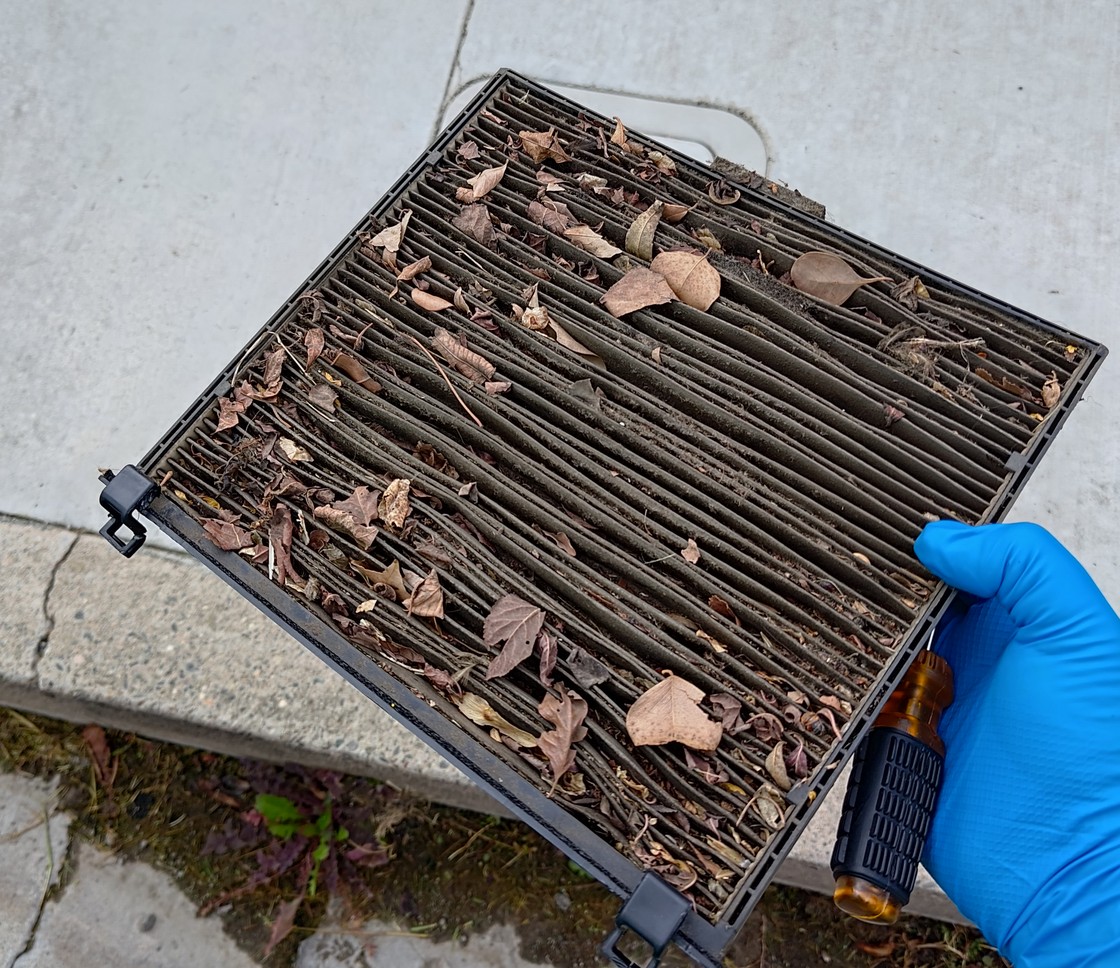
A pleated element at the end of its service, loaded with leaves and fine dirt. This one came out of a vehicle cabin, built with the pleat geometry a machine’s intake filter uses. Photo: UnifiedFunctionality, CC BY-SA 4.0.
Filter selection is a three-cornered argument between capture efficiency, pressure drop and service interval. No element wins all three. Push efficiency up with finer media and the resistance to airflow climbs with it. Efficiency has a published scale behind it. ISO 16890 rates a filter on what it captures in three size groups, with ePM1 covering 0.3 to 1 micrometre, ePM2.5 covering 0.3 to 2.5, and ePM10 covering 0.3 to 10. Anything catching under half of a group gets labelled ISO Coarse and carries no ePM number at all. Ratings round down to the nearest 5 percent. An element taking 73 percent at one micrometre, 79 at 2.5 and 92 at ten is sold as ISO ePM1 70 percent. On the MERV scale used in North America it sits around MERV 14. The top group stops at ten micrometres, the upper edge of the band that reaches boards and fins. A clean particulate element in an equipment enclosure typically costs something like a tenth to a quarter of an inch of water gauge. That sounds trivial until you put it beside a fan curve. Small axial fans, the type that fits inside a portable machine, deliver their rated airflow into almost no back pressure at all. Their output falls away steeply once resistance appears. Add a filter and the working point slides down that curve immediately. Dust then starts loading the element. Resistance climbs further. The fan responds by slowing down or by pulling more current, according to how it’s driven. Airflow falls the whole time. A partly loaded element captures finer particles than a clean one. The filter is doing its job better at exactly the moment the machine behind it is getting less air. A filter that looks like it’s working can be the filter that’s strangling the cooling. Nothing on the front panel reports the difference. HEPA practice puts the replacement point at around two inches of water gauge of accumulated resistance, roughly ten times a clean element’s figure. Equipment filters get changed on far tighter numbers. A construction site loads an element in weeks. The interval is a property of the place. Ask a maker for the element’s part number before buying the machine, because a filter nobody stocks turns into no filter at all by the second season. Ten grams of airborne solids in every cubic metre of air is what a filter faces during that test, sustained for six hours. A fan on a portable machine moves cubic metres of air every minute.
Folding media into pleats multiplies surface area inside one frame, which drops face velocity through the media and cuts pressure drop at equal efficiency. Every serious element is pleated for that reason.
Positive pressure is the other escape. Sealed industrial enclosures use it. One filtered inlet feeds the box. The box leaks outward through every other gap. Unfiltered dust never finds a path in. Portable machines rarely have the fan headroom for that approach. Where a site is dusty enough to justify the effort, an external filtered plenum around the intake achieves it.
Check what happens when a filter blocks completely. A design that derates, warns and keeps running has thought about the owner who forgot the element. Overheating is what happens where nobody thought about it.
Some enclosures fit a spring-loaded bypass. It opens when pressure drop crosses a threshold and lets dirty air through in place of no air. On a battery machine that trade keeps the machine running and leaves a maintenance debt behind it.
Heat is where the dust shows up
Dust reports itself as temperature long before anything fails. A layer on heat sink fins works as insulation. It also narrows the channels the air moves through. One fan then moves less air across a surface that has become worse at giving up heat.
What an owner sees is a machine that derates earlier in the day than it used to, or a fan that runs at full speed in weather that never called for it. Both are readings. The habit that pays is comparing this summer with last summer at one load.
A fan whose bearings have taken fine grit gets louder and moves less air at one speed. Grit inside a sleeve bearing shortens its life dramatically. Listen for a note that has changed since spring.
Cleaning, and whether to run at all
Compressed air is the instinct and it’s usually the wrong tool. A jet drives fine grit deeper into the machine, past gaskets and into bearings that were doing fine. Spinning a fan backwards on its own airstream damages the bearing it was meant to clean. Vacuum from outside, with a soft brush to lift the mat off the mesh. The dust then leaves the box altogether.
Filters come out of the machine to be cleaned. Tap a pleated element out unless the maker says the media survives water, since media that goes back in damp becomes a mould problem on top of a dust problem. Note the date on the frame with a marker each time. Two dates give an interval. That interval tells you whether the site’s getting worse.
A machine that runs through a dust storm draws air through the storm. The filter takes a season’s loading in an afternoon. Whatever fine fraction gets past it settles on boards that will be there for years.
Where the load can wait, shut down and cover up before the front arrives, with the cover anchored properly. A machine that isn’t drawing air is barely accumulating dust at all. Where the load can’t wait, run it inside a vehicle or a tent with the intake facing away from the wind. Change the filter once the storm has gone through, on its own schedule.
Give it an hour after the air clears before opening anything up. Fine dust stays in suspension long after the wind drops.
Common questions
Does a dust-tight rating mean a power station can run in a sandstorm?
No. A dust-tight rating describes a sealed enclosure. Any machine that cools itself by moving outside air through the case has openings by design. Sealing and airflow are separate questions. A portable machine has to answer both. The test that speaks to the running condition is MIL-STD-810 Method 510, which blows dust and sand at powered equipment for hours at a time.
How often should the intake filter be changed on a dusty site?
By condition. A construction site or a desert road can load an element in weeks. Mark the date on the frame each time you change it, since two consecutive intervals tell you what the site is doing better than any published figure.
What size of dust actually damages electronics?
The fraction between roughly 1 and 10 micrometres. Anything coarser gets caught on a mesh or a filter. Anything under a micrometre mostly stays airborne. The 1 to 10 band passes the filtration a portable machine carries and settles on boards and heat sink fins, which is why filter ratings are written around the fine test dust grades.
Will wind blow a power station over?
The machine itself, almost certainly not. At 30 metres per second the push on a typical case works out near 9 kilograms, on a mass several times that. The danger is anything with area attached to it. Two square metres of tarpaulin at that speed collects over 110 kilograms of force, enough to drag the machine or to tear the cover and its fixings apart.