Portable Power Station Core Technology LiFePO4 Inverter BMS MPPT
Six systems wired into one chain
Open a portable power station and six things are doing the work, of which the cells are only the most obvious. They hold the energy. Riding on top of them is a management board that watches every cell and drops the main switch the moment one steps outside its window, because a lithium cell pushed past its limits does not recover. An inverter takes the pack’s direct current and builds from it the alternating current a wall socket supplies, which is where most of the heat and most of the weight end up. Backwards along that road runs a charge controller, taking solar or wall or car voltage and trimming whatever arrives to suit the pack. Output ports hand the result back out. Wrapped around all five is a case whose job is keeping dust and water off the electronics. Beyond those six, nothing in the box matters much.
They form a chain, which is the part that changes how a specification sheet should be read, because every one of the six caps what the other five can deliver. Ten minutes is how long a 500 watt-hour pack lasts behind a 3000 watt inverter at full load, ten minutes being all that 500 watt-hours amounts to at that rate. Mismatches run the other way too, and 5000 watt-hours behind a 300 watt inverter will never boil a kettle no matter how long you wait. Feed the fastest solar input on the market into cells that fade inside two years and by year three the fast input has bought nothing at all. Marketing, meanwhile, picks whichever of the six photographs best and prints it large.
Arithmetic makes the coupling concrete: watt-hours divided by watts gives hours, before any loss is taken off. One hour is what a 2000 watt-hour pack manages behind a 2000 watt inverter at full tilt. Put that pack behind a 300 watt inverter and it goes six and a half hours at its own full output, with 1700 watt-hours of that capacity unreachable at any speed above 300 watts. Two machines holding 2000 watt-hours each can differ by a factor of six in what they hand over. Better to read the sheet from the load backwards. Add the running watts of everything meant to be on at once, check that the inverter clears that total with headroom for whatever motor starts, multiply the total by the hours needed and set it against usable watt-hours, then confirm the charge input can refill the pack inside whatever window exists between uses. Four checks in that order catch most mismatches before money changes hands.
Two ceilings printed on one label
Watt-hours count the energy held in the cells, watts how fast that energy is allowed to leave, and confusing the two produces most of the disappointment in this product category. Somebody reads 2000 watt-hours, buys for an 1800 watt induction hob, and finds out when the hob switches on that the inverter was the number that mattered. Both figures get equal weight in the label typography, which hides the fact that only one of them describes the battery at all. You need them together, because watt-hours divided by load in watts is what gives hours and neither half of that division means anything by itself. Pair 500 watt-hours with a 500 watt inverter and the machine runs flat out for an hour, whereupon raising only the inverter to 2000 watts brings full output down to fifteen minutes. Capacity never moved.
Neither figure reaches an appliance intact anyway. Rated capacity counts what the cells hold at full charge, and between those cells and a socket sit three separate deductions: firmware reserving a slice at each end of the range to keep every cell clear of both extremes, conversion from direct to alternating current running at roughly 85 percent on a pure sine inverter of this class, and idle consumption drawing away for as long as the output stays switched on. Published guidance across the category lands usable output near 85 percent of rating, which is to say that a 1000 watt-hour label is really about 850 watt-hours at an AC socket. Call it 850.
Run that deduction against something real. A 60 watt refrigerator cycling at roughly a third duty wants about 480 watt-hours across 24 hours, which against the 1700 usable watt-hours in a 2000 watt-hour machine gives three and a half days on paper, or nearer three once standby losses and a warm afternoon have taken their share. Size a station against rated capacity and you will be short by about a sixth, every time. Cycle counts have a related problem, in that they get quoted with the depth left off. One trip from full to empty and back is a cycle at 100 percent depth. Take a cell only down to 20 percent remaining and published cycling data for phosphate chemistry shows the count climbing by a large multiple, because the damage lives at the two extremes. Which means a 5000 cycle claim measured at 80 percent depth and one measured at 100 are describing two different products. Firmware reserving a slice at each end is buying cycle life with capacity the buyer paid for.
Pack voltage decides what you can lift
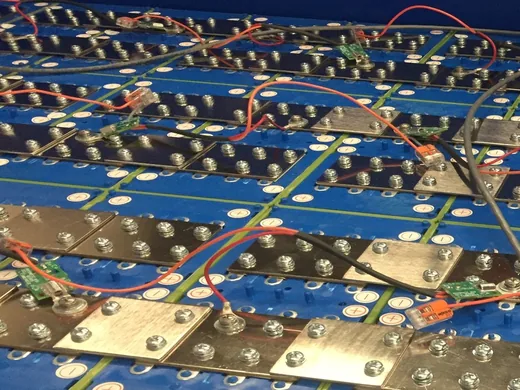
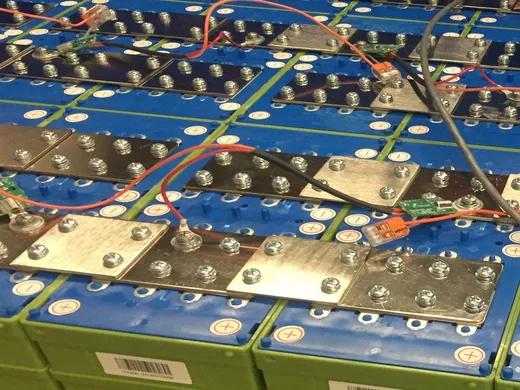
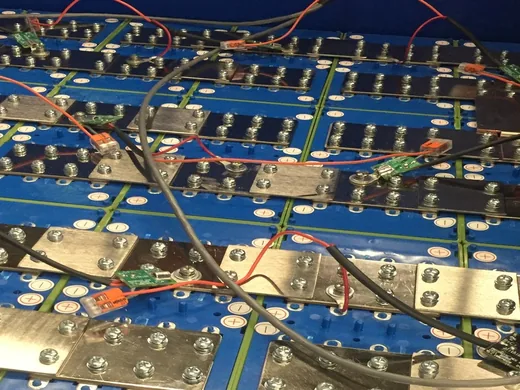
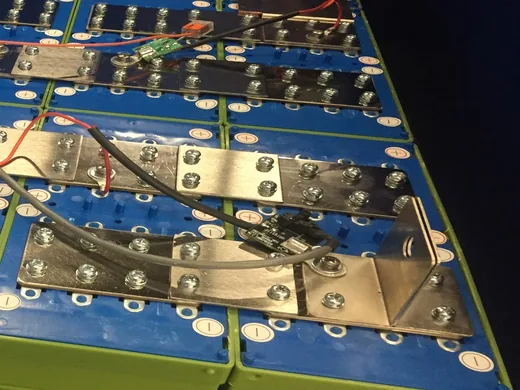
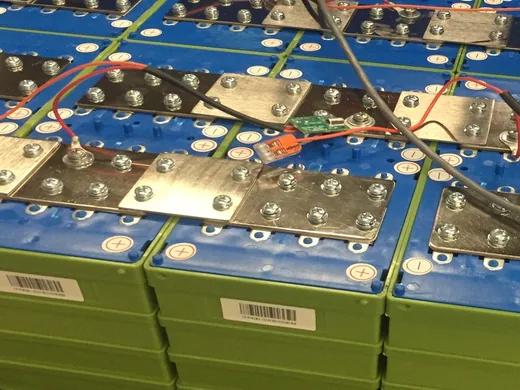
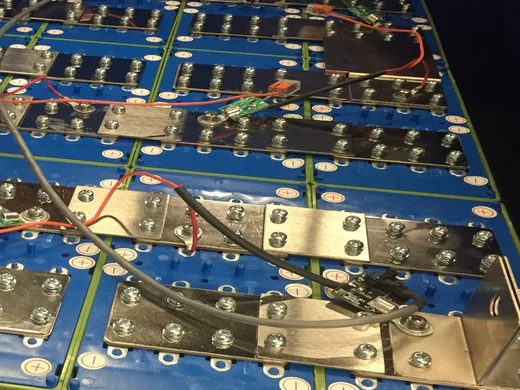
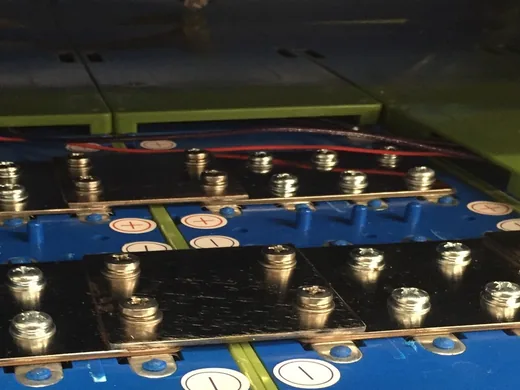
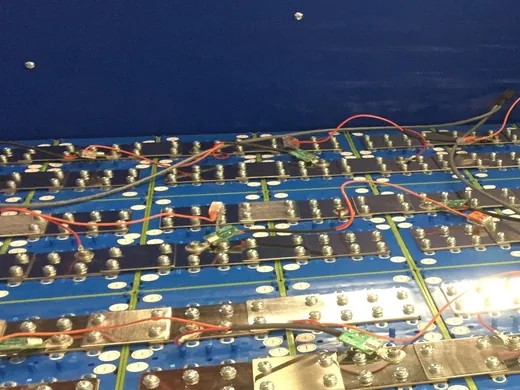
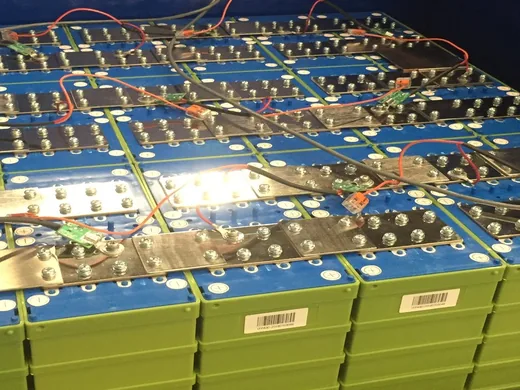
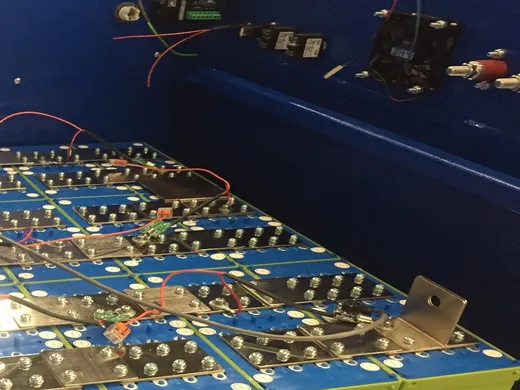
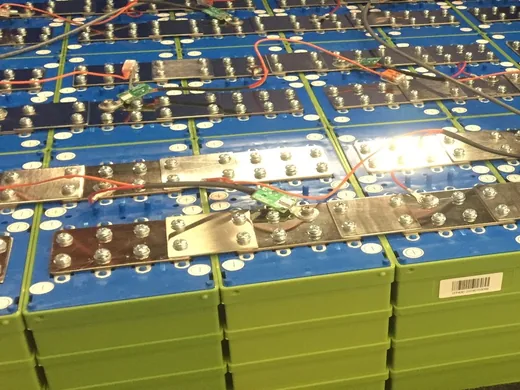
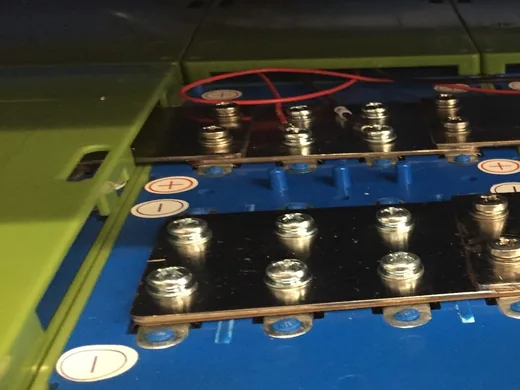
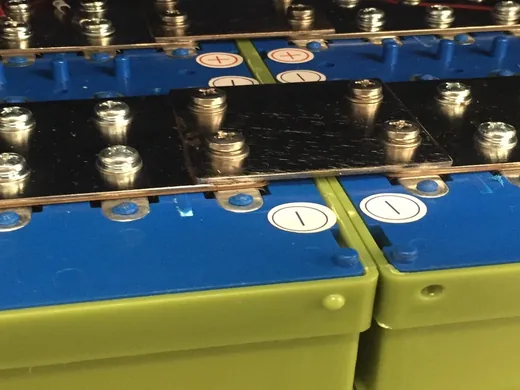
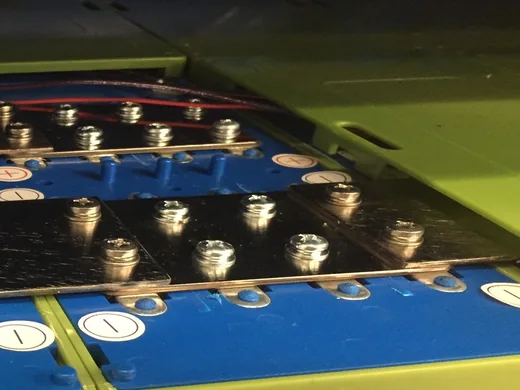
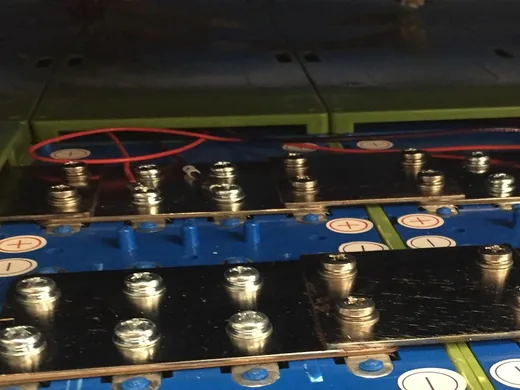
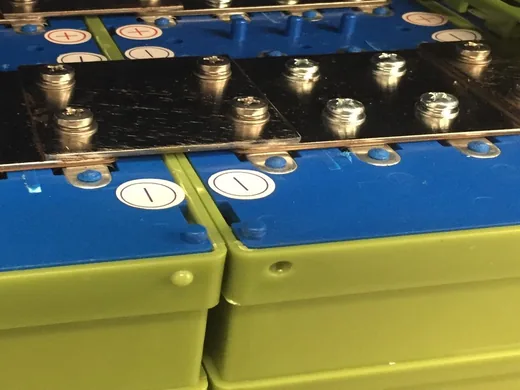
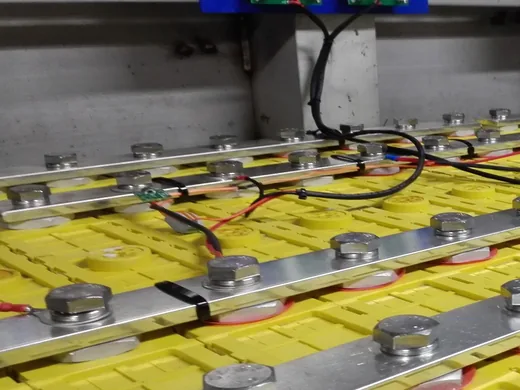
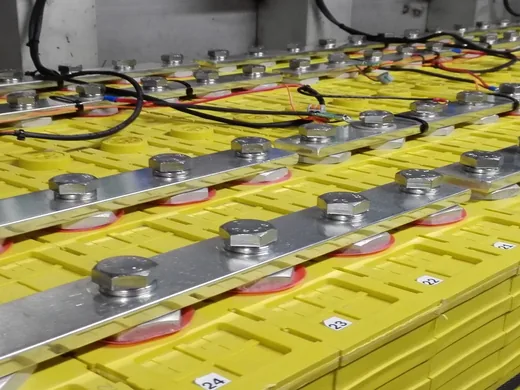
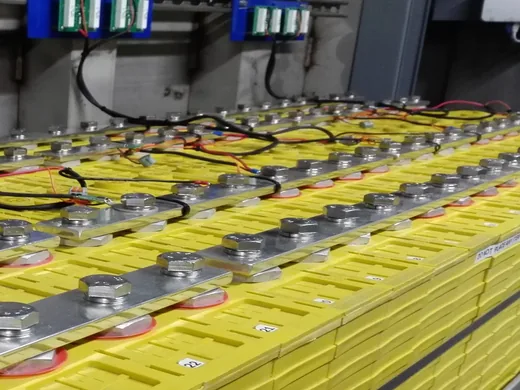
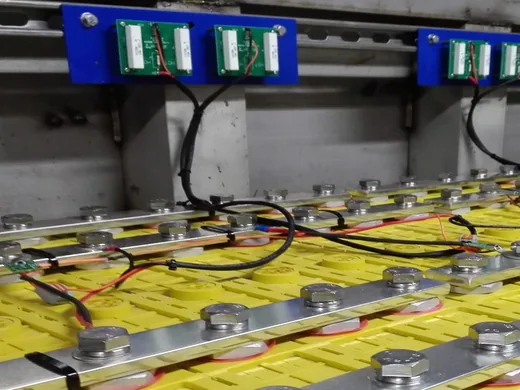
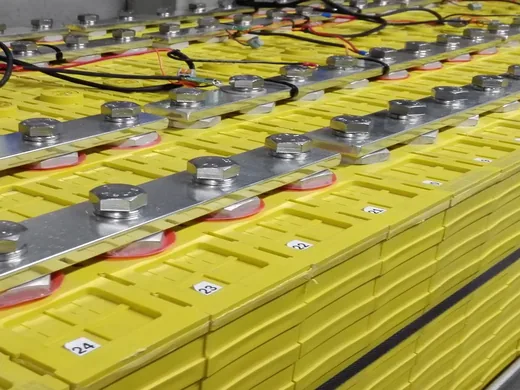
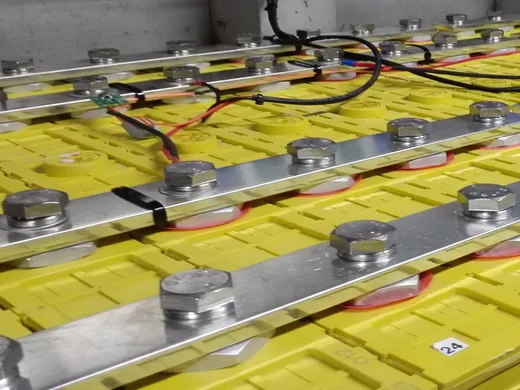
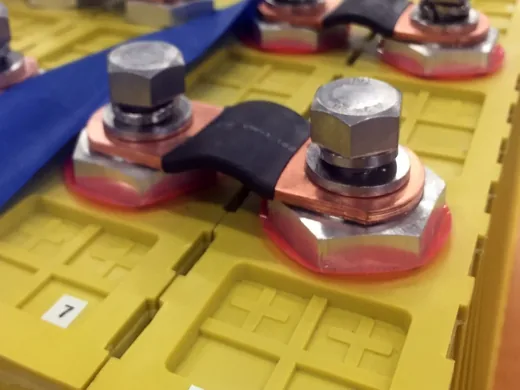
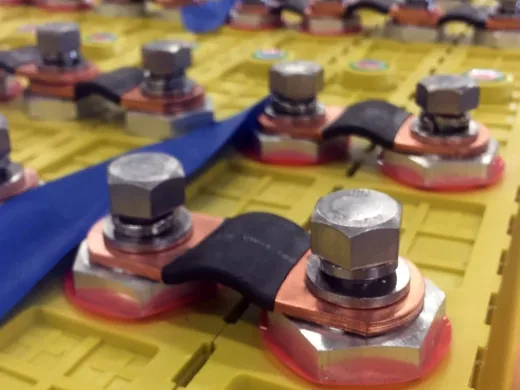
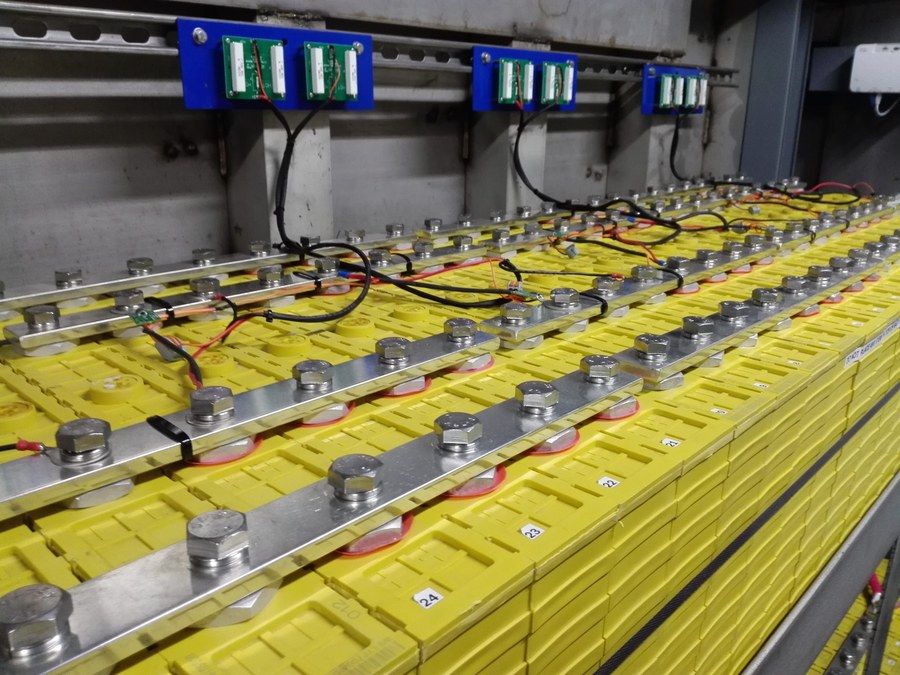
Prismatic lithium iron phosphate cells joined across their terminals by flat busbars, with balancer boards on the rail above and a sense lead running to each series group. A portable station uses this arrangement at a smaller scale. Photo by Yo-Co-Man, CC BY-SA 4.0.
Series count decides pack voltage, and pack voltage governs almost everything mechanical about the box, which is why a number that never appears on a label ends up deciding what the machine weighs. A lithium iron phosphate cell holds 3.2 volts nominal, putting eight in series at 25.6 volts and sixteen at 51.2. Small units mostly take the first arrangement, larger ones the second. Work a 2000 watt-hour pack through both and the consequences show up quickly enough. At 25.6 volts you need 78 amp-hours, which is eight cells of 80, where 51.2 volts wants 39 amp-hours out of sixteen cells of 40. Delivering 2000 watts then asks 78 amps of the low-voltage pack against 39 for the other, and because conduction loss goes as the square of current, doubling the voltage takes that loss down to a quarter. Thinner wire, smaller busbars, a cooler interior: one decision, made before any of the rest.
Under all of it, cell mass sets a floor nobody can design around. Commercial prismatic lithium iron phosphate cells in the 100 to 314 amp-hour range hold about 130 to 160 watt-hours per kilogram, where nickel manganese cobalt, the chemistry in laptops and cars, reaches 150 to 250 on that basis. Take the middle of the phosphate range and a 2000 watt-hour pack is carrying close to 14 kilograms of cells before the case, the inverter, the heatsinks or the handle have been added, which is how finished machines of that size end up near 20 kilograms. Past that they arrive on wheels, for a reason no marketing department chose.
The cell and the board sitting on top of it
That weight penalty was chosen deliberately. Lithium iron phosphate cells at 130 to 160 watt-hours per kilogram trade roughly a third of the energy density nickel manganese cobalt would have given them, and what they buy with it is thermal stability and cycle life. Oxygen sits in a stronger bond in phosphate, which raises the temperature at which a damaged cell begins feeding its own heating. A pack of the stuff left in a closet for a year loses very little for having been left there. Every quality station in this category now runs on it.
Sixteen cells wired in series and left to themselves are not a safe object, one weak member dragging the whole string and any cell driven past its voltage window degrading fast or venting. A management board watching all sixteen series groups reads every cell voltage, bleeds the high ones down to meet the low ones, keeps an eye on pack temperature, and opens the main switch the moment any reading leaves its window. The state of charge on the screen comes off that board too, integrated from current in and out, that being the only place in the machine such a number could come from. Nothing else is counting.
Cells fade whether they work or sit, cycling costing a fraction of capacity each time round and calendar ageing taking a slow trickle from a pack doing nothing whatever. Depth of discharge moves the cycle count far enough that a 5000 cycle claim means very little with the depth left off it. Then there is the question of what happens after eight or ten years, when the cells are worn and the inverter, the case and the electronics are all perfectly fine. Whether a worn pack can be swapped at that point decides which of them goes to landfill: some designs take a bolt-in module, others have the pack glued to the chassis. Price tracks the cells more closely than any other component, roughly half the mass and a large share of the bill of materials being pack. A machine undercutting the market by a third has usually found that saving in cell grade, in how carefully the cells were matched before assembly, or in the board that watches them. None of which is visible until about year four.
Making wall power out of a battery
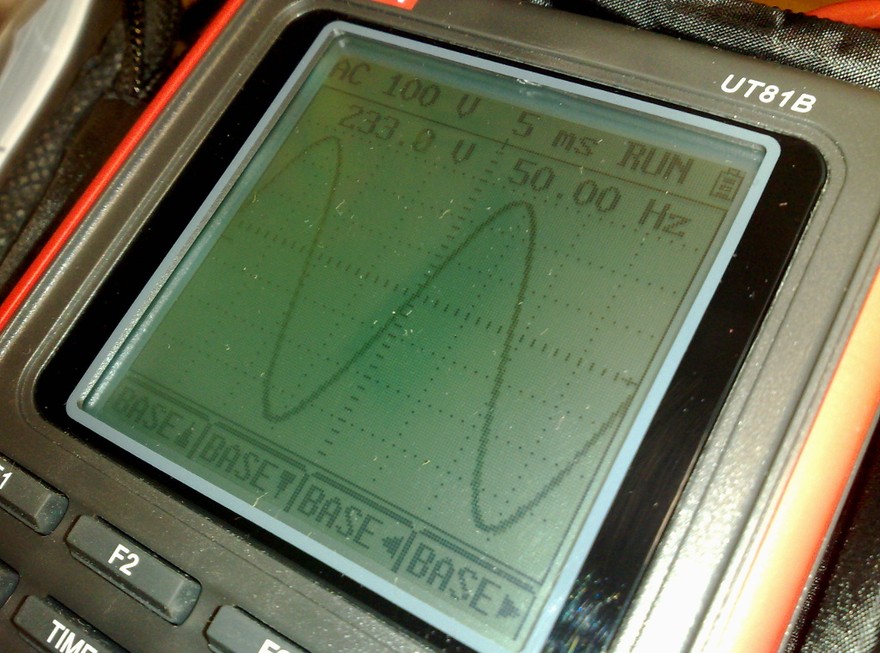
Measured output of a battery-fed inverter on a handheld oscilloscope: 233.0 volts at 50.00 hertz, 100 volts per division vertically and 5 milliseconds per division horizontally. Two clean half-cycles fill the screen. Photo by Dsimic, CC BY-SA 3.0.
Inverting is the heaviest electrical work in the box. Switching transistors chop the pack’s direct current into a train of pulses whose widths vary across each cycle, after which a filter of inductors and capacitors rounds that train off into something smooth, arriving at 120 or 230 volts and held at whatever the local grid runs, 50 hertz or 60. How close that curve comes to a true sine wave decides whether a motor runs cool or hums, whether a sensitive monitor works or reads its supply as noise. One screen on an oscilloscope settles it.
None of it is free. Somewhere between a tenth and a seventh of the power crossing the inverter leaves as heat in the transistors and the magnetics, split between switching losses driven by frequency and conduction losses driven by current. Every watt of it has to be out of the case before something inside crosses a limit. Hence the fans and the metal chassis on a 2000 watt machine. Efficiency falls away at very light loads as well, where the fixed overheads dominate, and running a 15 watt router through a 2000 watt inverter wastes more in conversion than the router itself consumes. Hence the fans.
Continuous rating and surge rating answer different questions, which is the distinction most tripped stations come down to. At the instant a motor starts, before the rotor turns and back electromotive force has had a chance to build, current is limited by winding resistance alone, and that figure, locked rotor current, typically reaches five to seven times running current on a compressor and holds anywhere from a fraction of a second to a few. So a 1000 watt inverter will carry a 700 watt refrigerator all day and still fall over the moment the compressor restarts. Surge ratings exist for that half-second.
Sizing follows from both numbers together: add the running watts of everything on at once, then check that the largest single motor’s inrush still fits under the surge ceiling with that running total already sitting underneath it. A workshop with a 900 watt saw wants an inverter rated well past 900, a circular saw biting into timber pulling several times its plate rating for a moment. Size on running watts alone and the surge finds you anyway. Owners tend to describe that as the station tripping for no reason. There is always a reason.
Efficiency, in any case, is a curve across load. A single number on a datasheet says very little. Losses divide into a fixed part that stays put whatever the load and a conduction part that climbs with current, which means that at a tenth of rated output the fixed part dominates and efficiency drops sharply, while the curve peaks somewhere around half to three quarters of rating. Datasheets quote the peak. Real use often sits far down the left-hand side of it, a 2000 watt machine driving a 40 watt laptop, overheads costing more than the laptop. Peaks are for datasheets.
Watts a station spends doing nothing
Switching the AC output on costs power before anything has been plugged into it, because keeping an inverter live means holding the switching stage running, the filter energised and the display lit whether a load exists or not. Across this product class that idle consumption falls between 5 and 30 watts, most machines landing between 8 and 25. Measured figures collected across common sizes put a 300 watt-hour unit at 8 watts idle down 96 watt-hours over twelve hours, roughly a third of its pack, a 1000 watt-hour unit at 15 watts down 360 in a day, a 2000 watt-hour unit at 25 watts down 600. None of it went anywhere useful.
Thirty to 48 percent of a pack per day, then, with nothing connected. Leave a machine switched on over a long weekend and it will empty itself for you. Deep sleep modes are what stop that happening, dropping the inverter out and waking on a button press or on the first current from a solar panel. A backup unit meant to sit on a shelf for six months depends on nothing else quite so much. Owners reporting a flat station after a quiet week have almost always left the AC output live.
Route around the inverter and the arithmetic changes completely. In one published comparison a 15 watt router fed from a station’s DC output ran 66 hours where the AC socket gave 40, the extra 65 percent coming out of conversion overhead alone with the router drawing its 15 watts throughout. Anything on 12 volts belongs on the DC port, as does any low-wattage device left on overnight. Charging walks the identical chain backwards: energy from a wall socket crosses a rectifier and a charge controller before it reaches the cells, losing a tenth or so on the way, which is why filling a 2000 watt-hour pack from empty draws closer to 2200 watt-hours out of the wall. Solar is worse again, panel output having to cross the tracker as well. Push 100 watt-hours in from a panel and expect around 80 at an AC appliance once both conversions and the standing idle draw have been paid. Specification sheets rarely carry round-trip efficiency, which is the one figure worth comparing between machines. Very few publish it at all.
Three doors in, one row of doors out
Three sources refill a pack, and better machines take more than one at a time. Wall charging moves the most power, one to two hours for a mid-size unit on the faster settings. Car charging trickles in through a cigarette socket at 100 to 150 watts, useful across a long drive. Solar comes in through a tracker hunting for the panel’s maximum power point as the clouds move, and tracking that moving point across a day recovers 15 to 30 percent more harvest than a controller clamping the panel to battery voltage. That gap is why trackers exist.
Input ceilings matter as much as input types do. A machine accepting 200 watts of solar fills at 200 watts no matter how many panels get hung off it, extra panels past the cap buying earlier starts and later finishes on cloudy days without ever lifting the peak. Voltage limits bite harder, because a string that opens above the tracker’s maximum input on a cold bright morning will shut the input down or damage it, and open circuit voltage climbs by around 0.3 percent for every degree below 25. Cold mornings are when arrays die.
On the way out, power splits across a row of sockets with individual ceilings underneath one shared total, the low-voltage ports coming off a separate converter from the AC side with a car socket or a USB outlet drawing from the pack without troubling the inverter at all. Which ports a machine carries and what each one caps at decides what it actually serves. Phones and a cool box want a car socket and a pair of USB outlets, an RV wants a high-current Anderson connector, a workshop wants household AC. On most machines those port ceilings add up to more than the inverter can supply, which you find out the first time every socket is loaded at once. The inverter has the last word.
Those ceilings also move as other loads appear, since USB-C sockets negotiate their power level with whatever is plugged in and a laptop asking 100 watts alongside a phone asking 30 can force a shared 100 watt converter to cut one of them back. AC sockets on a shared inverter do the identical thing at a larger scale. A per-port cap published alongside the total is describing real firmware behaviour. Where only the total appears, the buyer works out the split by experiment.
Heat and cold set the real limits
Temperature governs this machine at both ends of the thermometer. Each end fails in its own way. Charging a lithium iron phosphate cell below freezing plates metallic lithium onto the anode surface. Damage of that kind is permanent. Firmware blocks charge current under 0 degrees. Field-grade machines add a heater to bring the pack up first. Discharge below freezing works, at reduced output. At the hot end, cells and electronics both derate: a pack worked hard at 35 degrees returns close to a tenth less than one at 15, partly from the derating and partly from its own heat adding to the ambient. Heat inside the case arrives from three sources at once: cells warming as current crosses their internal resistance, the inverter shedding a tenth of everything it converts, and sun on the lid whenever the machine sits outdoors. Fans and a metal chassis move that heat out. Firmware slows the machine deliberately when they cannot keep up. A bench test in a cool room flatters any unit destined for a hot van. Fan noise arrives as the audible cost of all this, loudest when the machine works hardest. Units meant for a bedroom trade output for quiet. An IP54 rating covering dust and splashing water plus an internal frame that survives a drop mark out a machine built for a job site from one built for a desk. Ratings of that kind describe a laboratory test. Nobody promised anything about a rainstorm. IP54 means protection against dust in harmful quantity and against water splashed from any direction, with nothing said about immersion, jets or a machine left out overnight in a downpour. Owners who read the two digits carefully avoid most of the warranty arguments in this category. Storage temperature carries its own rule, separate from both limits above. Calendar ageing answers to temperature and state of charge together. A pack parked full in a hot vehicle ages faster than one held at half charge in a cool cupboard.
Which number to read first
Which number comes first depends on the job. Camping with phones to charge and a fan to run, you read watt-hours and solar input, a modest inverter being enough for the rest of it. On a job site with a circular saw the surge rating comes first, running watts alone not being able to start the tool. Buying for home backup you read cycle life and warranty, that machine possibly sitting charged for four years before its one hard week arrives. Running a CPAP overnight, it is usable watt-hours against 30 watts for eight hours. Call it 240 watt-hours a night.
Shortfalls trace back, almost always, to one number nobody checked. The 300 watt-hour unit bought for a CPAP runs dry before dawn, its capacity never having been set against 240 watt-hours of overnight demand. A 2000 watt unit bought for a well pump trips on the first start, its surge ceiling never checked against an inrush five to seven times running current. In both cases somebody read a large number on a box and stopped. And these machines ship as a sealed matched set, inverter and charge controller and pack chosen together and wired behind one panel, with nothing swapping in later. An owner who outgrows the inverter is buying a second machine. That permanence is what makes an hour of arithmetic beforehand worth spending. Four numbers cover it: the running total of everything on at once, the inrush of the largest motor, watt-hours needed between charges divided by 0.85, plus whatever charge rate the window between uses allows. Every one can be read off an appliance label or worked out on paper. Not one of them appears on the front of the box.
Figures behind each subsystem, with the arithmetic or the source for each one
Quantity
Figure
Where it comes from
LiFePO4 nominal cell voltage
3.2 V
8 in series give 25.6 V, 16 give 51.2 V
LiFePO4 energy density
130 to 160 Wh/kg
commercial prismatic cells, 100 to 314 Ah
NMC energy density
150 to 250 Wh/kg
same measurement basis
Cell mass in a 2000 Wh pack
about 14 kg
2000 divided by 145 Wh/kg
Pack current at 2000 W
78 A at 25.6 V, 39 A at 51.2 V
conduction loss falls to a quarter
Usable share of rated capacity
about 85 percent
1000 Wh label delivers about 850 Wh
Pure sine inverter efficiency
about 85 percent, DC to AC
portable class, mid-load
Inverter idle draw
5 to 30 W, commonly 8 to 25 W
measured across common sizes
Idle loss, 300 Wh unit at 8 W
96 Wh over 12 hours
about 32 percent of the pack
Idle loss, 1000 Wh unit at 15 W
360 Wh over 24 hours
about 36 percent of the pack
Idle loss, 2000 Wh unit at 25 W
600 Wh over 24 hours
about 30 percent of the pack
15 W router, AC socket against DC port
40 hours against 66 hours
65 percent more runtime
Motor locked rotor current
5 to 7 times running current
compressor inrush, under a few seconds
MPPT gain over PWM
15 to 30 percent more harvest
across a day of moving cloud
Car socket charge rate
100 to 150 W
cigarette lighter outlet
Charge cutoff temperature
0 degrees
below it, lithium plates on the anode
Warm running penalty
about 10 percent at 35 degrees
against an identical pack at 15
Panel voltage rise when cold
about 0.3 percent per degree below 25
open circuit voltage
Common questions
What is actually inside a portable power station?
Six systems: a lithium cell pack, a management board, an inverter, a charge controller, a set of output ports and a sealed case. Cells store the energy at 3.2 volts each, wired eight or sixteen in series. Everything else exists to protect them, convert their output or refill them.
Why does a 1000 watt-hour machine deliver less than 1000 watt-hours?
Three deductions sit between the cells and the socket. Management firmware reserves a slice at each end of the range, conversion to AC runs near 85 percent, and idle consumption draws while the output stays live. Expect about 850 watt-hours at an AC load.
What is the difference between watt-hours and watts?
Watt-hours count energy held, watts count how fast it can leave. A 2000 watt-hour pack behind a 300 watt inverter holds plenty and delivers slowly. Both figures appear on the label in identical typeface, and only the first describes the battery.
Why do power stations use LiFePO4 instead of the chemistry in laptops?
Lithium iron phosphate gives up about a third of the energy density available from nickel manganese cobalt, at 130 to 160 watt-hours per kilogram against 150 to 250. In exchange it tolerates far more cycles and behaves calmly when damaged or overheated. A heavier machine that lasts a decade suits this job better.
My station keeps tripping when the fridge starts. What went wrong?
Surge current did, in place of running power. A compressor pulls five to seven times its running current for a fraction of a second as the rotor breaks away. A 1000 watt inverter runs a 700 watt fridge comfortably and can still trip on every restart. Read the surge rating, and treat the continuous figure as a separate question.
Does leaving the AC output switched on matter?
It empties the pack. Idle draw of 15 watts on a 1000 watt-hour machine costs 360 watt-hours a day, about a third of the battery, with nothing plugged in. Switch the output off, or use a deep sleep mode, or run low-power devices from the DC port.