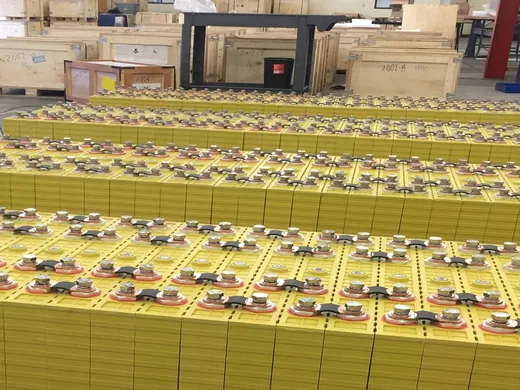
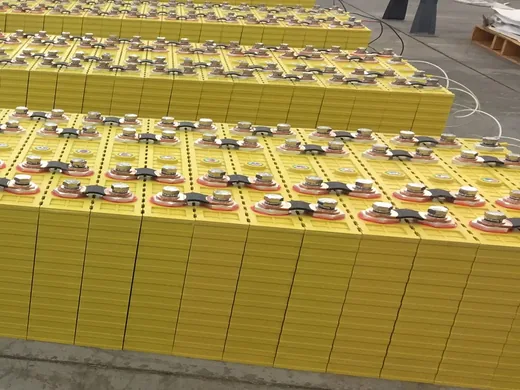
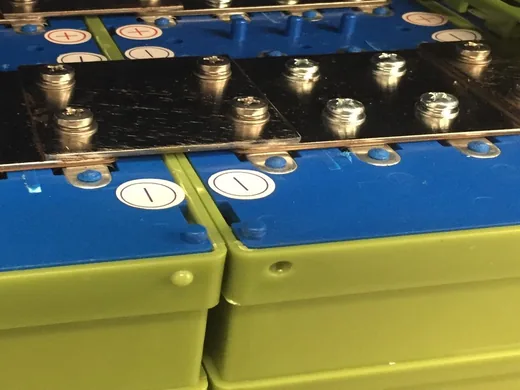
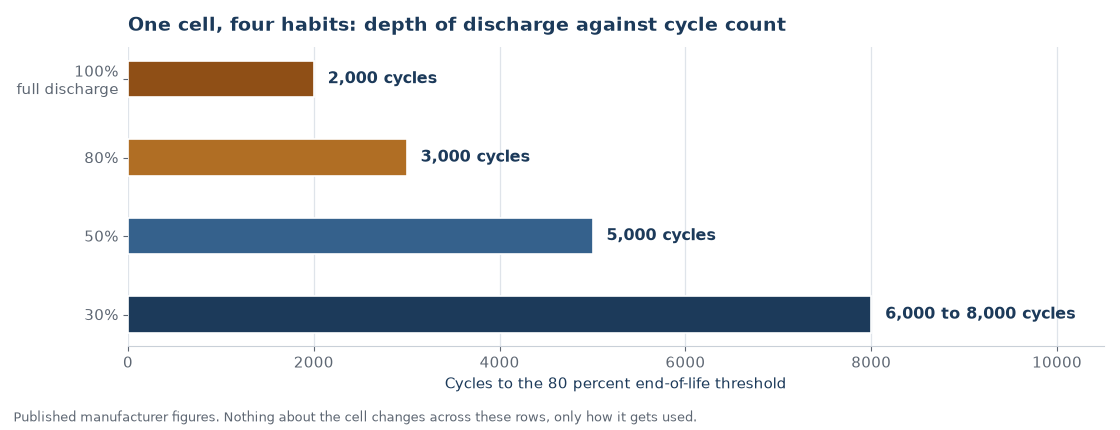
The widest lever anybody has over a pack. Nothing about the cell changes between these rows, only how deeply its owner works it each time.
Every portable power station quotes a cycle count. Three thousand, four thousand, six thousand on the ambitious ones. The figure looks like a property of the cells, in the way that a mass or a voltage is a property of them. It’s nothing of the sort. A cycle count is the result of one test, run under conditions the marketing copy never states, and four of those conditions decide the answer between them. Test temperature comes first, since 25 degrees is the standard and anything warmer shortens the count. Depth of discharge comes second, because a cell taken to 30 percent and back survives many times more cycles than one worked from full to empty every time. Charge and discharge rate come third, with slow charging at or below 0.5C promoting even lithium diffusion and gentler ageing. The end-of-life threshold comes fourth, and moving it from 80 percent capacity down to 70 raises the published figure without anybody touching the cell.
The end-of-life line itself is settled by IEC 61960-3 for anybody who follows it, which fixes end of life at the point where capacity falls to 80 percent of the original rating. The other three stay open to whoever writes the datasheet. Two manufacturers can both quote honest numbers that differ by a factor of three, on cells off one production line, which is why comparing two cycle counts without their test conditions compares nothing at all.
Depth of discharge is the variable with the widest leverage, and published tables show it plainly. One manufacturer’s figures put a full 100 percent discharge at around 2,000 cycles, 80 percent at around 3,000, 50 percent at around 5,000, and 30 percent at somewhere between 6,000 and 8,000. Translated into daily use, that table runs from five or six years at the deep end out to twelve or more at the shallow one. Nothing about the cell changes across those rows. Only the habit of the person using it changes.
Switch from counting cycles to counting energy and the picture sharpens further. Two thousand full cycles on a 1 kilowatt-hour pack move 2,000 kilowatt-hours in total. Five thousand half cycles move 2,500. Shallow use delivers more energy across the working life of the pack and asks less of it on any given day, which is the whole argument for leaving headroom at both ends of the range. Charging to 80 and stopping at 20 costs nothing you’ll ever notice on a machine sized correctly in the first place.
Published tables also disagree with each other. The disagreement is itself the point. No single table is defective. Some datasheets put a full discharge nearer 500 cycles and a 10 percent one nearer 10,000. Nothing reconciles the two sets of numbers except reading the test conditions behind them. Checking a figure against a real machine takes a load and a meter, which is the ground third party measurement of a cell’s rated capacity covers in detail.
Heat is the other multiplier
Temperature works on a cell whether or not anybody is using it. Published guidance puts nominal cycle life at temperatures between 10 and 35 degrees. Run the identical cell between 45 and 60 and the figure drops by 20 to 40 percent, through accelerated growth of the passivation layer on the anode surface. Past 60 degrees the loss reaches 60 percent or more. The mechanism changes character as well, with surface chemistry giving way to structural damage inside the electrode material itself. No amount of careful use afterwards reverses that. Those percentages come straight off the cycle count. A pack rated 3,000 cycles at 25 degrees is a pack rated somewhere near 2,000 in a hot shed, on a specification sheet that prints 3,000 either way. Nobody’s lying. The test was run at 25 and the shed isn’t 25. The rule of thumb behind those bands is simpler than the bands themselves: every 10 degrees above 25 speeds the chemistry up, which is why guidance for hot climates puts the loss at 15 to 30 percent of the rated cycle life before anybody has cycled anything. A machine sold on a 3,000 cycle figure and shipped to a place where sheds sit at 45 all summer was quoted a number from a different country.
How fast heat escapes depends partly on how the cell was built, which is one of the quieter arguments inside the trade-off between cylindrical and prismatic cells. A steel can with a small cross-section moves heat to its surface one way. A large flat face clamped hard against its neighbours does it another. The difference shows up across years, never across an afternoon.
Two clocks, and the one most owners never read
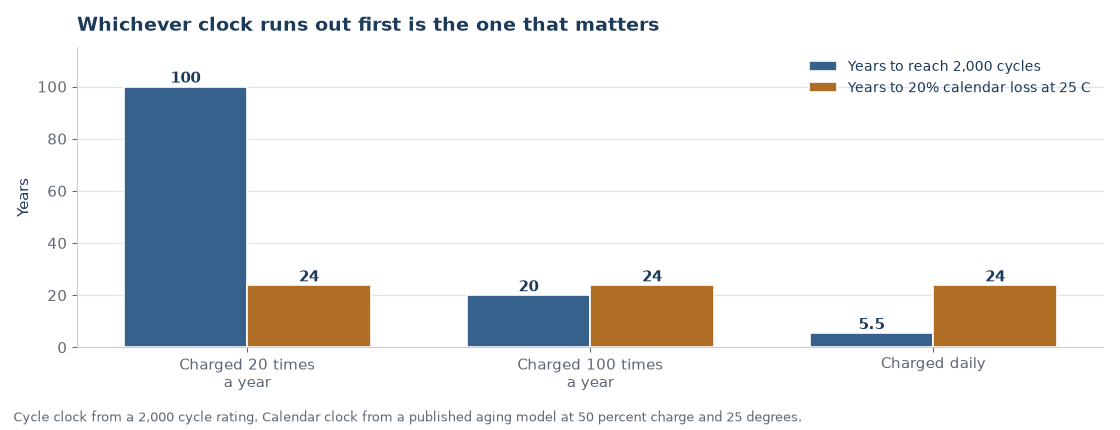
Twenty charges a year puts the cycle rating a century away while the calendar arrives in twenty-four. Charge daily and the order reverses. Somewhere near a hundred charges a year the two clocks cross.
A pack ages two separate ways at once. Cycle aging is the one everybody quotes. Each charge and discharge moves lithium in and out of the electrodes, strains the material a little, and costs a small fraction of the capacity. Calendar aging is the other. It runs whether the machine works daily or sits in a cupboard untouched. Its mechanism is the slow growth of the solid electrolyte interphase, the passivation film on the anode, which consumes active lithium and raises internal resistance as it thickens. That growth follows a square root of time law, which makes the first weeks of a pack’s life cost more capacity than any equivalent stretch a decade later. Research into low-usage cells is blunt about which clock wins: where cycle depths and currents stay low, calendar aging dominates the result outright. Put numbers against a real household machine and the gap turns startling. A unit charged twenty times a year needs a century to reach a 2,000 cycle rating. One published calendar-aging model puts the wait for a 20 percent capacity loss at around 23.8 years with the pack held at 50 percent charge and 25 degrees, falling to about 8.7 years at 40 degrees. The cycle number never becomes the limit for that owner. The calendar does. It arrives roughly four times sooner than the figure printed on the box would suggest. Storage temperature and storage charge level decide the outcome, which makes where a machine spends its idle months matter more than what it does on the days it works. Heavy users invert the whole picture. A machine cycled daily reaches 2,000 cycles inside six years, at which point cycle aging is the binding constraint and the calendar has barely started counting. Somewhere between twenty charges a year and three hundred and sixty-five lies a crossover. Every owner sits on one side of it. Working out which side you’re on takes one year of counting charges. An owner on the calendar side should spend their attention on where the machine sleeps and at what charge. An owner on the cycle side should spend it on depth of discharge and charge rate, since those are the only two levers that touch the count.
What the warranty actually covers
Cycle ratings and warranty terms come from different departments. The gap between them is easy to measure. Published cycle claims across the major brands run 3,000 to 4,000, with one premium range reaching past 6,000. Warranty terms line up nothing like that. One maker offers five years as standard across its whole catalogue, covering both cell degradation and the electronics around them. A second ships two to three years depending on the model and where it was bought, with three years available for buying direct and an extension to five sold separately. A third lands in that two to three year band as well. The pattern holds across the category: the cycle figure belongs to the cells, the warranty belongs to the company, and nobody ever negotiated the two together.
Set one against the other. A 3,000 cycle rating consumed at one cycle a day takes 8.2 years to exhaust. A three year warranty covers 1,095 of those cycles, a little over a third. The cell specification and the commercial promise are describing different lengths of time, and only one of them carries an obligation. Warranty wording repays reading closely for a second reason. The better terms cover capacity falling below 80 percent inside the period, which converts the IEC threshold into something enforceable. Weaker terms cover defects alone, meaning a pack that fades on schedule has no claim attached to it, whatever its owner feels about the fade.
Neither arrangement is dishonest. A buyer who reads the cycle number as a guarantee has simply read the wrong document. The guarantee’s the shorter number, further down the page.
Eighty percent, and the shape of the curve
End of life sounds terminal. What it describes is a cell holding 80 percent of the capacity it shipped with. On a 1 kilowatt-hour machine that’s 800 watt-hours and a device that still does most of what it did before. The threshold exists for two practical reasons. Degradation accelerates past that point on several chemistries. A line has to be drawn somewhere for warranty arithmetic to function. Iron phosphate cells routinely carry on for thousands of cycles beyond it at slowly declining capacity, which makes a pack reaching its rated count a reason to measure it before replacing anything.
Predictions about the far end of that curve are cheap. Measurements are not. The few long studies that exist are worth more than any datasheet projection. The honest version of a ten-year answer separates two populations: machines cycled hard for a decade land in one place, machines that spent it on a shelf at a sensible charge level land somewhere much closer to where they started. Anybody who wants that detail with figures attached should read the condition of a power station after ten years of use.
Capacity loss is not a straight line drawn from new to worn out. The fade follows a root curve against elapsed time, running fastest when the pack is newest and slowing steadily from there. Anybody watching a display closely through the first months is looking at the steepest part of the whole trajectory, and reasonably concludes the machine is in trouble. Extrapolating from that early slope produces alarming answers that turn out wrong. A pack giving up 4 percent in its first year is not on course to surrender 40 percent by year ten. Grid-scale iron phosphate installations are generally expected to lose somewhere between 20 and 30 percent across a first decade of daily work, a far gentler average than the opening months suggest.
The mechanism explains the shape. A fresh anode grows its passivation film quickly, since bare surface is available for the reaction. As that film thickens it slows its own growth, because lithium has further to diffuse before reaching anything unreacted. Chemistry that starts fast and then throttles itself produces exactly the curve the long datasets show.
Power fades before energy does
Capacity is the number everybody watches. Internal resistance is the one that changes the experience first, in a way the percentage display cannot show. As the passivation layer thickens, resistance climbs. Voltage under load sags further than it used to, bringing the pack to its low-voltage cutoff sooner and making a heavy load behave like a heavier one. A machine that started a compressor without complaint in year one can trip on that identical compressor in year seven, on a pack still holding 85 percent of its rated energy. Runtime on small loads looks almost unchanged. Starting current is where the age announces itself, which is why the first symptom an owner meets is usually something refusing to start, well before anything runs short. Watching that happen from the outside, and separating it from a genuine fault, is the subject of how battery aging affects output power. Catching it early costs one measurement a year. Put a known heavy load on a full pack, read the voltage a second after it settles, and write the figure down. Voltage sag under an identical load, measured identically each year, tracks internal resistance more honestly than any percentage the machine chooses to display.
Measuring what you actually bought
A load, a meter and an afternoon settle every figure quoted so far. Discharge a full pack at a steady modest rate, time it, then multiply the two. Delivered energy in watt-hours falls out. Compare that against the nameplate and against last year’s figure. Two cautions apply to the method. Measure at a low rate, since a hard discharge understates capacity through voltage sag and inflates the apparent loss. Measure at room temperature as well, because a cold pack delivers less and gives it back once warm. Neither caution needs equipment beyond a known resistive load and a watt-hour meter. A 100 watt lamp and a plug-in energy monitor will do it on an AC output. A car bulb with a cheap DC meter handles the 12 volt side. What matters is repeating the identical setup, since the absolute figure matters less than the difference between this year’s and last year’s. Measuring at an AC socket puts the inverter inside the measurement. An inverter running at a small fraction of its rating wastes a large share of what passes through it. A pack that looks 15 percent down on an AC test can be 5 percent down at the cells, with the other 10 sitting in a conversion stage that was never part of the question.
What the same cell reports under different published test conditions
Condition changed
Typical published figure
Effect on the cycle count
100 percent depth of discharge
around 2,000 cycles
baseline
80 percent depth
around 3,000 cycles
up by half
50 percent depth
around 5,000 cycles
up 150 percent
30 percent depth
6,000 to 8,000 cycles
up threefold
Run at 45 to 60 degrees
minus 20 to 40 percent
whatever the row above said
Run above 60 degrees
minus 60 percent or more
structural damage
End of life set at 70 percent
higher than 80 percent gives
no change to the cell
Run the identical test annually on the identical load and you’ll see the drift long before it turns into a problem. Three data points across three years say more about a specific machine than any figure a manufacturer prints about a population of cells.
When the pack outlasts the machine around it
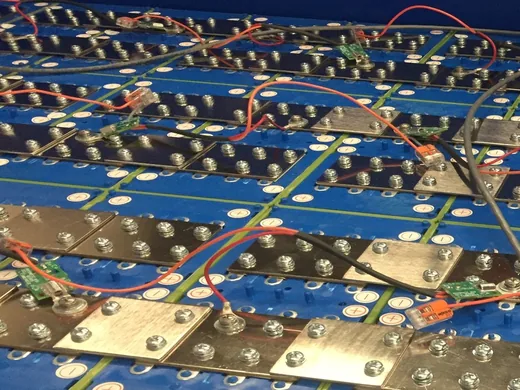
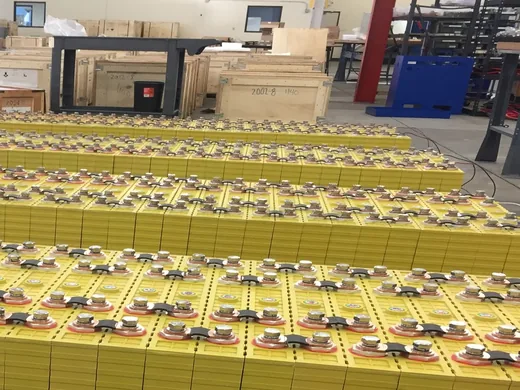
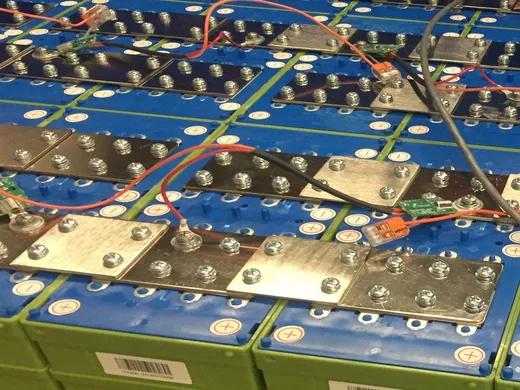
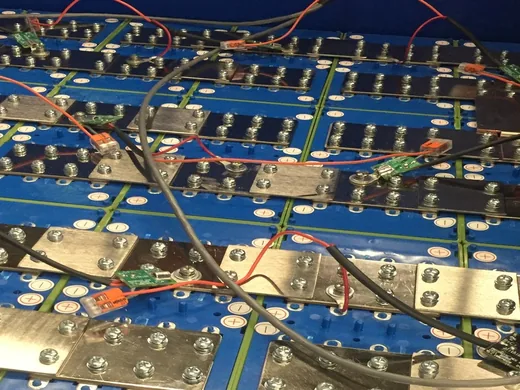
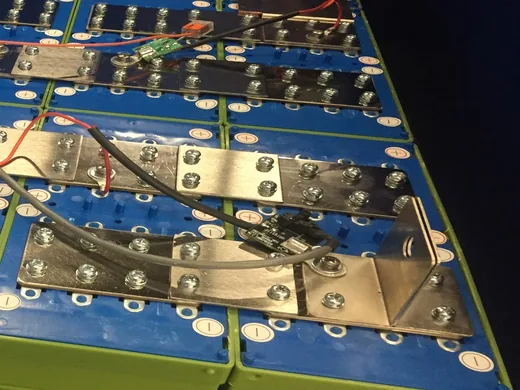
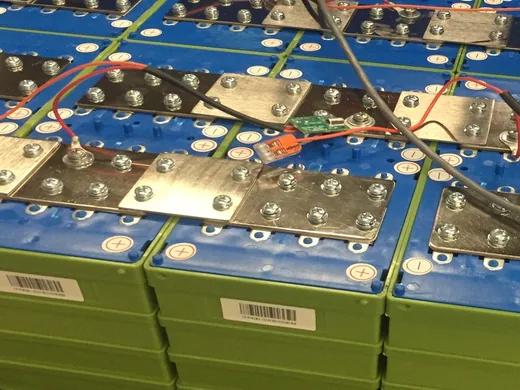
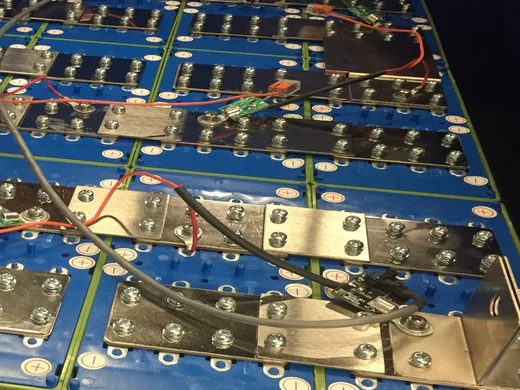
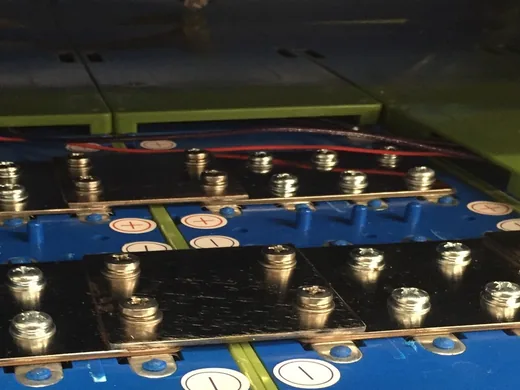
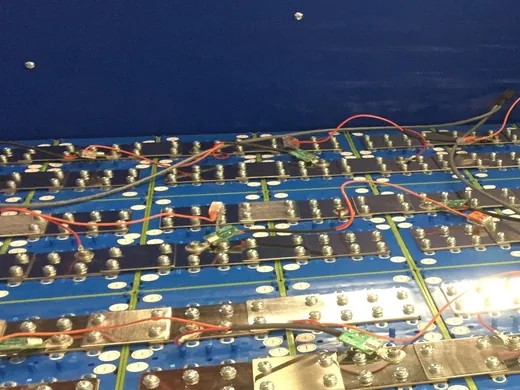
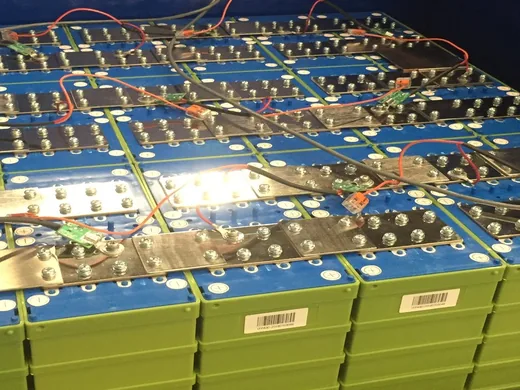
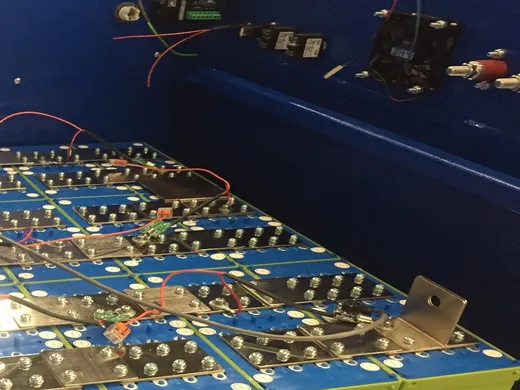
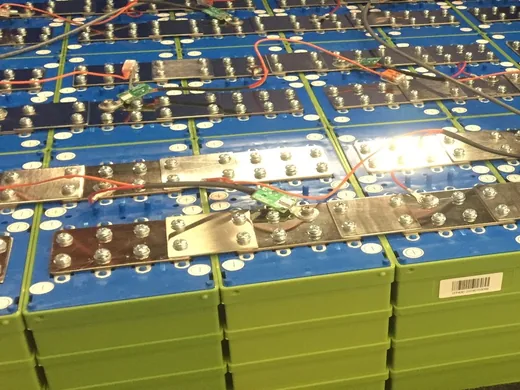
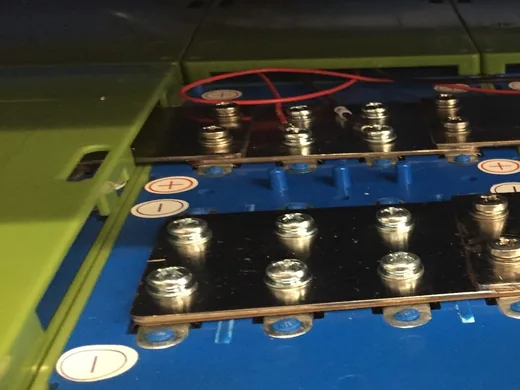
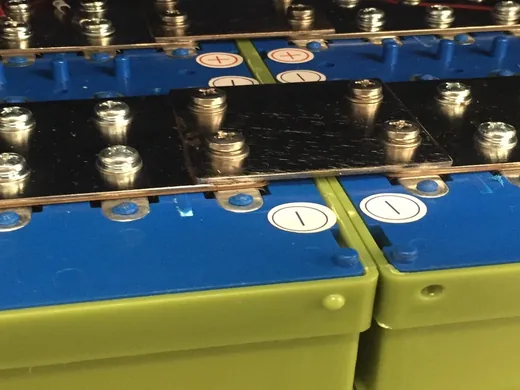
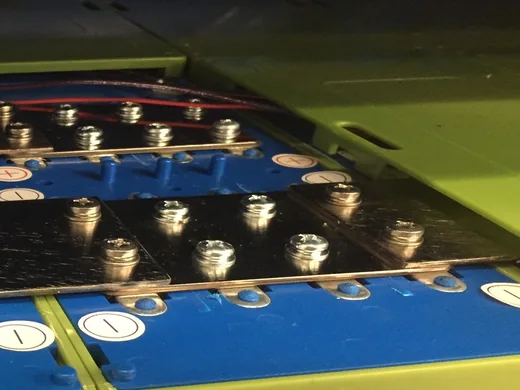
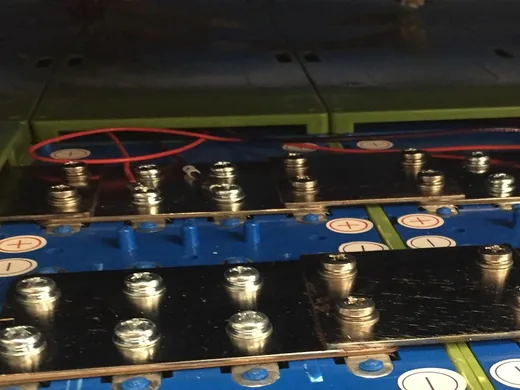
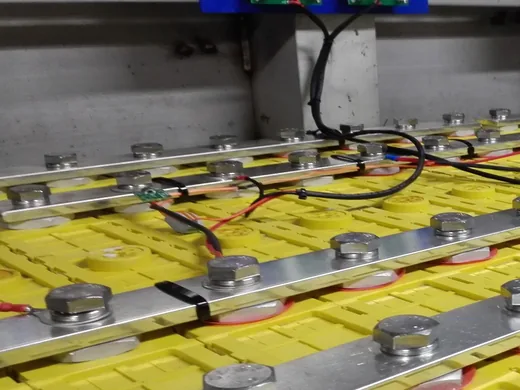
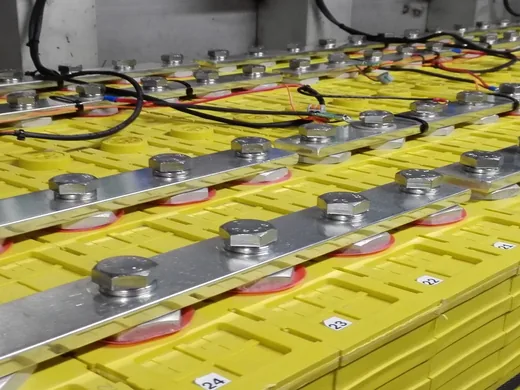
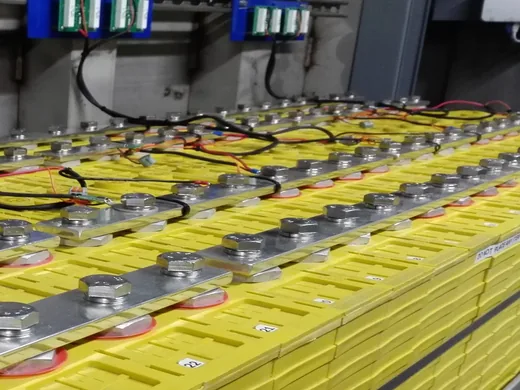
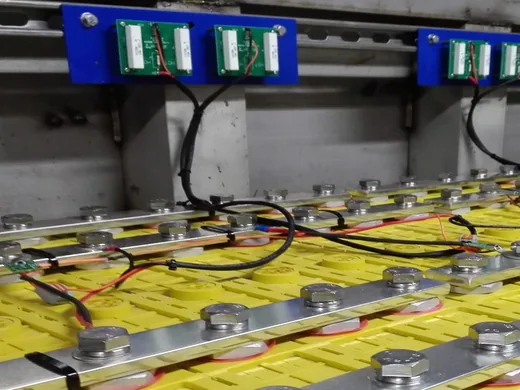
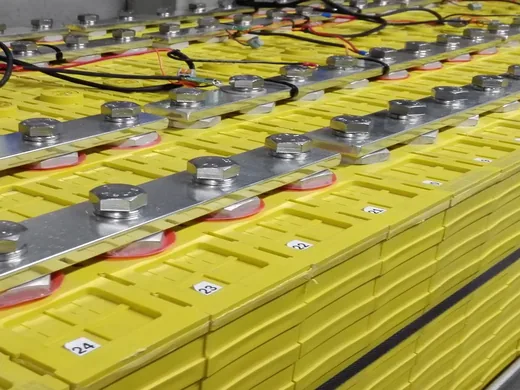
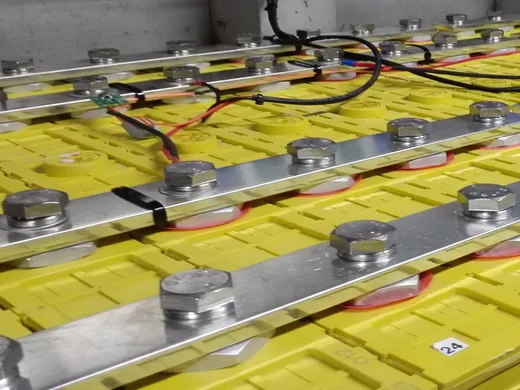
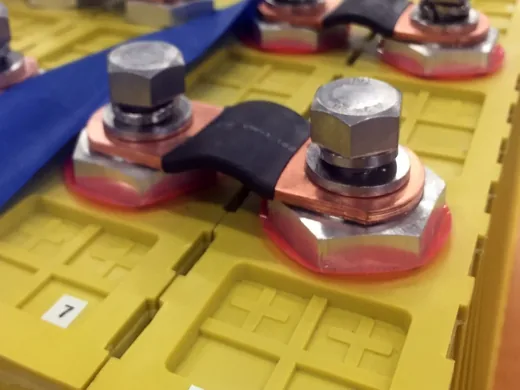
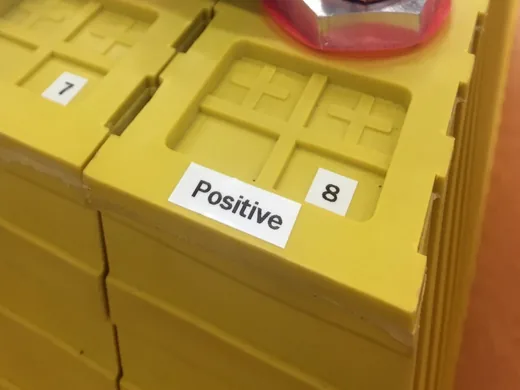
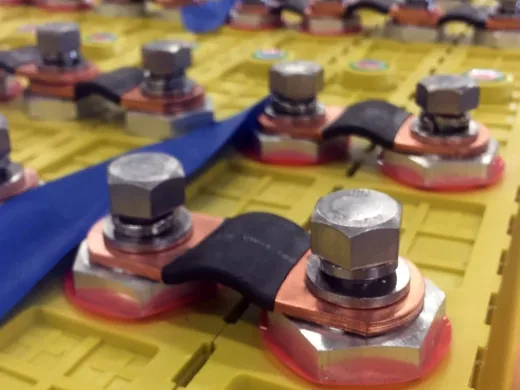
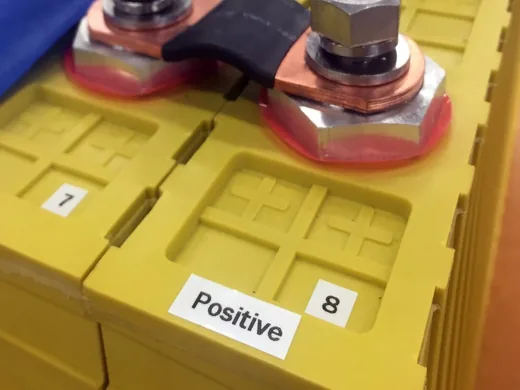
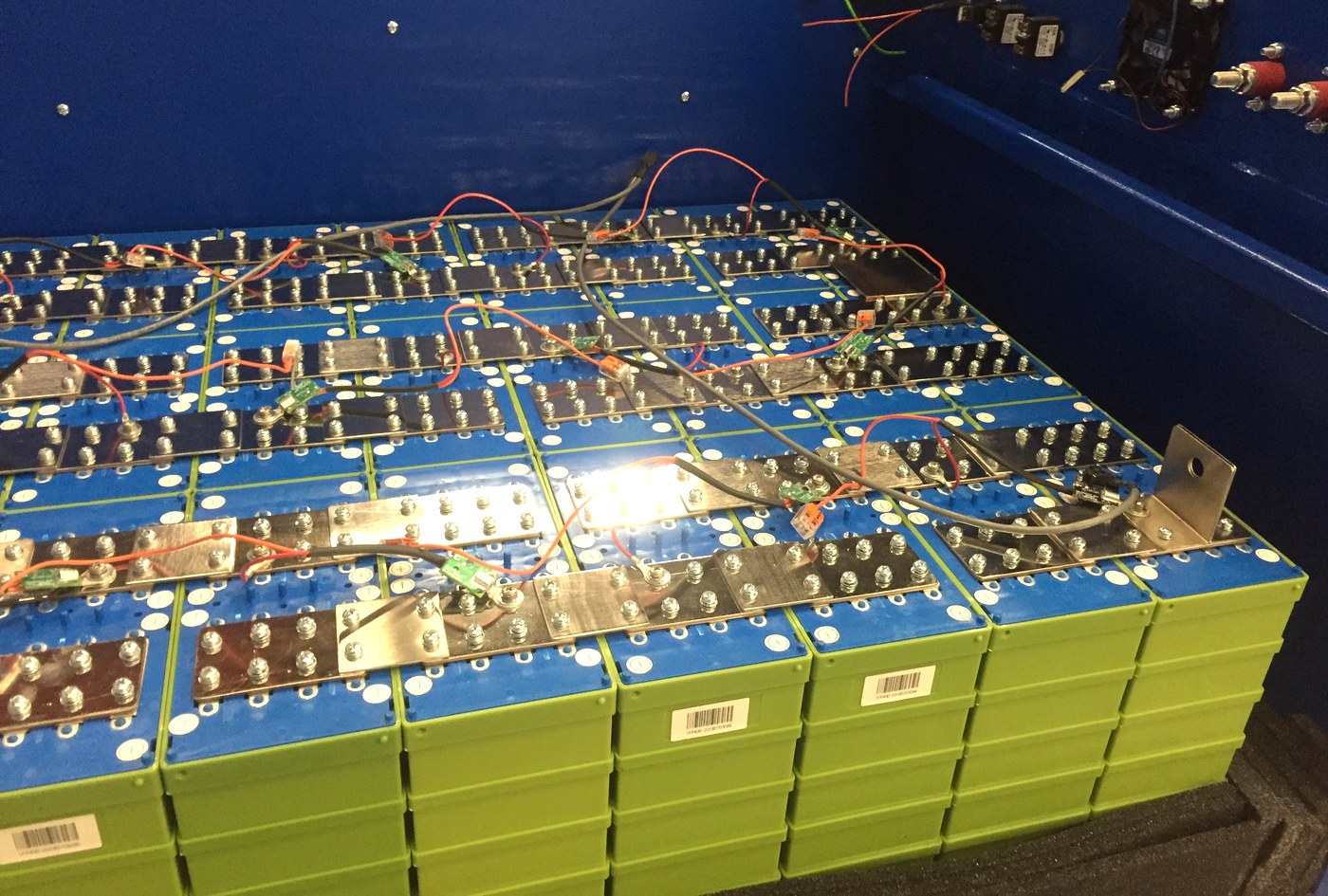
Prismatic cells bolted into a bank, with a sense lead on every terminal. Replacing a pack means reaching this layer, which some machines allow and others seal away for good. Photo by Yo-Co-Man, CC BY-SA 4.0.
Cells are rarely the first component to fail. Fans seize. Connectors corrode. Firmware stops receiving updates, a display cracks, a fuse blows in a way that needs the case opened. Each of those has a shorter life than a lithium iron phosphate pack kept at sensible temperatures, which puts the cells at the wrong end of a queue nobody expected them to be in. A pack still holding 85 percent at year eight is a perfectly good pack trapped inside a machine whose fan died in year five. That imbalance makes one design decision matter more than any cycle rating on the specification sheet. A machine built so the pack comes out has a second life waiting whenever something else gives up. A sealed machine reaches end of life when its weakest component does, whatever the cells still hold at the time. How replaceable the battery pack is in a power station decides which camp a given unit belongs to. Establishing that before purchase costs nothing at all.
Cells that do come out have somewhere to go afterwards, which isn’t true of a pack nobody can reach. Iron phosphate contains no cobalt and carries less recoverable value than the nickel chemistries do, which shapes the economics of collection without removing the obligation to collect. Where a retired pack ends up, and who pays for the journey, is laid out in the recycling pathway for retired lithium batteries. Plan the replacement at purchase. A machine with an accessible pack, from a maker still selling modules in year eight, is a different proposition from one that turns into waste the day its cells drop below useful. That difference rarely shows in the price.
Common questions
Is a 6,000 cycle rating better than a 3,000 cycle one?
Only when both were measured under identical conditions. Check the depth of discharge, the test temperature and the end-of-life threshold behind each figure. A 6,000 cycle claim at 30 percent depth and a 3,000 cycle claim at full depth can describe cells of identical quality, tested by two people who made different choices.
Does using less of the battery each time really help?
The effect is large. Published tables run from around 2,000 cycles at full discharge to 5,000 at half and 6,000 to 8,000 at 30 percent. Shallow cycling also moves more total energy across the life of the pack, which makes the headroom free in the long run.
My machine sits unused most of the year. What should I worry about?
Storage temperature and storage charge level, in that order. Cycle count will never become your limit at twenty charges a year. Calendar aging will, and one published model has it running roughly three times faster at 40 degrees than at 25.
What happens when a pack reaches 80 percent?
Very little, immediately. Eighty percent is a threshold chosen for warranties and standards. Nothing fails at it. Iron phosphate packs commonly run for years past it at slowly declining capacity.
Why does my machine trip on a load it used to start?
Internal resistance has risen with age. Voltage sags further under load than it once did, reaching the cutoff sooner. Surge capability degrades ahead of runtime, which puts starting current where the years show first.
How do I tell whether cycle life or calendar life is my limit?
Count your charges for a year. Twenty or thirty a year puts you firmly on the calendar side, where storage conditions decide everything and the cycle rating is somebody else’s specification. Two hundred a year and up puts you on the cycle side, where depth of discharge and charge rate are the levers worth pulling.
Should I worry about losing capacity in the first year?
Less than the number suggests. Fade follows a root curve, steepest when the pack is new and flattening from there, which makes an early drop a poor guide to the decade. Grid-scale iron phosphate is generally expected to give up 20 to 30 percent across ten years of daily work.
Can I replace individual cells instead of the whole pack?
On a machine that opens, sometimes. The catch is matching: a fresh cell dropped into an aged string gets dragged to the weakest neighbour’s state on every cycle, which leaves the balancing circuit correcting a mismatch nobody needed to create. Replacing a whole matched set costs more and behaves far better.
Does leaving it plugged in shorten the cells?
Sitting at 100 percent is the part that costs. The cable itself does nothing. Calendar aging runs faster at a high state of charge, which puts a permanently full machine on the quicker end of its range. Backup duty justifies it. Convenience does not.
Does the warranty cover the cells fading?
Sometimes. The better terms cover capacity dropping below 80 percent inside the period. Weaker ones cover manufacturing defects alone, which leaves ordinary fade outside the claim.