A battery loses two different things as it ages, by two different mechanisms, on two different schedules. Capacity fade comes from loss of lithium inventory and loss of active material, which is the store of energy shrinking. Power fade comes from impedance rise, described in the literature as growth in voltage polarization, which is the pack becoming less able to deliver current at a useful voltage. Owners meet them as separate complaints. A pack down on capacity runs a kettle for fewer minutes. A pack down on power struggles with the kettle at all. Most writing about aging quietly collapses the two into one number. State of health gets quoted as a percentage, the percentage refers to capacity, and power gets left out of the conversation entirely. That works until somebody asks why a machine reading 85 percent capacity trips out on a load it carried without complaint three winters ago. Nothing about the capacity figure predicts that, because the two properties can drift apart. Impedance rise is the quantity that decides how much current a pack can push before the voltage collapses under it.
Measurement practice has caught up with the distinction even where the marketing has not. Direct current internal resistance is widely used as a health indicator in its own right, because it takes seconds to obtain and climbs reliably as a cell ages. A capacity test needs a full discharge and most of a working day. A resistance test needs a known load and two voltage readings. Both measurements belong in the record, each labelled with the test that produced it.
Where the volts go when the load arrives
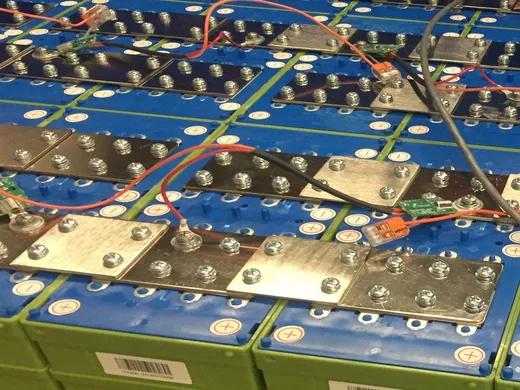
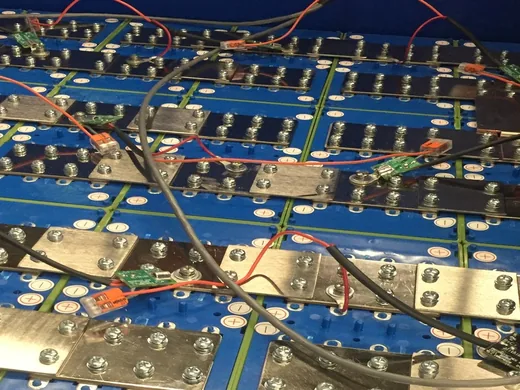
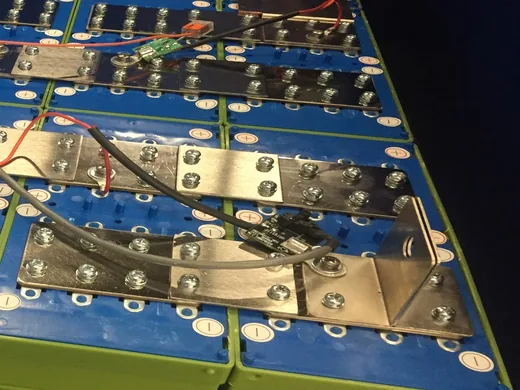
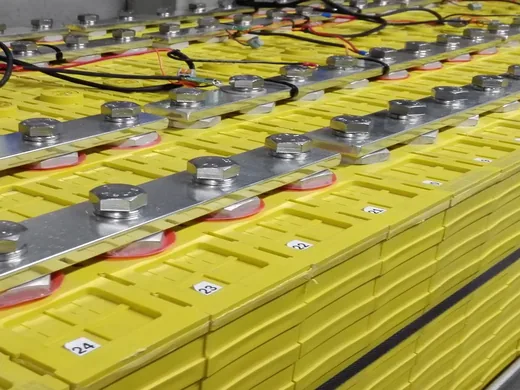
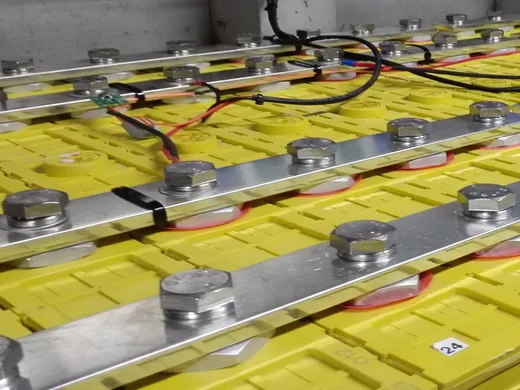
Terminal voltage under load is resting voltage minus current times internal resistance. Every symptom below comes out of that one line of arithmetic. A modern iron phosphate cell starts life with remarkably little resistance to work with. Published data sheets put a 3.2 volt 100 amp-hour cell at 0.39 milliohms plus or minus 0.05, or at half a milliohm as an upper limit for a different manufacturer. Four of those in series, plus the management board and the internal wiring, land a healthy 12 volt pack somewhere under 3 milliohms in total. Commercial packs quote a ceiling of 12 milliohms on that specification line.
Put numbers into it. A 3 milliohm pack pulling 100 amps drops 0.3 volts, arriving at the inverter at 12.8 volts from a resting 13.1. Double the resistance to 6 milliohms and the drop becomes 0.6 volts. At 12 milliohms the loss reaches 1.2 volts, which is a tenth of the working voltage disappearing into heat inside the pack before any of it reaches a socket. That heat is real: 100 amps through 12 milliohms dissipates 120 watts inside the case, warming the cells that produced it. Notice which variable the arithmetic punishes. Doubling the resistance doubles the loss at every current. Doubling the current doubles the loss as well, then doubles the heating a second time, since dissipation follows the square of current. Aging pushes on the first term. Ambitious loads push on the second. A pack that has gone from 3 to 9 milliohms behaves normally on a laptop charger. A circular saw finds it out.
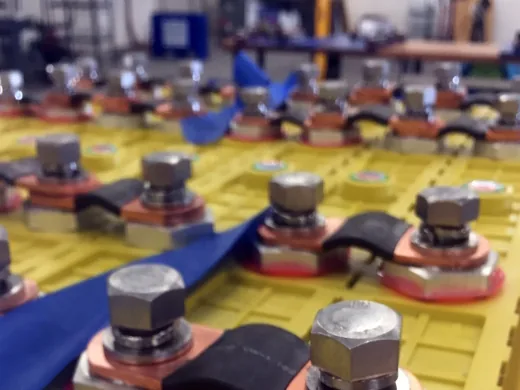
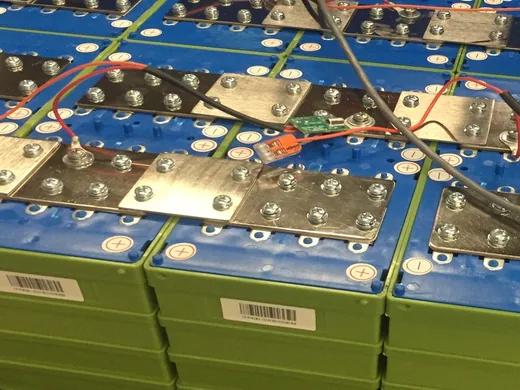
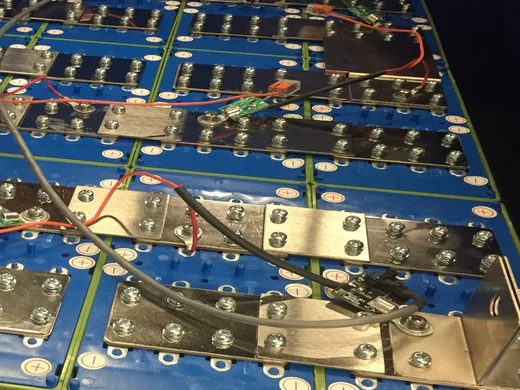
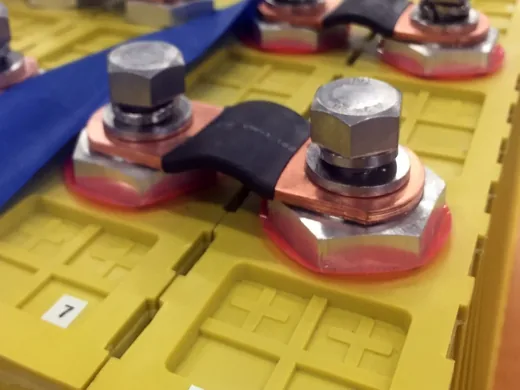
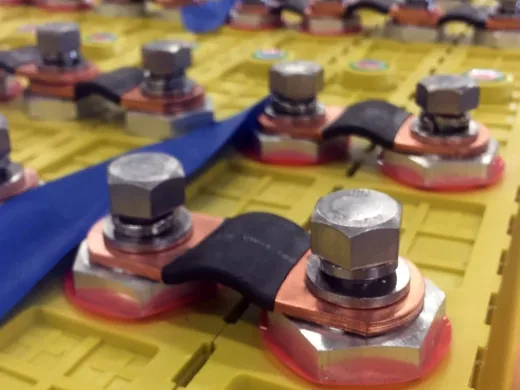
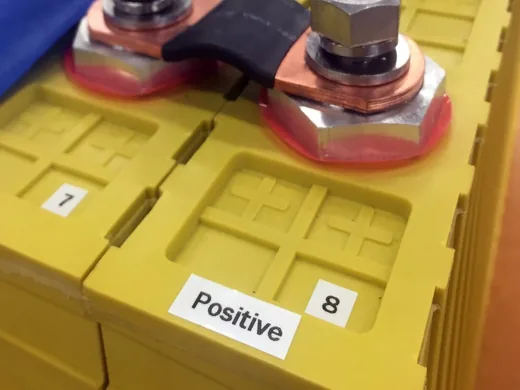
Resistance outside the pack enters the arithmetic on equal terms. It can dwarf whatever sits inside. Copper resists roughly 1.68 hundred-millionths of an ohm-metre. Work that through for a two-metre run of 4 square millimetre cable, counted out and back, then compare the results: the cable lands near 17 milliohms, comfortably more than a healthy pack contributes. Undersized leads, a terminal screw that was never properly tightened and an oxidised crimp all add their share in series with the cells. An owner chasing an apparent battery fault should read the voltage at the pack first, then at the far end of whatever cable feeds the load. Whatever separates those two readings has nothing to do with aging cells.
Terminal voltage of a 12 volt pack resting at 13.1 volts, by current and internal resistance
Current drawn
3 mΩ new pack
6 mΩ resistance doubled
12 mΩ four times new
10 A
13.07 V
13.04 V
12.98 V
50 A
12.95 V
12.80 V
12.50 V
100 A
12.80 V
12.50 V
11.90 V
126 A, fridge starting
12.72 V
12.34 V
11.59 V
175 A
12.58 V
12.05 V
11.00 V
200 A
12.50 V
11.90 V
10.70 V
What makes the resistance climb
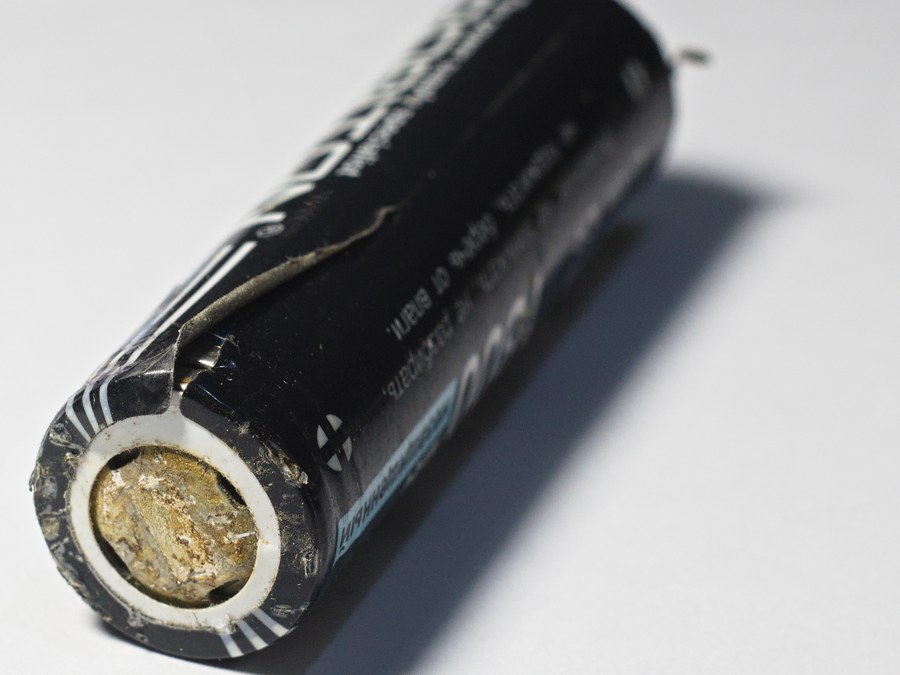
The negative end of a cell that failed after five years. Corrosion products in a contact are resistance added exactly where the arithmetic is least forgiving. Photo by Retired electrician, CC0.
Several unrelated processes push impedance upward at once, which is why resistance growth rarely tracks capacity loss neatly. Passivating layers keep growing on the electrode surfaces through the whole life of a cell. On the cathode side, structural change into a rock-salt phase interferes with the kinetic transport of lithium ions across the interface. Both of those obstruct the movement of charge without necessarily consuming much lithium inventory, which is precisely why a pack can hold most of its energy while losing its grip on delivering it quickly. Mechanical damage contributes a second, separate share. Particles crack as they expand and contract through cycling. Cracked particles lose electrical contact with the conductive network around them, and material that has lost contact contributes neither capacity nor conductivity. Analysis of aged cells names contact loss of active material particles among the principal degradation modes.
Diffusion turns out to carry more of the blame than intuition suggests. Impedance work on aged cells identifies low-frequency diffusion as the largest single source of the total rise, meaning the slow business of moving lithium through the electrolyte phase and into the particles. Most descriptions concentrate on the fast interfacial steps and miss it. That distinction matters to an owner, because diffusion limitations get sharply worse in the cold. Everything outside the cells adds its own share on top. Terminal corrosion, a management board with tired switching devices, oxidised connectors and crimps that have relaxed all sit in series with the cells and all count toward the number the load actually experiences. The photograph beside this paragraph shows a cell that ended its life with visible corrosion at the negative terminal. Corrosion products at that contact measure in milliohms of their own.
Cold stacks on top of age
Temperature moves resistance faster than years do. Charge transfer resistance in an iron phosphate cathode measures around three times higher at minus 20 degrees than at room temperature. The consequences reach the owner as delivered energy: at 0 degrees a pack returns roughly 80 percent of its rated capacity, and laboratory work on an iron phosphate electrode at minus 20 recorded 45.4 milliamp-hours per gram, which is 31.5 percent of what the identical electrode gave at 23 degrees. Those two effects multiply for an owner. Neither of them waits its turn. A six-year-old pack at 9 milliohms in a warm room might sag 0.9 volts at 100 amps, which nothing on the machine objects to. Take that pack outside in February and the resistance it started from is higher before the load arrives. Sag that was tolerable indoors becomes a shutdown in the driveway. No new fault has appeared.
Which explains the seasonal pattern in complaints about aging machines. The failure gets reported in winter, attributed to the pack finally giving up, then quietly stops happening in April. Both observations are correct. The impedance was there in July as well.
The 0.3 seconds that decides whether the fridge starts
Motors ask for their worst current at the instant they start, before the rotor turns and before back electromotive force builds up to oppose the supply. Compressor nameplates carry the figure as locked rotor amps, the current drawn with the shaft stationary. Published guidance suggests planning for two to six times the running current of a refrigeration appliance, with field ranges of 600 to 1,800 watts at start for domestic fridges that run at 80 to 280 watts. Individual machines exceed the rule of thumb comfortably. One clamp meter capture on a full-size kitchen fridge recorded 1,420 watts for roughly 0.3 seconds at compressor start, settling to 145 watts running, which is close to ten times the steady figure for a third of a second. That third of a second is where an aged pack fails. The inverter converting to 230 volts has to pull the corresponding current out of the pack for the whole surge, which on a 12 volt machine means something above 120 amps for a 1,420 watt demand once conversion losses are added. Work the current back from the wattage first. A 1,420 watt demand at the socket, through an inverter running near 90 percent, pulls close to 1,580 watts from the pack. At a sagging 12.5 volts that comes to about 126 amps. A pack at 3 milliohms concedes about 0.4 volts during that instant, arriving at the inverter with plenty of headroom. A pack that has aged to 12 milliohms concedes 1.5 volts, and one that has aged further in a cold garage concedes more than 2. Terminal voltage during the surge is what the inverter reacts to, sampled far faster than any display refreshes. The machine either rides the dip or reports a fault and stops, all inside a third of a second, long before an owner sees a number change. Freezers ask a similar question with different numbers. Field measurements put chest freezer starts at 500 to 1,200 watts and upright freezers at 600 to 1,400, with defrost heaters drawing 300 to 700 watts of their own whenever the cycle calls for one. A machine sized against running watts alone meets every one of those the hard way. This is also why a station that ran the fridge for four summers refuses it in the fifth while still showing plenty of capacity in a runtime test. Nothing about the energy stored has changed much. What changed is the pack’s willingness to give up 120 amps without its voltage falling through the floor. A compressor either starts or stalls.
Why it stops with charge left in the pack
Every shutdown in a portable machine happens on a voltage threshold. Nothing in the box measures remaining energy directly. The management board watches individual cells and disconnects when one of them falls under roughly 2.5 volts. The inverter watches its DC input and quits on its own threshold, which sits between 10.5 and 11 volts on typical 12 volt equipment. One published 600 watt inverter specification warns at 10.7 volts and shuts down at 10.0. A common default pre-alarm setting sits at 10.9. Those thresholds were chosen for a pack with low resistance. Feed them a pack with high resistance and they fire early, because the voltage they are watching includes the sag. A cell sitting at 3.1 volts of true open-circuit potential, with 50 amps flowing through the resistance in front of it, can present under 2.9 at the terminal. Push the current to 150 amps and it presents less again.
The practical result is a machine that stops at an indicated 30 percent, then reads 45 percent five minutes later once the load has gone and the cells have relaxed. Both readings are honest. The pack genuinely could not hold voltage under that load. It genuinely still holds energy that a gentler load can reach. Owners reasonably interpret this as a broken gauge. The gauge is reporting one thing while the protection circuit acts on another, which is a consequence of the design and no sort of defect at all. A pack in this state still delivers most of its rated energy into a small load.
That effect also shortens the runtime a heavy load appears to achieve. The machine cuts out early. The owner records a short runtime. That figure then gets attributed to lost capacity. Measured gently the following day, the pack gives up far more energy. Neither measurement is wrong. One measures capacity. The other measures the pack under load.
Measuring the resistance at home
Resistance is easier to measure than capacity. The whole business needs about four minutes. Let the machine rest for twenty minutes with nothing connected and record the resting voltage at the pack or at a 12 volt output. Switch on a load you can quantify. Read the voltage again a second or two after the load settles, before anything warms up. Divide the voltage difference by the current and the answer is the resistance of everything between the cells and your meter. Repeatability comes from holding the other variables still. Do it at a similar state of charge each time, ideally somewhere in the flat middle of the range. Do it at a similar room temperature, since a cold measurement reads high for reasons that have nothing to do with age. Use a load big enough to produce a readable difference. A 20 watt lamp on a healthy pack moves the voltage by a few millivolts.
Probe placement decides what the number describes. Reading at the battery terminals measures the pack by itself. Reading at the output socket measures the pack plus every cable, contact and shunt between the two. Both readings have a use. The difference between them is the wiring’s contribution, obtained for free. One reading alone means little. A series of readings across years means a great deal. Resistance that has crept from 4 milliohms to 5 over three years describes a pack aging normally. Resistance that has trebled describes a pack whose ability to deliver current has gone, whatever its capacity test says. Direct current internal resistance serves as a health indicator across the industry. It rises reliably with age.
Small loads never notice
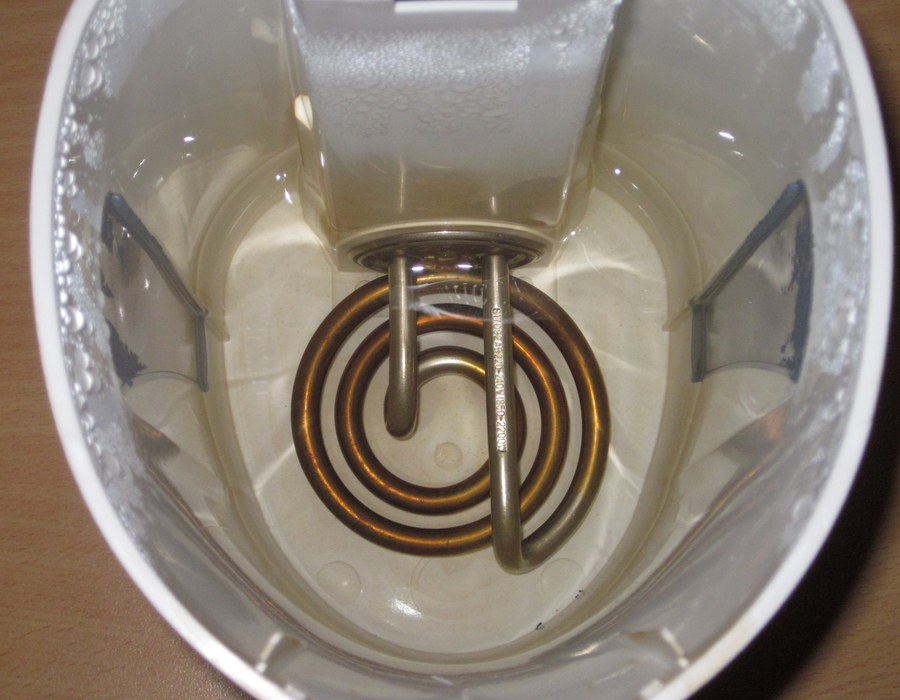
A kettle element asks for 130 amps from a 12 volt pack. At 12 milliohms that current costs a volt and a half before anything reaches the socket. Photo by Meganbeckett27, CC BY-SA 3.0.
None of this makes an aged pack useless. The arithmetic that condemns it under heavy load exonerates it under light load. A 20 watt router draws about 1.7 amps from a 12 volt pack. At 12 milliohms that current produces 20 millivolts of sag, which is invisible to every protection threshold in the machine. Run that pack at 200 amps and it loses 2.4 volts. Resistance is a fixed property that only becomes a problem when multiplied by a large number. Which suggests the obvious way to keep an old machine in service. Charging phones, running lights, keeping a router and a laptop alive through an outage, driving a 12 volt fridge for days: all of that sits in the region where impedance rise barely registers. A 12 volt compressor fridge drawing 45 watts pulls under 4 amps from the pack, which at 12 milliohms comes to 45 millivolts of sag, a figure lost in the noise of an ordinary meter. Ask that pack for a 1,500 watt kettle and it has to find 130 amps, where 12 milliohms costs it a volt and a half. Power tools, kettles, microwaves and compressor starts all sit in the region where impedance decides everything. The identical pack can be useless for one job and adequate for the other.
What the specification sheet actually promises
Rated output on a portable machine describes the inverter, tested with a good pack behind it. The number tells you what the electronics can convert. Whether the pack can feed those electronics at that rate, at the temperature and the state of charge and the age you happen to be at, is a separate question the number does not address. Three ceilings apply at once. Whichever of them sits lowest wins on any given day. The inverter imposes its continuous rating and its surge rating, the second usually specified for a few seconds. The management board imposes its own current limit, set by the switching devices and by the sense resistor. The pack imposes the third limit, and that one moves with age. A new machine is normally limited by the first two. An old one increasingly gets limited by the third.
Turn the surge rating into pack amps before trusting it. A 300 watt machine quoting 600 watts of surge has to find roughly 55 amps from a 12 volt pack for those few seconds. A 2,000 watt machine quoting 4,000 has to find 370. Resistance costs voltage in proportion to that current. The larger machine works its pack harder during a surge than the small one ever does. Surge specifications deserve particular scepticism on an aging machine. A rating of double the continuous output for a few seconds assumes the pack can supply the DC current for those seconds without the voltage collapsing. That assumption held when the specification was written and the pack was new. Nobody re-tests it at year seven. The number printed on the case stays where it was in year one.
Living with a pack that has aged
Warmth is the cheapest intervention available. A pack brought indoors for a few hours before a heavy job starts from a lower resistance than one pulled out of a cold van, which can be the difference between a compressor starting and a fault code. Warming a pack indoors takes a few hours. Cells in a van left overnight at 2 degrees need most of a morning indoors before they reach room temperature.
Peak demand is the next lever. Starting one motor at a time, letting a compressor settle before switching on a second load, and choosing the lower setting on anything with a heating element all reduce the current at the moment it matters. Sag is proportional to current. Removing half the peak removes half the sag, with no work done on the pack itself.
State of charge helps as well, since resistance is lowest and open-circuit voltage highest through the upper middle of the range. A pack asked to start a compressor at 20 percent charge is being asked at its worst moment on both counts. Keeping an aging machine above half charge when heavy work is expected buys headroom that costs nothing to arrange. The pack pays nothing for it either, provided the machine goes back to a mid-range charge for storage afterwards.
Heat does more than make the case uncomfortable to hold. Elevated operating temperature accelerates resistance rise in iron phosphate cells over the long run, and testing with active cooling has suppressed that drift enough to nearly double the cycle life achieved. A machine worked hard inside an enclosed space is aging its own resistance upward faster than one with air moving around it. Clear vents and a cooling break between heavy tasks hold that drift down.
Common questions
My machine shows 60 percent and shuts down under load. Is the battery dead?
Probably it has lost power capability, with most of the energy still in there. Confirm it by running the machine on a small load and seeing how long it lasts. A pack that delivers hours into a 30 watt load while refusing a 1,200 watt one has an impedance problem. Cold deepens it.
Does power fade happen faster than capacity fade?
Neither reliably leads the other, since they come from different mechanisms. Cells cycled hard at high current tend to show resistance rise early. Cells that mostly sat still tend to show capacity loss from calendar aging with resistance climbing more slowly. Elevated temperature accelerates both, and active cooling has been shown to suppress resistance drift substantially.
Will a bigger battery fix a starting problem?
Often it will, for reasons of resistance more than reasons of energy. Cells in parallel divide the current between them, which divides the total resistance. A pack of twice the capacity sags roughly half as much at an equal load. Two packs in parallel measure about half the resistance of one.
Why does the machine manage the load some days and refuse it on others?
Temperature and state of charge move the margin around by more than most owners expect. A borderline load sits close enough to the threshold that a cold morning or a half-empty pack pushes it over. A failure that repeats at any temperature points at the pack.
Can I measure this without buying anything?
A basic multimeter and a load of known wattage cover it. Read the resting voltage, apply the load, read again after a second, divide the difference by the current. Write the answer down with the date, the temperature and the state of charge. Next year’s reading goes underneath it. Three readings across three years describe a slope. That slope is what tells an owner whether to plan a replacement.