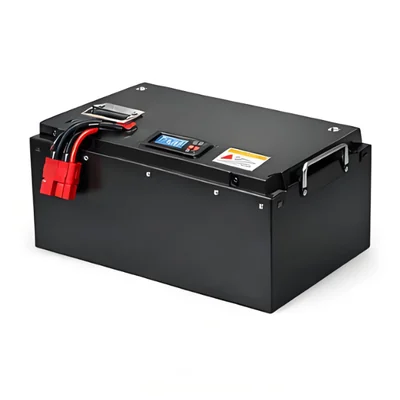
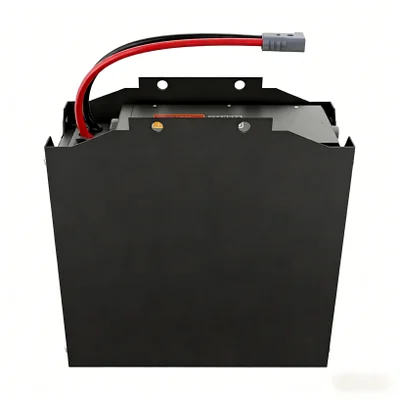
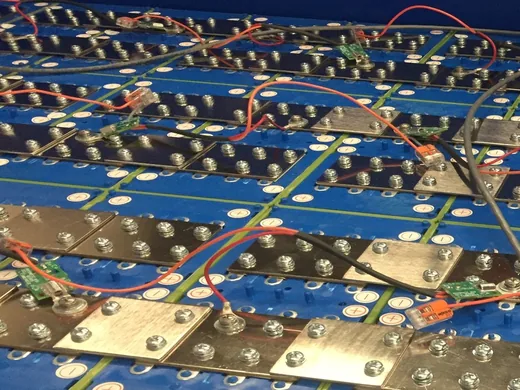
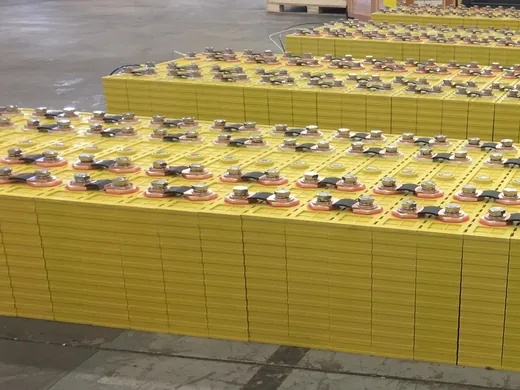
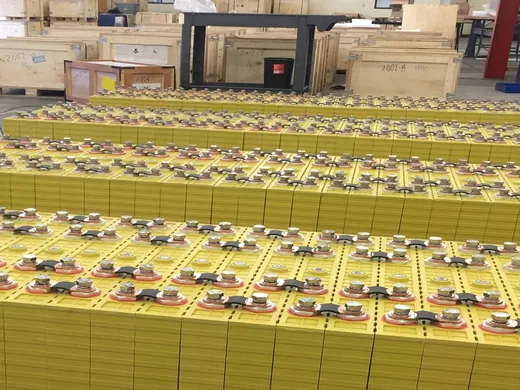
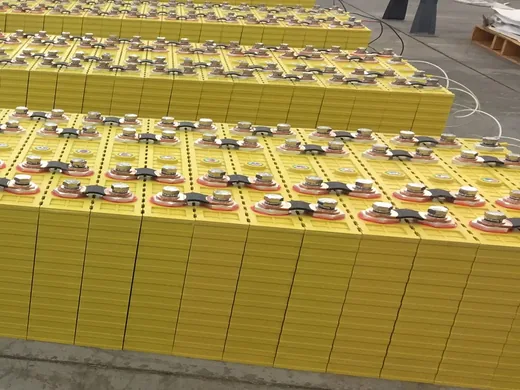
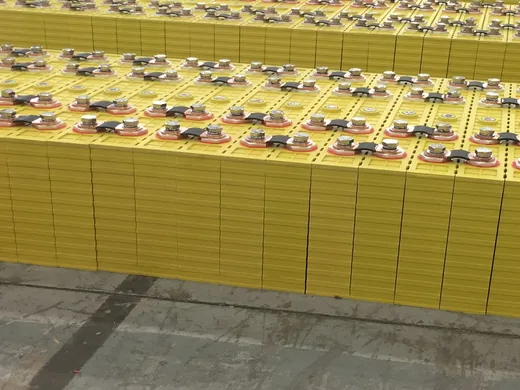
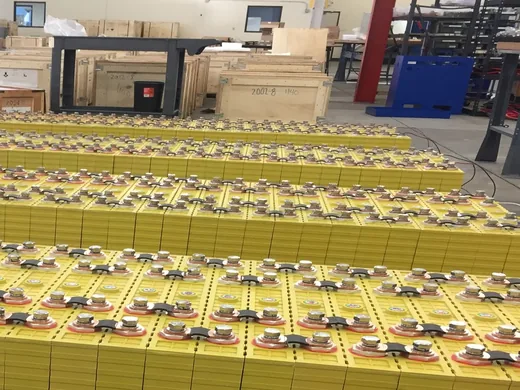
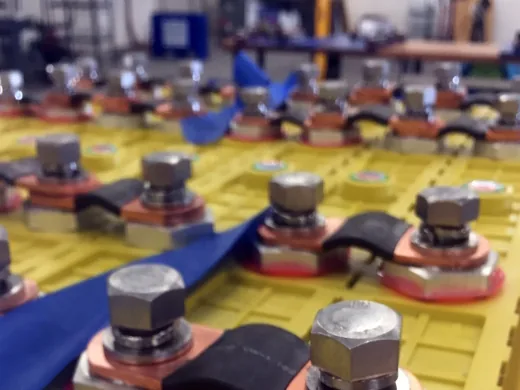
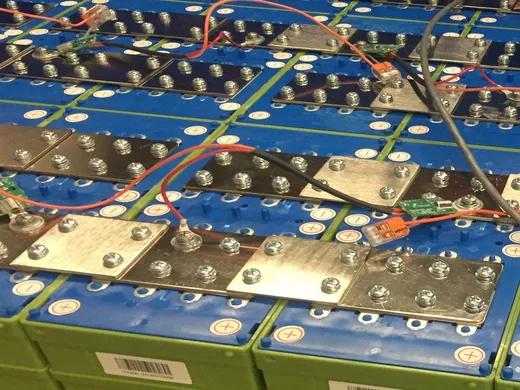
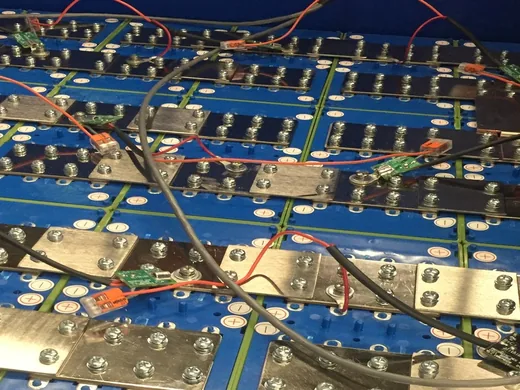
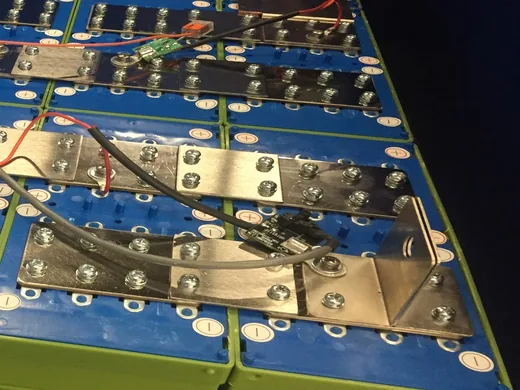
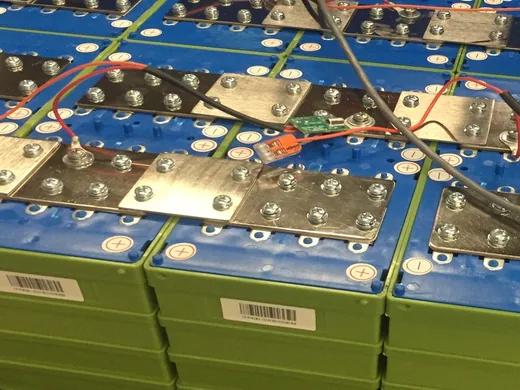
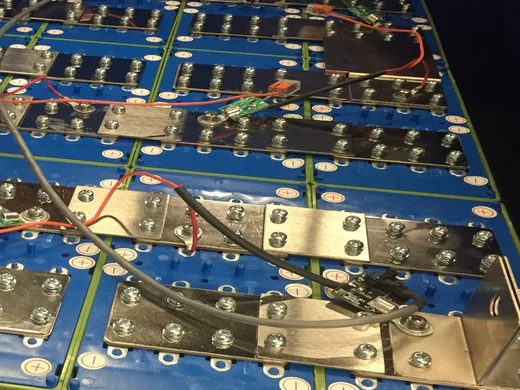
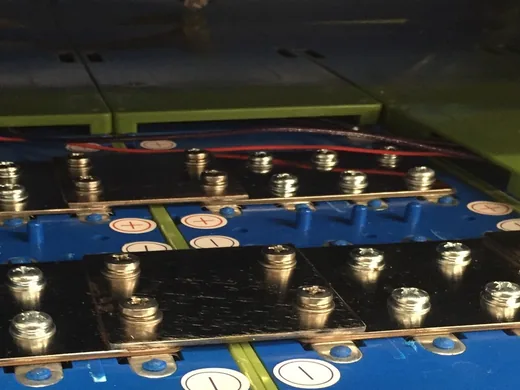
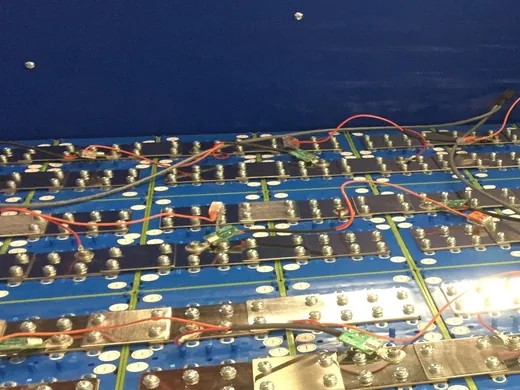
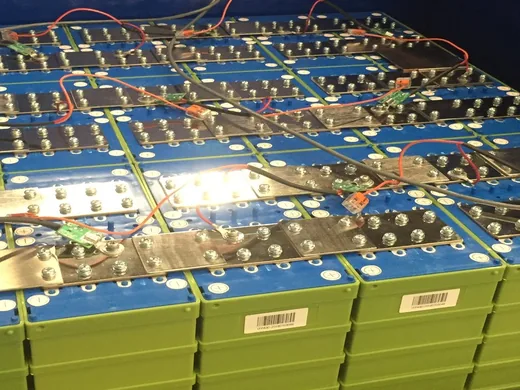
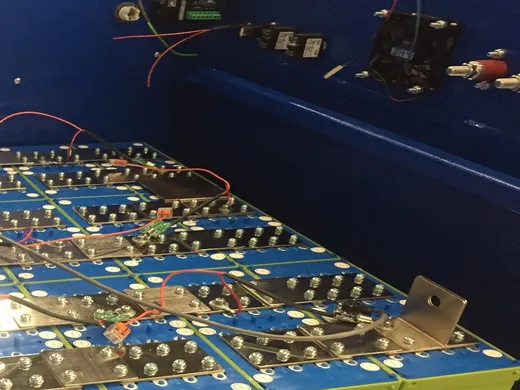
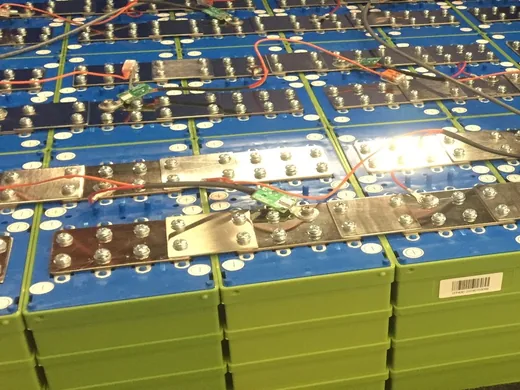
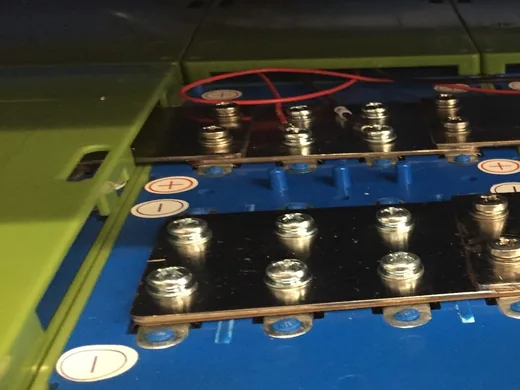
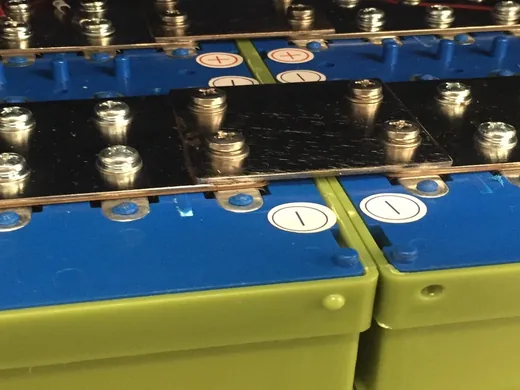
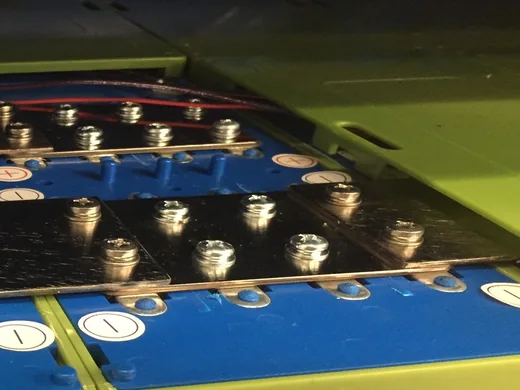
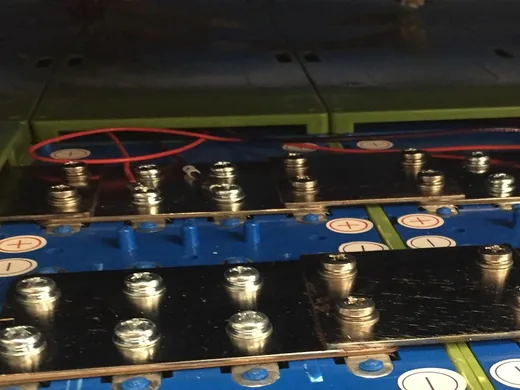
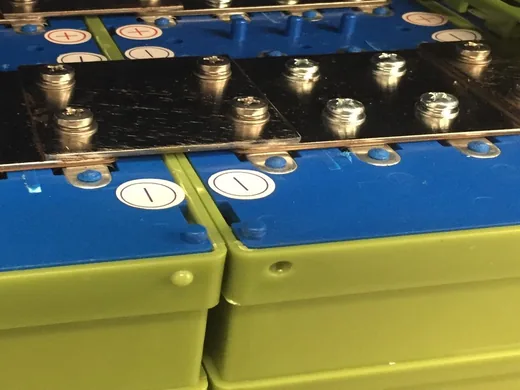
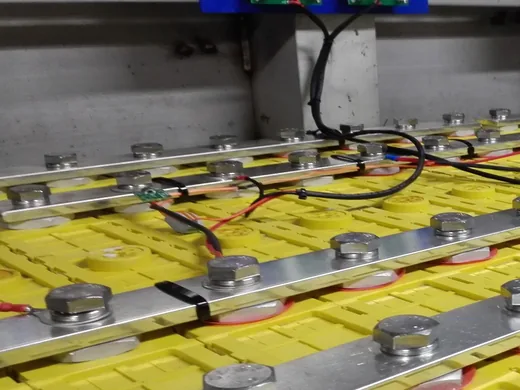
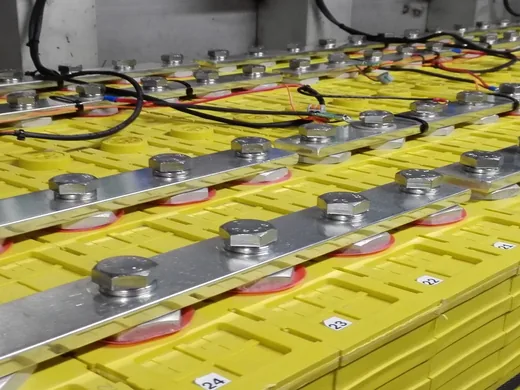
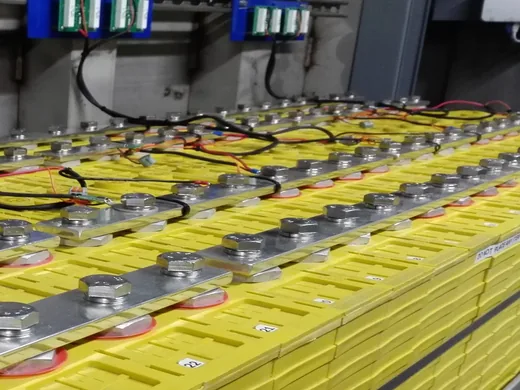
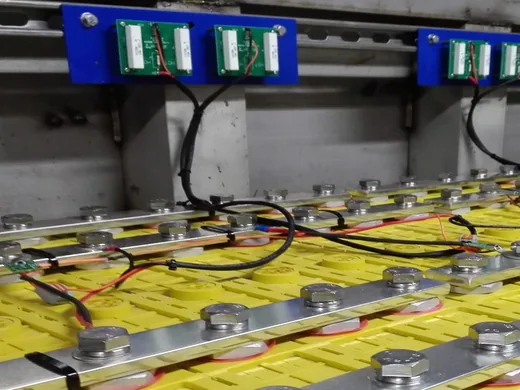
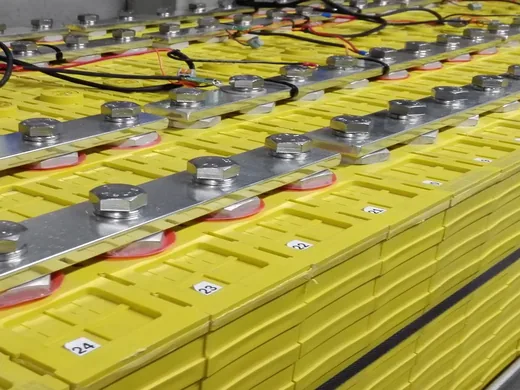
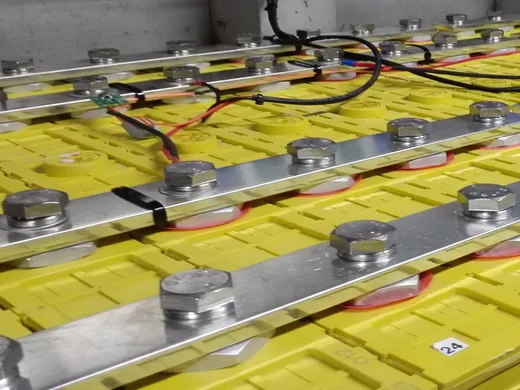
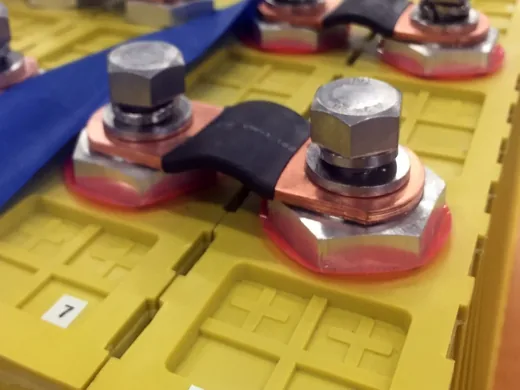
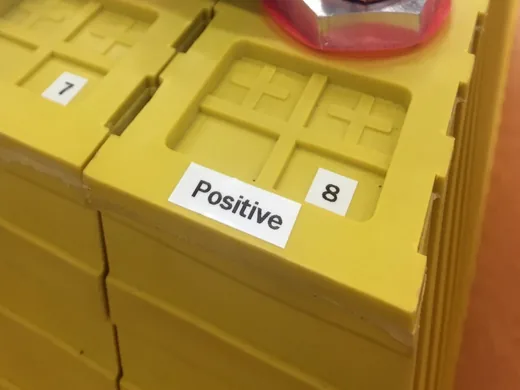
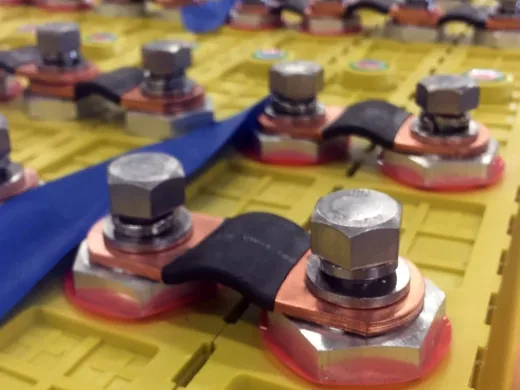
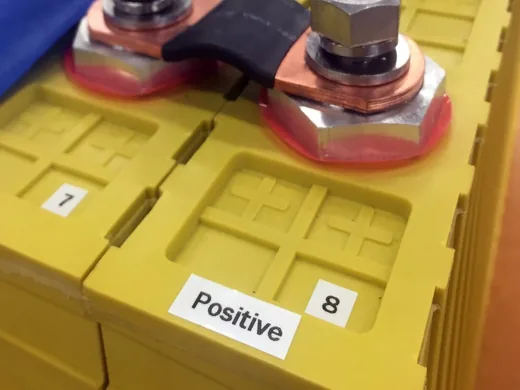
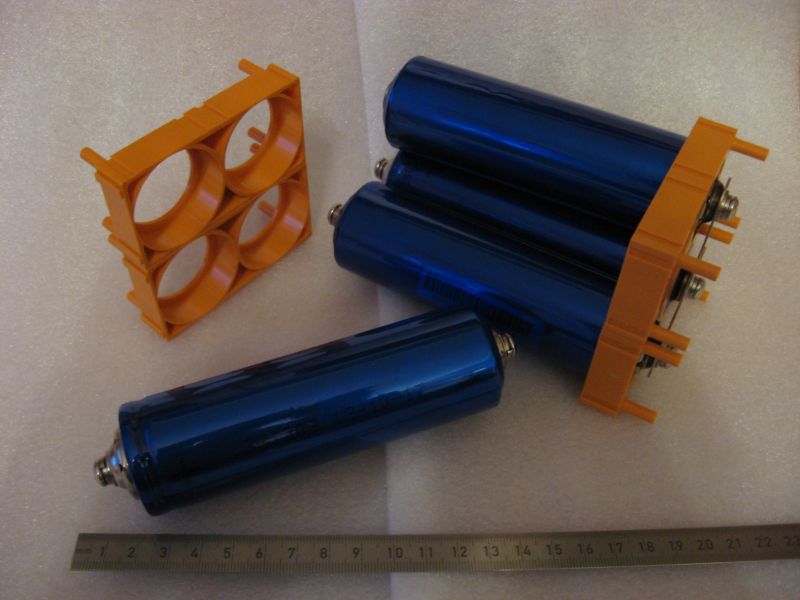
Cylindrical lithium iron phosphate cells in the 38120 format, with a plastic spacer to hold them in a block and a steel rule for scale. Each holds a nominal 3.2 volts. Larger stations use prismatic cells of the identical chemistry in the hundreds of amp-hours. Photo by Hadhuey, CC BY-SA 3.0.
LiFePO4 spells out its own cathode, one letter group per element: lithium, iron, phosphate. Those three sit in a crystal that sets a nominal 3.2 volts, which is low enough that a power station has to stack eight of them in series to reach 25.6 volts, or sixteen to reach 51.2. Nothing about the chemistry is exotic. Iron and phosphate are among the cheapest materials in the battery industry. What makes the chemistry interesting is the arrangement they end up in. Cheap ingredients, unusual behaviour. What it does, mostly, is refuse to catch fire. That behaviour traces to a single structural fact covered in the next section, which is why a manufacturer can seal forty kilograms of cells into a plastic case, hand it to somebody with no electrical training, and expect the thing to sit in a hallway on charge for a decade without incident. The older cobalt chemistries never earned that trust. Around 2020 the price of phosphate cells fell far enough that the argument for anything else in a portable power station stopped being an argument. Cost was the last thing holding it back.
You pay for the safety in kilograms. Phosphate cells reach roughly 130 to 160 watt-hours per kilogram in the commercial prismatic sizes, against 150 to 250 for the nickel manganese cobalt chemistry that goes into laptops and cars. A phosphate pack of equal energy is heavier, permanently. A phone cannot afford that trade. A box that lives on a shelf or gets wheeled to a campsite absorbs it without much complaint. The two markets settled on different chemistries and stayed there.
One more asymmetry follows from the materials. Nickel and cobalt are mined in a handful of countries and priced accordingly, where iron and phosphate are quarried almost everywhere, which means the cost of a phosphate cell tracks manufacturing scale far more closely than it tracks any commodity market. Scale is what happened. Cell prices fell year after year through the late 2010s as capacity was built out, turning the chemistry that had been the cheap compromise into the default for anything not required to fit in a pocket. Scale moved that price, with no help from chemistry.
The bond that keeps hold of the oxygen
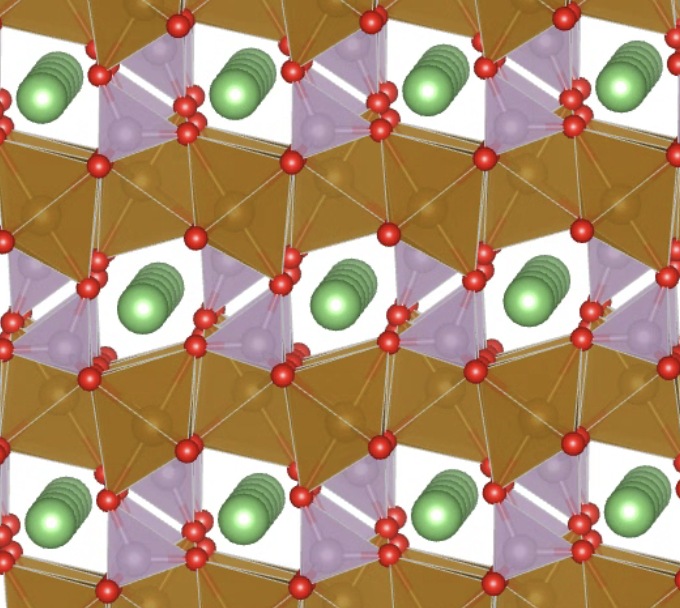
The olivine crystal of lithium iron phosphate. Green spheres are the lithium ions that travel in and out as the cell charges, running through channels in a rigid frame of iron-oxygen octahedra and phosphate tetrahedra, with oxygen in red. That phosphate cage is what holds the oxygen during a fault. Structure model by Aherthabey, CC BY-SA 4.0.
Every lithium cathode is a scaffold with lithium parked in it, the question that decides how a cell behaves in a fault being how tightly that scaffold grips its oxygen when it gets hot. In the layered oxides used for cobalt and nickel cathodes, the answer is: not very. Heat them enough and the layers collapse, releasing oxygen into an electrolyte that is already flammable. That is the mechanism behind the lithium fires that make the news.
Phosphate does it differently. Each phosphorus atom sits at the centre of four oxygens in a tetrahedron, a covalent cage where the oxides have an ionic layer, and prying oxygen out of that arrangement takes far more energy than prying it out of a layered oxide. Battery University’s reference figures for the lithium family put the thermal runaway threshold for lithium iron phosphate at 270 degrees, against 210 for nickel manganese cobalt and 150 for the cobalt and nickel-cobalt-aluminium chemistries. Sixty degrees of margin over NMC does not sound dramatic written down. In a sealed case in a hot van it decides whether one bad cell stays one bad cell.
Abuse testing is where the difference stops being theoretical. Drive a nail through a charged phosphate cell, crush it, overcharge it well past its 3.65 volt ceiling, short its terminals. It swells, vents some gas, declines to burn, the cage intact and no oxygen coming out of the cathode to feed anything. A cell that cannot supply its own oxidiser has to find oxygen in the room, and by then the electrolyte has usually finished venting. Standards bodies have written that behaviour into what they allow inside a dwelling. A 5 kilowatt-hour pack ships as consumer goods because of it.
One more thing falls out of that rigidity. The olivine frame barely changes dimension as lithium moves in and out of it, sparing the cathode the flexing that a layered oxide takes thousands of times over the life of a pack. Volume change across a full charge is around 6 or 7 percent for olivine, against considerably more for the layered oxides. Fatigue in a cathode accumulates the way fatigue in metal does. It never repairs, surfacing later as capacity that will not come back whatever anybody does to the cell afterwards. Safety and cycle life, in this chemistry, are two readings off one property.
Why the voltage curve is so flat
Plot a phosphate cell discharging and the curve looks broken, sitting at roughly 3.2 volts across most of the range before falling off a cliff near the end. Layered-oxide cells slope steadily from full to empty. The reason is that lithium iron phosphate does not dissolve lithium gradually through one phase. It separates into two, a lithium-rich phase and a lithium-poor one, and discharging simply converts the first into the second at a fixed boundary. Two phases in equilibrium hold a fixed voltage, a matter of thermodynamics with no engineering involved. The plateau follows from that. An inverter likes that plateau, since input voltage barely moves as the pack drains. State of charge is the loser. With voltage nearly constant from 90 percent down to 20, a voltmeter tells you almost nothing about how much is left, which is why the management board counts coulombs in and out and largely ignores the voltage, and why a badly calibrated board reports 60 percent for hours before dropping to zero in twenty minutes. Flat curves are good for the load and hard on the fuel gauge.
Where the lithium actually goes
A cell is two electrodes with lithium shuttling between them. On one side the iron-phosphate frame that gives the chemistry its name, facing it an anode of graphite, which is the identical material used across every lithium chemistry including the ones in phones. Between them sits a thin porous separator soaked in a lithium-salt electrolyte, passing ions and blocking electrons, which sends the electrons the long way round through whatever you have plugged in. That detour is where the work happens.
Charging pulls lithium out of the cathode and pushes it into the layers of graphite, where it sits until something asks for it back. Discharge runs the trip in reverse, lithium slipping out of the graphite and settling into the phosphate frame, driving current through the load on its way. During the first few charges a thin film forms on the graphite surface, consuming a little lithium permanently in exchange for protecting the anode for the rest of the cell’s life. Factories run that first cycle themselves under controlled conditions. Cells arrive partly charged, already tested.
Very little energy goes missing on the round trip. Coulombic efficiency, meaning charge out divided by charge in, measures 99 percent and above. Almost every lithium ion that went across comes back. Energy efficiency is the lower figure, around 95 percent at a gentle 0.5C, because the cell charges at a slightly higher voltage than it discharges at and the difference is dissipated as heat. Those two numbers get quoted interchangeably. Two different measurements.
Reading a cell by its numbers
Two figures on a cell decide most of what it can do, with a third that rarely gets printed deciding how it behaves under load. Nominal voltage is fixed by chemistry at 3.2, varying hardly at all between manufacturers. Capacity in amp-hours ranges from a couple of amp-hours in a small cylindrical cell up to 300 or more in the big prismatic formats. Internal resistance is the quiet third. A good large cell measures well under a milliohm, which matters because the heat it makes goes as current squared times that resistance: a hundred-amp draw through half a milliohm wastes 5 watts inside the cell, through five milliohms 50. Ten times the resistance, ten times the heat.
Amp-hours on their own tell you nothing about energy, which is where buyers most often go wrong. Multiply by voltage to get watt-hours: a 100 amp-hour cell at 3.2 volts gives 320 watt-hours, where a 100 amp-hour lead-acid cell at 12 volts gives 1200. The amp-hour number looks identical and the energy differs by a factor of nearly four. Turning amp-hours into watt-hours before comparing anything is the first arithmetic a buyer should get right, the sum running backwards for sizing a pack from a load. Volts do the work in that multiplication.
Cells come in three shapes and the choice is not cosmetic. Cylindrical cells are cheap, easy to cool and easy to make by the million, at the cost of needing hundreds of welded joints in a large pack. Prismatic cells stack flat, carry hundreds of amp-hours each, and reduce a pack to sixteen boxes and sixteen busbars. Pouch cells give up the hard case for a little more energy in equal volume, needing external compression to stop them swelling. A station built for ten years of service almost always uses large prismatic cells. Every joint is a thing that can fail.
Voltage limits matter as much as the nominal figure. A phosphate cell charges to 3.65 volts and is considered empty at 2.5, giving a working window of just over a volt. Push past 3.65 and lithium starts plating on the anode. Go under 2.5 and the copper current collector begins dissolving into the electrolyte. Neither is a low-battery warning. Both are unrecoverable. Those two limits are why a management board exists at all, and why a cell that has been over-discharged in storage should be treated as scrap even after it appears to take a charge again. Recovery charging a deeply flat lithium cell is a well-known way to build an internal short.
What it takes in and what it gives back
Charge and discharge rates get written as C-rates, where one C is the current that fills or empties the cell in an hour. A 100 amp-hour cell at one C is taking or giving 100 amps. Phosphate cells accept about 0.5C to 1C comfortably, with Battery University’s typical figure being a 1C charge to 3.65 volts and a three-hour charge time once the tapering stage at the top is counted. Discharge is more generous, one C being routine and some cell designs carrying a 25C rating for short bursts.
That comfort band is what sets how fast a power station can refill. A 2000 watt-hour pack at 0.5C takes in about a kilowatt, which is roughly the two-hour wall charge most machines advertise, and pushing toward 1C means thicker wiring, bigger contactors and more cooling for the sake of an hour saved. Manufacturers pick a point on that curve and build the rest of the machine around it. Charging is not one process at one current. A charger pushes constant current until the cell reaches 3.65 volts, then pins that voltage and lets current taper away, the tapering stage taking much of the clock: the last 10 percent of capacity can run as long as the first 60. Manufacturers quoting a charge time usually mean to 80 or 90 percent. That last stretch is slow by design.
At rest the chemistry is remarkably quiet, losing a few percent of charge a month, which leaves a pack stored full in a cupboard usable a season later with no top-up. Storing it full is the wrong instinct, mind you, since calendar ageing runs faster at high state of charge and high temperature both. Half charge in a cool room is the kind thing to do to a pack you are not using.
How many cycles are in one
Cycle life is the number that separates this chemistry from the one in a phone, and also the number most often quoted without the condition that makes it meaningful. Battery University gives 2000 cycles and higher, noting explicitly that the figure depends on depth of discharge and temperature. Manufacturers quoting 6000 are usually quoting at 80 percent depth in a temperature-controlled room.
Depth of discharge does the heavy lifting here. Running a cell from full to empty and back is one cycle at 100 percent depth, which is the harshest possible treatment, damage concentrating at the two ends of the range where the crystal is most strained. Take the identical cell only down to 20 percent remaining and the cycle count climbs by a large multiple. That is the arithmetic behind a management board reserving a slice at each end. Capacity on paper buys years in service.
A station cycled once a day gets through 365 cycles a year, which puts 3000 cycles at somewhere over eight years of daily use. Most owners never come close to daily cycling. Weekend use might be forty cycles a year, at which point calendar ageing overtakes cycle ageing entirely. Those cells go old before they go worn. What fading actually looks like matters more than the headline count. Capacity does not fall off a cliff at cycle 3000 but drifts down, industry convention calling a cell finished once it reaches 80 percent of original capacity, which is a bookkeeping threshold with no failure attached to it. How much a pack still holds after 3500 charges is measurable. Where a LiFePO4 pack stands after ten years depends on how much of that decade it spent hot and how much at full charge. Heat and state of charge do the damage.
Internal resistance rises alongside the capacity fade, which is the part owners actually notice first. A pack that once held its voltage under a kettle starts sagging, the management board tripping on low voltage earlier than it used to, the machine feeling weaker well before any capacity test has been run. Resistance and capacity fade for related but separate reasons, the first from growth of the surface film on the anode and loss of contact inside the electrodes, the second from lithium being consumed into that film and never returning to circulation. Owners notice resistance first.
Cold at one end, heat at the other
Temperature is the one variable an owner controls, with the two ends of the thermometer failing by completely different mechanisms, the fix for one being useless against the other. At the cold end the problem is charging: below 0 degrees, lithium arriving at the graphite anode plates out as metal on the surface without intercalating into the layers, and that metal never comes back. Every sub-zero charge permanently removes capacity, building dendrites that can eventually reach the separator. Discharging cold is fine, merely weak, the electrolyte being thicker and the internal resistance higher. Firmware blocks charge current under 0 degrees, a machine built for the field carrying a heater to bring the pack up before it will accept anything, which is the entire reason a winter-capable station costs more than a summer one. At the hot end nothing dramatic happens at any single moment, which is what makes heat the more expensive problem: every chemical process inside the cell speeds up with temperature, ageing that would take a decade at 20 degrees arriving considerably sooner at 40. A pack worked hard at 35 degrees also returns less than the identical pack at 15, partly through derating and partly because its own losses add to the ambient it is sitting in. Making a pack usable across the full zero to sixty degree span takes heaters, insulation and a charge profile that changes with temperature, none of which show up on a specification sheet as anything other than a wider operating range. Neither limit is a cliff with a sign on it, which is part of the trouble. A cell charged at minus 2 degrees does not announce the damage. A pack cooked at 45 all summer looks fine until the third year. Storage sits outside both limits and has its own rule. Calendar ageing answers to temperature and state of charge together. A pack parked full in a hot vehicle ages faster than one held at half charge in a cool cupboard. Over a few summers that difference is not small.
From a cell to a pack
Sixteen cells in series make 51.2 volts nominal, and getting there is more than a matter of bolting terminals together, because a series string delivers what its weakest member allows. Cells get matched before assembly, sorted by capacity and internal resistance to keep the string ageing evenly. A manufacturer skipping that step ships a pack whose weakest cell will define it for a decade. Balancing hardware helps at the margins without fixing a bad match: a passive balancer bleeds off a few hundred milliamps from whichever cell runs high, which is enough to correct normal drift and nowhere near enough to hide a cell that was 5 percent down on day one. Balancing corrects drift. A bad match stays bad.
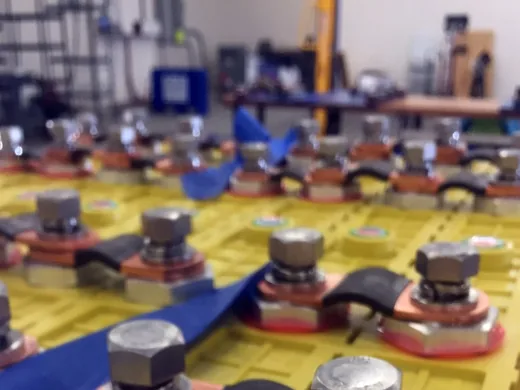
Mechanical design carries as much weight as the electrical side. Prismatic cells swell slightly as they charge and need compression to stay flat, busbars have to accommodate that expansion without stressing terminals, every part of the assembly has to survive being dropped off a tailgate. The internal structure of a 5040 watt-hour pack shows what that looks like once compression plates, sense wiring and thermal paths are all fitted into a case somebody still has to lift. Weight is the constraint on everything.
What separates a good cell from a cheap one
Grade A cells come off the line meeting specification on capacity, resistance and self-discharge. Grade B cells miss on one of those and get sold cheaper, often into markets where nobody is checking. The difference does not announce itself on day one, a B-grade cell at 98 percent of rated capacity looking perfectly healthy in a machine nobody has load-tested. Year one proves nothing. Where it shows up is year four. A pack assembled from unmatched cells drifts apart, the weakest one hitting its voltage limit earlier on every cycle, the board cutting off with energy still sitting in the other fifteen. Capacity measured at the terminals falls faster than any individual cell is actually degrading. Most premature power station deaths look like that from outside, with no dramatic failure anywhere in them.
Price tracks this closely enough to be a signal. Cells are roughly half the mass of a machine and a large share of its bill of materials. A station undercutting the market by a third has found that money somewhere, cell grade being the easiest place to find it. Nothing in a specification sheet distinguishes the two. A long warranty from a company with a real address is the proxy most buyers are left with.
Testing is what separates the two claims in practice. A cell arriving from a reputable line comes with a capacity and a resistance measured on that individual cell, a batch average being no use at all, which lets a pack builder sort against real figures before anything gets welded. Buying untested cells and sorting them yourself is possible, takes a discharge rig and several days, and is what a good deal of the enthusiast market actually consists of. A finished station gives a buyer none of that visibility. Warranty length and a phone number that still works in year five are what remains.
Lithium iron phosphate cell figures, with the source or arithmetic behind each
Quantity
Figure
Where it comes from
Nominal cell voltage
3.20 to 3.30 V
8 in series give 25.6 V, 16 give 51.2 V
Working voltage window
2.50 V to 3.65 V
Battery University BU-205
Thermal runaway threshold, LFP
270 degrees
same reference
Thermal runaway threshold, NMC
210 degrees
same reference
Thermal runaway, cobalt and NCA
150 degrees
same reference
Specific energy, BU reference
90 to 120 Wh/kg
same reference
Specific energy, current prismatic
130 to 160 Wh/kg
commercial cells, 100 to 314 Ah
Specific energy, NMC
150 to 250 Wh/kg
same measurement basis
Cycle life
2000 and higher
depends on depth of discharge and temperature
End-of-life convention
80 percent of original capacity
bookkeeping threshold, not a failure
Charge rate, typical
1C to 3.65 V, about 3 hours
Battery University BU-205
Discharge rate
1C routine, 25C on some cells
same reference
Coulombic efficiency
99 percent and above
charge out over charge in
Energy round-trip efficiency
about 95 percent at 0.5C
voltage gap between charge and discharge
Self-discharge at rest
a few percent per month
pack stored full stays usable a season
Energy in a 100 Ah cell
320 Wh
100 Ah times 3.2 V
Resistive loss at 100 A
5 W at 0.5 milliohm, 50 W at 5
current squared times resistance
Charge cutoff temperature
0 degrees
below it, lithium plates on the anode
Cycles a year at daily use
365
3000 cycles is over eight years
Common questions
Why do power stations use LiFePO4 and phones do not?
Weight. Phosphate cells hold 130 to 160 watt-hours per kilogram against 150 to 250 for the chemistry in a phone, which a pocket device cannot afford and a box on a shelf can. What the extra weight buys is a 270 degree thermal runaway threshold against 150, plus several times the cycle life.
Is a 6000 cycle claim believable?
At the depth of discharge it was measured at, probably. Cycle counts are meaningless without that condition attached, since a cell taken only to 20 percent remaining lasts a large multiple longer than one run flat every time. Ask what depth the number refers to.
Why does my battery percentage jump around?
Because the voltage curve is flat. A phosphate cell holds near 3.2 volts from 90 percent charge down to about 20, which tells the board very little, leaving it to count current in and out. A board that has drifted reports 60 percent for hours, then falls off quickly.
Can I charge one below freezing?
No, and firmware in any decent machine will not let you. Lithium plates onto the graphite as metal without going into it, taking capacity away permanently and building dendrites. Discharging cold is fine, just weaker. Field-grade machines carry a heater for exactly this.
Should I store it full or empty?
Around half, somewhere cool. Calendar ageing answers to temperature and state of charge together. A pack parked full in a hot car ages considerably faster than one at half charge in a cupboard. Self-discharge of a few percent a month means it will still be usable next season either way.