How Wide Temperature 0 to 60 Batteries Are Achieved
What a 0-to-60 rating means
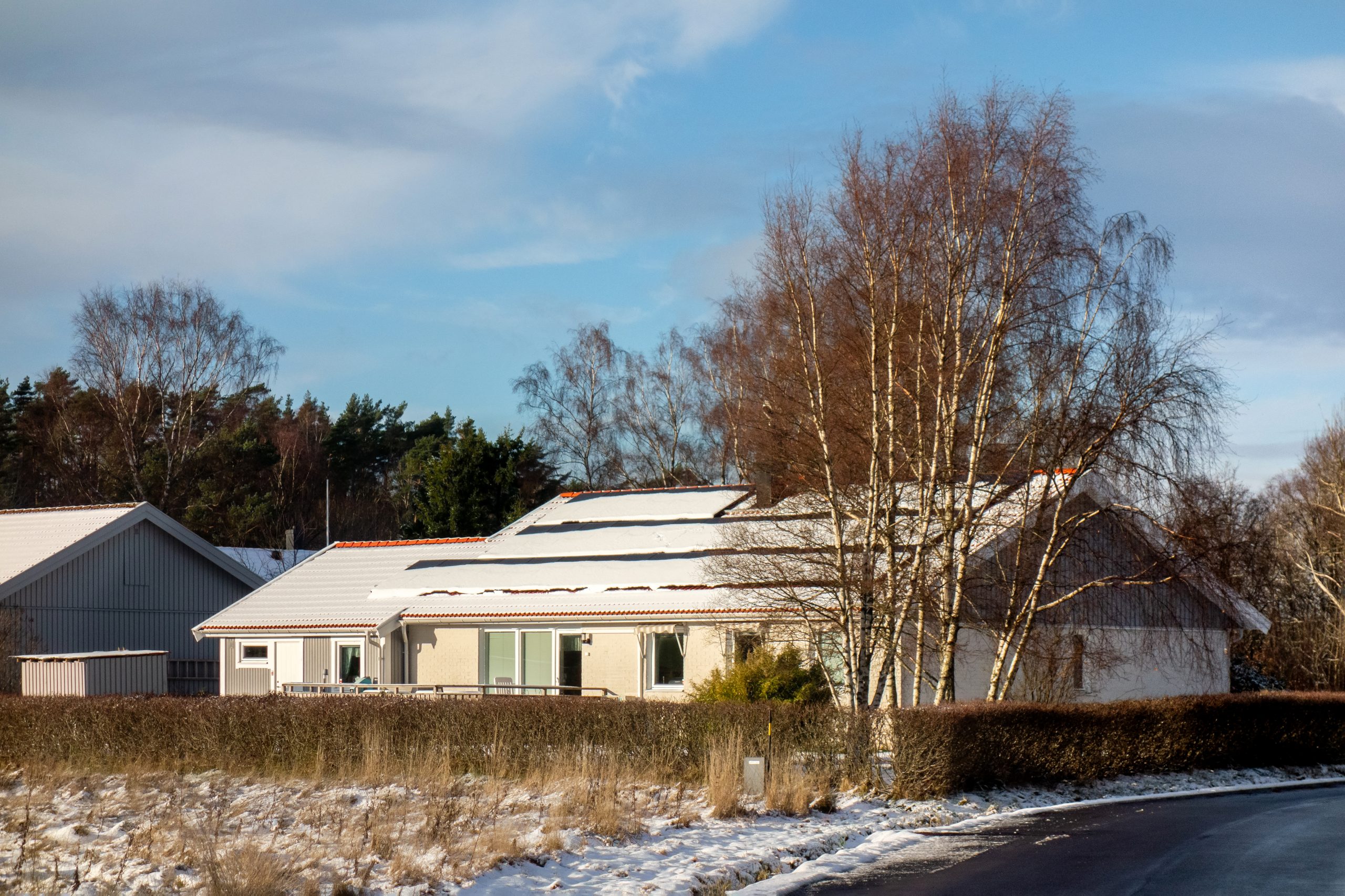
Solar panels under snow on a winter roof. A power station charging from panels like these in deep cold cannot take the current until its cells are warmed, the reason a wide-temperature pack carries a heater of its own.
A LiFePO4 power station rated for zero to sixty degrees Celsius charges, holds, and delivers its energy across that whole band. The band runs from a freezing winter morning to the stifling heat inside a closed summer car. The rating promises the box keeps running where a bare cell would quietly quit. The lithium cell at the station’s heart manages neither edge of the range by itself, so reaching the full band takes real engineering. Its charge limit and its discharge limit sit far apart. A wide-temperature design has to respect both. The heater, the insulation, the derating, the watchful board all serve that one goal.
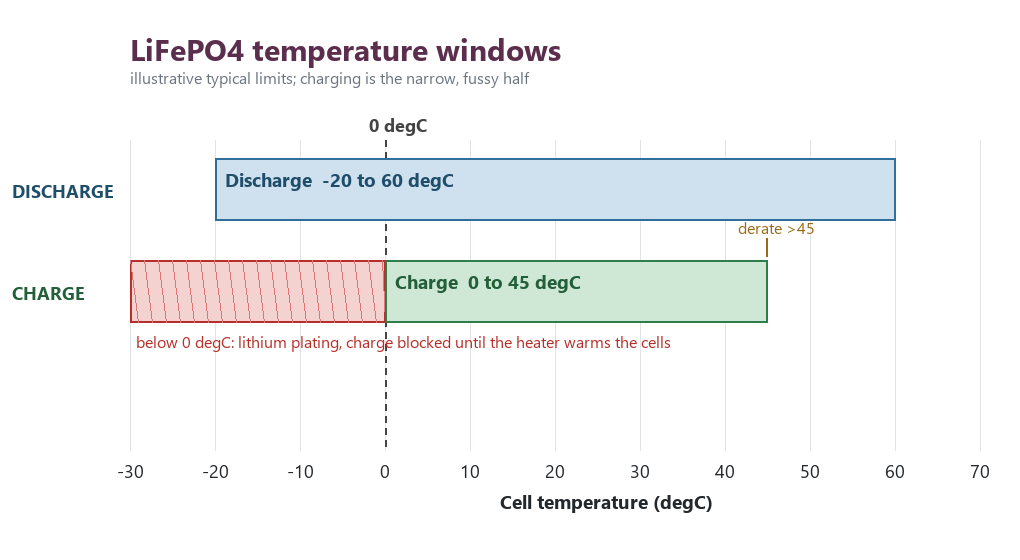
Charging is the fussy half. A LiFePO4 cell takes current only from about zero to forty-five degrees, far below the minus-twenty-to-sixty span it discharges across. Makers usually headline that charging window. Cold-country buyers watch it closest. A cell forced to charge in the cold heads for early failure. Some stations bury the charging limit inside a broad operating range. The one number a winter buyer needs disappears into it. That number decides whether the box charges at all in the cold.
Of the two edges, the cold gives a maker the worst trouble. The cells will not safely take a charge until something warms them. So the whole craft of a wide-temperature station lives at that lower edge. Getting the cold right is the harder job. A 0-to-60 rating is an added capability. The engineering puts it there. The bare cell is handed a heater and a watchful controller to reach either end.
Why the cold is the hard end
The two temperature windows of a LiFePO4 cell, drawn as a diagram. Charging holds to a narrow band, roughly zero to forty-five degrees, with a hazard zone below freezing where a cold charge plates lithium and must wait for the heater. The wider discharge band, minus-twenty to sixty, shows how much more freely the cell gives power than takes it in. The limits are illustrative, the exact figures set by the cell and the design.
Below freezing a lithium cell turns dangerous to charge. The reason sits in the chemistry. On a normal charge the lithium ions slip into the layers of the graphite anode. They settle there. Cold slows that journey. The graphite takes the ions in sluggishly. They back up at its surface. The excess plates out as a film of metallic lithium on the surface. That plated lithium stays for good. It piles up, cycle after cold cycle. It robs the cell of capacity. It grows sharp threads that can one day reach across and short the cell from within. A colder cell drinks slower and plates more. The threat climbs the colder the cell and the harder the current is pushed. A fast charge into a deeply cold cell does the worst harm. Take away either the cold or the speed. The harm eases toward nothing. Battery University states the rule plainly: no charge is permitted below freezing. A sub-freezing charge plates metallic lithium on the anode. That loss of performance and safety is permanent.
The damage is permanent. The damage is easy to miss. A cell fast-charged a few times below freezing loses capacity for good. No later warming brings it back. The plated metal sits there as a quiet hazard. It stays long after the cell returns to room temperature. A maker who allows a hard cold charge trades a working winter for a shortened life. A wide-temperature design exists to dodge that trade. Discharge in the cold does no such harm. Pulling lithium out of the graphite plates nothing. So the cold limit a buyer reads is almost always the charging limit. A cell discharges well below zero. It only gives less the colder it gets. Its chemistry slows. Its voltage sags under load. A cold discharge leaves the cell unharmed. This is why the two ends of a temperature rating sit so far apart. The cold-end problem, then, is a charging problem. Every answer to it comes down to one move. Warm the cells before any real current goes in. Warming works because the harm is all about rate. A cold graphite anode cannot drink lithium fast. Any current beyond a trickle backs the ions up and plates them. Lift the cell a few degrees. The graphite drinks freely again. A few degrees of warmth pushes the plating threat aside. A cell held just above freezing takes a full clean charge. That is why a heated pack draws its charging limit right at the zero-degree line. Specialty cells stretch the rule a little. Some can trickle a small charge down to about minus ten degrees. A power station leaves that trick to them. It relies on the heater, simpler and surer. The heater warms every cell in the pack alike. A cold charge that plates one weak cell drags the whole string down. So a heated pack treats the zero-degree line as firm. It warms first and charges second, every cold morning of its life.
The plating has a threshold and a rate. It grows worse the colder the cell falls toward and below zero. It grows worse again the harder the charge is pushed. A slow trickle into a cold cell does far less harm than a fast bulk charge. So a careful design blocks only the fast cold charging. It still allows a gentle trickle while the pack warms. It saves the full current for a cell above freezing. The threads of plated metal are the real danger. These fine filaments can grow through the thin separator between the electrodes. They touch the far side. They seed an internal short, the kind that ends a cell for good. A trickle so gentle it barely registers can inch a cold pack upward and stay clean of plating. That loophole is what a heated design and a patient charger both lean on.
Cold steals range even when it does no harm. A pack delivers its full rating at room temperature. Near freezing it hands back noticeably less. The lost capacity returns once the cells warm. This part of the cold story is reversible. It is a temporary shrinking, soon undone by warmth. A wide-temperature design leans on that. It lets a cold pack run short for a while. The only rule is that it never takes a charge it cannot safely hold. The drop can reach a fifth of the rating in hard cold. A winter night’s run comes up noticeably short. All of it returns once the pack is warm. A colder pack holds back more. A small one near minus ten can give only two-thirds of its summer run. The rest returns once the cells warm.
The cold sets the harder engineering puzzle.
Knowing where the real danger sits changes how the range is read. Of the two cold figures, only the charging one has to be built. It is paid for in heaters, insulation, and a patient control board. The board holds off the current until the cells are ready. The minus-twenty discharge figure asks nothing of the design. The chemistry grants it for free.
Warming the cells to charge in the cold
The answer to the cold end is heat, applied before the charge. A wide-temperature pack carries a heating element. It is a thin film or a mat of resistive wire pressed against the cells. It wakes the moment a cold charge is asked for. The board reads the cell temperature. It holds the incoming current back while the heater runs. It opens the charge only once the cells clear freezing. From the outside this looks like a slow start on a cold day. Inside, the pack is warming itself into a state where it can take current safely. The wait can run from a few minutes to nearly a full hour. How deep the cold is and how much heat the element pours set the time. The board keeps the charge shut until the reading clears zero.
The heat has to come from somewhere. A cold pack has two places to find it. It can borrow from the same source trying to charge it. The first watts of solar or wall power go to the heater before any reach the cells. Or it can draw a little from its own charge for a faster start. Either way the first watts of a cold charge store nothing. They lift the pack into its safe window first. The cold weather levies that tax on every winter charge. A common design borrows from the incoming charge. That spares the stored energy. It accepts a slower start on the coldest mornings.
The heating costs real energy. A winter buyer does well to weigh it. Warming a large pack from deep cold to its charging window spends a clear slice of a charge. A small pack needs tens of watt-hours. A big one needs more. The colder the start, the larger the bill. A station charging from a solar panel on a freezing morning may pour its first hour of weak sun into the heater alone. The cells stay empty until the box is warm. On the coldest mornings a careful owner starts the charge early. The heater then has time to finish before the day’s real charging begins. This is the hidden price of a wide cold rating. It is paid in a slower, costlier winter charge. The spec a buyer reads stays silent about it. A maker sizes the heater to warm the pack in a fair time without draining it. The size is a balance between a quick cold start and the energy the warming burns. A buyer in a hard climate plans for that bill. A heater keeps a pack charging in winter, only slowly. Without it the pack goes dead until spring. The slower charge is the price of a box that works at all.
Insulation makes the heat go further. A wrapped pack holds the warmth its heater makes. It also holds the warmth its own working generates. So a little heating brings it up to temperature. The warmth then lingers long after. The better designs treat the pack like a flask. A short burst of heating carries it through a long cold session. The cells ride on their own warmth well after the heater switches off. A well-wrapped pack can hold its working warmth through a cold night of light use. Once it is up to temperature, it rarely calls on the heater again.
How fast a pack warms is a craft of its own. So is how a maker brings it up to temperature before a charge. The point here is narrower. The zero-degree charging figure on a wide-temperature station is the work of a heater. It is a capability built into the pack. The bare cell never had it.
The electrolyte and the cell at the edges
Inside the cell, the liquid that carries the lithium sets much of the temperature range. In deep cold the electrolyte thickens toward syrup. It drags the lithium through slowly, so the cell does less in the cold. A wide-temperature cell uses an electrolyte blended to stay fluid further down the scale. Additives hold off that thickening near freezing. A few extra degrees of cold stay usable. Internal resistance climbs in the cold too. More of every amp turns to heat. The voltage sags harder under load. That is one more way the cold pinches what a pack can deliver.
The phosphate chemistry helps at the top of the range. Lithium iron phosphate holds its structure well past two hundred degrees. That is far above anything a working pack will see. So the sixty-degree upper figure sits nowhere near the cell’s own danger point. Wear and the gear around the cells set the hot limit. The cathode is in no danger of letting go. That is part of why this chemistry reaches into heat that would worry a cobalt cell. In heat, the wiring, the plastics, and the slow chemistry of wear tire first. The cathode is the last part of the pack to feel sixty degrees. One bond holds the cell safe through a nail or an overcharge. The same bond holds it through heat. It grips its oxygen as firmly at sixty degrees as at twenty.
The hot end and holding it back
The high end of the range asks mainly for patience. A LiFePO4 cell charges and discharges well into the heat. So the sixty-degree figure needs no heater and no special trick. It needs only a controller willing to ease off in the heat. Heat speeds the slow wear that ages a cell. A station run hot all its life fades sooner. The cure is to ease the pace. The station keeps working. The hotter the day, the harder the trim. The station spends watts to buy years until the heat lets up. None of this strains the cell itself. The cell would run hotter without complaint. The limit guards its long life. Its safety is never in question. A station holds back to keep its warranty years intact.
Pulling power back is how the hot end is held. Once the cells warm past a set point, the board trims the charge current and the output. It sheds the load that runs the hottest. The pack gets room to cool. A fan helps where one is fitted. It pushes air across the cells and the electronics to carry heat out of the case. The output a station holds in a hot tent is smaller than its label figure. The box is quietly protecting itself. It holds back before it can cook the cells. The trim stays invisible from the outside. The box still answers every plug. On the worst afternoons it just works with a quieter hand.
The pull-back follows a smooth, sloping curve. The pack climbs through the forties and toward the fifties. The board trims its limits by degrees. Each step up allows a little less current. So the output fades smoothly. It never drops out at one hard line. A buyer rarely sees the curve on a spec sheet. The label prints only the temperature where the station stops. The slow taper toward it stays off the page. The same taper protects the cells from within. The controller reads their warmth. It eases the load before the heat can do its slow damage. In a hot tent or a desert afternoon the box still runs. It runs at a gentler pace. Its full label power waits for the cool of the evening.
Placement and spacing do quiet work at the hot end. Cells get a little room between them. Metal spreads the heat. A path lets air move. Under the same load such a pack runs cooler than cells crammed tight in a sealed brick. A maker building for heat leaves that room and that metal. The pack then sheds warmth as fast as it makes it. It never climbs to the point where it has to throttle hard. The cooler design also holds a higher output for longer in the heat. The metal and the airflow hold the output minutes longer than a sealed brick could.
The sixty-degree figure, then, is held by management. No heroics are asked of the cell. The station holds the line well below what the cell could take. It does so on purpose, to spend the heat slowly across the years its warranty promises. A wide-temperature station treats sixty degrees as an ordinary working condition. An afternoon in the heat leaves the cells none the worse. A station that throttles a little outlives one that pushes full label power through every hot afternoon. The restraint costs a few summer watts in trade for years of life.
What the board watches over it all
A temperature sensor on the cells turns all of this from hope into control. The board reads the pack warmth many times a second. It blocks a charge while the cells sit below freezing. It runs the heater until they are ready. It trims the current once they near the hot limit. It cuts off entirely if the temperature runs past safety in either direction. That same small brain stretches the usable range to the full zero-to-sixty band. It guards both ends of it. A pair of small thermistors pressed to the cells feeds it the reading. The board logs the warmth over time. A technician can read back how hot or cold a pack has lived. That record tells more about a tired battery than any single number on the case. The thresholds the board enforces come from the cell maker’s own limits. Each edge keeps a margin of safety.
LiFePO4 temperature limits (typical; set by the cell and the design)
What
Typical limit
Past the limit
Charge temperature
0 to 45 degC
below 0: lithium plating, heater needed
Discharge temperature
-20 to 60 degC
below -20: little output, reversible
High-temp derating
starts near 45 degC
output trimmed by degrees
Cathode breakdown
above ~200 degC
far beyond any working heat
Capacity near freezing
~70 to 80% of rated
returns when the pack warms
Reading a temperature spec
A temperature line on a spec sheet rewards a careful eye. The first thing to separate is the charging range from the discharging range. The two differ by a wide margin. A single headline number leaves the reader guessing which it means. Some stations print only a broad operating range. They give no split between charge and discharge. Those leave out the half a winter buyer needs above all.
A heater is the tell for the cold end. A station rated to charge at zero or below has a heating system inside, named or not. The heater is the only way that low figure is reached. A buyer headed for real cold reads the charge-temperature line first. A box that will not take a charge below freezing goes flat through a winter outage. It stays flat. Real cold rewards reading that line twice. A zero and a five on the charge spec are a wide gap apart. A box that needs five degrees to charge sleeps through a hard winter. It stays dead until spring.
The rating reads differently for different lives. A box kept in a heated room and carried out only on summer trips rarely meets either edge. Its wide rating is a comfort it never spends. Where a box lives decides which edge of the rating it spends. Matching the rating to that life counts for more than chasing the widest number on a shelf. A range never reached is money paid for nothing. A buyer in a mild climate carries a wide range for nothing. It is a fair price for the one trip that does meet the cold.
The hot figure carries its own fine print. A sixty-degree operating rating rarely means full power at sixty. It means the station keeps running and protecting itself up to that mark. Its output is trimmed well before it. Read together, the two ends of the rating describe a taught battery. It survives a span its bare cells never could. The heater and the controller stretch the range at both ends. Read a wide rating as a built capability. Every degree at each edge is added by the heater, the controller, and the board between them. The bare cell owns none of it. A wide rating, then, says more about the engineering than about the chemistry. The same bare cell sits in a narrow box and a wide one. The heater and the board make the difference.
Common questions
Can a LiFePO4 battery charge below freezing?
A bare LiFePO4 cell should not take a charge below zero degrees Celsius. Charging in the cold plates metallic lithium on the anode. That damages the cell for good. A wide-temperature station gets around this with a built-in heater. The heater warms the cells above freezing before any charge current flows. The cell can still discharge well below zero without that harm.
Why is the cold limit lower for discharging than for charging?
Charging in the cold forces lithium onto the surface of the graphite. There it plates as metal and scars the cell for good. The same cold does no such harm on discharge. Discharge pulls lithium out of the graphite and plates nothing. So a cell runs far colder than it can safely charge. This is why a spec often reads minus twenty for discharge and zero for charge.
How does a power station work in 60-degree heat?
Lithium iron phosphate stays stable far past sixty degrees. In the heat the worry is wear, with safety never in question. The station holds the high end by pulling its charge current and output back in the heat. Spacing, metal, and a fan where one is fitted all help. Its full power is available well below sixty. The rating marks how high it keeps running in a protected, reduced state.
Does cold weather reduce how much a battery holds?
Cold temporarily shrinks the energy a pack delivers. A cell near freezing hands back noticeably less than the same cell at room temperature. This loss is reversible. The capacity comes back once the pack warms. This is a passing loss. The permanent kind comes only from charging in the cold. That kind never comes back.