A portable power station takes charge from four places. A wall socket, a solar panel, a car’s accessory socket and a USB-C port cover nearly every unit on sale. Larger machines add a generator inlet, or accept two sources at once. Each door has its own converter behind it. The AC inlet feeds a rectifier and then a step-down stage. A maximum power point tracker waits behind the solar port. The car socket leads into a DC-to-DC converter working upward from 12 volts. USB-C is different again, since a negotiation controller has to agree a voltage with whatever is plugged in before any current moves. All four end in one place. Parallel multi input charging is possible because the doors stay independent right up to the battery, where a single charge controller decides what the cells receive. A unit with an 1100 watt AC inlet and an 800 watt solar port often caps the pair at 1500 watts, well under the 1900 the two ports promise separately.
Every figure printed beside an input port is a claim about the door. The battery makes a claim of its own. It wins every argument. Charge current, cell temperature and the point the pack has reached on its curve each narrow what any door may deliver, moment by moment. Reading input specifications without that in mind is how people end up surprised that two fast chargers don’t halve the clock.
What a panel delivers, and the window that accepts it
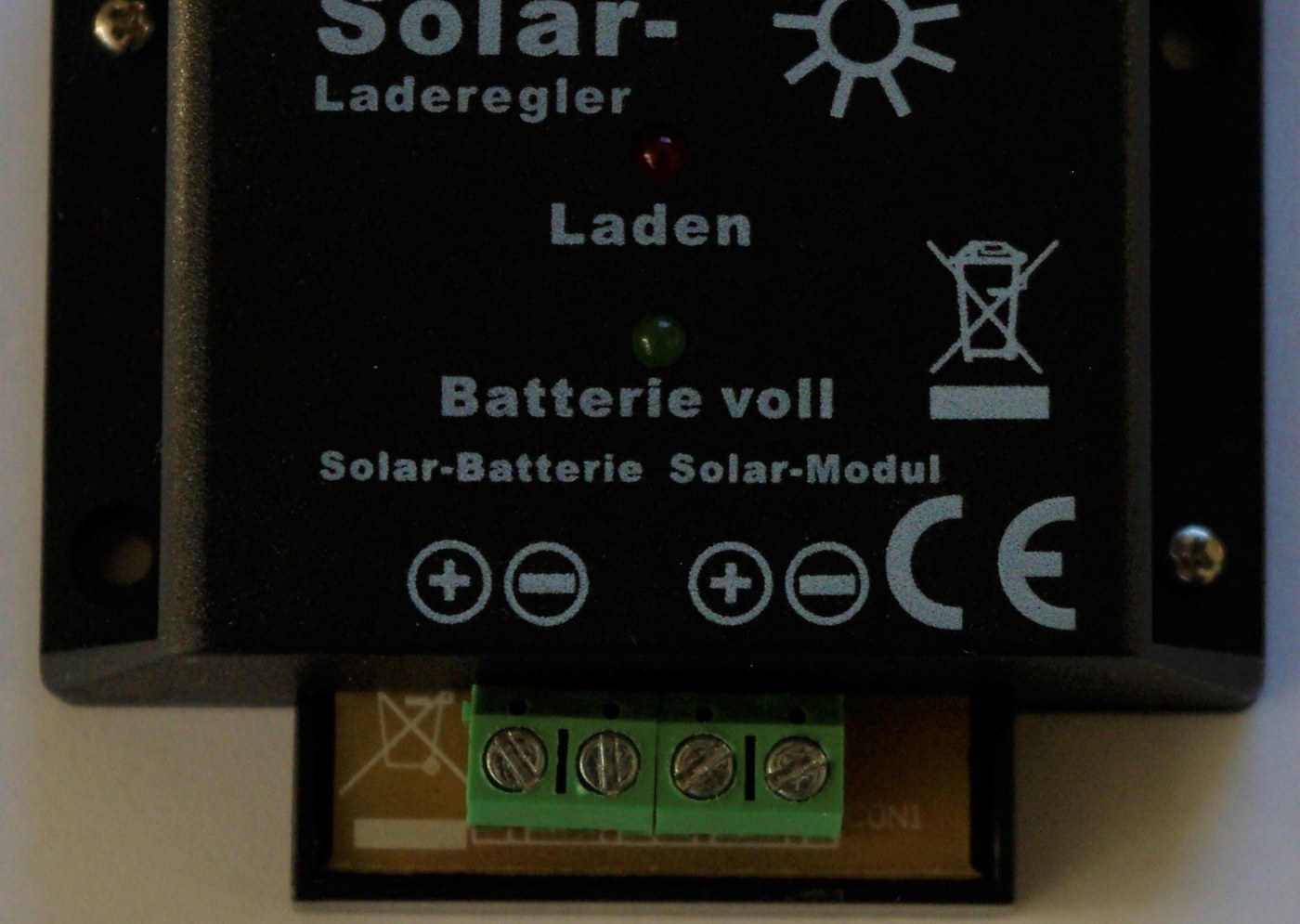
A solar charge controller with its terminal pairs labelled separately for the module and the battery. Everything on this page happens between those four screws. Photo by MAmberg, CC BY-SA 4.0.
Panel ratings come out of a laboratory. Standard test conditions put 1000 watts per square metre of light onto the panel and hold it at 25 degrees. Neither condition survives contact with a real field. Angle, haze, cell temperature, cable loss and the controller’s own conversion together cut the real world power output of solar charging to nearer 140 watts from a panel rated 200 on a good day. Planning guides fold all of it into a single derate factor of 0.75 to 0.85.
Heat is the slice people miss. Because a panel runs hotter than the air around it, the silicon inside gives up voltage all afternoon. A solar input carries two numbers beside it, a minimum voltage and a maximum. Panels have to land between them before any charging starts at all.
A tracker needs headroom to work in, which is the whole reason for an MPPT controller’s voltage window range. It holds the panel at whatever voltage produces the most power, then converts that down to what the battery wants. A panel sitting at 30 volts feeding a 12 volt battery has its surplus voltage turned into extra current.
The older approach threw that surplus away. A PWM controller drags panel voltage down to battery voltage and the difference leaves as heat. An 18 volt panel on a 12 volt battery runs at 12 volts. Measured across 2024 testing the two land about twenty points apart: 98 to 99 percent conversion for MPPT, 76 to 79 for PWM. There is the origin of the familiar claim of 15 to 30 percent more harvest. Cold weather widens the gap. Open-circuit voltage climbs as temperature falls, which pushes a panel toward the top of the window on a January morning and hands the tracker more surplus to convert.
The opposite failure comes out of that identical effect. A string sized comfortably in August can overshoot the maximum in winter and shut the port down.
The wall, the cable and the car socket
Mains charging is the one door with a speed control. Most machines let you pick a rate, sometimes as a slider inside an app. Neither end of that dial is free. Heat in the conversion stage and fan power spent removing it are where the efficiency loss between AC fast and slow charging actually goes. Filling a 1000 watt-hour station pulls 1100 or more from the wall. A good charger converts at 92 to 95 percent. Current is what the loss tracks. Resistive heating follows the square of it, which means doubling the charge rate roughly quadruples that share of the waste. When the fan gets loud, that is the arithmetic you are listening to. USB-C arrived late as a charging input and changed what a small machine has to carry. One cable now covers a laptop, a phone and the power station itself.
Stations set the Type-C PD charging input power cap anywhere between 60 and 240 watts. Standard Power Delivery tops out at 100 watts, built from 20 volts at 5 amps. The extended range reaches 240. Both ends negotiate before current flows. The cable declares a limit of its own as well, which is why a thin one quietly caps a charger you paid extra for. Charging a power station from a 12V car socket meets a fuse nobody thinks about. Most cars protect that circuit at 10 or 15 amps, which allows 120 to 180 watts at 12 volts. Put that beside the AC inlet and the gap is stark. A station able to take 500 watts from the wall still draws 120 through the socket. An hour of driving adds about what you’d get from a quarter of an hour at home.
When the engine is the grid, and why the tail is slow
Stay off grid long enough and the wall socket has to be manufactured. That leaves hybrid generator charging for a power station, on one condition. The condition is waveform quality. At a charger’s front end, a rectifier feeds a switching stage. Rough power confuses it. Inverter generators produce a clean sine and portable stations accept them without complaint. Out of an older open-frame machine comes something coarser. Many stations either charge slowly on them or refuse outright. Sizing matters in the other direction too. Because the charger presents a load that arrives all at once, a generator has to exceed the station’s input by a comfortable margin. The station then works as a buffer. From the engine’s side, output stays steady into the pack. Household loads draw from the pack at whatever rate they please. Charging happens in two phases and only the first one is quick.
Constant current comes first. A charger rated 1000 watts drives 1000 watts into the pack and holds it there. Cell voltage climbs slowly as charge accumulates. That phase covers most of the capacity. Every headline charging figure gets measured inside it. Once the highest cell reaches its charge voltage, around 3.65 volts on iron phosphate, the charger stops raising current and begins holding voltage steady. Current then falls on its own, quickly at first and afterwards in a long taper. The pack counts as full when that taper reaches roughly 0.05C, five amps on a 100 amp-hour battery, at which point a decent charger terminates. Everything between the changeover and termination is the constant voltage phase. It’s slow by construction. Nothing’s gone wrong. Chemistry sets the pace, since pushing more current at that point would drive cell voltage past its limit. Published guidance puts that constant voltage phase at the last 5 to 10 percent of the charge. Two other jobs happen inside the identical window. Cell balancing runs here, because balancing only operates in charge mode and only once a cell has climbed clear of the flat plateau where voltage says nothing useful about charge. The board also takes a state of charge reading against a known point, resetting a count that has been drifting since the last full charge. A machine that never finishes a charge never balances and never recalibrates. There is the hidden cost of stopping at 80 percent every time. Across a few hundred cycles it turns into a real one. The absorption window itself lasts anywhere from six minutes to two hours depending on how far apart the cells have drifted, which is why two charges of one pack can finish at noticeably different times. None of this appears on a specification page, where a single number describes the fast half of a process that has two halves.
Exactly that fast half is what gets quoted as a power station’s 0 to 80 fast charging time. On a 1024 watt-hour pack charging at 1000 watts, 80 percent is 819 watt-hours, arriving in about 49 minutes before losses. The remaining 205 watt-hours can take as long again. Temperature moves the clock too. A cell specified for 1C charging at 25 degrees may need derating to 0.3C at zero to avoid plating, which turns a fifty minute claim into something closer to three hours on a cold morning. Finish the job properly once a week and the board gets what it needs.
Working while charging, and what comes back out
Pass-through is the feature that lets a machine take charge in one side and deliver power out the other at once. Anything used as backup depends on it, since a unit left on mains has to keep the fridge going the moment the mains disappear. Doing both jobs together costs heat. Fans start earlier and stay on longer. A pack held warm through repeated cycling ages faster than one left alone. UPS duty asks for more than pass-through by itself. The machine also has to hold its output up through the changeover, which is a question about transfer time, separate from anything on the charging side. A unit that supports pass-through and still takes 30 milliseconds to switch will drop a desktop every time.
Manufacturers split on it. On cheaper machines with weak heat paths, pass-through is either disabled outright or flagged with a warning that heavy use shortens pack life. Units built on iron phosphate cells with active cooling treat it as an ordinary operating mode. Since the front panel looks identical either way, the manual is the only place that says which one you’ve got.
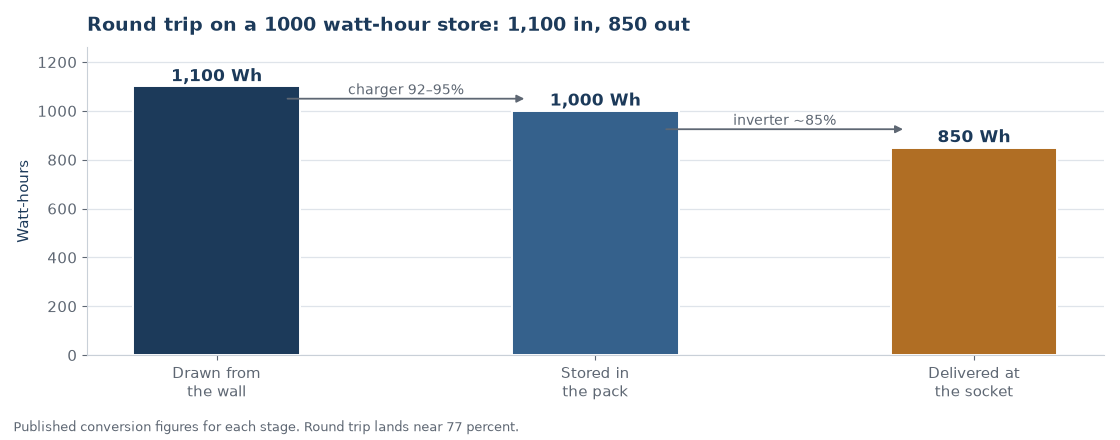
Wall to pack to socket on a 1000 watt-hour store. Charger conversion runs 92 to 95 percent and the inverter near 85, which leaves about 850 watt-hours of the 1,100 drawn.
Between a wall socket and a laptop sit two conversions. On the way in, alternating current comes down to pack voltage. On the way out, pack voltage goes back up to alternating current. Neither step is free. Line the published numbers up end to end. Storing 1000 watt-hours costs about 1100 from the wall, since a good charger converts at 92 to 95 percent. Recovering that energy through the inverter lands near 85 percent on typical figures, which turns the stored 1000 into roughly 850 at the socket. Eleven hundred in, eight hundred and fifty out. The round trip works out near 77 percent. No specification page prints that number. Some analyses land lower once the reserve a board holds back and the depth of discharge limit are counted, arriving near 765 watt-hours of genuinely available AC from a 1000 watt-hour nameplate. If you’re budgeting a night’s power off a capacity figure, knock a fifth off before you start.
The charge you leave it at, and what speed costs
A machine spends most of its life doing nothing at all. Whatever charge it holds through that idle time decides how much of the pack survives to be used. A 2025 study recommissioned 100 commercial 26650 iron phosphate cells after ten years of uninterrupted shelf storage at 50 percent charge and 6 degrees. They came back holding 96 to 98 percent of their original capacity. Resistance changes were too small to matter. Rate capability was unchanged up to 3C. Ten years on a shelf cost those cells two to four percent.
Temperature is what does the damage. In one published calendar-aging model, the wait for a 20 percent capacity loss at 50 percent charge runs around 23.8 years at 25 degrees and about 8.7 years at 40. Storing full accelerates it further. What the data asks for is cool and half charged, against every instinct to put a machine away with a full tank. One snag comes attached to that advice. The percentage a machine reports is a drifting count. It only gets corrected at a full charge. Storing at an indicated 50 percent after months of partial cycles may really mean 40, or 60. Charge to full once before putting a machine away, then run it back down to half. The number you leave it at is then a number you can trust.
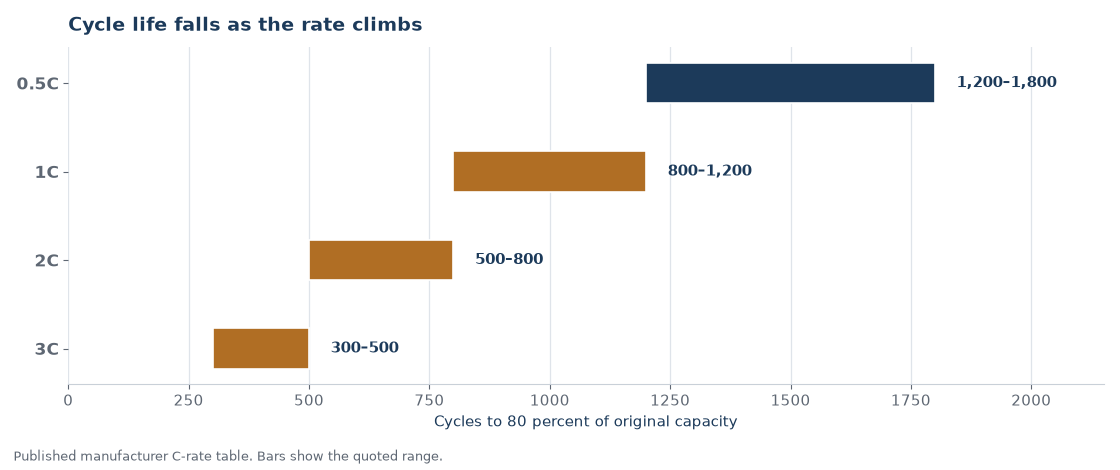
Quoted cycles to 80 percent capacity by rate. The published range narrows from 1,200 to 1,800 cycles at 0.5C down to 300 to 500 at 3C.
As the rate climbs, published cycle-life figures fall steadily. One manufacturer’s published C-rate table puts cycles to 80 percent capacity at 1200 to 1800 for 0.5C, 800 to 1200 at 1C, 500 to 800 at 2C and 300 to 500 at 3C. Between 1C and 2C the quoted cut runs 30 to 50 percent. Guidance elsewhere sets the penalty for habitual 1C charging at 20 to 40 percent against 0.5C. Capacity itself shrinks at rate. A cell delivering 100 amp-hours at C/5 may give 85 to 90 at 2C and around 70 at 5C. None of that energy is gone. It just can’t come out that fast.
Work out what the rate means for a given machine before choosing. A 1024 watt-hour pack filled in one hour is charging at 1C. Filled in two, at 0.5C. The slider that halves your charging time is the slider that shortens the working life of the thing.
Sizing an array, and heat on the way in
A solar port rated 800 watts is a ceiling on what the port will accept. It says nothing about how much panel you need to reach it. Work backwards from the 70 percent that panels actually yield. Around 1150 watts of panel is what an 800 watt port needs to see its limit, and even then only through the middle hours of a clear day. For a daily yield, one more number is needed. Peak sun hours condense a whole day of light into equivalent hours at full test intensity. Where you are decides the figure: 5.5 to 7 across Arizona and New Mexico, 4 to 5 through the American southeast and midwest, 3 to 4 in the Pacific northwest and northeast. Southern Spain averages 5 to 5.5. In Britain and northern Europe the figure is 2.5 to 3.5.
Multiply and the picture arrives. Four hundred watts of panel in a four peak-sun-hour region, derated to 0.8, yields roughly 1280 watt-hours a day. On that, a 1024 watt-hour station fills with something to spare. Take the identical array to a British winter at 2.5 hours and it yields 800, which no longer covers one full charge in a day. Charging has an upper temperature limit as well as a lower one. Published charging windows for iron phosphate run 0 to 50 degrees. Individual cell datasheets are often tighter. EVE’s 280 amp-hour cell specifies 45 degrees for charging against 55 for discharging. Thermal protection on the board arrives much later, somewhere between 60 and 80. Those two charging figures disagree by five degrees. A machine follows whichever one its designer wrote into firmware. Nothing on the outside says which.
Between those figures lies a gap where a machine works normally and quietly ages. Sustained heat accelerates capacity loss without tripping anything at all. Board protection sits 15 to 35 degrees above the cell maker’s own charging limit. Nothing inside that band raises a fault. Leave a machine charging in a hot car boot and you are in that band. So are you charging it in direct sun with a dark case. No fault appears in either case. The life they spend never shows up on a display.
Reading an input spec line
An input spec line folds four decisions into one row of text. Each figure constrains something different. Reading them out of order is how people end up buying the wrong panel. The AC number is a maximum draw, usually adjustable downward from an app. A solar entry carries two things, a voltage window and a watt cap. That window decides whether your panels work at all. Read it first. A car figure near 120 watts tells you the designer assumed an ordinary fused socket. A Type-C figure of 100 means standard Power Delivery. Anything at 140 or 240 means the extended range. Then find the combined figure, which usually hides in small type or in the manual. Add 1100 and 800 together and the machine rarely agrees with the answer. Whatever the machine caps them at is the number that governs a storm-prep fill. It’s also the one figure on the row that most buyers never look for. Four doors, four ceilings, one battery. Figures are for a 1024 watt-hour pack before conversion losses, which makes every hour shown optimistic by roughly a tenth. One thing the table cannot show is two doors open at once. That case runs on the combined cap, which usually falls below the sum of any two rows.
Common questions
Will charging from the car flatten the car battery?
With the engine running, the alternator carries the load. Nothing comes out of the starter battery at all. Everything below applies to the engine-off case, where the arithmetic gets short. A 60 amp-hour starter battery holds about 720 watt-hours. Starter batteries are meant to stay above 75 percent charge, which leaves roughly 180 watt-hours to spend. At 120 watts that’s an hour and a half. Take one below 10.5 volts and a single deep discharge can cost a lead-acid battery 20 to 50 percent of its capacity for good.
How long do the panels themselves last?
For crystalline silicon, NREL puts median degradation at 0.5 percent a year, leaving a panel at year 25 producing around 88 percent of what it made new. Warranties usually guarantee 80 to 92 percent at that point. Portable folding panels are the exception, since hinges, handling and repeated packing tend to bring them in at 10 to 15 years.
Why does charging stop when it gets cold?
Below freezing, lithium that reaches the anode plates out onto the surface as metal in place of entering the graphite. That damage doesn’t reverse. Boards refuse charging outright once the sensors read below zero. Between 0 and 5 degrees, published guidance holds charge current to 0.1C, which on a 100 amp-hour pack is 10 amps. Discharging carries on well below that, which is why a machine can look broken and be working correctly.
What does the derate factor actually cover?
Five things, mostly. Inverter conversion, wiring resistance, panel heat, soiling on the glass and an orientation that’s never quite square to the sun. Together they remove 15 to 25 percent, which is where the 0.75 to 0.85 planning figure comes from. If someone quotes a yield without them, they’ve quoted a laboratory number.
Can I leave it plugged in permanently?
Many machines are built for it and hold themselves at a set level. Two costs come with the habit. Sitting at 100 percent ages cells faster than sitting at 50. The inverter’s own standby draw also continues the whole time, which on some units is 30 to 40 watts. A backup unit that has to be ready justifies both. A machine used once a month doesn’t.
Does fast charging matter if I only charge occasionally?
Cycle life gets counted in cycles. How often you fill the machine is what decides the answer. Twenty charges a year against a 1C figure of 800 to 1200 cycles puts the pack forty years out, long past the point anything else on the machine survives. Charge it daily and the identical figure lands at two to three years, where dropping to 0.5C buys back the 1,200 to 1,800 band.