Zero to eighty on a power station names the stretch of a charge that runs at full rated intake: from an empty battery to four fifths full, in one flat stretch of full power. A maker quoting fifty-five minutes is quoting this window, on this pack, at this input. Fast-charge marketing lives here for a plain reason. Inside the window, minutes follow watt-hours in a straight line anyone can check with a clock. Boxes, banners, and product pages all quote it in the same form, minutes to eighty percent from empty at the rated wall input. Fifty-five minutes on a mid-size unit is the shape of the whole subject in one number. Everything else on this page unpacks that one number into shape, causes, and uses.
Past the window, prediction gets murky. The final fifth of a charge follows a taper the firmware tunes, machine by machine. The printed 0-80 figure is the one part of the clock that transfers cleanly between machines. Quoting the flat window keeps the printed figure honest across a whole product line. Reading the figure the same way keeps a plan honest at home. None of it needs a login, an app, or a meter. A wall clock and the unit’s own display carry every check. The rest of this page works that window from every side: its shape, its arithmetic, its weather, and the claims built on top of it.
The shape of a charge from empty
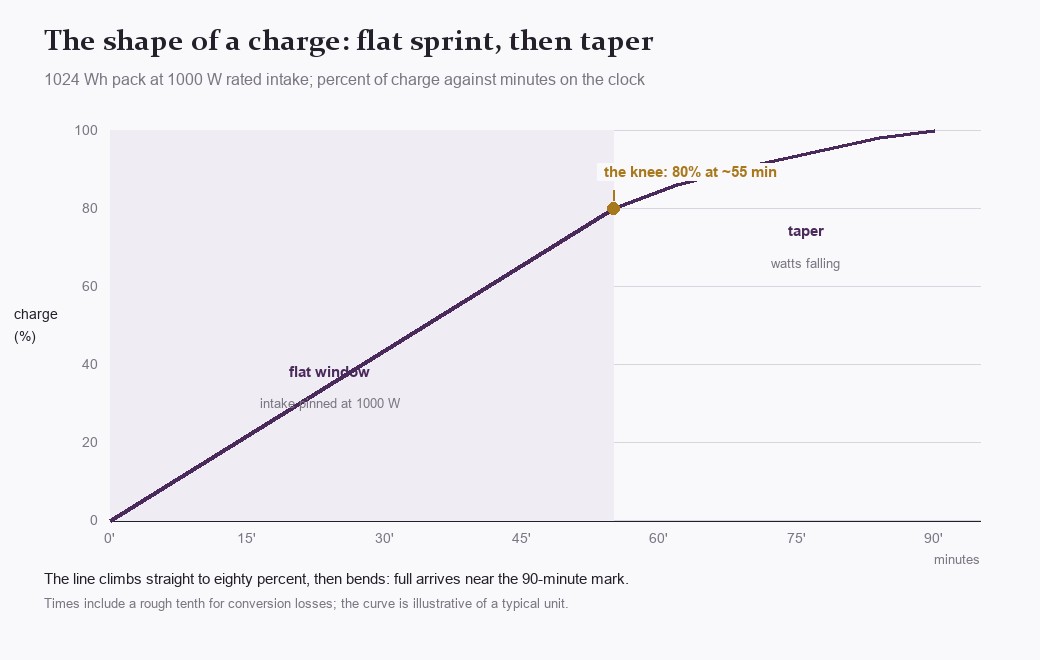
The two-phase shape on the worked example. The shaded band is the flat window, intake pinned at the rated 1000 watts; the gold dot marks the knee at eighty percent near minute fifty-five. Full lands near the ninety-minute mark. Illustrative curve, a rough tenth added for losses.
From near empty, a healthy pack takes everything the charger offers. Intake sits pinned at the rated figure through the whole flat phase. State of charge climbs in a straight line. Each minute buys the same slice of capacity as the minute before it. Chargers hold this phase steady on purpose. On a display the phase is unmistakable: input watts frozen at one number, percent climbing at one speed, estimated time falling in step. Ten minutes of that steadiness says more about a unit’s health than any single number on the label.
Near eighty percent the line bends. Cell voltage has climbed close to its ceiling by then, so the pack begins stepping its intake down. Charging on lithium runs in two stages: a constant-current stage that ends near the mid-eighties of charge, then a saturation stage under falling current. The knee on a power station’s display is that handover, moved a little by chemistry and tuning. Charging literature puts the constant-current handover near the mid-eighties of charge for lithium generally, a mark conservative station tuning rounds down to eighty on many machines. Lithium iron phosphate packs, the common station chemistry, hold their flat line deep into that range before the bend shows. Nothing on the screen announces the handover in words. The falling input figure is the announcement.
Past the knee, watts fall in stages. A display that held 1000 through breakfast reads 700, then 400, then double digits near the top. The trickle at the end holds the last percent steady. Nothing about the fall is a fault. The curve was always going to bend there. First-time owners often read the fall as a fault and unplug into the mystery. Watching one full charge end to end teaches the shape better than any spec sheet. The estimated-time readout stretches through the taper for the same reason; falling watts buy fewer watt-hours per minute.
Every source rides the same curve. Wall power, solar, a car socket, a generator: each feeds the same two-stage shape through its own port. The knee belongs to the pack alone. Combined inputs obey it in one sum, a subject with its own page. What changes by source is only how high the flat line sits. The bend arrives at the same state of charge regardless. A generator-fed evening charge and a solar noon charge bend at the same percent on the same unit. Owners who learn the curve once carry it across every source they ever plug in.
Minutes, worked from the numbers
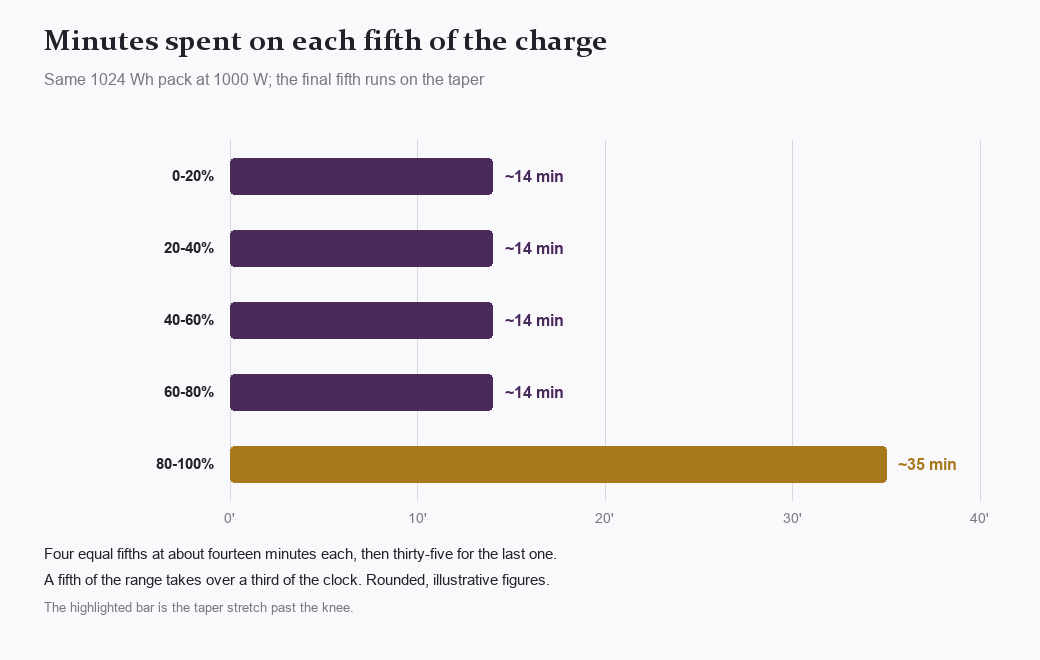
The clock, cut into fifths of charge on the same worked unit. Four equal fifths at about fourteen minutes each; the gold bar is the taper stretch past the knee, about thirty-five minutes for the final fifth. Rounded, illustrative figures.
The arithmetic needs three figures. Pack size in watt-hours, rated intake in watts, and a tenth on top for the machinery’s own losses. Eighty percent of the pack, divided by the intake, times sixty, plus the tenth: the 0-80 minutes fall out of one line of a phone’s calculator. Watt-hours sit on the battery label. Rated intake sits on the input panel. The tenth is a working allowance that suits station hardware well. No other figure on the spec sheet enters into it. The table below carries the common sizes ready-worked.
Run it once on a common mid-size unit. A 1024 watt-hour pack charges at 1000 watts from the wall. Eighty percent of 1024 is 819 watt-hours. At 1000 watts flat, 819 watt-hours take forty-nine minutes; the tenth on top brings the figure to about fifty-five. Set a clock at the plug-in and the display tracks it: twenty percent near the fourteen-minute mark, forty near twenty-eight, sixty near forty-one, the knee arriving just before the hour. Intake starts easing there, on schedule. The remaining 205 watt-hours crawl in under falling watts, an average somewhere in the low hundreds. The tail runs half an hour or more on many units. Full lands around the ninety-minute mark. Read that clock again from the top: a fifth of the range took over a third of the time. Doubling the pack doubles the flat window at the same watts, a 2048 watt-hour unit posting one hundred and ten minutes to eighty on the same 1000 watt cord. Doubling the watts pulls the same window back down: 2048 watt-hours at 2000 watts posts near fifty-five again. Short sessions live entirely inside the flat window and inherit its straight line. Fifteen minutes at 1000 watts is 250-odd watt-hours into the pack, a quarter of the mid-size unit, every session the same size as the last. The one thing the arithmetic cannot promise is the tail, which is the exact reason the printed figure stops at eighty. One more reading rounds the picture out. At the forty-minute mark the display shows the percent in the low seventies with intake still pinned at 1000, a snapshot of the flat phase doing its plain work. Ten minutes on, the same screen shows the knee in progress, percent in the mid eighties, intake already down by a few hundred. Two glances, ten minutes apart, cover the whole story of the curve.
The last-fifth share is the planning fact to keep. On the worked example, waiting for one hundred percent stretches a fifty-five minute job past ninety minutes. The extra covers 205 watt-hours, an hour of a small fridge. Whether that hour of capacity justifies the wait depends on the day’s plan. The wait suits an idle evening far better than a ticking deadline. The held-back fifth also serves as cushion; a pack parked at eighty meets a surprise evening with real reserve. Refrigeration, lighting, and phone charging rarely miss that fifth on a day trip. Heavy loads, power tools and induction cooking among them, argue for the full pack when the day includes them.
Scaling stays honest in both directions. The bigger the pack, the more minutes at a fixed intake. The higher the intake, the fewer minutes on a fixed pack. No clever cable or setting bends the line; the flat window is chemistry plus arithmetic all the way through. The straight line is also why halfway charges take half the time. Twenty to sixty behaves exactly like zero to forty. Fixed intake means fixed cost per percent as well: on the worked unit every ten percent is 102 watt-hours and about seven minutes, from plug-in to the knee, morning or midnight.
Claimed minutes and measured minutes usually land close when the three figures behind them match. A shortfall traces back to one of the three: a smaller true intake, a bigger pack than the claim assumed, or losses past the usual tenth. Each cause shows up in the input figure on the display within the first five minutes. Measured minutes drifting longer across months point at pack age, the one variable the formula leaves out. Checked once, the plan holds.
Worked 0-80 minutes by pack size at rated intake (arithmetic + one tenth for losses)
Pack
Rated intake
80% of pack
0-80 worked
Tail 80-100, typical
512 Wh
500 W
410 Wh
~54 min
+25–35 min
1024 Wh
1000 W
819 Wh
~55 min
+30–40 min
2048 Wh
1500 W
1638 Wh
~72 min
+35–45 min
3600 Wh
1800 W
2880 Wh
~106 min
+40–60 min
Why the tail slows down
The slowdown protects the cells. Through the flat window, cell voltage climbs steadily under full current with room left above it. Near eighty percent that room runs out. Holding full current past the point would push voltage over the ceiling the chemistry tolerates, so intake falls to hold the voltage line. Voltage, held at that ceiling, does the regulating from there on. Current becomes the variable that gives way. The ceiling itself sits a shade over three and a half volts per cell on iron phosphate chemistry.
The taper trades minutes for pack life. Cells filled gently at the top age slower, hold capacity longer, and pass more cycles before fading. Firmware writers pick the trade deliberately. A machine that sprinted to one hundred at full watts would pay for its headline in years of pack life. Cycle-life tables in a spec sheet quietly assume the taper stays in place. Station firmware often tapers earlier and softer than a phone’s would, sized as it is for a decade of cycles.
On the display, the taper reads as input watts stepping down on their own. The wall cord did nothing. The breaker did nothing. A charge past the knee draws less on its own, all the way down to the trickle that tops off the final percent. Cell balancing rides in the same quiet stage, evening out small differences between cells before the display calls the pack full. Unplugging during the taper costs nothing except the unfinished percent; the pack holds whatever it reached. A pack left on the cord past one hundred sits at a float, drawing next to nothing.
Where the fast window ends
Past eighty percent the pack sets the pace, at falling watts. Rated input stops being the number that matters.
Temperature and the clock
Cold stretches the whole window. Chilled cells accept current reluctantly, so the flat phase runs below its rated figure from the first minute. The colder the pack, the wider the gap between printed minutes and real ones. A unit stored in a winter garage posts a slower 0-80 than the same unit warmed indoors. Ten degrees of pack temperature move the clock by minutes, twenty by a good deal more. The flat window keeps its straight line in the cold; the line starts lower and runs longer. Manuals print the working band for charging, commonly zero to forty-five degrees, with the honest pace living in the middle of it. A pack that spent the night in a van deserves the same hour indoors that a winter garage unit gets.
Near freezing, many stations step in harder. Charging pauses outright below zero on some models. Others hold intake to a trickle until the cells warm, a few heat the pack first on their own. Lithium plated by sub-zero charging never recovers. The firmware treats the risk accordingly. Winter routines adapt on their own: charge indoors, charge once the cabin has warmed the pack, give it an hour at room temperature ahead of the cord. An hour of warming often buys back half an hour of charging on the coldest days.
Heat trims from the other end of the scale. A pack baking on a summer job site pulls its intake down to keep cell temperature in band. The printed 0-80 assumes a room-temperature pack on full wall power. Winter mornings and August afternoons both deserve a margin on top of it. Shade and airflow claw part of the summer loss back. A unit charging out of the sun keeps more of its printed pace. The pack’s own charging heat adds a little on top in a hot room, one more reason the taper exists. Neither season moves the knee itself; the bend stays parked near eighty whatever the thermometer says.
Planning around the eighty mark
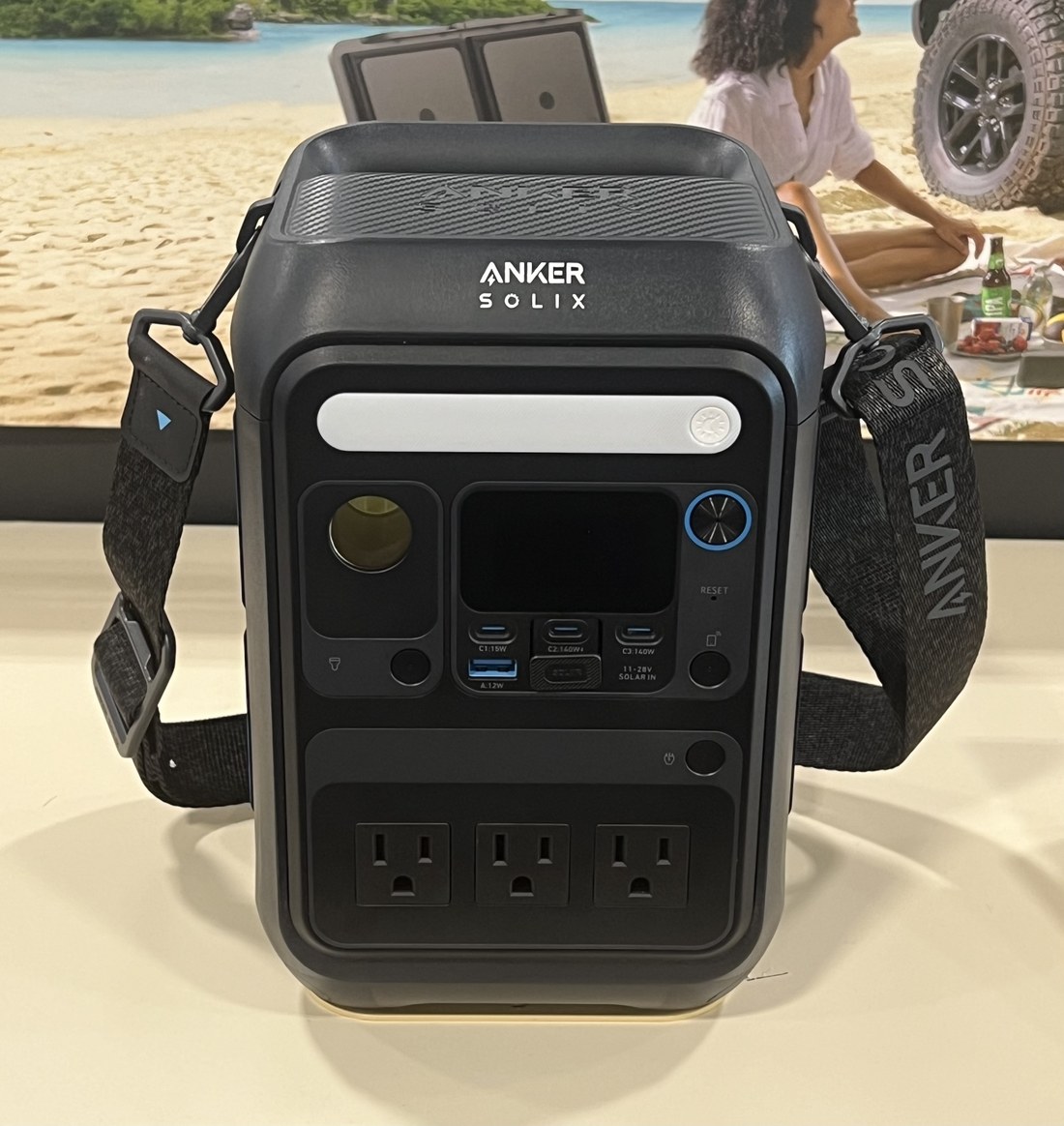
A compact power station idle on a display table, an Anker SOLIX C300X here; the beach scene behind it is a printed backdrop. The screen between the light bar and the port panel sits dark on an idle unit. On charge, the same screen carries the percent and input watts this page reads. Visible port labels are output ratings, C2 and C3 at 140 watts among them, with the solar input marked 11-28V SOLAR IN below the USB block. Photo: TaurusEmerald, CC BY-SA 4.0.
A ferry morning shows the mark at work. The boat leaves at nine; the station reads twelve percent at seven. Plugged in at breakfast, a 1024 watt-hour unit on 1000 watts climbs the flat line: forty by half past, sixty-five at eight, the knee a few minutes before nine. Departure lands at eighty-two percent. The tail would have cost another half hour past the sailing. Eighty was the right place to unplug. Nothing on board that morning needed the missing eighteen percent. The fridge, the phones, and the router all ran the day out with charge left over.
Departures rarely need the final fifth. The tail buys 200-odd watt-hours on a mid-size unit at the price of a third of the total clock. Loads that finish a trip on eighty percent finish it on time. Evenings own the stretch to one hundred, plugged in with nothing waiting on it. Framed that way, the tail stops being a delay at all. It becomes a background task for hours that had no other claim on the machine. Eighty as a default departure mark survives contact with nearly every real schedule. Mornings that need the full pack were provisioned the evening before by definition; the tail ran overnight, unwatched.
Many models make the mark a setting. A charge limit set at eighty stops the intake at the knee, on the same screen that shows the input watts. Daily cycling lives well there: the pack works inside its gentlest band, the clock stays inside the flat window, the tail never runs at all. The setting also steadies the arithmetic. Every charge ends at the same mark, so every wait matches the last one. Cells cycled shallow between twenty and eighty age at their slowest pace. Guests treat the limit as invisible; the unit behaves like any appliance that stops when done. Setting it takes under a minute on the display or in the companion app.
Full still has its seasons. Outage weeks, long off-grid stays, a forecast with a name on it: those call for one hundred percent and the patience it costs. Lifting the limit for the season takes a moment. The tail runs overnight, unwatched, on the days the last fifth earns its minutes. A calendar note at the season’s turn covers the whole discipline. Nothing about the pack minds the occasional full charge; the cost lives in making one hundred percent the daily habit.
Top-up habits fall out of the same shape. Short plug-ins land inside the flat window whenever the pack sits under eighty, so a lunch-break session buys a predictable slice every time. Fifteen minutes at full intake is a quarter of a mid-size pack. Three such sessions across a day keep a working unit topped without a single long sit. The same habit suits shops and film sets, anywhere the unit works through the day near a socket. Crews that live by call sheets tend to discover the habit within a week.
Reading a fast-charge claim
Every claim decodes with the same line of arithmetic. Take the pack’s watt-hours, multiply by 0.8, divide by the claimed minutes over sixty. Out comes the intake the claim assumes. A 512 watt-hour unit claiming eighty percent in twenty-five minutes is assuming near 1100 watts of real intake; the spec sheet’s input rating either backs that or it does not. Thirty seconds of decoding sorts marketing from engineering on any product page. A notebook of decoded claims makes short work of comparing a shortlist. The same line run backward sizes a purchase: minutes wanted, pack size chosen, intake required falls out. Implied intake past the sheet’s own rating marks a claim measured on a different pack or rounded past honesty. The arithmetic catches it either way.
Small packs post dazzling minutes by nature. Fewer watt-hours cross the line sooner at any given intake. The honest comparison across sizes is watts per watt-hour, or plainly the worked minutes on the pack size being bought. The arithmetic holds at every pack size. A 512 watt-hour pack at 500 watts and a 2048 at 2000 post the same minutes; the arithmetic says so before the stopwatch does.
Claims also assume their conditions. Room temperature, a wall socket at full rating, a start from near empty, no charge limit set: the printed minutes stand on all four. Each missing condition stretches the real figure. A winter garage alone can add a quarter to the clock. Claims read best as ceilings. A real morning lands somewhere under them. A claim footnoted with its test conditions reads as a good sign in itself. Reviewers time the window at room temperature for exactly this reason.
A home check settles any doubt. Time a charge from twenty percent to sixty and double the result; that estimates the 0-80 window with no need to drain the pack to zero. The measured figure sits within a few minutes of the decoded claim on a healthy unit. A wide miss usually names the source, the cable, or the temperature. The pack itself sits last on that list of suspects. Sudden shortfalls trace to sources and cables in nearly every case. The twenty-to-sixty stretch also sidesteps the taper entirely, keeping the doubled estimate inside the flat phase where the line holds straight.
Feeding the fast window
The flat window only runs flat on a source that covers the rated intake. A wall socket does it as a matter of course. Solar does it in strong sun on a big enough array, the car port does it within its own small ceiling, each source through its own door at its own width. Undersized sources still charge; the line runs shallower, stretching the window to match. Matching source to rated intake is its own subject, port by port, covered on the pages for each input. A source at half the rated intake doubles the flat window’s minutes with the same straight-line behaviour throughout. The stopwatch check from the previous section doubles as a source check: a flat window running under its printed pace names the door, the cable, or the sky. The battery earns suspicion only after those three clear. Ten such checks across a year of ownership cost less time than one afternoon of wondering.
Zero to eighty earns its place as the working number of the whole machine. Departures plan on it. Claims decode through it. Charge limits park at it. The tail keeps its uses on quiet evenings and ahead of hard weeks. The clock keeps its shape either way: a straight sprint to the knee, then a patient glide. Kitchen arithmetic covers the sprint. The sprint covers nearly everything a day asks of the battery. The number on the box, read the way this page reads it, turns out to be the one figure a household uses every week. Minutes to eighty, at rated watts, on this pack: three figures, one line, the whole plan.
Common questions
How long does 0 to 80 percent take?
Multiply the pack’s watt-hours by 0.8, divide by the rated intake in watts, add about a tenth for losses. A 1024 watt-hour station at 1000 watts lands near fifty-five minutes. A 2048 watt-hour station at 1500 watts lands near sixty-five. Cold packs and undersized sources stretch the figure.
Why does charging slow down after eighty percent?
Cell voltage sits near its ceiling from there, so the pack steps its intake down to protect the cells, following lithium’s two-stage charge shape. The taper is deliberate, working protection for the cells. Waiting for one hundred percent costs a third or more of the total clock for the final fifth of capacity.
Is stopping at eighty percent good for the battery?
Daily cycling at an eighty percent limit keeps cells in their gentlest band and skips the slow tail entirely; many stations offer the limit as a setting. Full charges keep their place ahead of outages and long trips. The limit lifts in a moment when a season calls for the whole pack.