A generator feeds a power station the same alternating current a wall socket does, made on the spot from a tank of petrol, propane, or diesel. Plug the station’s own wall charger into the generator’s household outlet and the two work together in the way the grid and the station would at home. Behind that outlet sits an engine burning fuel, the one fact that colours everything about the charge: how fast it goes in, how clean it arrives, and how much it costs to put there. Generator charging is wall charging fed by an engine a person carries into the field.
The appeal is range that never leans on the weather. A power station holds a fixed store of energy and then waits for a refill. A generator supplies that refill on demand, in the dark, in the rain, in a deep winter week when solar panels gather almost nothing, for as long as there is fuel in the can. That store of petrol waits out the whole trip, ready to become charge on the hour the battery calls for it. That independence from daylight is the reason to carry one at all.
Charging from a generator is rarely the entire plan. Off-grid setups pair the engine with solar panels, with the grid on the days the grid comes back, and with a battery large enough to coast for hours between runs. The generator covers the gap the other sources leave behind. One hour of run time can put back the charge a cloudy day failed to gather, and then the engine goes quiet again while the battery takes over. Hybrid is the honest word for how these pieces fit together in practice.
Power quality is what turns generator charging into its own subject, apart from plugging into a wall. A power station’s charger is a far fussier load than a kettle, a lamp, or a drill, paying close attention to the shape of the AC it is fed. Feed it clean power and it charges at its full rated speed. Feed it rough power and it slows down, sometimes to a crawl, or refuses the source and blinks an error where a charge should be. Everything else about running a generator into a station follows from that one demand for a clean wave.
Clean power the charger can use
The grid delivers a smooth sine wave at a rock-steady frequency. A power station’s charger is built around that exact shape. Fifty or sixty times every second the voltage rises and falls in a smooth rounded curve, a shape the charger’s electronics lean on to time their own switching. Hand them the wave they were designed for and they run at their rated input, drinking the full eight hundred or twelve hundred watts the station is rated to accept. The charger asks for nothing exotic. It asks only for the shape the grid has supplied all along. Given that shape, the charger has an easy time of it.
A generator’s task is to imitate that grid wave closely enough that the charger accepts it as the real thing. How closely a given generator manages the imitation is the question that decides the charge. Some designs reproduce the curve loosely, with steps and wobbles a charger can feel. Others rebuild it almost perfectly, indistinguishable from the mains as far as the electronics can tell. The distance between those two approaches is the distance between a station that charges at full rate off an engine and one that charges at a fraction of it, or not at all.
The inverter generator and the old kind
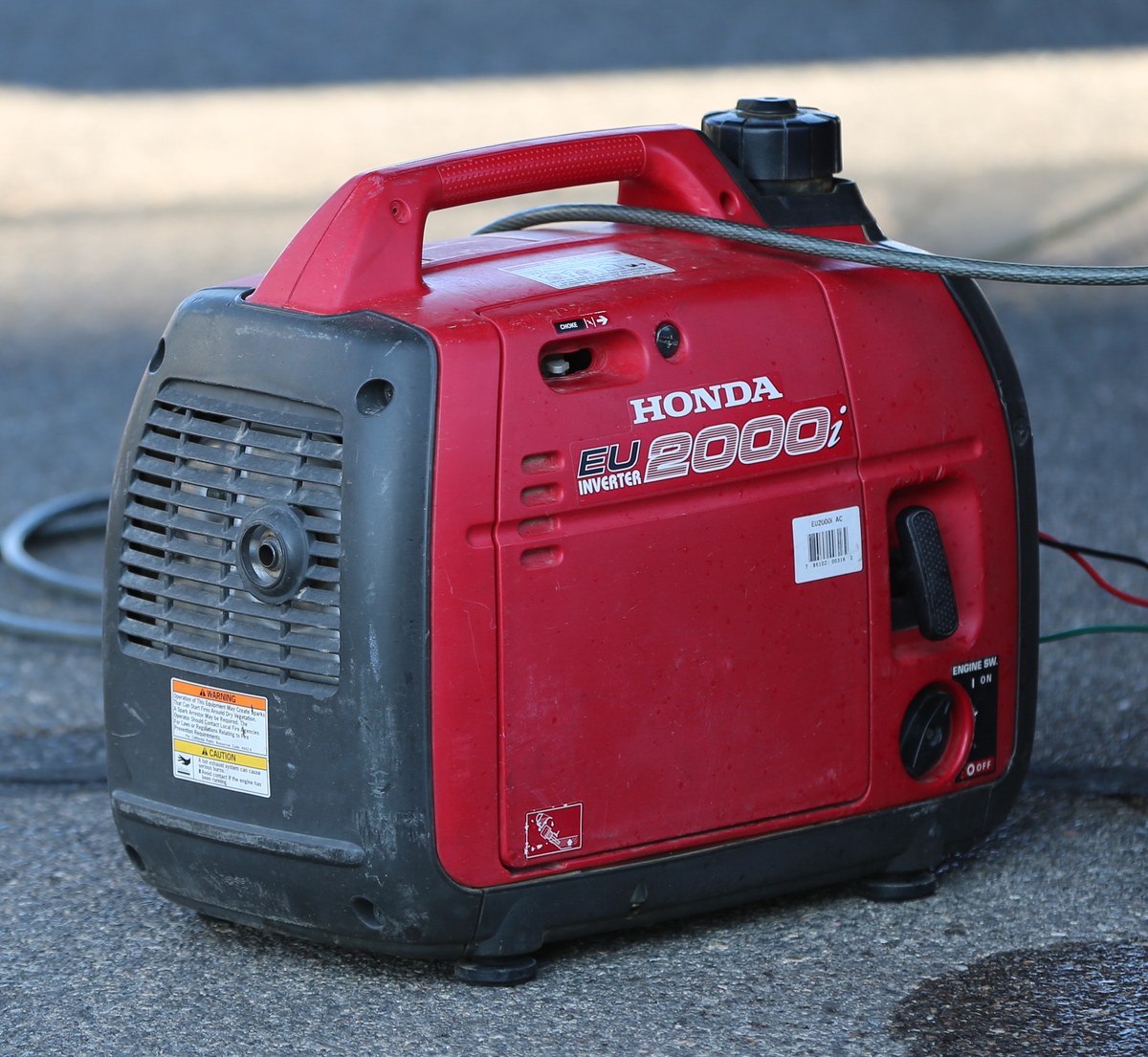
A Honda EU2000i portable inverter generator, the “INVERTER” badge set below the model name. The visible controls are a choke lever and an engine on/off switch; the yellow label is a standard exhaust warning. A portable unit of this class supplies the low-distortion AC a power station’s charger accepts at full rate. Photo: TaurusEmerald, CC BY-SA 4.0.
A conventional generator bolts its engine straight to the alternator that makes the power. Engine speed sets the output frequency directly, so a mechanical governor works to hold the engine at a fixed rpm and keep that frequency near its mark. Change the load, and the engine lurches for a moment before the governor can catch it. Every electrical wobble in the output traces straight back to that one mechanical linkage. Frequency and voltage sag and surge through every lurch, leaving a waveform that only ever approximates a true sine. On the cheapest open-frame units the wave comes out looking like a staircase.
Even the roughest output runs a work light or a heating element, loads that care only about raw watts. Inside a power station, the charger pays attention to the shape of the wave itself, catching what a simple load never feels. A charger meets a rough wave in one of two ways: quietly dropping its rate to cope, filling the battery slower than the label promises, or reading the drift and the spikes as a faulty supply and shutting the input down, an error showing where a charge should be. Which way a particular station reacts comes down to how forgiving its charger firmware was written to be.
An inverter generator reaches the outlet by a wholly different path. Its engine spins a small internal generator feeding a bank of electronics that build the AC wave fresh from scratch, in the way the power station itself builds the AC at its own sockets. Engine speed no longer ties to the output frequency at all. When the load climbs, the engine revs to meet it. Once the demand falls away, the engine settles back toward idle. Through every one of those speed changes the electronics hold the output wave rock steady, clean, and locked to its frequency.
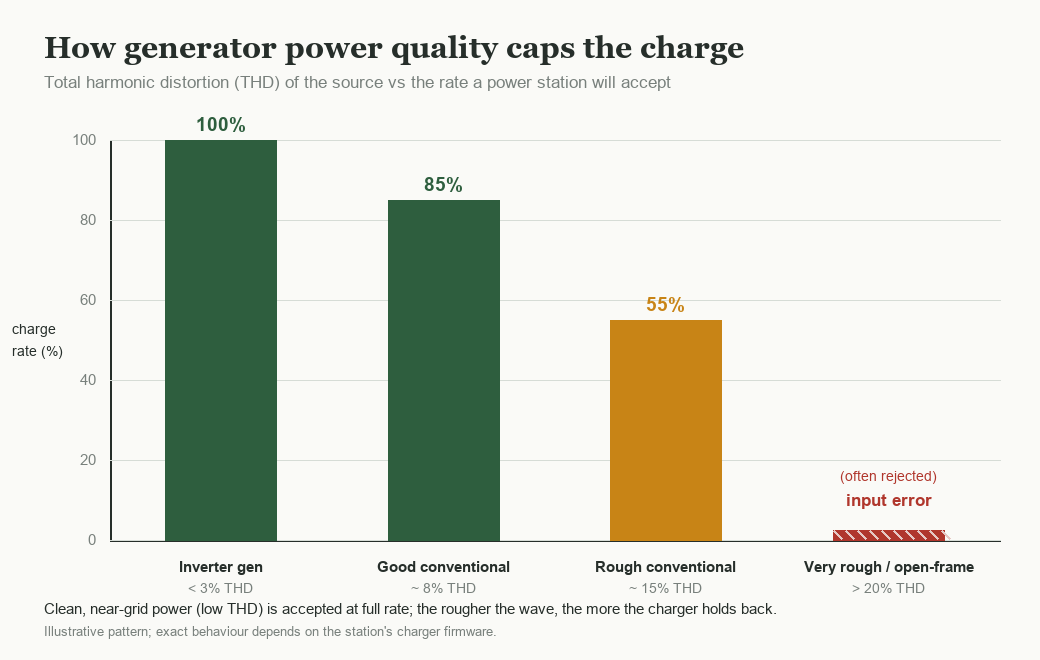
The payoff of that design shows up the instant a power station is plugged in. Total harmonic distortion measures how far a waveform strays from a perfect sine, capturing the whole difference in a single number. A quality inverter generator holds its distortion under about three percent, close enough to grid power that a station treats the outlet as a wall socket and pulls its full rated input without hesitation. A conventional generator commonly runs several times that figure, past ten percent and past twenty at the cheap end, rough enough that a sensitive charger either backs its rate off or balks at the source outright. A station cannot clean up dirty input on its own. It accepts what the generator hands it, at whatever rate its charger judges safe, so the quality of the source sets a hard ceiling on the speed of the charge. Frequency stability counts for every bit as much as the shape of the wave. A charger watching for a steady fifty or sixty hertz gets exactly that from an inverter generator and settles straight into charging. Let the frequency wander each time the load changes, and the same charger holds back or drops out to guard itself. Variable engine speed pays a second dividend at the fuel tank. An inverter unit throttles its engine down to meet only the load in front of it, sipping fuel near idle and opening up just when the draw demands. Over a long charge that habit alone stretches a tank of petrol dramatically further and keeps the noise down to a soft hum for the bulk of the run. This is why nearly every power station manual names an inverter generator as the recommended source, and warns in plain language that a conventional one may charge slowly or refuse to charge at all.
Clean power, the one feature to buy for, comes from an inverter unit in the portable world.
Generator power quality by type, and how a power station’s charger responds (illustrative)
Source
Typical THD
Frequency under load swing
Station charge result
Grid (reference)
2–5%
±0.1 Hz
Full rated input
Inverter generator
< 3%
±0.1 Hz, held flat
Full rated input
Good conventional
5–10%
±1–2 Hz
Reduced, ~80–90%
Rough / open-frame
15–25%
±2–3 Hz
Slow, or input error
What rough power does to the charge rate
How the source’s power quality caps the charge. The lower the distortion, the closer the station runs to its full rated input; the roughest supplies end in an outright input error. The bars are illustrative; the exact cut-off depends on the charger’s firmware.
Give a station clean power and its charge rate climbs straight to the charger’s rated ceiling. Give it rough power and that rate falls, by a hair or by half, depending on how the charger was built to react. The cleaner the incoming wave, the closer the charge creeps to full speed. The rougher the wave, the further the rate slides away from it. Power quality works as a dial the charger reads, moving the rate up and down by degrees.
The slowdown is nothing but the charger guarding itself. Rough power carries voltage spikes and dips through every cycle. A charger pushed hard on that ragged diet heats up faster and ages sooner than one fed smooth power. Once the charger reads its input as poor, it throttles back to a rate it can hold without cooking its own components. The rougher the supply, the harder it holds itself back, trading a little charging speed for a longer working life.
Outright rejection is the harder stop to swallow. Some chargers set a firm floor under power quality and flatly refuse to run below it. The station throws up an input error and sits there doing nothing while fuel burns in the engine for no return. The only cure is a cleaner source. No cable, no menu setting, and no amount of patience will coax a charger past the quality floor its designers built into it. Swapping an open-frame unit for an inverter model is the one move that clears the error for good.
The station sits between engine and load
Here is the piece that makes the whole thing hybrid. The generator charges the battery. The battery, in turn, runs the loads. The two ends never have to meet directly or match each other watt for watt. A modest generator pours an even trickle into a large battery for an hour. Out of that same battery come the heavy bursts a power tool or a fridge demands. The buffer sitting in the middle is what lets a small engine do the work of one several times its size.
Sizing the generator to the input
The number a generator has to match is the station’s charge input. A power station might accept eight hundred watts of AC input at its ceiling. That ceiling is the whole target a generator aims at. Feed it from a unit rated at two thousand watts and it still draws only its eight hundred, leaving well over half the engine sitting idle. The loads on the sockets are the battery’s problem, buffered off separately, so they never enter the sizing sum. Paying for a generator past the input ceiling buys nothing but a heavier machine that drinks more fuel for no gain.
The floor to aim for is the input the station can take, plus a small cushion. Match the generator to that figure with a little headroom and the charge runs at full rate on the least fuel the job allows. A generator that can just cover the station’s input, with a margin left for a hot day and thin air, is the efficient pick every time. The unit to steer clear of is the one too small to hold its output steady once the charge pulls hard on it. Around that floor, a couple hundred watts of headroom is plenty. Piling on more brings no prize.
Altitude and heat quietly shrink the real output a generator can deliver. Thin mountain air and a hot afternoon each rob an engine of power it would make at sea level on a cool morning, often stripping away a tenth or more between them. A generator sized with no margin can come up short on exactly the high, hot, off-grid trips where a full charge cannot afford to fail. Reading a maker’s derating chart before a summer expedition turns that guesswork into a firm number. Adding a fifth on top of the bare requirement covers that loss and still leaves a little room for a surge.
Oversizing carries its own quiet costs. An oversized generator left loafing at a small fraction of its rated load burns fuel badly for the watts it makes. On many designs it wet-stacks as well, glazing its cylinders with unburnt fuel and oil that fouls the engine over time. Loading a generator to somewhere near its rated output, which a full-rate charge into a station tends to do, keeps it running hot enough to stay clean. Right-sizing looks after the engine’s health as much as it looks after the fuel budget. A load held near the rated figure gets the best work out of every litre.
The surge the battery swallows
Motor-driven loads spike hard at the instant they start. A fridge compressor, a water pump, or a power saw can pull several times its running wattage for a fraction of a second as the motor breaks into motion. Run that load straight off a generator and the engine has to swallow the entire surge in that instant or stall trying. Routed through the station, that same surge lands squarely on the battery, with the generator doing nothing but charging behind it. The engine behind the battery only ever feels the steady charging draw. Behind the scenes, the battery’s own power electronics deliver that violent half-second of current. The little engine never feels it happen.
This buffering is the reason a generator can run small. Sized only to the station’s input, it never has to meet a startup surge head-on. The battery stands squarely between the two, absorbing every spike and passing the generator a load that never jumps. Wire a little generator straight to a workshop saw and it stalls dead on the first pull. With the station’s battery slipped in between, the same generator runs the same saw without a stumble.
Fuel and the run-then-rest rhythm
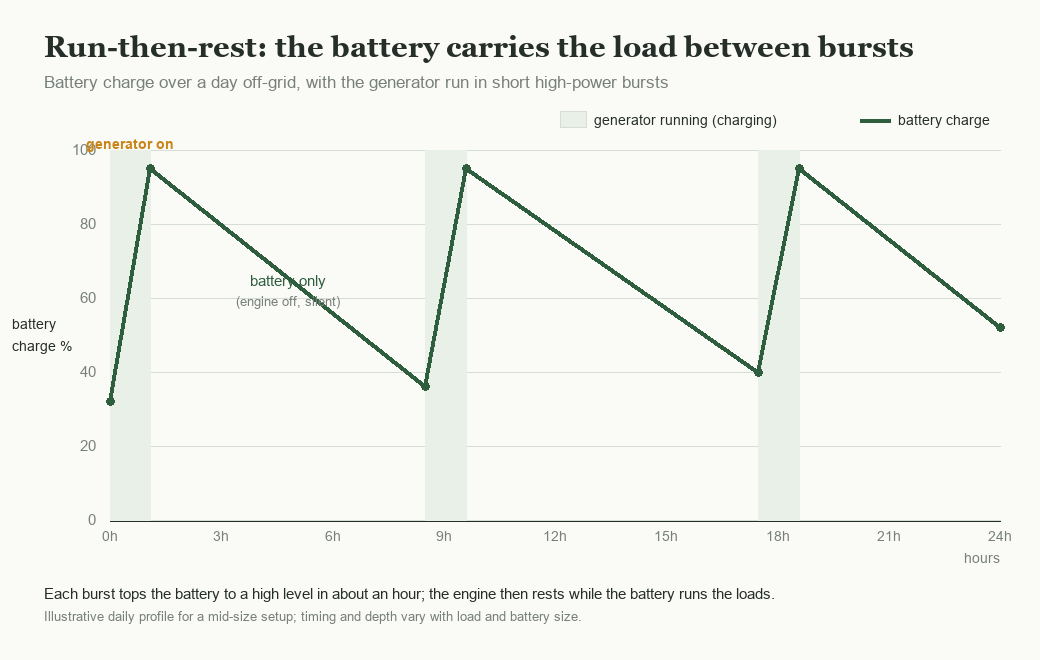
The run-then-rest rhythm across a day off-grid. Each shaded band is a short generator burst that tops the battery to a high level in about an hour; between the bands the engine is off, leaving the battery alone to run the loads. The daily profile is illustrative; load and battery size set its exact shape.
A generator charges quickly. Its thirst for fuel is the reason to run it in short spells. Every hour the engine turns it drinks petrol whether the battery needs a lot of charge or a little. The efficient pattern is to run hard and then stop. Charge the station quickly up to a high level, shut the engine down, and let the loads run in silence off the battery until the charge falls low enough to call for another burst.
The battery is what makes that stop-start pattern workable in the first place. Take the battery away and a generator has to idle along all night just to cover a small base load, burning fuel through the quiet hours to keep a few watts flowing. Put a large battery in front of it and the whole shift changes: the engine works flat out for one hour and then rests for the next six while the battery carries the house. The longer the battery can shoulder the load on its own, the fewer hours the engine runs and the less a night off-grid costs in fuel.
The fuel a generator burns shapes how far off-grid it can wander. Petrol turns up almost anywhere and keeps a season in a sealed can. Propane keeps for years in the bottle and burns a touch cleaner. Diesel powers the biggest units through the longest hauls. Whatever fills the tank sets the real range of the whole setup, since the fuel runs dry long before the battery gives up. Between the three fuels, easy availability tends to count for more than the small gaps in how each one burns.
Runtime figures printed on a generator’s spec sheet almost always assume one fixed, gentle load. A unit rated for eight hours at a quarter of its capacity may give barely three when it runs flat out. Charging a power station pulls a near-full load from the generator for the entire length of the charge, so the honest number to plan fuel around is the heavy-load figure, the one that reflects a station on charge. A single spare jug of petrol in the boot can stretch a one-tank trip into a comfortable two-day stay.
Noise tracks the throttle closely on an inverter unit. Idling between charges, it settles to a low murmur. Opening up to charge, it lifts to a steady hum, well short of the flat-out roar a conventional generator makes while it holds full rpm all day. Running the engine in short bursts keeps those louder stretches brief. A campsite or a row of neighbours will forgive one hour of hum far sooner than they forgive a whole night of roar.
Hooking it up without trouble
Connecting the two is as plain as plugging the station’s wall charger into any household socket on the generator. No adapter, no special lead, and no wiring stands between them. The charger that shipped in the box with the station takes the generator’s AC in the way it takes the wall’s. Start the engine, give it a moment to find its feet, and plug the station in. From the station’s side, nothing about the source has changed. Beyond that first plug-in there is nothing to learn, since it behaves like any wall charge from then on.
A short warm-up spares the charger a rough jolt. A generator swings a little wild in its first few seconds, voltage and frequency both hunting around before the governor or the inverter board pulls them into line. Let the engine run for thirty seconds and steady itself before the station goes on. On the way out, reverse the order: pull the station’s plug first, and only then kill the engine, so the charger never rides the voltage spike a generator can throw as it spins down.
Grounding and placement finish the safe setup. A generator belongs outdoors at all times, well clear of every door, window, and vent, since its exhaust carries carbon monoxide that kills fast indoors and gives no warning. Follow the manual on grounding, which for a portable unit feeding a floating load like a power station rarely asks for more than the bonding already built in. Keep the whole run dry as well, the engine under a canopy when it rains and every connection lifted off the wet ground.
Where a generator fits a power setup
A generator comes into its own wherever the sun cannot be trusted to deliver. Long grey winters, the deep shade of thick woods, a job site tucked under a solid canopy: anywhere solar output falls short of the need, an engine fills the same battery on demand and on schedule. Pair a generator with panels and the two split the year between them. Sunlight does the work for free whenever it shows up. The engine covers the stretches when it does not. The battery in the middle never knows which source filled it.
For pure backup at home, the sums tilt back toward the battery. A house that loses power only a handful of times a year leans first on stored charge and solar, keeping a generator in reserve for the rare outage that drags on for days. Out on a daily off-grid site, the engine takes the main role, sized as the first source, with the battery smoothing the surges it cannot meet. The right split between battery, sun, and fuel follows the way a given setup gets used across a year. Match the source to the pattern of the days, and a power station stays full through all of them. Whatever the mix, the generator’s job stays the same: pour clean power into the battery on the days nothing else can.
Common questions
Can any generator charge a power station?
Almost any can. A conventional generator may charge slowly, or its rough power may trip the station’s charger. An inverter generator produces the clean AC a station’s charger accepts at full rate, and it is the type nearly every manufacturer recommends. Check the station’s manual for its stance before leaning on an open-frame unit.
What size generator do I need?
Size the generator by the station’s AC charge input. That input cap, set by the station itself, is the number to match. A station that accepts eight hundred watts of input charges at full speed on any generator that supplies that much cleanly, plus a fifth added for altitude, heat, and a margin of safety. A bigger generator charges no faster, since the station caps its own input.
Can I run appliances and charge the station at the same time?
Yes. Routing them through the station is the point of a hybrid setup. The generator charges the battery. The battery runs the appliances. A startup surge from a fridge or pump lands on the battery alone. Behind it, the generator keeps its steady charging load. A generator too small to start a motor directly handles it with ease through the station’s buffer.
How long should I run the generator?
Run it hard for short spells. Charge the station up to a high level quickly, shut the generator off, and let the battery carry the loads until it runs low again. This run-then-rest rhythm burns far less fuel than idling all night. On an inverter unit it keeps the loud stretches short too.