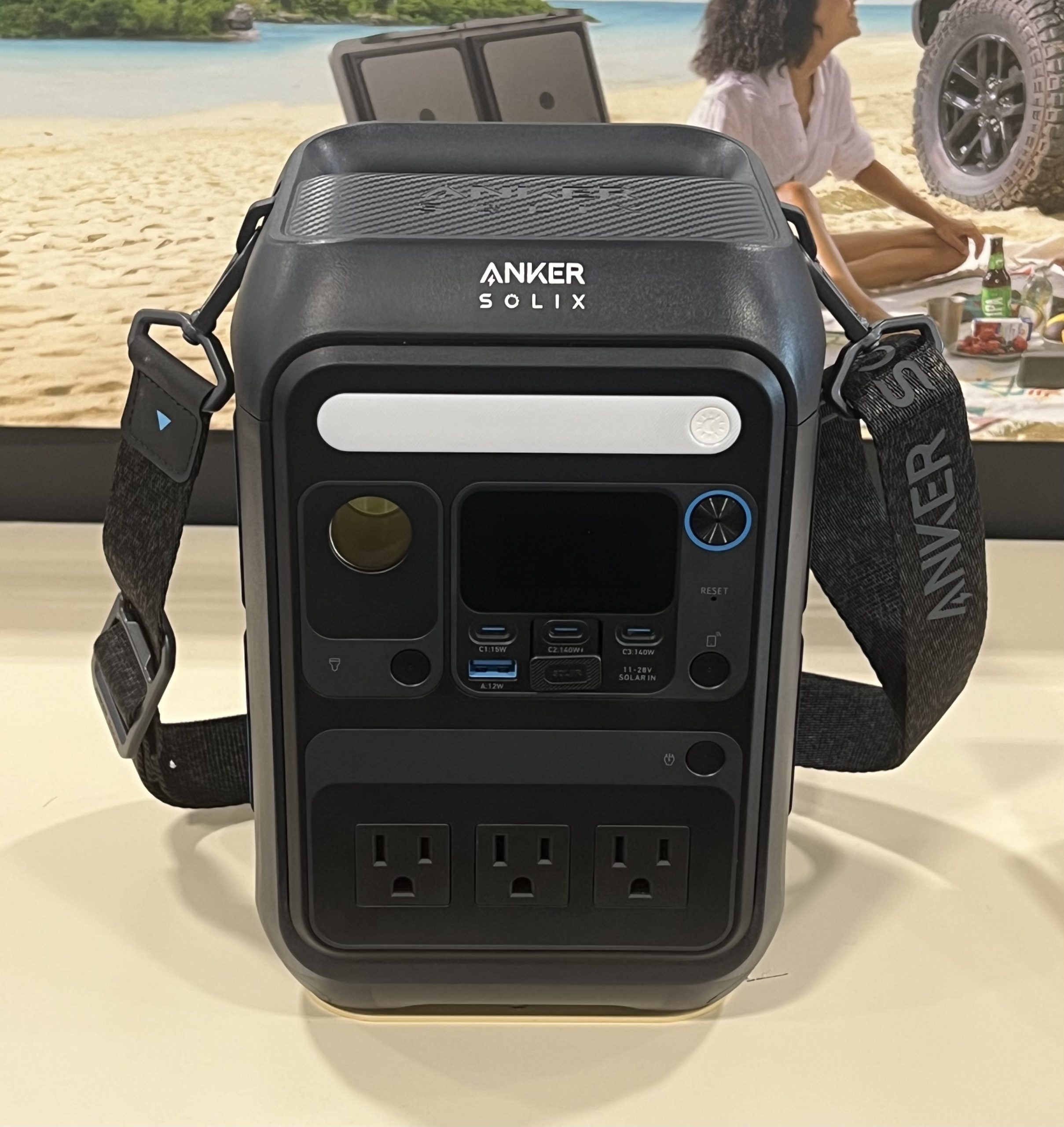
An Anker SOLIX C300X portable power station, the kind of unit charged from an AC wall outlet. The screen in the centre shows the live watts going in and out. The three sockets at the bottom are AC outputs. The USB-C ports above carry their output ratings, 15 to 140 watts. The unit takes its own AC charge through a separate inlet, at a speed set in the menu. The backdrop is a retail display scene. Photo: TaurusEmerald, CC BY-SA 4.0.
Charging a power station from the wall loses a little energy along the way. The wall meter counts more watt-hours than the battery ends up holding. The difference turns to heat inside the charger and the cells. A full charge of a 1000 watt-hour station can pull 1100 or more from the wall. Inside that gap sits every loss the charge runs through. It all ends as warmth in the charger and the air around it.
The size of that loss is not fixed. The faster the charge runs, the more of it turns to heat. Each charge speed carries its own size of loss. A dial or an app setting picks the speed. The higher up the dial a charge sits, the more of each watt-hour ends as warmth. Picking the speed picks the loss in the same breath.
Knowing where the energy goes helps a user choose well. A few percent lost on every charge adds up over a year. The heat that loss makes shortens cell life by a touch. A charge speed sets the balance between a quick fill and a clean one. Many days leave room to pick either one on purpose.
The two jobs inside the charger
A charger does two jobs at once. It turns the wall’s AC into the DC a battery takes. It pushes that DC into the cells at a controlled rate. Each job leaks a little energy as heat. Neither one runs at a perfect hundred percent. Between them they set the whole loss. Conversion takes its flat cut. Delivery takes the rest.
The first job is conversion. Wall power arrives as alternating current at 120 or 230 volts. The cells want steady direct current at their own voltage. The charger’s electronics bridge the two. Switching transistors flip on and off thousands of times a second to do it. Each flip wastes a sliver of power. Added up over a charge, those slivers become a few percent.
The second job is delivery. A current has to flow from the charger into the cells. That current meets resistance in every wire, joint, and cell it crosses. Resistance turns a slice of the push into heat. Every amp that flows pays that resistive toll. Faster flow pays more of it. Doubled flow pays four times as much.
Both jobs run more cleanly at a gentle pace. Conversion holds a steady efficiency across nearly all of its range. A higher current drives the delivery loss up steeply. The pace of the charge decides how much each one costs. The gentler the charge, the lower both bills run.
The conversion step
Turning AC into DC costs a few percent. The switching electronics that do it run warm. A good charger converts at 92 to 95 percent. The few percent left behind leaves as heat from the brick or the case. Warmth on the charger body is that conversion loss made plain. Cool to the touch, a good brick wastes little there. A few percent here reads the same on a slow charge or a fast one.
Conversion loss stays roughly flat across speeds. The electronics draw their overhead whether the charge is fast or slow. A bigger charger spreads that overhead across more watts. The percentage holds fairly steady from a trickle to a full-power charge. The same small percentage applies at any speed.
A charger left plugged in keeps drawing a trickle. Standby electronics sip a watt or two doing nothing. Over weeks that adds a small waste of its own. Unplugging a finished charger closes that last leak. Pulled from the socket, a finished charger draws nothing at all.
Why loss grows with charge current
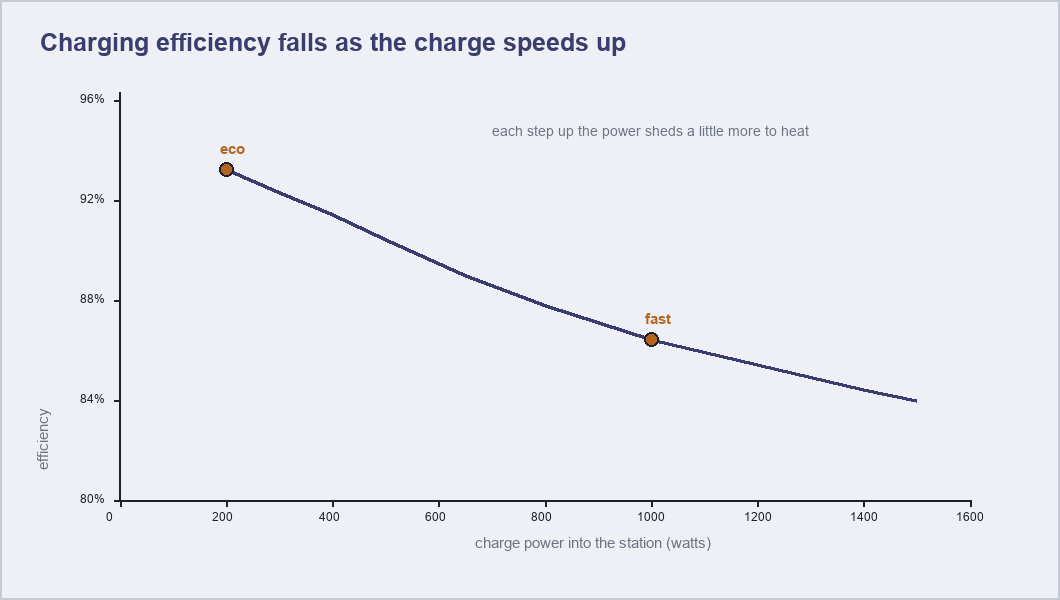
Charging efficiency against charge power for a typical portable station. The curve falls from about 93 percent on a gentle 200-watt charge to about 84 percent at 1500 watts. The eco and fast points mark two common settings. Each step up the power sheds a little more of the wall’s energy as heat. The figure is illustrative.
The heart of the fast-and-slow story is one law of physics. The power lost in a resistance equals the current squared, times that resistance. The squared part is what matters. Double the charging current, and the resistive loss quadruples. Triple the current, and the loss climbs ninefold. A charge that fills a battery in one hour pushes far more current than one that takes four. It pays a steep premium in heat for that speed. Picture a battery that charges happily at 10 amps with little loss. Raise the rate to 20 amps, and the heat in the wires and cells jumps to four times what it was. Raise it to 30 amps, and the loss is nine times the gentle figure. The faster the charge, the further the wasted energy outruns the delivered energy, because waste follows the square of the current. That gap is why a fast charge stores a smaller share of the energy it pulls from the wall. The resistance itself sits in the cells, the connectors, the cables, and the charger’s own output stage. None of it can be wished away. A thicker cable and a tighter joint trim the resistance a little. A cooler battery holds its resistance lower. The current itself is set by the charge speed. The squared law magnifies every extra amp. A power station that charges in an hour runs its electronics and cells hard. A noticeable fraction of the wall’s energy never reaches the battery. The same station on a gentle setting moves the same total charge at a lower current over more time. Far less of it scatters as heat. Speed and efficiency pull against each other through that one squared term. Engineers call that loss ohmic heating, the I-squared-R term in every power sum. Halving the charge current cuts it to a quarter, a four-to-one return for going slow. Doubling the current for half the time never breaks even, since the loss runs with the square. Two hours at 10 amps lands more energy in the cells than one hour at 20, on every count but the clock. That single squared term is the whole reason a fast charge costs more than the watt-hours it adds.
Resistance lives in many small places. The cells have an internal resistance of their own. The connectors and the cabling add a little. The charger’s output stage adds the last share. Summed together, those small resistances set the floor on every charge. None can be wished away. Only a slower current keeps them quiet.
Temperature nudges the internal resistance up and down. A cold cell carries more of it at the start of a charge. The charge warms the cell within minutes. A warm cell carries less. The middle of the charge often runs cleanest. Warmed by its own current, a pack carries less resistance partway through.
The squared law sets a hard limit on fast charging. Past a point, the heat rises faster than any cooling can clear it. The charger holds the current there to protect the cells. That ceiling is why a station fills the last stretch more slowly. Near full, the charger eases off to hold the heat in check.
Slowing the charge is the surest way to cut the loss. Half the current makes a quarter of the resistive heat. The trade is time. A user picks where to sit on that scale. Dropping the rate a notch pays back twice over in heat. Time is the only price. Paid in minutes, it buys back watt-hours and cell life.
Heat, the form the loss takes
Every watt of loss shows up as heat. The charger brick warms in the hand. The case of the station grows warm to the touch. Current crossing the cells heats them too. Nowhere does the lost energy vanish. It always surfaces as warmth somewhere. Heat is the loss in a form a hand can feel. The case, the brick, the cells: each carries its share.
Heat is the loss made visible. A cool charger is wasting little. The hotter a charge runs, the more power it sheds on the way. The warmth in the case is the wasted energy, leaving the only way it can. Felt through the case, the loss reads plainly on the skin.
Fast charging makes heat in two places at once. Higher throughput warms the charger’s electronics. Higher current warms the cells. Both need the heat carried away to stay safe. Two heat sources at once ask more of the cooling. A fan answers the call. Spun up, the fan holds the temperature safe.
A station limits its own heat by limiting the charge. Sensors watch the temperature of the cells and the electronics. A charge that runs too warm gets throttled back. The protection trades a little speed for a safe temperature. Backed off in time, a hot charge never reaches a danger point.
The cooling fan’s own draw
A fan spins to carry the heat away. The faster the charge, the harder the fan works. Its motor draws power of its own, a few watts to tens of watts. That draw counts as part of the charge’s overhead. Spinning hard, a fan can draw tens of watts of its own. Slow charging spares it the work.
A silent slow charge often needs no fan at all. The gentle heat drifts away on its own.
Putting a number on efficiency
Charging efficiency is a simple ratio. It divides the energy stored in the battery by the energy drawn from the wall. A station that stores 1000 watt-hours from 1100 at the wall runs at about 91 percent. The figure rolls every loss into one number. One percentage tells how much of the bill reaches the battery. The rest of the bill heats the air.
A watt meter at the wall reads the input directly. The station’s own screen shows the watt-hours going in. The gap between the wall figure and the stored figure is the loss. A clear afternoon of measuring settles the real efficiency of a setup. Read once at the wall and once on the screen, the loss falls right out.
A portable station usually lands between 85 and 93 percent on AC. The gentler the charge, the nearer the top of that band it sits. The model and the speed set the exact figure. A spec sheet rarely prints it. A meter tells the truth. Measured for real, a setup lands where the physics predicts.
The dial from slow to fast
Many stations put the charge speed in the owner’s hands. A switch or an app offers a slow, a standard, and a fast setting. The further up the dial, the sooner the fill and the more it wastes. Time against efficiency and heat is the trade the dial makes.
A worked comparison at two speeds
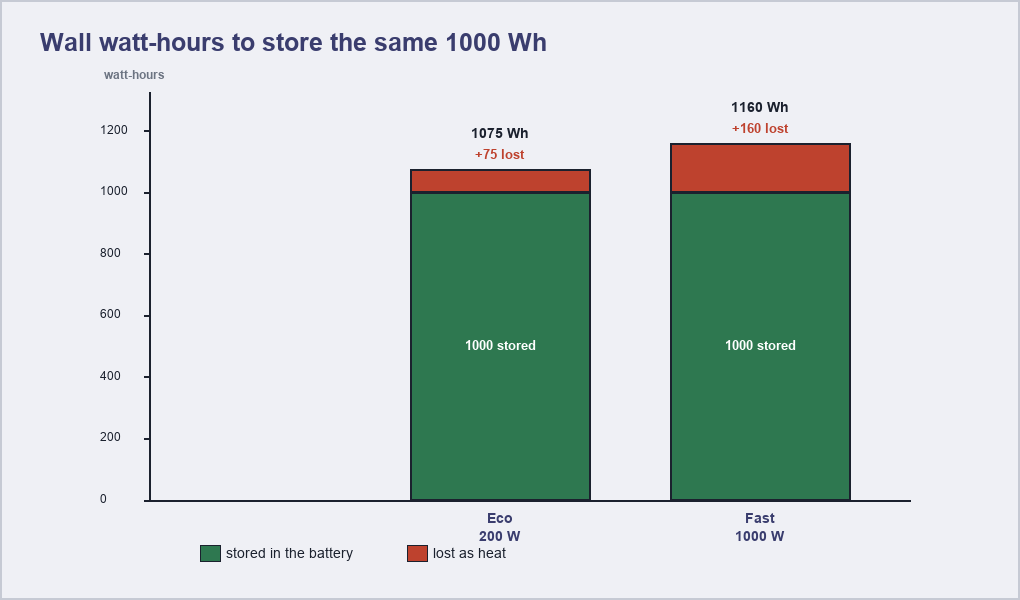
The wall watt-hours needed to store the same 1000 watt-hours in the battery, at two charge speeds. The green block is the energy stored. The red block on top is the energy lost as heat. The eco bar at 200 watts totals about 1075 watt-hours. The fast bar at 1000 watts totals about 1160. The figures are illustrative.
A worked example puts numbers on the trade. Below, the table sets a few charge speeds against the same 1000 watt-hour station. Each row gives the input power, the time to full, and the watt-hours drawn from the wall. The losses sit in the last column. Reading down it, the cost of speed stands out at a glance.
The same 1000 Wh battery, filled at four charge speeds (illustrative)
Setting
Input power
Time to full
Efficiency
Drawn from wall
Lost as heat
Eco
200 W
~5.5 h
93%
1075 Wh
75 Wh
Standard
500 W
~2.2 h
90%
1110 Wh
110 Wh
Fast
1000 W
~1.1 h
86%
1160 Wh
160 Wh
Turbo
1500 W
~0.8 h
84%
1190 Wh
190 Wh
Across the fast row runs a clear story. At 1000 watts the station fills in just over an hour. To store 1000, it draws about 1160 watt-hours. The 160 lost leave as heat from the case and the fan. Pushed in within the hour, that charge runs warm throughout. The fan runs with it the whole time.
Down the eco row, the numbers read gentler. At 200 watts the station takes around five and a half hours. For the same 1000 stored, it draws about 1075 watt-hours. The 75 lost barely warm the case. Trickled in over hours, the same energy lands with barely a degree of warmth. No fan stirs through a gentle fill.
Per charge, the difference looks small at first. Eighty-odd watt-hours separate the two on one fill. Over 300 charges a year, that grows to 25 kilowatt-hours, a real sum on a power bill. The heat saved adds up in cell life on top of that. Multiplied across a year of charges, that small per-charge gap grows into a real sum. Counted in dollars, it pays for a careful habit.
The cost in heat and cell life
Heat is the part of the loss that lingers. Gone for good are the wasted watt-hours. While it lasts, that warmth works on the cells. A battery charged hot, again and again, ages a little faster. Lingering in the cells, heat does its slow work over time.
Lithium cells dislike heat under charge. Every charge at a high temperature nibbles at the cell’s life. A gentle charge keeps the cells cooler throughout. In return, the cells give more cycles over the years. The cooler a pack stays through its charges, the longer it holds its capacity.
The effect here is real. The hotter a charging habit runs, the more it trims off a pack’s lifespan over the years. The effect compounds across hundreds of cycles. Over a pack’s whole life, the gentle charges show in the count. Compounded over years, a gentle habit shows in a healthier pack.
Speed costs more than energy alone. A fast charge spends extra watt-hours and a little cell life to buy its speed. The slower the charge, the more of both it keeps. Each user weighs that trade for their own needs. Whoever charges gently banks both energy and cell life.
Where fast charging earns its place
Fast charging earns its place when time is short. A station near empty before a trip fills in an hour and rides along full. Spent on speed, a few extra watt-hours buy a ready battery. Speed is the whole point in that moment. For a sudden departure, a ready battery beats a handful of saved watt-hours.
Some days leave no room for a slow charge. A cloudy stretch drains a pack faster than solar refills it. A grid charge at full power tops it up before the next need. The small loss is a fair price for being ready. Through a cloudy week, the wall keeps a pack alive when the sun cannot. A full-power top-up has the pack ready by the next need.
A fast charge also suits a brief window of cheap power. A short block of off-peak rates fills a battery quickly. The speed captures the cheap energy before the window closes. A higher loss still leaves the charge cheaper overall. Caught inside the off-peak window, the energy stays cheap even after the loss. Bought low and stored fast, the power still wins on price. Stored inside the cheap window, the energy beats a daytime fill.
Where a gentle charge pays
A gentle charge pays off on a quiet overnight. A station plugged in at bedtime has all night to fill. A low, slow current sips power and makes little heat. Morning finds the battery full and the cells cool. Plugged in at bedtime, a station has hours it never needs to rush. Eight hours of slack turn a fast job into a gentle one.
Daily charging rewards the gentle setting. A pack topped up slowly each day loses the least to heat. The cells stay cool through it. The pack earns more cycles for that care. The saved watt-hours add up quietly over a year. Topped up gently each day, a pack barely warms at all. Day by day, the gentle habit guards the pack.
A gentle charge runs silent on top of all that. The fan stays still with little heat to clear. A bedroom or an office keeps its quiet. The same charge that saves energy saves noise. Running fanless, an eco charge disturbs no one nearby. A bedroom or a desk stays as quiet as before. Through the night, nothing hums or whirs.
The eco mode switch
Many stations build the choice into an eco mode. A single setting caps the charge power low. The battery fills slowly, cool, and silent. Eco trades the speed a user may not need for the efficiency they keep. One press sets the cap and leaves it there.
An app often holds the same control. A slider sets the maximum charge watts. A lower cap stretches the time and lifts the efficiency. The number lives a tap away on the screen. Eased lower, the cap trades speed for a calmer fill.
Eco mode shines on solar and overnight charges. Neither one is in a hurry. Matched in pace, the slow fill suits the unhurried source. The setting and the situation fit each other well. Matched to an unhurried source, eco wastes the least. Solar and sleep both move at its pace.
Switching off eco mode takes one tap when speed is needed. The full-power charge returns at once. A user drops to eco again for the next quiet fill. The choice rides on the need of the moment. Tapped back to full power, the station fills fast again when it must. Back on eco afterward, it returns to its thrifty pace. One tap each way covers the whole range.
Cable, wall, and the things around the charge
A few things around the charge nudge the efficiency. A thin or coiled extension lead drops voltage and adds heat. A loose wall socket warms under a heavy draw. A sound mains lead of decent gauge loses the least. Coiled tight or run too thin, a lead warms and steals a little.
Wall voltage itself plays a small part. A charger runs a touch more efficiently at the higher of its rated voltages, by a margin too small to notice. A solid wall connection matters more than the exact voltage. Firmly seated, a plug carries the charge with no waste of its own. Snug in the socket, it stays cool through the longest charge. Run short on heavy wire, a lead barely warms.
Choosing a charge speed
The right charge speed follows the need of the day. Short on time, a user reaches for the fast setting. Given a whole night, eco does the job. The dial offers both at a tap. Whichever the day asks for, the station serves it up.
Efficiency and speed sit at opposite ends of one dial. The faster the setting, the sooner the fill and the larger the loss. Every setting in between splits the difference. A user slides to the point that fits the day. Somewhere on that scale sits the right charge for every need. Reading the need first points to the setting.
A portable power station hides all of this behind a clean charge. Behind the readout, the charger and the cells handle the losses without a fuss. A user sees the percentage climb and the time tick down. The watt-hours lost stay small on any sensible setting. Behind the clean readout, the squared law quietly does its work.
AC fast and slow charging comes down to one squared term. Push the current harder, and more of it scatters as heat. Ease the current, and the battery keeps a larger share. A charge speed chosen for the day fills a power station at the cost a user means to pay. Set with intent, a charge costs exactly what it should. No watt-hour leaks away unaccounted for. Paid knowingly, the loss stops being a surprise.
Frequently asked questions
Why is fast charging less efficient than slow charging?
A faster charge pushes more current into the battery. The energy that resistance turns to heat depends on that current squared. Doubling the charge speed roughly quadruples the resistive loss. That heat is wall energy stopped short of the battery.
How much energy does charging a power station waste?
An AC charge typically wastes 7 to 15 percent. The gentler the charge, the nearer the low end of that range it sits. Charging a 1000 watt-hour station pulls roughly 1075 to 1160 watt-hours from the wall, nearer the high end at the fast settings. A wall watt meter shows the exact figure for a setup.
Does fast charging damage a power station battery?
Fast charging adds heat. Heat is what ages a lithium cell. A habit of fast charging might trim a few percent off a pack’s life over its years, a modest effect across that time. A station limits the current to keep the cells from overheating. Charging gently when there is time keeps them cooler still.
What is eco mode on a power station?
Eco mode caps the charge power at a low level. Slowly, cool, and silent, the battery fills at the highest efficiency the station offers. The fan often stays still through the whole charge. The mode suits an overnight or a solar fill, where speed is no concern.