An MPPT controller’s voltage window is the span of panel voltage its solar port accepts, printed on the housing as a pair of numbers, 11 to 28 volts on a common small unit. Panels presenting a voltage inside that span get tracked, converted, and fed to the battery. The window is the compatibility contract between a power station and every panel that will ever plug into it. Voltage decides whether a panel’s rated watts ever flow. On the spec sheet the window hides in the input row, two small numbers beside the amp figure, doing more gatekeeping than everything printed above them. Shoppers comparing three stations on watt-hours alone have skipped the row three times without knowing it.
Both edges come from the converter behind the port: a wake-up threshold at the bottom, a component rating at the top. Between them stretches the working span where the tracker does its usual job of holding the panel at its best operating point. The edges themselves do no tracking. One edge decides when charging can begin at all. The other decides what the port survives. Behind the arrangement sits plain converter design. Stepping panel voltage down to battery level needs working room above that level, the origin of the bottom edge. Internal packs run at their own voltages, class by class, which is one reason windows sit where they do on each machine. Silicon inside the stage carries a hard voltage rating of its own, the origin of the top one. Nothing in settings or cabling relocates either edge. Updates tune tracking behaviour inside the span. The span itself is soldered in place.
Matching a panel to the window takes two label readings and one margin. Made once, at purchase time, the match holds for the life of the gear. Skipped, it produces the two classic solar failures: an array that never wakes the port, or an array that kills it. Every section below serves that one five-minute check. Owners who run it never meet the window again. Each new panel that enters the household gets the same sixty-second reading on arrival. The port wakes on schedule for years, on every panel the check approved, in every season the margin covered. Skipping it trades five minutes now for a gamble every cold morning after.
Two voltages on the back of a panel
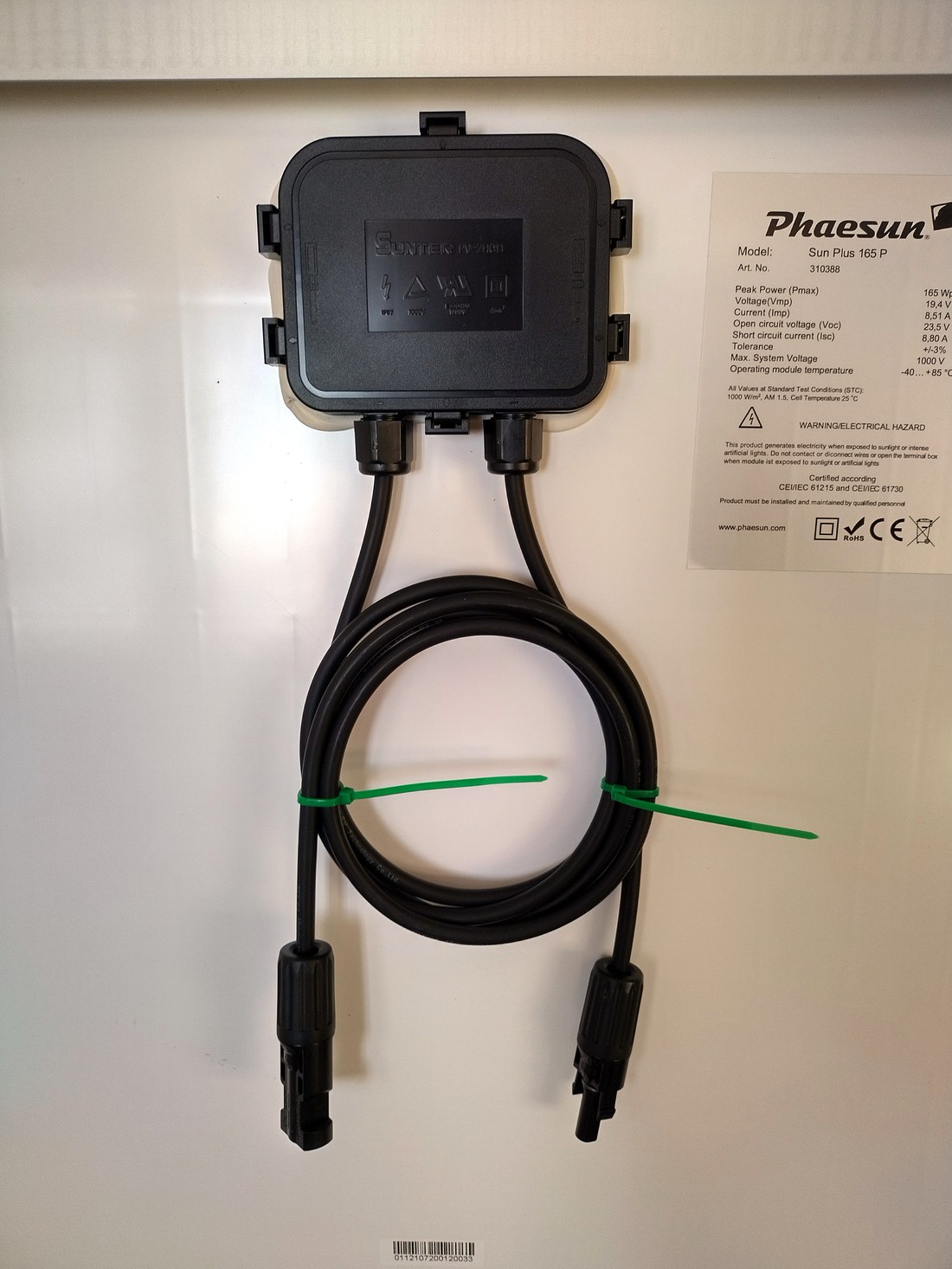
The label the whole check reads, on the back of a 165 watt panel. The sticker’s rows carry both figures this page uses: Voltage Vmp 19.4 and open-circuit voltage Voc 23.5, comma decimals in the European style, beside the currents and an STC note. The 1000 volt line further down is the panel’s insulation rating for grid strings, a separate figure from any port window. Below the box hang the two MC4 leads, tied with green straps for shipping. Photo: Veikk0.ma, CC BY 4.0.
A panel’s label carries two voltage figures. The window check uses both of them. The first, open-circuit voltage, listed as Voc, is the reading with no load attached, the highest voltage the panel produces. The second, maximum power voltage, listed as Vmp, is the level the panel holds while working under load. On a typical 100 watt folding panel the pair reads 22.5 and 18.6 volts. Both figures come from the maker’s lab flash test and sit printed side by side, on the back sticker and again on the datasheet’s electrical table. Real mornings move them a little in both directions. The label pair remains the planning baseline every check starts from. Lab figures assume bright standard light on cells at 25 degrees, conditions a spring noon roughly matches. Panels from any brand carry the same two rows, so the check works across every mix of maker and port.
Open-circuit voltage appears whenever light lands on an unloaded panel. Unplugged in the sun, freshly connected, sitting in dawn light too weak for real current: the panel sits at Voc through all of it. Every array crosses this state on the way into every working day. The port’s ceiling gets tested by Voc alone. A multimeter across an unplugged panel’s leads in sunshine reads Voc directly, a thirty-second habit before any first connection. Meter readings above the label figure on a cool day are normal physics, the exact behaviour the cold margin exists to cover. Shade, a bad connector, or a damaged cell string announces itself in the same test, as a reading far under the label, caught in the driveway with no port involved.
Maximum power voltage is where the tracker parks the panel once real charging runs. The controller holds the panel near a fixed fraction of its open-circuit voltage, around three quarters, hunting the exact point as light and heat move it. Vmp is the voltage of the working day. Its job in the window check is the floor: a panel working below the wake-up threshold never starts a charge. Heat pulls Vmp lower through the day, a volt or two on a baking afternoon. Floor margin covers that slide the way the cold tenth covers the ceiling. Hot-climate buyers weigh the floor harder for exactly that reason.
Each edge of the window gets its own reading. The ceiling check compares Voc against the top number, with a cold margin added. The floor check compares Vmp against the bottom number, with comfortable room above it. Running the two checks against the two label figures is the entire discipline. Margins have working sizes: a tenth on top of Voc for the ceiling, a couple of clear volts under Vmp for the floor. Tighter fits can run for years and fail on the one morning that finds the gap.
Every figure this page uses sits on two labels: the panel’s back and the port’s face.
One match, worked end to end
Take the 100 watt folding panel and a small station with an 11 to 28 volt window. Ceiling first: open-circuit voltage reads 22.5, and a tenth on top for cold mornings brings the planning figure to 24.9. That sits under 28 with three volts to spare, so the port is safe in any weather the panel will ever see. Floor next: maximum power voltage reads 18.6, well clear of the 11 volt threshold, so the panel holds the port awake even in weak light with its working voltage sagging a little. Both checks pass with margin. The pair is a match, settled for good, with nothing about the combination to think about again. The same two comparisons, run in the same order, settle any panel against any port in the aisle of a shop. Sixty seconds with two labels replaces every forum thread on solar compatibility. Shops see the reverse case weekly: a bigger panel bought on watts alone, its 45 volt string voltage waved at a 28 volt port, a return desk visit later the same week. Two label rows, read in the aisle, would have redirected the purchase toward a machine with the taller span.
Wiring panels into the window
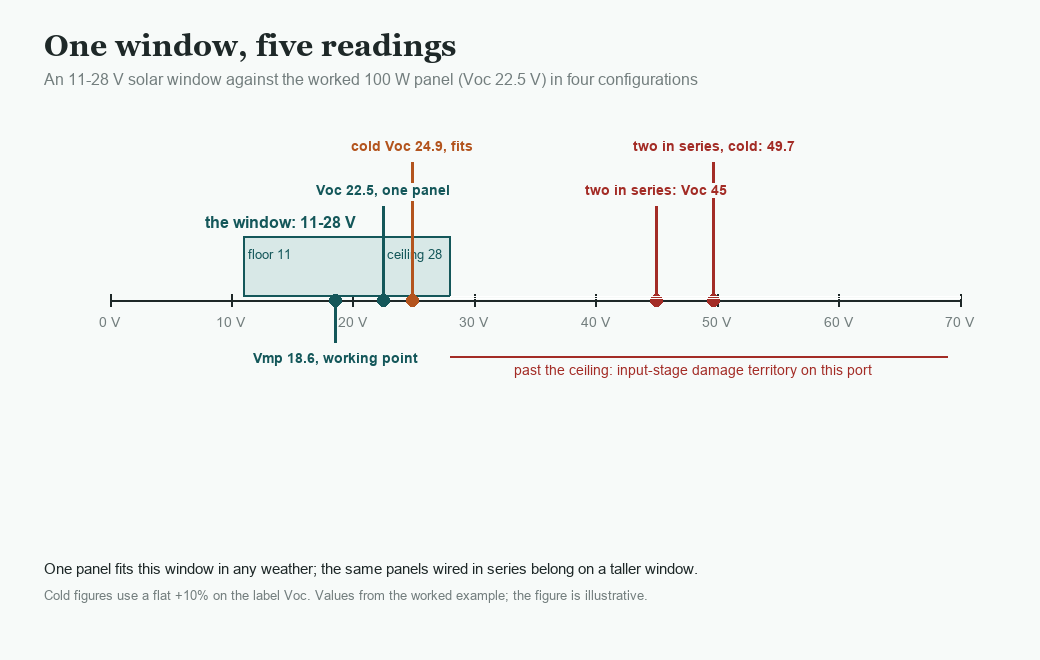
The whole check on one line. The shaded band is an 11-28 volt window; teal marks are the worked panel’s working point and label Voc, copper its cold-morning Voc, still inside. The red marks are the same panels wired two in series, past the ceiling in any weather on this port. Values from the worked example; the figure is illustrative.
Series wiring stacks voltage. Two of the worked panels joined end to end present 45 volts open-circuit and 37.2 working, at one panel’s current. Three in a string reach 67.5 open-circuit. Each panel added lifts the string by a full label’s figure, so strings climb toward any ceiling fast. Current staying at one panel’s level is the quiet gift of series wiring: the same thin extension cable carries a two-panel string at no extra loss, one plug into the port at the end of it. MC4 plugs chain panel to panel in seconds, positive to negative down the line.
Parallel wiring holds the label voltage steady. Two of the same panels side by side still present 22.5 volts open-circuit; the currents add, 5.4 amps each into 10.8 together. Ports carry a current limit beside the window figure, commonly 8 to 15 amps. A parallel pair meets that limit sooner than any voltage edge. Ports clip gracefully at their amp cap, taking what the limit allows from a stronger pair. Watts stop growing once either printed limit is reached. Branch connectors for a parallel pair cost little and wire in minutes. Past two branches the arithmetic tightens. Each added panel piles its full current onto the same small cap. Bigger parallel banks bring branch fusing into the picture as one more part to buy and fit.
Choosing between the two layouts is a window question first. A tall window, 60 volts and up, invites strings of two or three, which run their current low. A low ceiling forces single panels or parallel pairs. The pages on each product class print the exact spans; the wiring plan falls straight out of the printed pair of numbers. The worked pair lands cleanly on a 60 volt class port: 45 volts open-circuit, 49.7 on a frozen dawn, ten clear volts of ceiling margin left over. Layouts that drop out of the numbers this neatly tend to run for a decade untouched.
One rule stands over every layout. Stacked open-circuit voltage stays under the printed ceiling on the coldest morning of the year, with margin, or the layout is wrong. A string sized against a summer reading crosses the same ceiling on the first hard frost. Autumn gives such layouts a false season of good behaviour first. Voltage past the ceiling can destroy the input stage outright, a failure no fuse inside the port catches in time. Overvoltage damage sits outside warranty terms across the industry, a repair bill plus freight in the best case. One meter reading across the assembled string, taken before the first plug-in, proves the layout at the cost of a minute.
Cold mornings raise the voltage
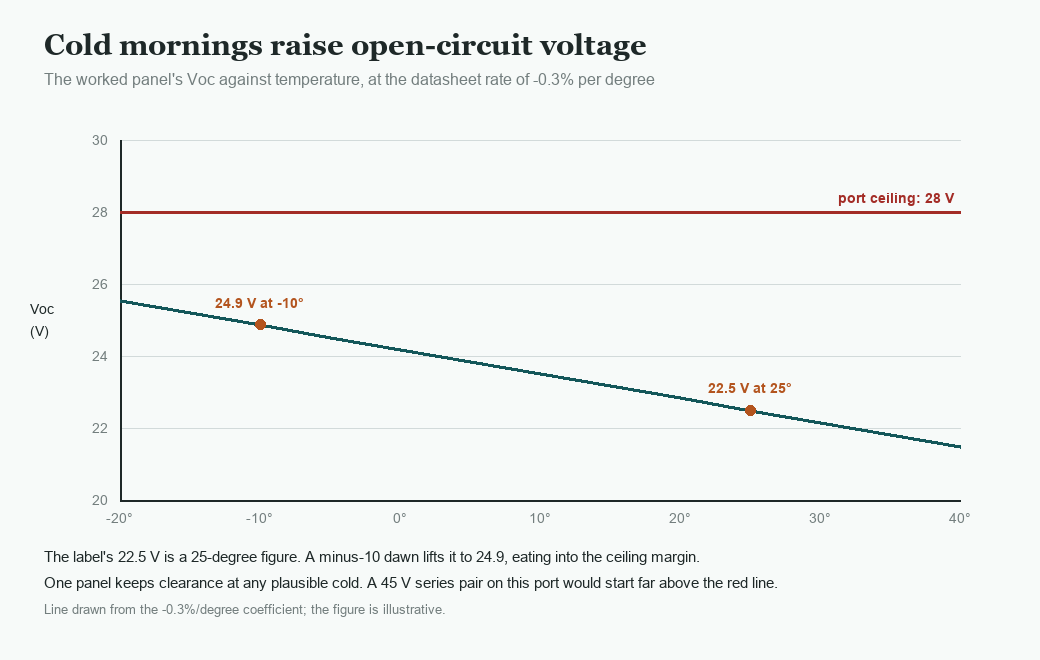
Open-circuit voltage against temperature for the worked panel, drawn from the datasheet’s -0.3 percent per degree rate. The red line is a 28 volt port ceiling. Cold lifts the label’s 22.5 to 24.9 at minus 10 degrees, trimming margin without crossing. The figure is illustrative.
Panel voltage runs on temperature. The colder the cells, the higher the open-circuit voltage climbs, at a rate the datasheet lists near a third of a percent per degree. From a 25 degree rating down to a minus 10 degree dawn is a 35 degree swing, enough to grow open-circuit voltage by a tenth or more. The 45 volt string of the wiring section reads 49.7 on that morning, one long stride closer to any ceiling. Datasheets print the exact rate on the electrical table as the temperature coefficient of Voc, a negative percentage per degree. Multiplying the swing by the coefficient gives the rise; skipping the row and using a flat tenth lands within a volt of the same answer on common panels.
The tenth-on-top margin exists for exactly this reading. Cold-checking takes one multiplication: open-circuit voltage times 1.1 for mild-winter country, a little more where dawns run below minus 20. Frost plus early sun is the season of dead solar ports, because the voltage peak lands in the first minutes of light, on cells at their coldest, before any current flows to pull the level down. Ski-trip mornings and desert winter dawns share the pattern. Sizing on the multiplied figure retires the whole scenario. Highland winters and prairie cold snaps push the working multiplier toward 1.15. Coastal mild-winter owners keep the plain tenth and move on. Installers in such places size strings one panel shorter than the summer arithmetic allows, trading a little midday harvest for a port that greets every January sunrise intact. The habit costs a few percent of the year’s harvest, cheap insurance for a port that has to meet January.
A day at the window’s edges
Dawn belongs to the floor. Voltage arrives ahead of power on a solar panel; thin early light lifts an unloaded array close to its open-circuit figure on a current still too small to use. On many controllers the wake threshold sits a little above the letting-go level, a deliberate gap that keeps the port from flapping on and off through twilight. The gap runs a volt or two on common designs. Twilight voltage crosses one line minutes before the other, so the port makes one clean decision at each end of the day. The flickering dozen never happens. Displays show the effect as one clean start time, repeatable to the minute in stable weather.
Watch one clear day from the port’s side of the cable. In full dark the panel presents nothing and the port sleeps on zero. First grey light puts volts on the wire almost at once, the unloaded array climbing past 15, past 18, brushing its open-circuit figure before the sun has cleared the hill. Reading that level, the port waits out its start delay, then closes the connection. Tracking begins with almost nothing to track: the controller loads the array and parks it near 18 volts, where the first watts arrive in single digits, enough to run the display that reports them. Through morning, brighter light means more amps, hour over hour. Working voltage spends that whole climb wandering less than a volt, current carrying the day’s drama on a nearly flat line. Midday puts the array at its warmest, the working voltage a shade lower, the amps at their peak, the port converting steadily a comfortable distance inside both edges. Heat moving the working point a volt is routine housekeeping for the tracker, invisible on the charge line. A cloud shelf crossing in the afternoon cuts the watts by two thirds in a minute; the loss lands on current, the port rides through without a restart, the sun’s return brings the figure straight back. Evening reverses the morning in slow motion, amps thinning first, the working point easing downward, until the level slips below the letting-go threshold and the controller opens the connection for the night. Somewhere in the last half hour the watts drop to single digits again, the same figures the dawn opened with, bookends around eight hours of quiet conversion. The array spends its dark hours presenting next to nothing to a port that has stopped listening. Nothing in the whole arc asked for a hand on the gear. The display told the story to anyone who cared to watch, watts rising through breakfast, sagging under the cloud shelf, gone by supper. Every reading traced back to where the panel’s voltage stood inside the printed span. Days like that one stack into seasons without a single intervention.
Heavy shade rehearses the evening in miniature. Deep overcast can drag a marginal array’s working voltage toward the floor. Down there, a panel whose Vmp barely clears the threshold drops out for the length of the squall. The port comes back on its own when the light does. Recovery takes the same start delay the dawn wake-up used, a few seconds to a minute on common firmware. Progress already banked stays banked through the gap.
Margin above the floor buys hours at the edges of the day. The higher a panel’s working voltage stands over the threshold, the earlier the port wakes into the dawn charge, the deeper into dusk it hangs on. Two extra volts of floor margin can lengthen a winter charging day noticeably at each end. Winter sun spends hours near the horizon, so the edges are exactly where December harvest lives. Arrays matched with lazy margin give those hours away unseen. Summer hides the difference; long bright days start every array early. The margin shows its value in the season that has none to spare.
None of the edge behaviour needs supervision. The controller wakes, tracks, holds through cloud, and lets go on its own schedule. The owner’s whole contribution was the label check at purchase time. Set-and-forget is the honest description, earned by one honest hour of reading two labels.
Reading the spec line
A solar input line reads like this: 12 to 60 volts, 10 amps, 400 watts max. Three limits, all live at once, the lowest one biting first. An array can sit mid-window on voltage and still hit the amp limit early, leaving the watt figure out of reach. Decoding a port means checking a plan against all three numbers, in the order voltage, current, watts. Run the worked panel against that line: a two-panel string presents 45 volts, mid-window, at 5.4 amps, half the current cap, for 200 rated watts, half the watt cap. Roomy clearance on all three numbers marks the layout as future-proof as well. Every number clears with room, the signature of a plan that will bore its owner for years. Plans that clear one limit by a whisker deserve a second look at the other two.
The buying workflow runs the checks off two documents. From the panel datasheet, open-circuit voltage times 1.1 against the window’s top, working voltage against the window’s floor with a couple of volts spare, string arithmetic on both when wiring in series. The worked configurations in the table below carry the pattern for the common cases. Datasheet rows carry standard names, Voc and Vmp for the voltages, Isc and Imp for the currents. The four sit together in one electrical table on any reputable sheet, the whole check contained in five printed lines. Sheets that bury or omit the electrical table say something about the panel behind them.
Worked window checks for a 100 W folding panel (Voc 22.5 V, Vmp 18.6 V, 5.4 A, cold at +10%)
Layout
Voc 25°C
Voc -10°C
Current
11-28 V port
12-60 V port
1 panel
22.5 V
24.9 V
5.4 A
fits, 3.1 V margin
fits, 35.1 V margin
2 in series
45.0 V
49.7 V
5.4 A
over the ceiling
fits, 10.3 V margin
3 in series
67.5 V
74.6 V
5.4 A
over the ceiling
over the ceiling
2 in parallel
22.5 V
24.9 V
10.8 A
fits under a 15 A cap
fits under a 15 A cap
Window figures also settle which upgrade path stays open. The taller the ceiling, the longer the add-a-panel road runs before a printed limit ends it. Ceilings near 28 volts end that road at a single parallel pair, closed off by the amp cap soon after. Buyers with expansion in mind read the top number first.
Windows across the classes
Small S class units keep the window low, in the 11 to 28 volt band, sized around one folding panel of the kind that travels in a car boot. The match is deliberate: one common panel, one window built around its label, no wiring decisions in the box. Cable in the box, panel on the lawn, sixty seconds from boot to first watts. Nothing in the class asks for a screwdriver or a diagram. Simplicity is the feature the low window buys. Travel weight rides on the same choice, one panel and one short cable covering the class’s whole solar story.
W class machines lift the span into the 12 to 60 volt band. Two panels in series land mid-window with cold margin intact, the layout the class is sized for. The taller ceiling turns a pair of boot-sized panels into a single quick-connecting string on a campsite table. One cable run replaces the branch harness: one plug at the port, current held at a single panel’s figure the whole way. Packing lists shrink accordingly on every trip the pair takes.
L class units run the ceiling toward 100 volts and beyond, with amp limits to match. Strings of three and four fit with winter margin. On the largest units, the second tracker gives an east and a west string each a window of its own. Roof arrays built for a cabin plug in without a repartition. Tall windows carry the cold arithmetic lightly as well. A three-panel string rising a tenth on a frozen dawn still sits far under a 100 volt ceiling, margin the class was designed to hold. Owners moving up from smaller units bring their old panels along, restrung taller into the wider span.
Across every class the discipline never changes. Two label voltages, one cold multiplication, two comparisons against one printed pair of numbers. The check travels with the owner from class to class, the same one-minute reading at every upgrade, on every mix of old panels and new ports a household accumulates. The window decides whether the solar half of a power station ever runs. Few lines on a spec sheet carry more.
Common questions
What does a solar window like 11-28V mean?
The port accepts panel voltage inside that span. Charging starts once panel voltage stands above 11 volts and the port is rated for open-circuit voltage up to 28. Check a panel’s Voc, plus a tenth for cold, against the top figure, and its Vmp against the bottom one.
What happens if panel voltage goes over the window’s top?
Voltage past the printed ceiling can destroy the port’s input stage, a hardware failure outside warranty on many brands. The risk peaks on cold clear mornings, when open-circuit voltage runs a tenth or more above the label figure. Size strings so the cold-adjusted Voc stays under the ceiling with margin.
Why does my solar charge start late in the morning?
The port wakes once panel voltage clears the window’s floor plus a small start offset. An array whose working voltage sits barely above the floor reaches that level late in weak light. More floor margin, from a panel with higher Vmp or two in series where the window allows, moves the start earlier.
Do two panels in series need a bigger window?
Series voltages add. Two panels of 22.5 volt open-circuit each present 45 together, near 50 on a frosty dawn, which needs a ceiling of 60 volts. Wired in parallel, the same pair presents 22.5 volts at 10.8 amps. The amp figure is the one to check against the port’s current cap.