Parallel multi input charging runs two charging sources into a power station at once, their watts added on one battery. A wall cord occupies the AC port. Solar panels occupy the solar port. Both streams flow at the same moment, each through its own electronics, the sum governed by the machine itself. Combined intake is the whole idea: more watts per hour into the pack, every port inside its printed rating. On a dual-input machine the arrangement takes under a minute to set up. Two plugs go in. The screen shows two live figures the moment both doors carry power. Speed is half the point. The other half is flexibility, a machine that accepts whatever mix of grid, sun, and engine a day happens to offer.
Dual input ships on the bigger half of the market. W class machines carry an AC inlet beside a solar port as standard fit. L class machines widen both and add further doors beside them. On the housing the feature is plain to see: two input ports, two shapes, two labels, one battery behind them all. No accessory unlocks it. The capability sits in the unit from the first day. Owners find it on the spec sheet under combined input, a line many read for the first time months after buying.
Waits shrink in direct proportion. Intake watts divide into the pack’s watt-hours, an arithmetic that hands back the hours. Raise the intake and the hours fall. Parallel feeding raises intake past what any single door offers, the one lever left open after purchase. Everything else about a charge, chemistry, capacity, cable runs, was fixed at the factory. Intake is the term the rest of this page leans on: watts crossing into the battery each hour, whatever mix of doors supplies them. Two hundred watts more intake means the same fraction fewer minutes, an arithmetic with no exceptions.
Separate doors into the same room
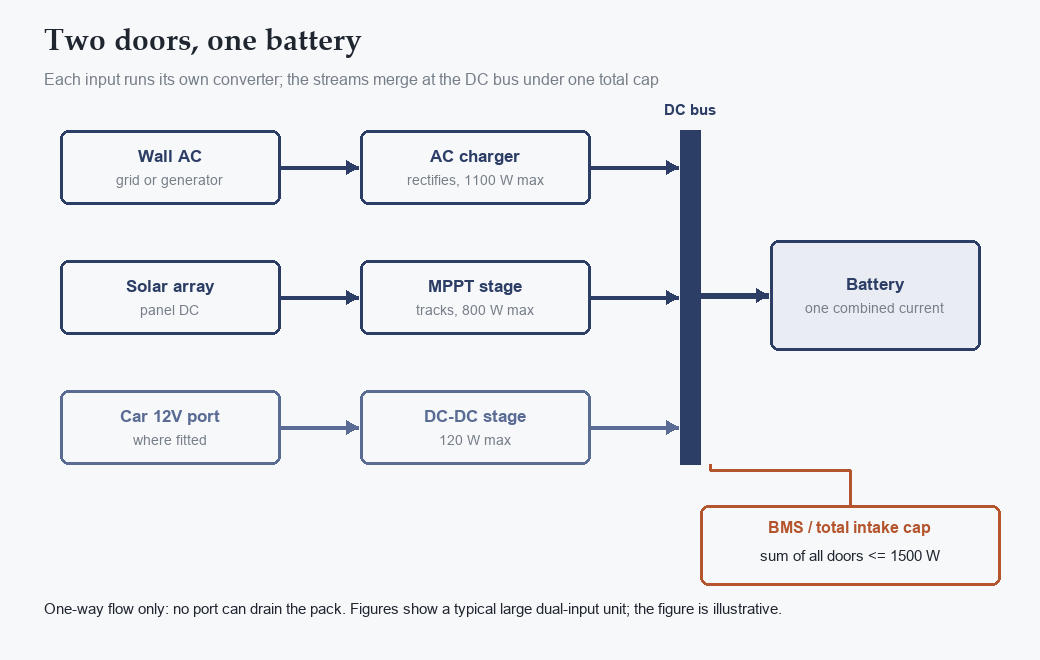
The implementation in one picture. Each source feeds its own converter; the converted streams merge at the internal DC bus and reach the battery as one combined current. The brick-red callout marks the total intake cap the BMS enforces on the sum. Port wattages show a typical large dual-input unit; the figure is illustrative.
Behind each port sits its own converter. The AC inlet feeds a rectifying charger that turns wall current into battery current. The solar port feeds an MPPT stage built around panel DC. A car port, where fitted, feeds a small DC-to-DC stage of its own. Separate hardware walks each source from plug to battery. Nothing inside one converter reaches into another. Each stage carries its own fuse, its own filtering, its own control loop. A fault inside one stage trips that stage’s own protection and nothing else. Charging continues on whatever doors remain healthy.
All of those converters empty into the same internal DC bus, the copper spine that feeds the battery. Watts from the wall meet watts from the sun on that spine, already converted, already matched to the pack’s voltage. Past the bus, the battery reads one combined current. Cells keep no record of the doors behind it. Bus voltage tracks the pack itself, a shared reference every converter aims at. Copper on this spine runs thick, sized for the total cap with reserve on top.
One-way flow keeps the doors honest. Each converter passes power toward the bus alone. Wall power cannot climb out through the solar port. A shaded panel cannot pull charge back out of the pack. Even a dead source on one port leaves the other port’s stream untouched. Diode behaviour at each stage output enforces the direction in hardware. Night proves the design daily: panels sit dark on the roof for ten hours with the pack holding every stored watt-hour behind the one-way wall.
Above the converters sits the charge controller, the piece that reads the battery’s limits and trims each door to fit. Its orders go out many times a second. Narrow the solar stage a step, hold the AC stage, follow the ceiling: the sum stays legal at every instant. Firmware carries the whole negotiation. Hands never enter it. Trim orders land on the converters as current targets, digital messages on an internal wire, the same mechanism single-source charging uses. Response beats any human reflex by three orders of magnitude.
Every watt lands in the same cells, whatever door it came through.
One ceiling, set at the battery
One number rules the merge. A lithium pack accepts charge up to a current ceiling set by its chemistry and its state, the figure a battery management system computes as its charge current limit. Two doors feeding at once still answer to that single figure. The sum of every input, converted and merged, stays under the ceiling the BMS names. Over-current during charging sits on the same system’s list of protections, the backstop under the whole arrangement. Everything above that line, ports, converters, firmware, exists to feed the pack quickly and leave the backstop untouched. The ceiling is the pack’s own property. Ports merely queue up behind it.
The ceiling moves through the day. A cold pack names a lower figure. A pack close to full names a lower figure again. Whatever the moment’s number, the controller shapes the combined intake to sit beneath it, trimming doors in whatever share the firmware picks. From the cells’ side, a two-door charge reads the same as a one-door charge held to the same line. Third-party meters clamped on the pack confirm as much: current under the ceiling, temperature in band, no signature of the second source at all. Summer heat moves the ceiling as well, in the same protective direction. Nothing about parallel input appears anywhere in the cell’s experience.
Port limits and the combined limit
Every port carries its own printed limit. An AC inlet on a large unit takes in the range of 1100 to 1800 watts. A solar port takes 400 on mid-size units, 800 and up on the L class. A car port holds near 120 watts. Printed on the spec sheet, those figures set each door’s width on its own. Width here means watts, the ceiling a port enforces on its own stream before the merge. Port limits live in hardware, in the converter each door owns, past any user setting.
Above the per-port figures sits one more number, the combined intake cap. A unit with an 1100 watt AC inlet and an 800 watt solar port may cap the pair at 1500 watts together. Offered 1900, it takes 1500. The total cap guards the pack and the chassis at a level the single ports cannot see from where they stand. Spec sheets print it near the input table, one line, easy to miss on a first read. The gap between 1900 offered and 1500 taken is not waste; panels idled at the margin lose nothing except time.
Feed it past the cap and the trim happens without a sound. No error shows. No light blinks. The firmware narrows one door until the sum fits, on many units the solar door first. The screen carries the only evidence: a solar figure sitting below the panel’s midday form of a moment before. Watching that figure for a minute settles any doubt about whether the cap is engaged. Cloud and clear sky call for different trim depths; the firmware recomputes the share each second, always enough to hold the sum at the printed figure.
Planning starts from the smaller of two sums. Add up the ports in use, then set that against the combined cap; the lower figure is the real intake. Divide the battery’s watt-hours by that figure for the honest wait. A margin of ten percent on top covers conversion losses and the slow tail near full. Worked once, the numbers make the plan.
Real intake and the wait it buys on a 2048 Wh pack (illustrative large dual-input unit)
Input mix
Ports offer
Combined cap
Real intake
2048 Wh from empty
Solar alone
400 W
1500 W
400 W
~5.6 h
Wall AC alone
1100 W
1500 W
1100 W
~2.1 h
AC + solar
1100 + 400 W
1500 W
1500 W
~1.5 h
AC + big solar
1100 + 800 W
1500 W
1500 W (400 W trimmed)
~1.5 h
A storm-prep fill, walked through
Take a concrete afternoon. A storm sits three hours out on the radar. In the hallway stands a 2048 watt-hour station at forty percent, 1229 watt-hours short of full. The wall cord goes in first: 1100 watts on the screen. The balcony panels go in next: 380 more, midday sun through thin haze. Combined intake reads 1480 watts, just under the unit’s 1500 watt cap, so nothing gets trimmed. Divide the missing 1229 by 1480 and the answer says fifty minutes at headline rate. Real charging stretches that a little. Past ninety percent the pack eases its intake to protect the cells, on any mix of doors. The last stretch crawls in at a few hundred watts. Call it seventy minutes end to end. Twenty minutes in, a cloud bank crosses; the combined figure sags to 1240, the loss all on the solar side, the fill carrying on with no restart and no complaint. Sun returns, 380 comes back, the clock tightens again. At the hour mark the screen shows ninety-six percent. The panels come off then, carried in ahead of the rain, leaving the cord to finish the tail alone. Storm arrives at six. The station sits at one hundred percent with the fridge already plugged into it. Run the same afternoon on the cord alone and the arithmetic lands near seventy minutes at headline rate before the same slow tail, a fill that meets the front with thinner margin. Two doors together shaved the wait by a clear quarter. Nothing in that hour asked for a setting, a menu, or a mode. Two plugs went in. One came out early. The bus took what each door offered, the ceiling watched over the sum, the screen reported the split the whole way through. Halfway in, the fan stepped up one notch, the sound of two converters sharing one chassis, then settled once the intake tapered. Laundry, a router, and a phone all charged off the same unit through the evening that followed, the whole reserve built inside a single hour of two-door intake. Multiply the story across a season of storms and the saved minutes turn into whole afternoons handed back. Parallel charging in practice is exactly that undramatic, an afternoon errand folded into an hour with margin to spare.
Pairs the ports allow
AC plus solar is the pairing nearly every dual-input unit ships with. Two dedicated ports cover the two sources with no overlap to manage. The wall carries the base rate, with daylight adding its share on top for as long as it lasts. Storm prep, weekend turnarounds, and winter top-ups all lean on this pair first. Hardware for it ships complete in the box on W class units: the AC cord, the solar lead, two ports already live. First-time owners usually meet parallel charging here, by accident, on the first sunny day the wall cord was already in.
Out on the road, the solar port and the car port make the second pair. Both run on DC, each behind its own converter. A roof array works the MPPT door at highway speed, wind and all. The dash socket adds its small stream through the DC door beside it. Together they turn a driving day into a steady all-day fill. Neither DC door minds the other. Separate converters keep the alternator’s rough supply well away from the panel’s clean one.
L class units go further with two solar ports on two separate trackers. Each array hangs at its own angle on its own string, so the east string and the west string each get their best hours of the same day. Harvest widens without a single panel moving. Two trackers also keep a mismatched pair of arrays from dragging each other down. Serious solar users rank this second tracker among the main reasons to step up to the larger chassis. Angled roofs, garden fences, and van sides all become usable at once when each string answers to its own electronics.
Small S class units play the same game through USB-C. A PD port rated near 100 watts runs beside the AC inlet. On a desk, a laptop charger and the wall cord fill the little unit through both doors at once. The PD ceiling itself is its own subject. For the small units, the pairing matters on work desks above all, where wall power and a spare laptop brick both sit in reach.
Anything that makes household AC occupies the AC door, a generator included. Solar keeps its own door beside it. Off-grid, engine plus panels form the same parallel pair the wall and the panels form at home. The bus reads identical arithmetic in both places. Any AC source of adequate quality plays the wall’s role; the firmware never learns the difference. Manuals fold the generator case into the same input table for exactly that reason.
Plugging in and dropping out
Mid-charge additions ask for no ceremony. Plug the second source in whenever it appears, midway through a wall fill, an hour before dusk, any moment at all. The bus folds the new stream into the old one inside a second. On the screen, the combined figure steps up by the new door’s share. Ten seconds of watching the display confirms the addition took. The same casualness covers removal: pull either plug mid-fill and the remaining door carries on at its own width.
Even with a cloud parked over the panels, the fill keeps moving on the remaining door, no restart, no error, no lost progress. The solar share returns on its own once the sky clears. Sources come and go all afternoon on an autumn day. The charge line on the display just keeps climbing at whatever slope the moment funds. Batteries are patient loads. Progress already banked stays banked through any interruption.
No order governs any of it. First plug, second plug, either sequence lands in the same place. The controller reads whatever stands present at each instant. Memory of who arrived first exists nowhere in the system. Households treat it accordingly: whoever passes the unit plugs in whatever source stands idle. Guests manage it without instruction.
Why the combined cap sits below the sum
Heat explains the combined cap. Two converters at full output share one chassis, one fan, one thermal budget, all of it sealed inside a box the size of a picnic cooler. Their losses land in the same enclosed air. A cap on the sum keeps that inside air at a temperature where the electronics live long lives. Fan speed at full combined intake tells the story to anyone standing near. Designers size that cap for a hot room in summer, which leaves margin in the cool. Cheaper single-converter designs dodge the problem by refusing parallel input altogether, one door open at a time by wiring.
Cell chemistry explains the rest. A pack rated near one C accepts roughly its own capacity in watts each hour, 2000-odd on a 2048 watt-hour pack at best, less when cold, less again near full. The combined cap sits at or under that chemistry line by design. The pack’s appetite is the scarce resource in the whole arrangement. Doubling the doors on the same pack would double nothing once the chemistry line was reached.
Where parallel charging pays
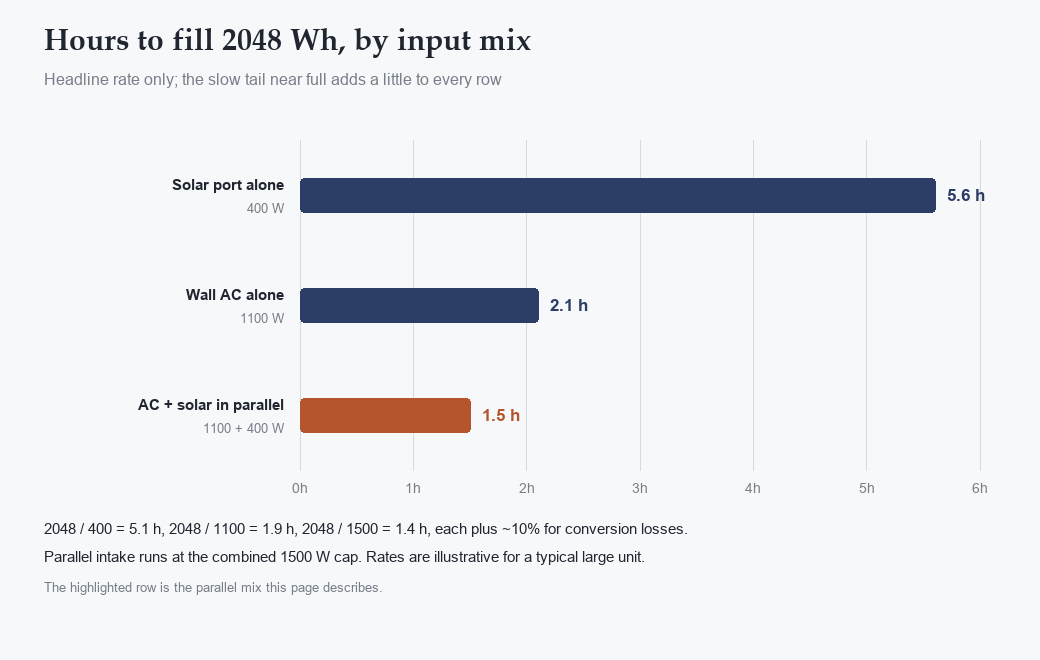
Hours to fill a 2048 watt-hour pack at headline rate, by input mix. The highlighted bottom bar is the parallel AC-plus-solar mix, running at the combined 1500 watt cap. Figures include a rough ten percent for conversion losses; the slow tail near full adds a little to every row. Rates are illustrative.
Turnaround time is the first payoff. Between an outage and the next warning, between a Saturday trip and a Sunday one, the station has to climb back to full inside a fixed gap. Combined intake shrinks that climb to fit the gap. Full arrives before the next departure does. Rental fleets and film crews run this arithmetic daily, with charge windows measured against booking sheets. A pack that turns around in ninety minutes fits into far more of a day’s plans than one that needs four hours.
Winter solar brings the second. A December sky offers three usable hours around noon. Add the wall to that same window and a big pack lands full with room to spare, the noon harvest folded in on top of the cord’s steady base. Short days stop dictating the schedule. Summer flips the same trick toward economy, panels shouldering the base with the cord topping off whatever the evening needs.
Forecast lead time is the third. Warnings arrive hours ahead. Hours-to-full, read off the combined rate, tells whether the station meets the front at one hundred percent. At 1500 watts a 2048 watt-hour pack crosses from near empty to full in about an hour and three quarters. Few warnings run shorter than that. Margin like that turns storm prep from a scramble into a checklist item. The same read works in reverse ahead of planned grid work announced a day early.
Departure mornings close the list. A trip that leaves at nine, decided at seven, leaves two hours to load a pack that sat unplugged all week. Two doors make two hours enough. The wall does its part at breakfast rate. The panels, already out on the lawn for the trip, do theirs. Nine o’clock arrives with the pack full and the panels folded on top of it.
Reading the screen, catching the quiet trims
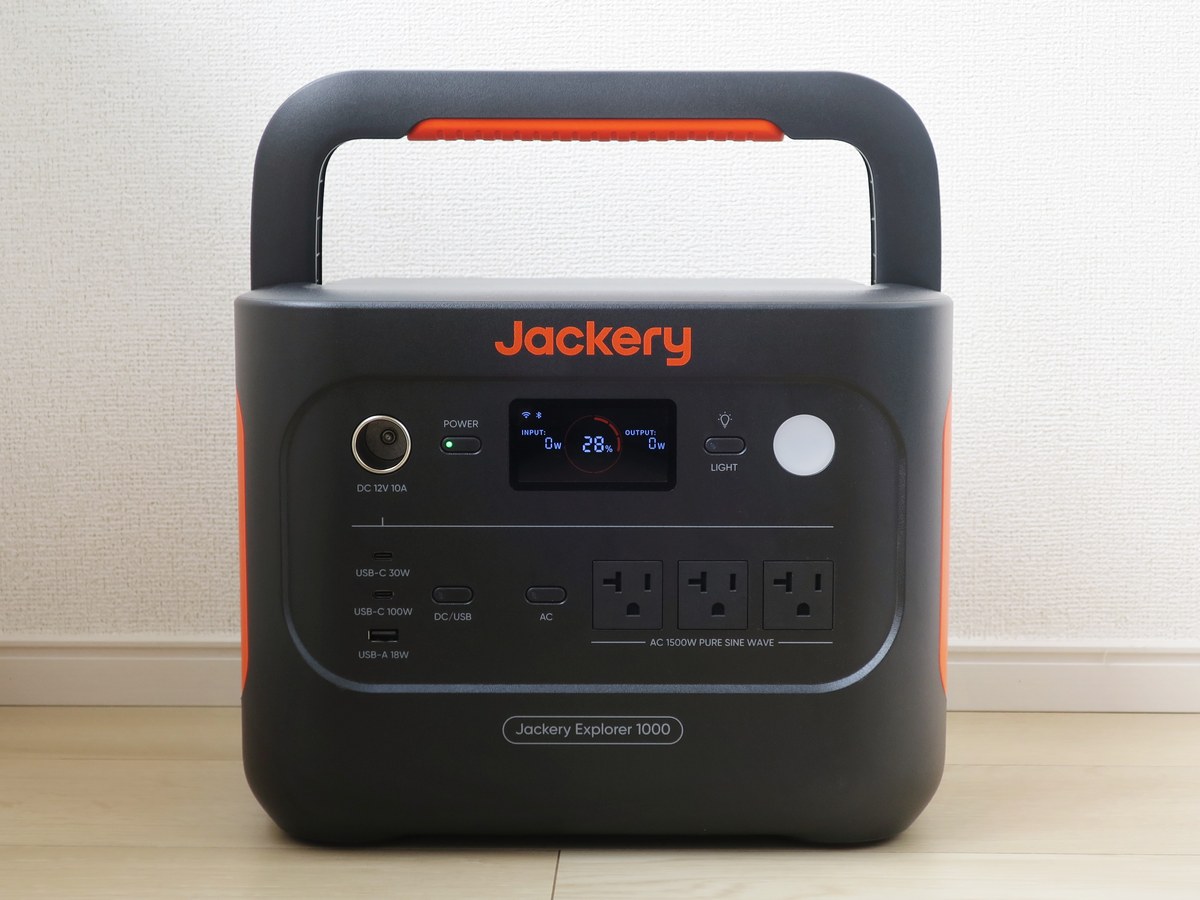
A portable power station’s front face, a Jackery Explorer 1000 here. The display carries the input line this page leans on, reading INPUT 0 W with the unit sitting idle at 28 percent; on charge, that line reports the live combined intake. This face carries outputs only, the labelled DC, USB, and AC sockets below the screen. The charge ports sit on the unit’s other panels. Photo: Qurren, CC BY-SA 4.0.
The input screen settles every question about what the doors are doing. On dual-input units the display carries a figure per source, watts from AC, watts from solar, one line each, refreshed every second. Both lines move in real time. A glance shows which doors stand open and how wide. App dashboards mirror the same two lines for anyone away from the unit. Units without per-source lines still show combined intake, enough to verify the sum against expectation.
Quiet trims show up there first. With the AC door at full width on a 1500 watt unit, the solar line sits pinned near the 400 watt remainder, the combined cap paring that share on purpose. Nothing is broken. The cap is working as printed. Unplug the wall cord and the solar line climbs toward the panel’s own limit. Watching that climb is the cleanest demonstration of the cap a unit can give.
One check ends the setup. Combined intake on the screen, set against the spec sheet’s total, tells whether both doors run at width. Matching figures close the case. A shortfall points at a cable, a port limit, or the cap itself, in that order of likelihood. Five minutes with the screen beats an hour of guessing at the hardware. Cable faults announce themselves there long before any tool comes out.
Getting the setup right
Right cables finish the job. Solar goes in through the MC4-to-port lead sized for the array’s current. AC goes in through the cord from the box. Car charging keeps its dedicated lead. Rated adapters only; a thin third-party lead narrows a door invisibly. Port shapes prevent outright mistakes; nothing dangerous fits the wrong hole. The worst a wrong cable manages is a slow door. Length matters on the solar side above all; thin DC runs give up watts as heat before the door ever sees them.
Parallel charging is the fast lane the spec sheet already paid for. Two ports stand on the housing either way. Feeding both at once turns the printed combined cap into real minutes saved, on storm days, on departure mornings, on any afternoon with sun and a socket in reach. Plug both doors, read the two lines on the screen, let the bus do the adding. Every figure above came off standard dual-input hardware, no accessories, no settings, the machine as it left the box.
Common questions
Can AC and solar charge a power station at the same time?
Yes, on dual-input models. Each source enters through its own port and its own converter. The streams merge at the internal bus under one total ceiling. The battery reads a single combined current the whole time.
Does parallel charging wear the battery faster?
No. The battery management system holds the combined current under the same charge current limit that governs single-source charging. Adding doors cannot push the pack past its ceiling. Heat stays managed through the total intake cap.
Why does the solar figure drop when the wall cord goes in?
The combined cap is at work. With the AC port running at full width, the firmware trims the solar share until the sum fits under the total. The panels are fine. Unplug the wall cord and the solar figure climbs back.
Which inputs can run in parallel?
AC plus solar is the standard pair on dual-input units. Large L class units add a second solar port on its own tracker. Small units pair USB-C PD beside AC. Car charging joins on models with a live DC port; the manual’s input table lists the legal pairs for each machine.