
Cortex-M Families Beyond STM32
The 32-bit Arm Cortex-M market runs far past the STM32. NXP, Microchip, Renesas, and Nordic each build parts with strengths the STM32 does not always match, in a specific peripheral, a wireless radio, a security block, or a supply guarantee. The reasons to leave the STM32 default are specific and few. Each one points at a single vendor whose part does that one job better.
Why look past the STM32
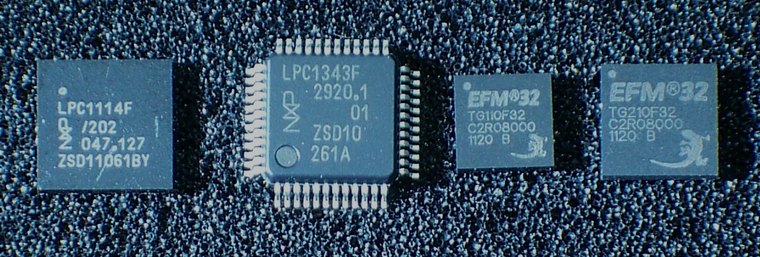
The core inside all of these parts is the same. NXP, Microchip, Renesas, and Nordic each license an Arm Cortex-M core, the same family that runs from the Cortex-M0, the smallest processor Arm builds, up to the M85, exactly as ST does. A program written for one Cortex-M part compiles for another with the same compiler. The processor is a shared commodity across the whole market. Arm sells the same core to every vendor on the same terms. The number of licensees runs into the hundreds. NXP, Microchip, Renesas, and Nordic are the four a Western design team meets in practice. A part from any of them speaks the same machine language as an STM32. That commonality is what makes a second source possible at all. A team designs to the Cortex-M, then picks the vendor whose surroundings fit, with the core itself never in question. The shortage years drove the point home: when a single-source design stalled, a design that could move to a second part kept shipping.
The difference lives around the core. Each vendor wraps the same processor in its own peripherals, its own radios, its own security blocks, its own tools, and its own supply terms. A design that needs one of those things goes to the one vendor whose part has it. That space has a broad middle and a rim of edges. The STM32 owns the middle. Each edge is a real market that belongs to a specialist. The wireless edge, the high-compute edge, the precise-analog edge, and the long-life industrial edge each have a vendor that owns it. A design that lives at one of those edges is the one that looks past the broad middle. The Arm microcontroller market runs to tens of billions of dollars a year, spread across dozens of vendors. That spread gives a buyer real choice on every axis a design can pull, from the radio to the supply guarantee. A project with one sharp requirement leans on that choice from the first sketch, long before the schematic is drawn.
So a designer looks past the STM32 only when a concrete reason calls for it. A wireless link, a precise analog front end, a fifteen-year supply guarantee, a security certification, or a peripheral a specific part does better each pulls a design toward a particular vendor. The pull is specific, tied to one feature or one guarantee. A team names that need before it names the vendor. Four names weigh heaviest outside ST. Each one earns its slot in a different way.
| Vendor | Arm Cortex-M range | Specialty | Lines |
|---|---|---|---|
| STMicroelectronics | M0+ to M7 and M33 | the broad default | STM32 |
| NXP | M0+ to M33, plus crossover | widest range, security | LPC, Kinetis, i.MX RT |
| Microchip | M0+ to M7 | analog, industrial, ecosystem | SAM, PIC32CM, PIC32CX |
| Renesas | M23 to M85 (plus the RX core) | industrial, two architectures | RA, RX |
| Nordic | M4 and M33 | Bluetooth Low Energy | nRF52, nRF53 |
NXP, the broadest alternative
NXP is the closest thing to a full second source for an STM32 design. It carries a general-purpose Cortex-M range that reaches as wide as ST’s, a strong automotive and industrial pedigree, and a crossover line that climbs higher than a microcontroller usually goes. A team that wants one vendor to cover the bulk of its 32-bit work lands on NXP first. The scale shows in the catalogue. NXP ships hundreds of Cortex-M part numbers across its lines, in packages from a few pins to a few hundred, at prices from cents to dollars. A design rarely runs out of room inside the NXP range. The automotive heritage runs deep at NXP, from its own past in car electronics to the Freescale lines it absorbed. A design headed for a vehicle finds qualified parts and the paperwork to match.
The general-purpose parts come in two heritages. NXP’s home-grown LPC line runs from the tiny LPC800 up to the secure dual-core LPC5500. The Kinetis line came from the Freescale merger, strong in analog and backed by a long supply commitment. The cases where NXP’s LPC and Kinetis lines still beat the STM32 default come down to a specific peripheral, a legacy codebase, or that supply guarantee. NXP keeps both lines in production and supported. A buyer treats the two as one extended family across a single toolchain. A design moves up or down that family as the job grows or shrinks, with the firmware and the tools carrying across. That continuity matters to a product line that ships a low-cost version and a full-featured version off one codebase.
Above the microcontrollers sits a different kind of part. The i.MX RT family is what NXP calls a crossover processor: an application-class core run at hundreds of megahertz, programmed like an MCU. A design whose graphics, audio, or machine-learning work runs past a general-purpose part finds the positioning of the i.MX RT crossover line aimed straight at it. The crossover idea fills a real gap between two classes. Below it, a general-purpose microcontroller runs out of compute. Above it, a full application processor brings an operating system and a heavy boot process. The i.MX RT lands between them, with the speed of the larger class and the bare-metal simplicity of the smaller. The top parts run past a gigahertz with a graphics engine and a fast external-memory interface, enough for a colour touchscreen or an audio product. NXP added neural-network acceleration on the newer parts for on-device machine learning. A product that needs that headroom gets it inside the familiar MCU tools and programming model. The crossover class earns its place on a touchscreen panel, a high-end audio product, or an edge-AI sensor that has outgrown a plain microcontroller.
The tooling holds the range together. The MCUXpresso IDE, SDK, and config tools run across the LPC, the Kinetis, and the i.MX RT parts as one ecosystem. A team learns the flow once and reuses it from the smallest part to the largest.
The breadth is the point. A product family can put an LPC part on its cheapest model, a Kinetis part where the analog matters, and an i.MX RT part on its flagship, all from one vendor and one toolchain. For a team building away from ST at scale, NXP carries the widest catalogue in the field. That single-vendor breadth shortens the supplier list, simplifies the contracts, and lets one set of tools and habits cover a whole product range. NXP also brings an automotive line and a hardware-security platform, EdgeLock, for products that have to lock down their firmware and their identity. The catalogue reaches past the general-purpose middle on both ends.
Microchip and Renesas
Microchip reaches the Cortex-M market from two directions. The SAM line came from the Atmel acquisition, a set of Cortex-M parts with a long maker and industrial following. The PIC32 name carries Arm parts today, under a brand that began on a MIPS core. A designer weighing Microchip’s SAM D and SAM L meets the low-power, general-purpose end of that range, where the SAM L parts push battery life hard. The SAM line came to Microchip whole, with the Atmel tools and a large community of makers and small shops behind it. The family spans general-purpose SAM D parts, low-power SAM L parts, and SAM E parts that reach the Cortex-M7. A design already fluent in Atmel finds the family familiar from the first project. The SAM D21 sat at the heart of the Arduino Zero, which carried the part into classrooms and onto countless maker projects. That exposure built a base of engineers who reach for a SAM part by reflex. The SAM L series took the same architecture into the ultra-low-power space for battery designs. A wearable or a sensor that runs years on a coin cell is the natural home for the SAM L.
The PIC32 Arm parts sit alongside them for a buyer already inside the Microchip world. The draw there is the ecosystem and the supply: a single distributor relationship, the MPLAB tools, and Microchip’s own fabs behind the parts. Sourcing the PIC32CM and PIC32CX fits a shop that buys analog, memory, and microcontrollers from Microchip in one order. Microchip runs its own fabs, which gives the supply a stability a fabless vendor cannot always match. A shop that values one purchase order and one support line across its whole bill of materials reads that as a real draw. The PIC32CX parts add hardware security for the metering and industrial markets Microchip serves. Microchip also keeps parts in production for a long time, a promise that matters to an industrial customer planning a ten-year build.
Renesas plays a different hand. It carries the Arm-based RA family alongside the RX family on its own non-Arm core, a split that gives a buyer one vendor with two architectures. The RA parts reach high, with recent groups on the Cortex-M85 for edge AI work. A team running an older RX design that wants to move to Arm reads the trade in the Renesas RA against the RX before it commits. Renesas has pushed the RA line hard since it launched, with the Flexible Software Package tying the parts to a modern toolchain. The recent RA8 groups put the Cortex-M85 and its Helium vector extension on the family, aimed at edge AI and signal work. A team starting fresh on Renesas Arm finds a current, well-supported line. Renesas reaches deep into automotive and industrial markets, with a catalogue of analog, power, and connectivity parts a system designer can buy alongside the microcontroller. The RA and the RX share much of that surrounding catalogue, so a move between them stays inside one vendor’s world.
Both vendors share a trait that draws a certain buyer. They sell deep into industrial and automotive markets, with long lifecycles, broad analog catalogues, and the qualification paperwork those markets demand. A design rooted in that world often finds a natural home on a Microchip or a Renesas part.
Nordic, the wireless specialist
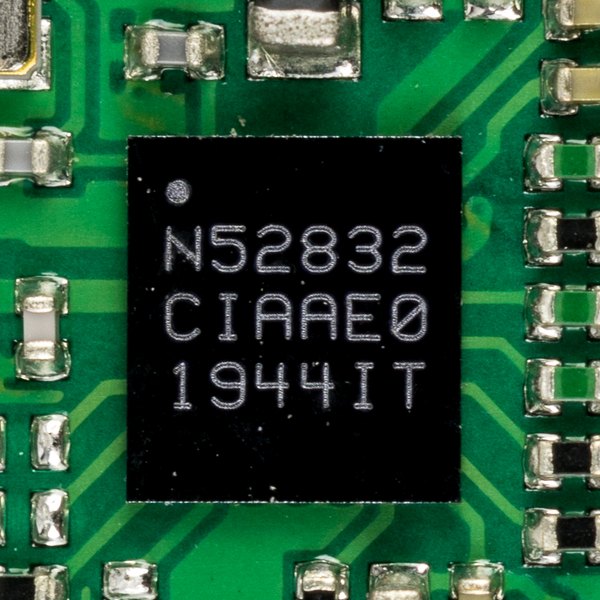
Nordic answers one question better than any general-purpose vendor: how to put Bluetooth Low Energy on a battery. Its nRF52 parts wrap a Cortex-M4 around a 2.4 GHz radio on one die, with a software stack and a regulatory story built for BLE from the start. A wearable, a sensor tag, or a smart-home node that lives on a coin cell finds the radio, the low-power modes, and the protocol stack ready on the part. Picking the Nordic nRF52 for BLE is the path a wireless design takes when the radio is the heart of the product. The nRF52 family has two main members. The nRF52832 suits a mainstream BLE node. The nRF52840 adds more memory, USB, and Thread or Zigbee. Nordic ships the SoftDevice protocol stack and a mature SDK, so a team reaches a working BLE link in days. The newer nRF53 splits the work across two cores, one for the application and one for the radio. The nRF54 carries the line forward. For a product whose value is the wireless link, Nordic is the specialist the market turns to. The radio design is the hard part of a wireless product. Nordic hands a team a module, a reference layout, and a regulatory pre-certification. Those cover much of the radio risk up front. Nordic also runs the nRF Connect SDK on the Zephyr real-time operating system, the direction much of the wireless industry has moved. Its cellular nRF91 parts carry the same approach to LTE-M and NB-IoT for products that reach past the range of Bluetooth. A team that standardises on Nordic for wireless carries one toolset from a short-range sensor to a cellular tracker. The radio expertise built into the parts and the reference designs keeps a wireless product on Nordic across generations.
What separates the vendors
The shared core means the comparison never turns on raw compute alone. Two parts on the same Cortex-M run the same instruction set at a similar clock. The choice turns on the surroundings: the radio Nordic integrates, the analog Microchip and Kinetis carry, the security NXP builds into the LPC5500, the crossover headroom of the i.MX RT, and the supply guarantees an industrial vendor puts in writing. None of those is a clock-speed number. A buyer who compares only the megahertz and the flash size misses the whole point of the field. The reason for the choice lives in the things a comparison table cannot hold. Certification is one of those things. A vendor with a stack of pre-qualified radio, safety, or security certifications saves a product months of its own testing. A team reads the vendor’s certification list as carefully as its part list. A safety-rated medical or automotive product depends on that paperwork as much as on the silicon. The vendor that arrives with it saves the design a long detour.
Ecosystem weighs as heavily as silicon. Each vendor ships its own IDE, SDK, and debug tools, and a team fluent in one moves fastest inside it. A shop with years of NXP or Microchip experience counts that fluency as real value, paid back on every engineer who already knows the flow. The part that fits a team’s habits often beats the part that wins on a datasheet line. Switching vendors carries a real cost in retraining, new tools, and a fresh debug setup, so a team weighs that cost against the gain before it moves. That cost is front-loaded onto the first design, then spread thin across every design that reuses the same parts and tools.
Choosing a part beyond ST
The method is the same one a good selection always uses. The method has two reads. The application read asks what the part has to do. The supply read asks whether it can be bought and supported for the life of the product. A specific need on either read points to a specific vendor. A second-source plan adds a second axis to the read. A design with a second vendor’s part already qualified keeps shipping through a shortage.
The need names the vendor more often than the vendor names itself. A BLE product points to Nordic. A high-compute display or audio job points to the i.MX RT. A precise measurement points to Kinetis or a Microchip analog part. A long-life industrial design points to the longevity guarantees at NXP, Microchip, and Renesas. A clean-sheet general-purpose design with no such need still finds the broad STM32 ecosystem the easiest default. The pattern repeats across the guides linked here. Each one starts from a need and ends at the vendor that serves it. The need does the choosing. A team that reads its own requirements honestly finds the vendor already named by the time the list is done.
So the field beyond ST is a set of specialists, each strong where the need is specific. A team reads the need first, then reaches for the vendor whose strength matches it. The guides linked above walk each of those vendors in the depth a real design decision asks for. The point of the field is choice. A team that knows its one hard requirement reads the rest of this section as a map. Each guide marks the vendor that owns one edge of the market.
Why would a design use a Cortex-M part other than the STM32?
For a concrete need the STM32 does not serve as well: an integrated Bluetooth radio, a precise analog front end, a hardware security block, a crossover-class core for heavy compute, or a long supply guarantee for an industrial product. Every one of these parts runs the same Arm Cortex-M core, so the difference lives in the peripherals, the tools, and the supply terms around it.
Which vendors compete with the STM32 in Cortex-M?
NXP carries the broadest general-purpose and crossover range. Microchip brings the SAM and PIC32 Arm lines with a deep analog and industrial catalogue. Renesas offers the Arm RA family alongside its own RX core. Nordic specialises in Bluetooth Low Energy with the nRF52. Texas Instruments, Infineon, Silicon Labs, and others fill further niches. These four are the ones a general-purpose design tends to meet first when it looks beyond ST.
Is moving off the STM32 to another vendor hard?
The core ports easily, since every vendor uses the same Arm Cortex-M instruction set and the same compilers. The work sits in the peripherals and the tools, which each vendor builds in its own way. A move means a new SDK, a new config tool, and a new debug setup, plus a board change for the new pinout. The application logic above the drivers usually carries over.
Does NXP make the closest STM32 alternative?
For a full-range second source, yes. NXP carries a general-purpose Cortex-M catalogue as wide as ST’s across its LPC and Kinetis lines, climbs higher with the i.MX RT crossover family, and holds it together with one MCUXpresso toolchain. A team wanting a single second vendor away from ST usually starts with NXP. Its broad part range lets one team cover a whole product line without changing vendor.
Which vendor is best for a Bluetooth product?
Nordic leads for Bluetooth Low Energy. Its nRF52 parts integrate the radio, the protocol stack, and the low-power modes a battery product needs on one die, with the regulatory qualification handled. A BLE design built on Nordic skips the external radio and the matching work an STM32-plus-radio approach would add.