What a panel is, and the conditions behind its rating
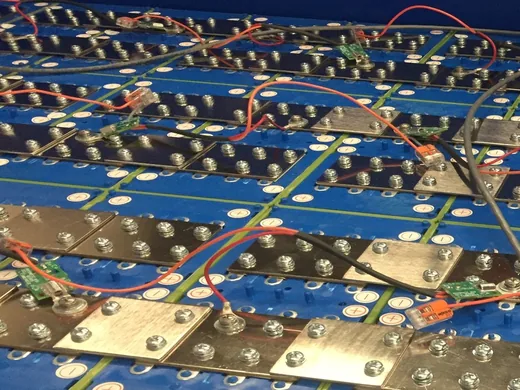
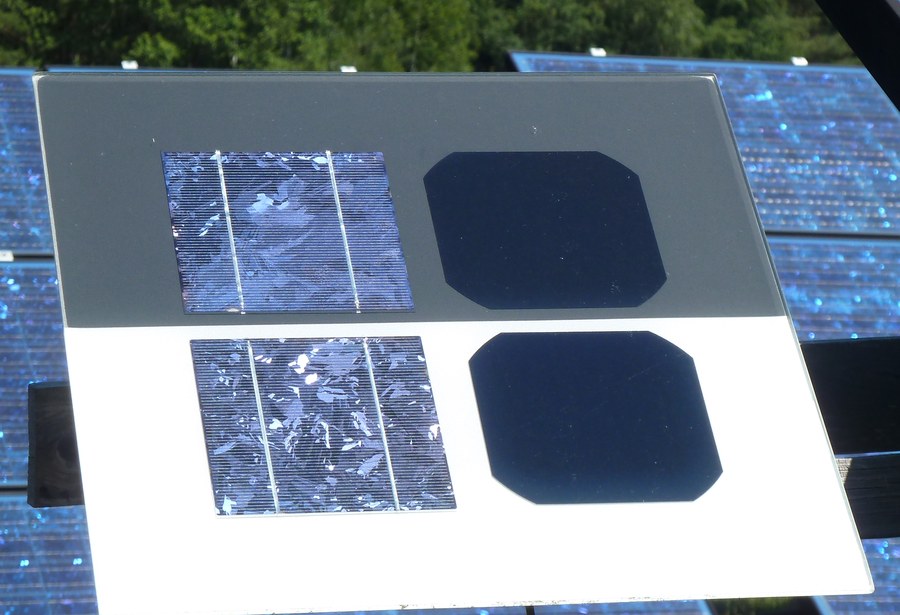
Two cells on a demonstration board. The flecked blue square is polycrystalline, its grain boundaries visible. The dark pseudo-square beside it is monocrystalline, cut from a round ingot, which is why its corners are chamfered. Photo by Klaus Mueller, CC BY 3.0.
A photovoltaic panel produces direct current in proportion to the light falling on it. No storage happens inside it, no regulation, no conversion to mains voltage. Cloud passes over and the output drops within a second. The sun sets and the output reaches zero. Everything useful a panel does depends on the machine behind it banking the energy while the light lasts. That division of labour explains the shape of this pillar. A panel is one component in a chain that runs light, silicon, cable, controller, battery, socket. Each link carries its own losses, its own rating convention, its own failure modes. The seven areas below take them one at a time.
Two numbers describe almost any panel in a sentence. Rated power in watts, measured under laboratory conditions, and open-circuit voltage, which decides what the panel is safe to connect to. A 100 watt panel with an open-circuit voltage of 23.5 volts is a different object from a 100 watt panel at 45 volts. The wattage matches. The second one may sit outside the input window of a small machine. Cells are the atoms of that arithmetic. Silicon cells produce roughly 0.5 to 0.6 volts each regardless of size. Cell count in series sets the panel’s voltage. Cell area sets its current. Two more figures on that label describe the working point between those extremes. Voltage at maximum power sits a few volts under open-circuit, and current at maximum power a fraction under short-circuit, because the point where volts multiplied by amps peaks lies inside both limits. Multiply those two and the rated wattage comes back out. Controllers work at that inner point, never at the extremes printed beside it. Thirty-six cells in series gives the familiar nominal 18 volt panel that suited 12 volt lead-acid charging for decades. Modern panels for portable machines run higher cell counts and higher voltages.
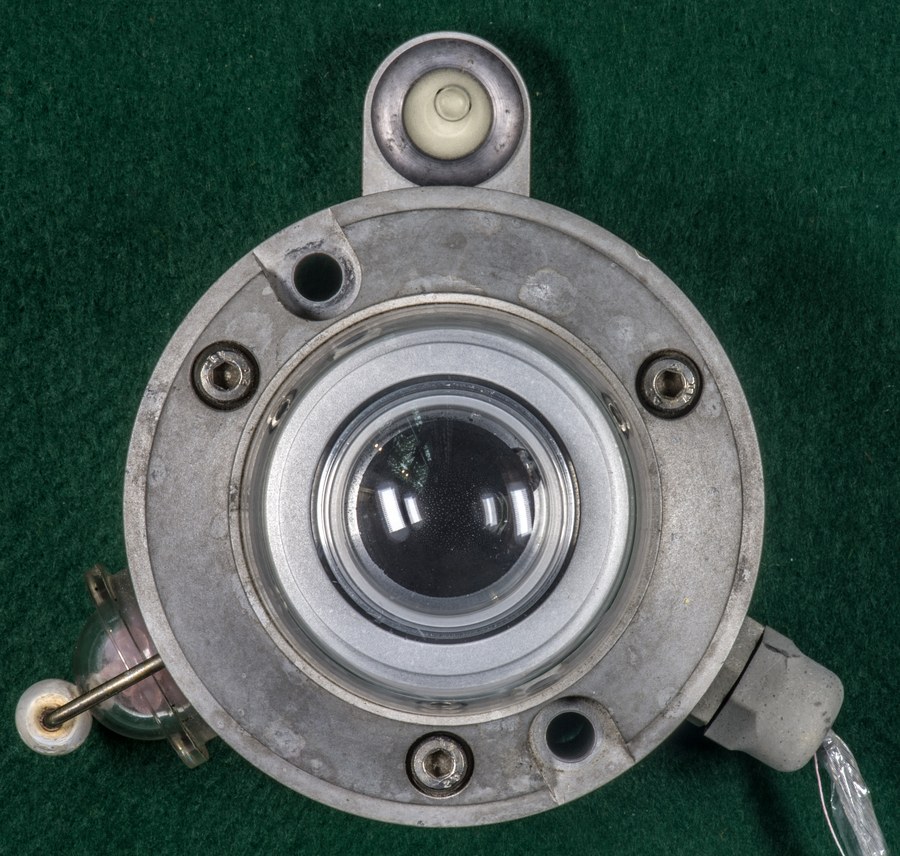
A thermopile pyranometer, the instrument that measures irradiance. Every rated wattage on every panel assumes 1,000 watts of it per square metre. Photo by Hannes Grobe, CC BY-SA 4.0.
Panel wattage comes from Standard Test Conditions. Three numbers inside that phrase decide how much of the rating an owner ever sees. Irradiance of 1,000 watts per square metre. Cell temperature of 25 degrees. An air mass 1.5 spectrum. That last one describes sunlight on a sun-facing surface tilted 37 degrees, the sun 41.8 degrees up. It is solar noon at the equinoxes in the continental United States.
Read those three together and the problem announces itself. Bright sun delivers something near 1,000 watts per square metre for a couple of hours around noon on a clear day. A panel sitting in that sun reaches 50 degrees or more, well past the 25 the test assumed. The spectrum shifts with the season and the hour. Real panels commonly deliver 75 to 90 percent of their rated wattage under conditions a person would call excellent.
A second rating exists precisely to say so. Nominal Operating Cell Temperature testing uses 800 watts per square metre, 20 degrees ambient, a metre per second of wind. The resulting figures land 10 to 15 percent below the Standard Test Conditions numbers. Manufacturers publish both on the datasheet. Marketing quotes the first. Working backwards from a datasheet takes about a minute and settles most arguments. Divide rated power by module area to recover the efficiency claim: 100 watts across half a square metre is 20 percent, since the test condition supplies exactly 1,000 watts to every square metre. A panel advertising 200 watts in the footprint of a 100 watt module is either using cells nobody else can buy or quoting something other than Standard Test Conditions. Physical area is the check that cannot be dressed up.
Where the silicon comes from
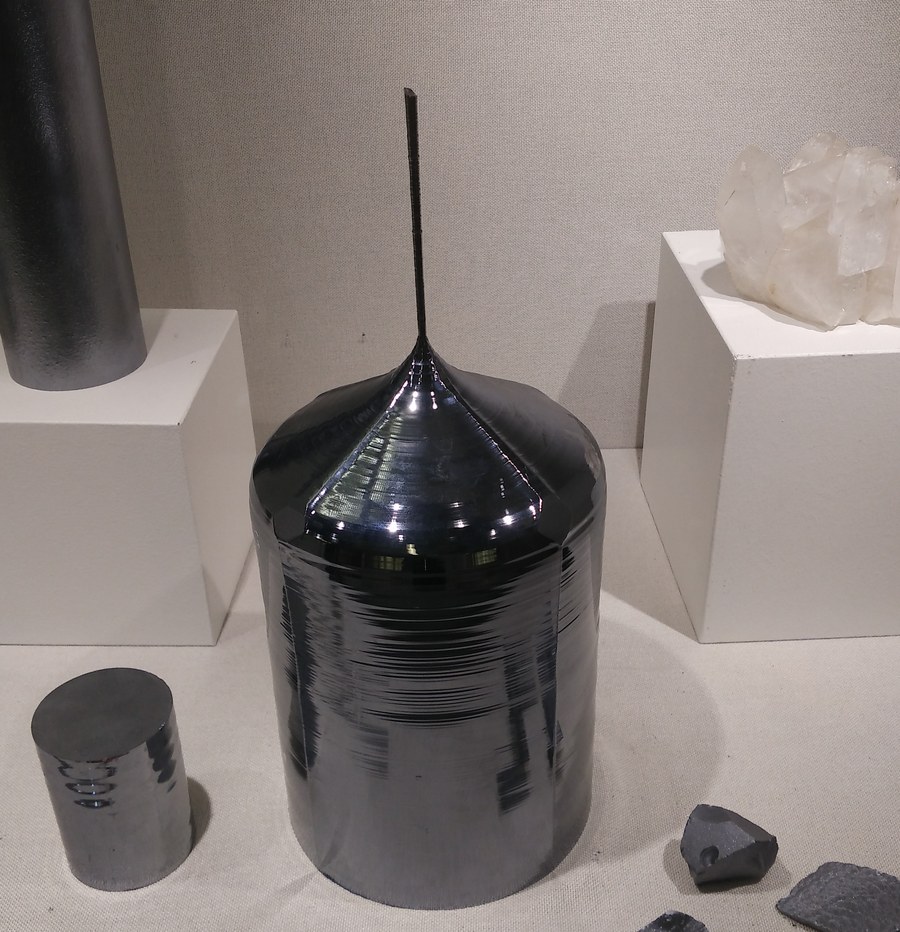
A monocrystalline ingot with the seed crystal still attached at the top. The whole cylinder is one continuous lattice grown from that spike, and the chunks beside it are the polysilicon feedstock it was pulled from. Photo by ArticCynda, CC0.
Monocrystalline means one crystal. A seed is dipped into molten silicon and drawn out slowly while rotating. The lattice follows it. What emerges is a cylinder of one continuous crystal from end to end. Sawing that cylinder into wafers gives cells with no grain boundaries in them, which is where the efficiency advantage comes from. The round cross-section also explains the chamfered corners on almost every mono cell. Mass-produced monocrystalline modules now reach 22 to 24 percent efficiency, which is the fraction of incident light energy leaving as electricity. Efficiency reaches a portable owner as area. A 22 percent panel needs about half a square metre to make 100 watts under test conditions. Drop to 17 percent and the identical 100 watts wants nearer 0.6 square metres. That is a bigger object to fold up and carry.
Most portable buyers start in the 100 watt monocrystalline class. A day, a year and two decades of returns from one such panel get worked out there.
Heat takes its cut first
Silicon loses voltage as it warms. Datasheets state the effect as a temperature coefficient of maximum power, quoted in percent per degree. Mono PERC cells sit around minus 0.35 percent per degree, with published figures spanning minus 0.34 to minus 0.37. Newer cell architectures do better: TOPCon near minus 0.29, heterojunction near minus 0.24. Turn the coefficient into a number an owner meets. Modules on a warm day run somewhere between 50 and 70 degrees, which is 25 to 45 degrees above the test condition. At minus 0.35 percent per degree that removes 8 to 16 percent of the rating before anything else in the chain touches it. Cold bright weather runs the other way. A panel in winter sun can briefly exceed its nameplate. Voltage carries its own coefficient, separate from the power figure and larger. Open-circuit voltage on a silicon module climbs roughly 0.3 percent for every degree below 25, which is the mechanism behind cold-morning controller damage. A string measuring 45 volts on a warm afternoon presents about 49 at minus 10. An input limit of 48 volts has been crossed before the owner is awake.
Shading behaves differently and worse. A cell in shadow stops contributing and becomes a resistance in series with the cells still lit. That is why a single leaf or a pole shadow across one cell can cost far more than its share of the area. Bypass diodes in the junction box limit the damage by routing current around a shaded group. Dirt sits between the two. A dusty surface scatters light before it reaches the cell. Loss accumulates slowly enough that owners stop noticing. Temperature, shadow and surface condition get measured separately in the environment a panel has to work in.
Counting the day in peak sun hours
Watts describe an instant. Watt-hours fill a battery. Bridging the two needs a figure for how much sun a location supplies across a day. Peak sun hours is the convention for it. Orientation multiplies into that figure before anything else does. A panel flat on the ground collects far less than one tilted toward the sun, since irradiance falls with the cosine of the angle between the panel’s normal and the incoming light. Thirty degrees off aim costs about 13 percent. Sixty degrees off costs half. Portable owners rarely track the sun through the day. The practical move is to aim at where the sun will sit in the middle of the useful window and accept the cosine loss at both ends. Because peak solar radiation is 1 kilowatt per square metre, the count of peak sun hours is numerically identical to the average daily insolation in kilowatt-hours per square metre. A site receiving 5 kilowatt-hours per square metre per day has five peak sun hours.
Continental United States figures run from about 3.5 peak sun hours a day in western Washington and Oregon to about 6 in Las Vegas, inland southern California and western Arizona, with most of the lower 48 between 4.2 and 5.5. Those are annual averages. December in Seattle looks nothing like the average, and neither does July. The arithmetic that follows is short and worth doing before buying anything. Rated watts times peak sun hours gives a theoretical daily energy. A 200 watt panel at 4.5 peak sun hours suggests 900 watt-hours. Then the derates land: temperature, angle, dirt, cable, controller. A realistic figure for a portable setup lands between 60 and 75 percent of the theoretical. That 200 watt panel arrives nearer 540 to 675 watt-hours on a good day.
Folding costs weight and buys carriage
Portable panels fold because a rigid 200 watt module is roughly a metre by a metre and a half of glass. Folding replaces the glass with a laminate over a flexible or segmented backing, hinges the segments together, and puts the whole thing in a zipped case with a stand sewn in. The trade is real on both sides. A folding panel survives carriage and storage in a way no glass module does. It gives up some efficiency per unit area, along with some of the twenty-five year outdoor durability a glass laminate offers. Hinges become the part that decides service life. Every fold works the wiring that crosses the joint. A panel folded twice a week for years accumulates cycles no laboratory sequence covers. Junction boxes on portable panels take that abuse differently. They get dragged across gravel and left in rain, never bolted to a roof for a decade.
Sizing follows carriage. Two hundred and forty watts in one folding case is one object to carry and one cable to route, while three 100 watt panels give redundancy and let a person deploy part of the array in the shade of a van. Both arrangements have their place. The 240 watt folding class settles the comparison with real generation figures and real case dimensions. Weather resistance on a portable panel is a design problem, with no rating attached. Hinges, junction boxes, stands, hail and years of ultraviolet each attack a folding panel differently from a framed one. How a folding panel is built to survive outdoors takes them in turn.
From several panels to one battery
One panel rarely fills a machine of any size. Panels get combined, which changes what the controller sees. Series wiring adds voltages while current stays at the level of the weakest panel. Parallel wiring adds currents while voltage stays at the level of the lowest panel. Both totals have to land inside the machine’s input window. That window has two walls. The upper wall is absolute. Open-circuit voltage rises in cold weather. A string sized against its warm-day voltage can exceed the input limit on a bright winter morning, taking the controller with it. The lower wall is practical. Panel voltage has to sit some margin above battery voltage before a controller transfers anything at all.
Mixing panels of different ratings brings its own arithmetic, since a series string is limited by the lowest current and a parallel set by the lowest voltage. Combining panels in series and parallel works through those limits. The voltage and current figures there decide which arrangement a given machine accepts.
A panel and a battery cannot simply be wired together. The panel’s voltage swings with light and temperature, the battery wants a controlled charge profile, and something has to sit between them deciding how much current flows. That something is the charge controller, built into almost every portable power station and sold separately for larger installations. Maximum power point tracking is the technique that earns its keep. A panel has one voltage at which the product of volts and amps peaks, and that voltage moves with irradiance and temperature. A tracking controller hunts for it continuously and converts whatever it finds down to battery voltage. A simpler pulse width modulation controller pulls the panel down to battery voltage. On a cool bright day that leaves a substantial fraction of the available power unclaimed.
Everything after the panel is copper, and copper charges rent. The industry standard connector is the MC4 family, covered by IEC 62852, typically rated 30 amps and 1,000 volts DC under the IEC scheme with 1,500 volt variants under UL. The standard sets what the connector has to survive. Contact resistance stays under 1.5 milliohms after 1,000 mating cycles. Thermal cycling runs 2,000 hours between minus 40 and plus 85 degrees.
Cable loss follows from resistance and distance. Copper resists about 1.68 hundred-millionths of an ohm-metre. Work that through a ten-metre run of 4 square millimetre cable, counted out and back: roughly 84 milliohms. At 8 amps that costs two thirds of a volt and about 5 watts of heat. On an 18 volt panel nearly 4 percent of the harvest is gone before the controller sees it.
Adapters add their own joints. A portable machine with an Anderson input and a panel with MC4 leads needs a conversion. Every conversion puts two more contact interfaces in the current path. Kits exist to remove the guesswork. Cables, connectors and kit bundles cover which combinations pair with which machines.
Twenty-five years of slow decline
Panels fade. Outright failure is the rare case. Published degradation runs about 0.5 percent a year, which leaves roughly 88 percent of the original output at year 25. Manufacturer warranties bracket that with a guaranteed maximum annual loss, commonly 0.25 to 0.55 percent per year. An end-of-warranty floor of at least 80 percent of rated power stands at 20 to 25 years. Two international standards stand behind those claims. IEC 61215 is the design qualification and type approval sequence, covering thermal cycling, humidity freeze, mechanical load and hail impact. IEC 61730 covers safety qualification. A panel without both marks has not been through the sequence, whatever its datasheet says. What ages is not only the silicon. Encapsulant yellows. Backsheets crack. Junction box seals harden. Aluminium frames corrode at the earth bond. Every one of those is a materials problem in the laminate and the housing, running on its own clock beside the silicon’s. A panel at 90 percent of rated output with a cracked junction box has become a maintenance problem. Which of those arrives first depends on climate. That question sits inside the monocrystalline pillar. Two failure patterns dominate the field reports. Potential-induced degradation shows up as a whole module producing far below its neighbours, driven by leakage between cells and a grounded frame at high system voltage. Cell cracking is the other, invisible from outside and usually traced to a mechanical event: hail, a foot on the glass, a panel dropped during transport. Neither shows on a sunny-day output check, since a cracked cell can carry current until the crack opens under thermal cycling. Both are what the qualification sequences in IEC 61215 exist to bracket.
Reading a panel specification honestly
Six figures on a datasheet decide whether a panel suits a machine. The marketing headline is one of the six. Rated power in watts under Standard Test Conditions. Open-circuit voltage, which is the number that must stay under the machine’s input limit at the coldest temperature expected. Voltage at maximum power, which is what the controller actually works with. Current at maximum power. The temperature coefficient of power. Module efficiency, the figure that converts the rest into physical size. Work an example through and the six stop being abstract. A 200 watt folding panel quotes 24.8 volts open-circuit, 20.6 volts at maximum power, 9.7 amps at maximum power, minus 0.35 percent per degree, 21 percent efficiency. Multiply 20.6 by 9.7 and the 200 watts comes back, confirming the headline describes the maximum power point. Divide 200 watts by 210 watts per square metre of output at that efficiency and the panel needs about 0.95 square metres of aperture, which is the real size of the object in a car boot. Take the open-circuit figure to a cold morning at minus 5 and it rises by about 9 percent to 27 volts, which has to stay under the machine’s input ceiling. Put the panel in July sun at 60 degrees and the power coefficient removes 12 percent, leaving 176 watts as the peak worth writing down. Multiply that by 4.5 peak sun hours and the theoretical day is 792 watt-hours. Apply the 60 to 75 percent system factor for angle, dirt, cable and controller and the machine sees somewhere between 475 and 594. Every step in that chain came off the datasheet or off a published condition. That finishing number is under a third of what the box lid implies for a 200 watt panel across a summer day. Nothing in the sequence required a measurement the buyer could not take from the label.
The figures that decide whether a panel suits a machine, and where each one comes from
Specification
Typical value
Condition it assumes
Rated power
100 W, 240 W and up
1,000 W/m², cell at 25 °C, AM1.5 spectrum
Nominal operating rating
10 to 15 percent under the rated figure
800 W/m², 20 °C ambient, 1 m/s wind
Module efficiency
22 to 24 percent for mass-produced mono
fraction of incident light leaving as electricity
Temperature coefficient of power
-0.34 to -0.37 %/°C for mono PERC
-0.29 TOPCon, -0.24 heterojunction
Real output on a warm clear day
75 to 90 percent of rated
module running at 50 to 70 °C
Peak sun hours, lower 48 states
3.5 to 6 hours a day
most sites between 4.2 and 5.5
MC4 connector
30 A, 1,000 V DC under IEC
IEC 62852, contact resistance under 1.5 mΩ
Annual degradation
about 0.5 percent a year
roughly 88 percent of original at year 25
Warranty floor
at least 80 percent of rated power
after 20 to 25 years
Nothing in that table is a secret. All of it appears on a proper datasheet. Arithmetic explains the gap between the headline and the working figure. What a buyer needs is the habit of reading past the first line.
Common questions
Why does my 200 watt panel never make 200 watts?
Because the rating was measured at 1,000 watts per square metre with the cells held at 25 degrees. A panel in real sun runs at 50 to 70, which at minus 0.35 percent per degree removes 8 to 16 percent on its own. Angle, dirt, cable and controller take the rest. Peak readings of 75 to 90 percent of rated are normal.
Is monocrystalline worth paying for over polycrystalline?
For a portable panel the argument is about size. Mono modules reach 22 to 24 percent efficiency. A given wattage needs less area at that efficiency. Less area folds into a smaller case. Weight drops with it: a folding 200 watt panel runs about 7 to 9 kilograms, where a framed glass module of that rating runs nearer 11. Both chemistries have the identical relationship with heat and shade.
How many panels can I connect to one machine?
Whatever keeps the combined voltage and current inside the machine’s stated input window, with headroom for the voltage rise that cold weather brings. Exceeding the upper voltage limit damages equipment. That limit takes the margin.
Do I need to clean the panel?
Rain handles most of it on a tilted panel. Bird droppings and pollen films shade cells, which is worse than dimming them. A shaded cell costs more than its share of the area.
How long will a folding panel last?
Glass modules carry 20 to 25 year performance warranties with an 80 percent floor. A folding panel usually meets a mechanical limit first: hinges, wiring across the folds, the junction box seal. Expect the electrical output to outlive the case.