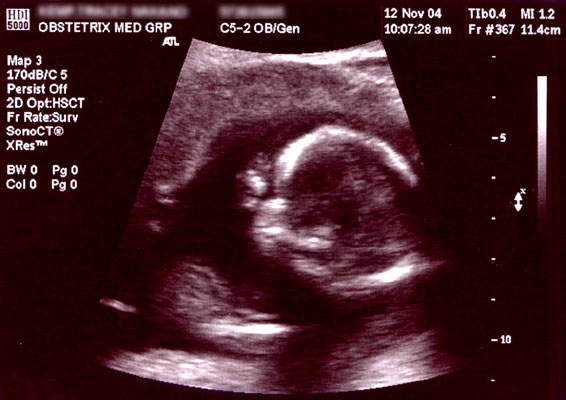
An ultrasound study; DICOM wraps the pixels in patient and study information so the image files itself into the record.
DICOM is the standard that lets a medical image leave the machine that made it and live usefully everywhere else, the agreed format and the agreed set of network conversations by which a scan becomes part of a patient’s record rather than a picture trapped on one device. For an ultrasound probe the standard governs two distinct things that buyers often blur: the format the image is saved in, with all the patient and study information wrapped around the pixels, and the network services by which the device hands that image to the hospital’s archive, pulls a patient’s details from a worklist, or confirms that a study was safely stored. A handheld probe that cannot speak DICOM produces images that are stranded, however good they look, and the standard is what turns a private picture into a record other systems can read, file, and retrieve years later.
An image that cannot leave the device in a standard form is a picture, not a medical record.
The format is more than the pixels
A DICOM file is not simply an image with a different extension. It wraps the pixel data in a structured set of information about the patient, the study, the equipment, and the acquisition, so the image carries its own context wherever it travels.
Inside a single DICOM object sit the patient identifiers, the study and series that organize it, the date and time, the device that made it, and the settings the scan ran at, all in defined fields a receiving system knows how to read. This is why a DICOM image dropped into a hospital archive lands under the right patient and the right study automatically, while a plain image file would arrive as an orphan no system could file. Ultrasound brings its own wrinkles the standard accounts for, since a scan is often a cine loop rather than a still, and the standard defines how a multi-frame ultrasound image stores its frames, its frame rate, and the calibration that lets a measurement made later read in real units. The standard also fixes how the pixels themselves are encoded, the transfer syntax, so a receiving system knows whether the data is uncompressed, or compressed by a method it has to support to read the image back. A maker that exports a tidy proprietary file, or a plain image with the patient details burned into the corner rather than carried in fields, has produced something that looks like an image and behaves like a dead end. The format is the part that makes the image survive the journey with its meaning intact. The same fields also carry the calibration a clinician relies on, so a distance or an area measured on the archived image reads in millimetres rather than pixels, and a study that lost its calibration on export would force every later measurement to start from a guess.
The pixels are the easy part; the information wrapped around them is what makes the image a record.
The conversations a device has to hold
Producing a valid file is half the standard. The other half is the set of network services by which a device exchanges those files with the systems around it, and a probe that can save a DICOM file but cannot send it has met only the easier half.
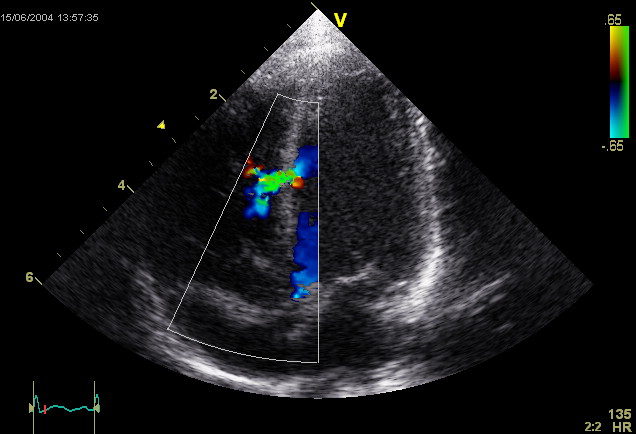
An echocardiogram; a cine loop is stored as a multi-frame DICOM object the hospital archive can read back.
The central service is storage, the conversation in which the device pushes a completed study to the hospital archive, the picture archiving system that holds every image the institution has made, and a device that supports this can file its scans where every other modality files theirs. A worklist service lets the device pull a patient’s identity and the ordered study from the hospital system, so the operator selects the patient rather than typing a name that may not match the record, and the scan comes back tagged with identifiers the archive already recognizes. A storage commitment conversation lets the device confirm that the archive has taken permanent responsibility for a study before the device lets go of its own copy, which matters above all for a handheld with little storage of its own. Each of these is a defined role the device plays, a service class it acts as the user of, and the standard specifies the conversation precisely enough that a device from one maker can talk to an archive from another. A probe that supports storage but not worklist forces manual patient entry that breeds mismatched records, and a probe that supports neither is an island that hands its operator a file to move by hand. The services are where a device stops being a standalone gadget and becomes a member of the hospital’s information system. A printing service and a procedure-step service round out the set for institutions that need them, and a device that supports the conversations its setting truly uses slots in without a technician building a bridge by hand.
The conformance statement is the contract
The standard is large, and no device implements all of it. The document that says exactly which parts a given device speaks is the DICOM conformance statement, and it is the one document a buyer or an integrator can lean on hardest.
The conformance statement declares which information objects the device produces, which service classes it supports and in which role, and which transfer syntaxes it can read and write, in a structured form an integrator can check against the hospital’s systems before buying. It is the contract that lets a hospital know in advance whether a probe will talk to its particular archive and its particular worklist, rather than discovering an incompatibility after the device is on the ward. A maker that publishes a full, specific conformance statement is making a checkable promise about how the device will behave on a network, while one that claims to be DICOM compatible without publishing the statement has made a claim no integrator can verify. The phrase DICOM compatible on a brochure means little on its own, since two devices can both be compatible and still fail to exchange a study if their supported objects and syntaxes do not overlap, and only the conformance statement reveals whether they do. An integrator reads the statement the way an engineer reads a datasheet, looking for the specific service classes and syntaxes the local systems require, and a maker confident in its implementation hands the statement over rather than hiding behind a slogan. The conformance statement is the place a vague compatibility claim becomes a precise, testable one.
A device is only as interoperable as its conformance statement says, and a missing statement says more than any line in one.
Why a shared format outlasts any one device
The deepest value of the standard shows itself not on the day a scan is made but years later, when the device that made it is gone and the image still has to be readable.
A hospital keeps images for years, sometimes for decades, and the machines that produced them are replaced long before the records are, so an image saved in a private format tied to one vendor becomes unreadable the moment that vendor changes course or disappears. A DICOM image, by contrast, can be opened by any conforming system, since the format is defined by a standard rather than owned by a maker, and a study filed today will still be legible on a system bought a decade from now from a different supplier. This durability is the quiet argument for insisting on real DICOM rather than a proprietary export that happens to work today, because the proprietary file is a hostage to one company’s survival and one application’s version, while the standard file belongs to the institution that holds it. The same property protects a buyer against being locked to a single vendor, since images that live in the standard format can be moved to a new archive or read by a new system without begging the original maker for a converter. A maker that stores in the open standard is handing the hospital control of its own records, while one that stores in a private format is quietly keeping a grip the hospital may regret later. The standard is, in the end, a promise that the image will outlive the device, and that promise outweighs any single feature on a brochure.
The image has to outlive the machine that made it, and only an open format lets it.
What it means for a wireless handheld
A wireless handheld probe lives or dies on integration, since its whole promise is to bring imaging to places a cart never reached, and that promise collapses if the images cannot reach the record.
A handheld used at the bedside, in the field, or in a clinic without a sonography department has to get its images into the patient’s record through whatever path the institution uses, and DICOM is the path the institution already speaks. A probe that exports only to a phone gallery, or to a proprietary cloud the hospital does not control, has produced images that never become part of the legal medical record, which is a clinical and a compliance problem rather than a convenience one. The handheld form also raises the storage commitment question more sharply, since the device holds little and cannot keep every study locally, so confirming the archive has the study before clearing space is part of using it safely. A maker that has built real DICOM support publishes a conformance statement, supports storage and worklist, and lets the device join the hospital network the way a cart does, while one that has bolted on a screenshot-to-email feature offers integration in name only. The buyer who needs the images in the record asks for the conformance statement first, since a handheld that cannot file its work properly is a camera with a clinical price tag.
The handheld earns its keep only when its images land in the record like every other modality’s do.
Reading a conformance statement, and the red flags
A buyer does not need to be an integration engineer to tell a serious DICOM implementation from a thin one. A handful of checks separate them.
The first is whether a conformance statement exists at all and is specific to the device rather than a generic template, since a maker serious about integration produces a real one. The second is whether the storage service is supported in the role of sending studies out, because a device that can only receive is of little use to a probe whose job is to file what it captures. The third is whether a worklist service is offered, since its absence forces manual patient entry and the mismatched records that follow. The fourth is whether the supported transfer syntaxes and ultrasound objects match what the hospital’s archive expects, the detail on which an otherwise capable device can still fail to connect. A device that passes these reads as one built to live inside a hospital’s information system, while one that fails them reads as a standalone gadget dressed up with the word DICOM. The handheld a buyer should trust is the one whose conformance statement an integrator can check against the local systems and find the overlap that makes the two talk, and a maker that welcomes that check is usually the one whose device passes it. None of this requires the buyer to read the raw protocol, only to ask for the statement and hand it to whoever runs the hospital network, since that person reads such documents for a living and will know within minutes whether the device belongs on the network or merely claims to.
The statement that an integrator can check before buying is the one that spares a hospital the discovery after.
About the Author
Julien Mercier
Senior R&D Engineer · Medical Ultrasound Transducer Development
Senior R&D Engineer with an M.S. in Applied Physics and over 15 years of experience in medical ultrasound transducer development, specializing in the design verification and performance testing of high-frequency imaging transducers. Currently leading the development and verification of the company’s next-generation high-frequency linear-array transducer, responsible for imaging performance evaluation and reliability analysis in preclinical testing. Brings extensive hands-on experience in piezoelectric element tuning, beamforming parameter optimization, and system-level performance testing.