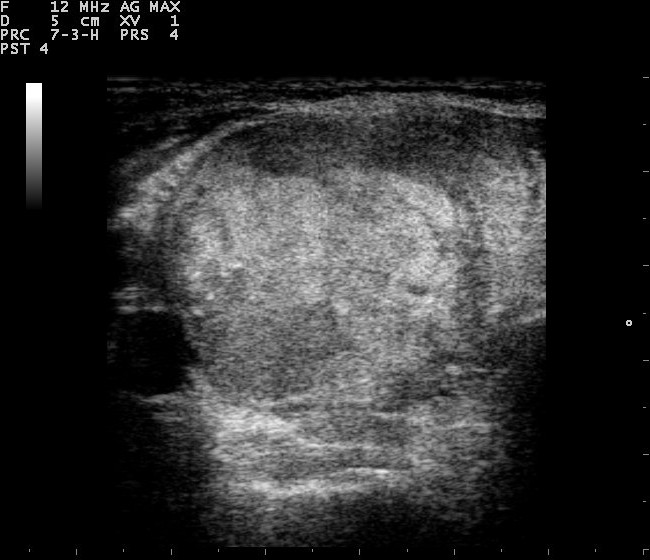
A high-frequency thyroid scan; the short wavelengths that sharpen shallow detail are absorbed strongly and turned to heat at the lens.
A high-frequency ultrasound probe gets warm in the hand, and the warmth is not a fault but a consequence of the physics it runs on, since making a sharp shallow image takes energy and some of that energy always ends up as heat in exactly the worst place, the lens that touches the patient. Two separate sources feed that heat: the sound itself, which is absorbed and turned to warmth as it passes through the lens and the matching layers, and the electronics packed a few millimetres behind the array, which draw current and give off heat like any chip. A higher frequency makes both worse, since high-frequency sound is absorbed more strongly and the electronics that drive it work harder, so the probes that produce the finest shallow detail are also the ones that fight hardest to stay cool. How a maker manages that heat, often through a thermally conductive coating or backing that carries it away from the lens, decides whether the probe can sustain its output or has to throttle itself to stay safe.
The heat is the price of the picture, and it lands on the one surface a patient feels.
Two sources of heat, one hot surface
To see why cooling is hard, it helps to separate the two ways a probe warms, because they come from different places and meet at the same lens.
The first source is acoustic, since not all the sound a probe emits travels cleanly into the body; a fraction is absorbed by the lens and the matching layers on the way out and turned into heat right at the face of the device, and the higher the frequency the more strongly that absorption happens. The second source is electronic, since the beamformer and its driving circuits sit just behind the array in a sealed handheld with no room for a fan, and every channel they run draws current that becomes warmth a few millimetres from the patient. Both sources deposit their heat at or near the lens, which is the single surface the patient feels and the one the safety standard caps, so the probe has the unhappy arrangement of generating heat exactly where it least wants it. A cart-based system could put its electronics in a large cooled body far from the contact point, but a handheld has folded everything into the head, so the acoustic heat and the electronic heat pile up together against the lens. The challenge of keeping a probe cool is not removing heat in general but moving it away from the one place it must not collect.
Sound and silicon both turn into warmth, and both do it next to the skin.
Why high frequency makes it worse
Frequency is the lever that sets both how fine the image is and how hot the probe runs, and the two move together in a way that makes high-frequency probes the hardest to keep cool.
A shallow detailed scan; the finest images come from the frequencies that warm the probe the most.
A high-frequency probe produces sharper, shallower images because short wavelengths resolve fine detail, which is exactly what a clinician wants for vascular, musculoskeletal, and other surface work, so the demand for high frequency is the demand for a better shallow picture. The physics that grants that sharpness also charges for it, since tissue and the probe’s own materials absorb high frequencies far more strongly than low ones, turning more of the emitted energy into heat the deeper the frequency climbs. The electronics keep pace with this, since driving a high-frequency array at a high frame rate means more pulses, more switching, and more current through the beamformer, all of which add electronic heat to the acoustic heat already rising in the lens. The result is that the probes built for the finest shallow detail are precisely the ones that generate the greatest heat at the contact surface, so the engineering that wins a sharp picture also inherits the hardest thermal problem. A maker that wants to offer high-frequency imaging without a probe that grows uncomfortably warm or throttles within minutes has to solve the heat at the same time as the image, and the two cannot be separated. The sharpest probes are the hottest, and managing that heat is the price of admission to high-frequency imaging.
The frequency that sharpens the picture is the same frequency that warms the lens.
How a cooling coating moves the heat
The answer to heat that collects at the lens is not to make less of it, which the physics forbids, but to carry it away to where it can spread and dissipate, and a thermally conductive coating or layer is one of the main ways a handheld does that.
The idea is to give the heat a fast path out of the lens region and into the larger mass of the probe body, where it can spread over a wide area and shed slowly into the air and the hand rather than concentrating at the contact point. A thermally conductive coating, backing, or filler, often built around materials that move heat well, sits behind or around the array and acts like a wick, drawing warmth from the lens and matching layers into a heat spreader that distributes it across the housing. Some designs use a conductive backing layer that pulls heat from behind the array, others a spreader of graphite or metal that carries it to the body, and the better ones combine several paths so the lens never becomes the place the heat has to sit. The aim is to keep the contact surface below the temperature limit while letting the rest of the device run a little warmer, since heat spread thinly across a large surface is harmless where the same heat concentrated at the lens would breach the safety cap. A probe with a good thermal path can then sustain a higher output for longer before the surface warms to the limit, while one without it reaches the cap quickly and has to throttle, so the coating is not a cosmetic detail but the thing that lets the probe deliver its rated performance over a real session. The coating does not defeat the heat; it relocates it to where it does no harm.
What the heat decides about performance
The thermal design is easy to overlook because it never appears as a headline number, and yet it quietly governs two of the things a clinician notices first, sustained output and scan time.
A renal scan; a probe that throttles as it warms dims halfway through a long study.
When a probe’s lens approaches the surface-temperature limit, the firmware lowers the acoustic output to keep the patient safe, and the picture dims at the very moment the device has been working hardest, so a probe with poor cooling images well for a minute and then fades as it warms. This throttling is invisible in a short demonstration and obvious in a long study, since the device that looked bright in a two-minute trial may dim halfway through a real exam, and the difference is entirely a matter of how well the heat was managed. The heat also drains the battery, since the same energy that becomes warmth came from the cell, so a probe that runs hot tends to run flat sooner, tying the thermal design to scan time as well as to image quality. A probe engineered with a strong cooling path holds its output and its battery across a full session, while one that skimped on thermal design throttles and drains in ways the specification never warned of, and both failures trace back to the same neglected coating. A buyer who tests a probe for two minutes learns little about its heat, but one who scans continuously for fifteen feels the throttling if it is there, and a long hands-on trial reveals the thermal design that no brochure discloses. The heat is the limit a long scan meets first, and the cooling is what decides where that limit sits.
The materials that carry heat, and the ones that trap it
Whether a probe runs cool or hot is decided largely by the materials a maker chose for the parts behind the lens, since some substances move heat readily and others hold it, and the choice is invisible from the outside.
The acoustic lens has to be soft and acoustically matched to the body, which tends to make it a poor conductor of heat, so the warmth generated in and just behind it does not escape on its own and has to be drawn out by something better at the job. A maker that cares about cooling places a thermally conductive layer immediately behind the array, often a material loaded with particles that move heat well, and connects it to a spreader of graphite or metal that fans the warmth across the housing where it can leave slowly into the air. A maker that does not care leaves the heat to sit in low-conductivity plastics that trap it against the lens, so the contact surface climbs to the limit while the rest of the body stays cool and useless as a heat sink. The same care shows in how the electronics are mounted, since a beamformer bonded to a heat-spreading substrate sheds its warmth into the body while one left to bake in still air adds its heat straight to the lens. None of this appears on a specification sheet, and all of it decides whether the probe throttles in five minutes or twenty, so the thermal materials are a hidden part of the device that a buyer can only infer from how the probe behaves over a long scan. The cooling is built into the parts the buyer never sees, and the heat reveals which choices the maker made. A probe that stays cool has good materials in places no brochure photograph shows.
The lens holds heat by nature, and only the materials behind it decide whether the heat escapes or sits.
What the buyer should weigh
Heat is hard to read from a spec sheet, since no maker prints a throttling curve, so the buyer has to probe for it with the right questions and a long enough trial.
The first move is to ask whether the probe sustains its rated output over a long continuous scan or throttles as it warms, and a maker confident in its cooling will speak plainly about sustained performance rather than a peak measured in the first cool minute. The second is to scan continuously for long enough that the device reaches its working temperature, since the heat that matters arrives after several minutes, not in the first few seconds, and a short trial hides exactly the failure that a long day exposes. The third is to feel the lens and the body after that scan, since a probe that has dumped its heat into a warm body and kept the lens cool has solved the problem, while one whose lens itself is hot has not. The fourth is to read the thermal claim against the frequency, since a high-frequency probe that promises long sustained output is making a harder claim than a low-frequency one and deserves more scrutiny. A buyer who scans long, feels the device, and asks about sustained rather than peak output has read the thermal design that the numbers hide, and a maker that welcomes the long trial is usually the one whose cooling holds. The probe that stays cool through a real session is the one that keeps the picture it promised.
Scan it long, feel the lens, and the probe that throttles will tell on itself where a brochure never would, since heat is the one limit a device cannot hide from a hand that holds it through a full exam.
About the Author
Julien Mercier
Senior R&D Engineer · Medical Ultrasound Transducer Development
Senior R&D Engineer with an M.S. in Applied Physics and over 15 years of experience in medical ultrasound transducer development, specializing in the design verification and performance testing of high-frequency imaging transducers. Currently leading the development and verification of the company’s next-generation high-frequency linear-array transducer, responsible for imaging performance evaluation and reliability analysis in preclinical testing. Brings extensive hands-on experience in piezoelectric element tuning, beamforming parameter optimization, and system-level performance testing.