Surge support is the brief burst of extra power an inverter can deliver to start a heavy appliance. A motor-driven appliance pulls several times its running watts in the first instant it switches on. The inverter covers that gulp for a fraction of a second, then settles back to the running level. The surge rating is the size of the burst the unit can hold.
The startup gulp explains a common surprise. A power station runs a refrigerator without trouble once the compressor spins. The hard moment comes earlier, in the instant the compressor first kicks in. That instant decides whether the appliance starts at all.
An appliance pulls its hardest in the moment it starts. The demand falls to the running level once the motor is up to speed. The running figure on a label describes the easy part of the job. The start hides behind it, several times larger and gone in under a second.
Surge support is what carries a heavy appliance through that start. A unit with enough headroom takes the gulp in stride and settles into the steady run. The size of that headroom decides whether the start succeeds. A unit sized for the running watts alone can leave a heavy motor dead at the switch. A few hundred watts of surge headroom can be the line between a clean start and a dead switch.
The appliances that demand a surge
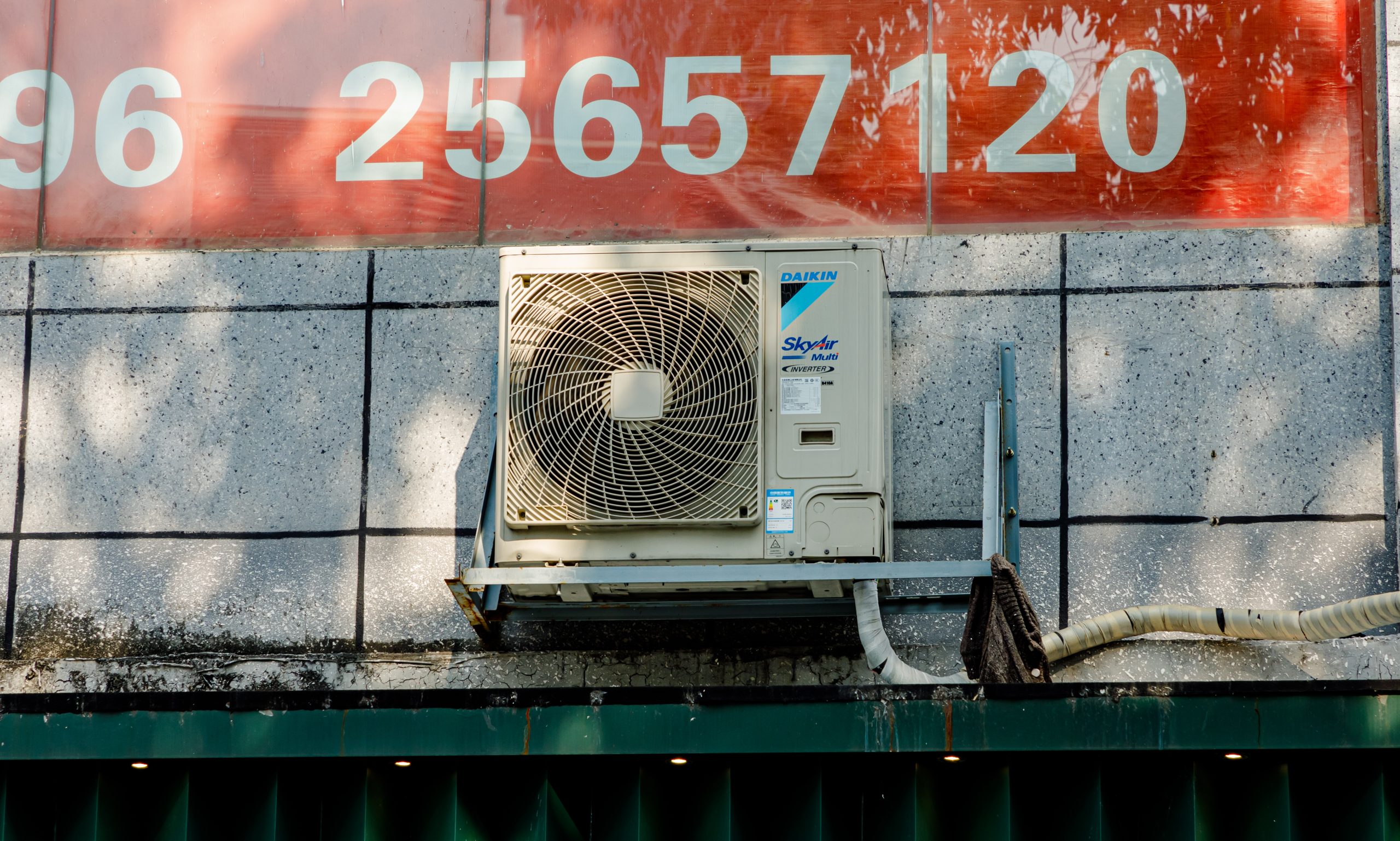
A real Daikin air-conditioner outdoor unit. The compressor sealed inside is a motor. Its start pulls roughly three times the unit’s running watts for a second or two. This wall-side condenser serves a household split system, larger than a portable power station would start without a soft starter. It stands as an example of the motor-driven heavy appliance that surge support exists for.
A surge is the signature of a motor. Any appliance that spins a motor to do its work pulls a hard gulp at startup. The list covers nearly every heavy load a power station is asked to run away from the wall.
A refrigerator or a freezer leads the list in a power station’s world. The compressor inside is a sealed motor that slams from rest to full speed in an instant. Its start pulls several times the modest running watts, for under a second, every time the thermostat calls for cooling. A chest freezer behaves the same way, its compressor pulling a hard gulp each time it wakes.
An air conditioner carries the same kind of compressor, sized larger. A window unit or a small split draws a steady few hundred watts during cooling. Its compressor start needs around three times that figure for the brief moment it spins up. A larger central unit climbs well beyond the reach of a portable station at its start. A portable station meets a window unit best with a soft starter on the compressor.
A water pump or a well pump hides a strong motor behind a small body. The motor works against water pressure from its first turn. Its start pulls a heavy surge. A deep well pump can ask for a few thousand watts in the instant it starts, far above its running draw.
An air compressor and a power tool round out the common heavy loads. A compressor motor starts against the pressure already in its tank and pulls a large surge on each cycle. A circular saw or a large drill spikes as its motor spins the blade or bit up to speed from a dead stop.
A few heavy loads start without a gulp. A space heater, a kettle and an incandescent lamp are simple resistive loads that draw their full watts from the first instant and hold steady there. These loads lean on the continuous rating of an inverter. The surge rating barely enters the picture for them.
The size of the startup gulp
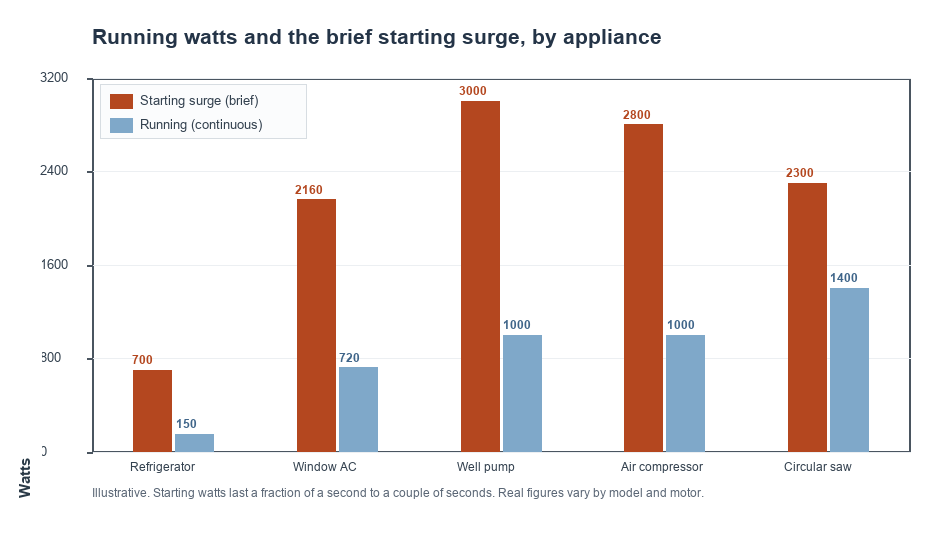
Running watts and the brief starting surge for five common heavy appliances. Each appliance shows two bars, the tall startup surge held for a fraction of a second to a couple of seconds and the lower steady running draw beside it. A motor start often reaches three times its running watts. The figures are illustrative and vary by model and motor.
The gulp is measured in starting watts, set beside the running watts on a sizing chart. A motor’s start often runs to three times its running watts. A stubborn motor under load can spike to five or seven times for the briefest moment. The exact multiple depends on the motor, the load on it and the way it is built.
The surge is short. A motor pulls its starting watts for a fraction of a second to a second or two, until it reaches speed. The draw falls back to the running level as soon as the rotor is turning freely. A motor at rest holds no momentum. The first turn from a dead stop is the hardest pull of the cycle. The whole event passes faster than an eye can follow.
The numbers reward a quick check before a start. A fridge at 150 running watts can demand 700 at its start. A well pump at 1000 running watts can demand 3000. The running figure on its own hides the size of the gulp the inverter has to cover. A reading taken from the start figure keeps the inverter inside its limits.
How an inverter holds the surge
Surge support rests on a brief overload the inverter is built to survive. For a fraction of a second the unit lets far more current than its steady rating leave the battery, push through the power stage and reach the appliance. The transistors carry the extra current. The battery delivers the extra power. The control circuit holds the output wave steady through the strain. A typical portable inverter can hold roughly twice its continuous rating for a few seconds. Some designs reach higher for a shorter window. A 2000-watt unit might offer 4000 watts of surge. A 3000-watt unit might offer 6000. The exact figure and the exact time both sit in the spec sheet, since the two trade against each other. A larger overload can be held only for a shorter moment. The limit comes from heat. The extra current warms the transistors fast. The inverter watches their temperature as the surge runs. The unit holds the overload as long as the parts stay within their safe range, then it either settles to the running load or shuts the output down to protect itself. A start that finishes inside the window goes unnoticed. The appliance spins up. The draw falls to the running level. The inverter returns to its easy steady state. The whole event lasts less than a second on a typical motor. The surge rating is the promise that the unit can pour out that brief flood of power on demand, again and again, every time a heavy appliance calls for its start. The number on the spec sheet, a figure like 4000 watts of surge on a 2000-watt unit, is that promise written down. A buyer reads it as the largest motor the station can wake from rest. A unit with a higher surge figure wakes a heavier motor. The figure earns a close look on any unit meant to start a compressor or a pump.
The surge lives in time. A unit promises its surge watts for a stated number of seconds, long enough to cover a normal start. A start that drags past that window pushes the inverter toward its protection. The time figure on the spec sheet matters as much as the watts.
The battery has to back the surge. A brief flood of watts pulls a brief flood of amps from the cells. A weak or cold battery can sag under that pull. A healthy pack with room to give holds its voltage through the start and lets the inverter do its work. A pack near empty has less to give and can fall short of a start it would have made at full charge.
The inverter design sets the surge it can promise. A unit built with strong transistors and a stout transformer carries a higher surge than a lean design of the same continuous rating. The surge figure is a real part of what separates two units that share a wattage on the box. Two boxes marked the same wattage can promise different starts.
The surge is there for the start and nothing more. Once the appliance runs, the inverter coasts at the running load. Its full headroom returns to reserve. The next start finds the surge ready again.
What the battery brings to a start
The surge draws on the battery as hard as on the inverter. A burst of output watts pulls a matching burst of current from the cells, many times the steady draw, for the same brief moment. The pack has to give up that current the instant the appliance calls for it. A cell rated for high discharge gives that current more readily than one tuned for a slow trickle.
A battery management system guards the cells with a current limit. The limit caps how many amps the pack will pour out at once. A surge that asks for more runs into that wall. A pack with a generous current limit backs a strong surge. A pack held to a tight limit can choke a start the inverter alone could have made.
Voltage sag is the battery’s answer to a hard pull. A heavy current drags the pack voltage down for the length of the surge. A deep sag leaves the inverter less to work with. A large healthy pack barely dips and holds the inverter steady through the start. The inverter reads that sagging voltage and works to hold its output steady against it.
Cold and age both weaken a start. A cold battery moves its charge slowly and sags harder under a surge. An old pack with worn cells gives up less current than it did when new. A healthy battery near full charge, kept warm, starts the heaviest loads a unit can handle.
A bigger battery tends to start bigger loads. A large pack carries more cells in parallel. More cells share the surge current with less strain on each. A small pack leans on fewer cells for the same burst and reaches its current limit sooner. The pack size sits quietly behind every surge figure a station can promise.
The half-second that decides it
The whole question of a heavy appliance comes down to one half-second. The motor demands its peak in the instant it breaks from rest. The inverter either meets that demand or trips. Everything after the start is the easy part, a steady run the unit handles without strain. The match between a power station and a heavy appliance is settled in that first brief gulp.
Running watts, starting watts, and the startup surge by appliance
Appliance
Running watts
Starting watts
Start as multiple of running
Surge duration
Refrigerator (compressor)
100–200 W
600–1200 W
~5–6×
under 1 s
Window air conditioner
700–900 W
~2160 W
~3×
1–2 s
Deep well pump (1/2 HP)
800–1000 W
2000–3000 W
~3×
1–2 s
Air compressor
1000–1500 W
2800–4000 W
~3×
1–2 s
Circular saw or large drill
1200–1500 W
2000–2300 W
~1.5×
under 1 s
Inverter (variable-speed) fridge
100–150 W
150–200 W
~1×
gentle ramp
Matching the surge to the heaviest start
Matching starts with the heaviest single start in the plan. A user lists the appliances, finds the one with the largest starting watts and checks it against the inverter’s surge rating. The surge rating has to clear that largest start with room to spare. A single number, the largest start in the plan, sets the bar the surge rating has to meet.
The running loads ride underneath the start. The inverter has to carry whatever is already running plus the surge of the appliance starting on top. A station running 500 watts of lights and electronics, then starting a 2000-watt-surge pump, has to find 2500 watts at that instant. The standard sizing rule adds the steady running total to the single largest starting surge. A surge rating that clears the heaviest start leaves the running loads easy to carry.
Reading a motor’s starting demand
A motor rarely prints its starting watts on the label. The running watts or the running amps sit there in plain view. The start has to be reckoned from them. A safe rule multiplies the running watts by three for a plain induction motor.
A nameplate code letter tells the rest of the story. A NEMA code letter, from A through V, sets the locked-rotor demand of the motor in kilovolt-amperes per horsepower. A higher letter marks a motor that pulls a harder start for its size. The letter rewards a glance on any motor whose start has to be planned.
Horsepower gives a rough path to watts. A motor’s horsepower times 746 gives its mechanical output in watts. The motor’s losses push the electrical draw higher still. A half-horsepower pump near 700 running watts can be read for a start near 2000 to 3000.
An amp figure converts straight to watts. The running amps times the voltage give the running watts. The start lands at a few times that figure. A pump drawing 8 amps at 120 volts runs near 960 watts and can spike past 2800 at its start. The same arithmetic turns any nameplate current into a starting figure a buyer can plan around.
A clamp meter settles the question for good. A clamp around the motor’s supply wire reads the running amps directly. A meter that holds a peak can catch the brief starting spike. The measured numbers beat any estimate from a label. A motor measured once needs no guessing for the next start.
When the surge falls short
A surge that falls short shows itself at the switch.
The motor may hum and stall. It draws hard and never reaches speed. A stalled motor keeps pulling its locked-rotor current and heats fast, since the rotor never breaks free to ease the draw. A motor left stalled for more than a moment risks heat damage to its windings.
The inverter may trip to protect itself. Its overload protection reads the surge as a fault and cuts the output. An error code follows on the display. The unit waits for a reset before it tries again. A repeated trip on the same load is a clear sign the start sits above the surge rating.
The voltage may sag through the attempt. A unit pushed past its surge can drop its output voltage under the strain. The dip can blink other devices or reset them. Repeated failed starts heat both the motor and the inverter. A string of attempts is a poor way to force a start.
Soft start and inverter-driven appliances
A soft start changes the shape of the demand. A soft starter feeds a motor a rising voltage over a second or two. The motor builds speed gently. Its peak draw stays far below a direct start.
The lower peak fits a smaller inverter. A motor that needs 3000 watts to start cold can come up on a fraction of that through a soft starter. The gentler ramp brings a heavy motor within reach of a smaller power station.
Air conditioners often take a soft starter as an add-on. A small device wired at the compressor cuts the start surge of a window or mini-split unit by half or more, which brings the unit inside the surge rating of a mid-size station. The same trick lets a modest power station run a unit it could never start on its own. The device costs a fraction of a larger power station and travels with the appliance.
Inverter-driven appliances solve the surge at the source. An inverter compressor in a modern fridge or air conditioner runs at variable speed. It starts by ramping up from a crawl. The hard locked-rotor gulp of a fixed-speed compressor never appears.
These appliances ask far less of a power station at start. An inverter fridge can ease on with almost no visible surge, a draw close to its running watts from the first second. The label on a modern unit often names it an inverter type, a strong hint of a gentle start. A buyer can read the word inverter on the appliance as a sign of an easy start.
A capacitor-start motor sits in the middle. The capacitor gives the motor a stronger first turn and trims the surge somewhat. The start still pulls a real gulp, smaller than a plain induction motor of the same size.
A soft starter pays off on a borderline match. A motor just past the surge rating of a station can come into reach with a soft starter, at a small cost and a little wiring at the appliance. A user who plans to run one heavy motor on a portable station often finds the soft starter the cheapest path to a reliable start.
Starting heavy appliances in the field
A job site puts surge support to a daily test. A circular saw spikes each time the trigger pulls. An air compressor kicks its motor in against tank pressure on its own schedule. A station sized for the saw’s steady run can stall at the saw’s start. A compressor cutting in during a cut stacks a second surge on the first.
An off-grid cabin leans on a fridge and a well pump. The fridge cycles through the day on its thermostat. The pump runs whenever a tap opens. Either one can start at any moment. The two starting together set the hardest demand of the day.
An RV carries its own heavy starter in the rooftop air conditioner. The compressor on an RV air conditioner pulls a stiff surge that has stopped many a power station at the switch. A soft starter fitted to the unit is the common cure. It drops the rooftop start within reach of a mid-size station.
Each scene rewards the same short list of habits. A reading of the heaviest start, a check of the surge rating against it, a soft starter on a borderline motor and a staggered start for two motors together carry the heavy loads through. The plan holds whether the loads sit in a workshop, a cabin, or a camp.
A food truck or a market stall stacks a fridge, a freezer and a blender on one station. The compressors cycle on their own clocks through a busy service. A blender adds a sharp start whenever an order calls for one. A station with surge headroom over the largest compressor, plus the running total of the rest, carries the stall through the rush.
Staggering starts and reading the spec
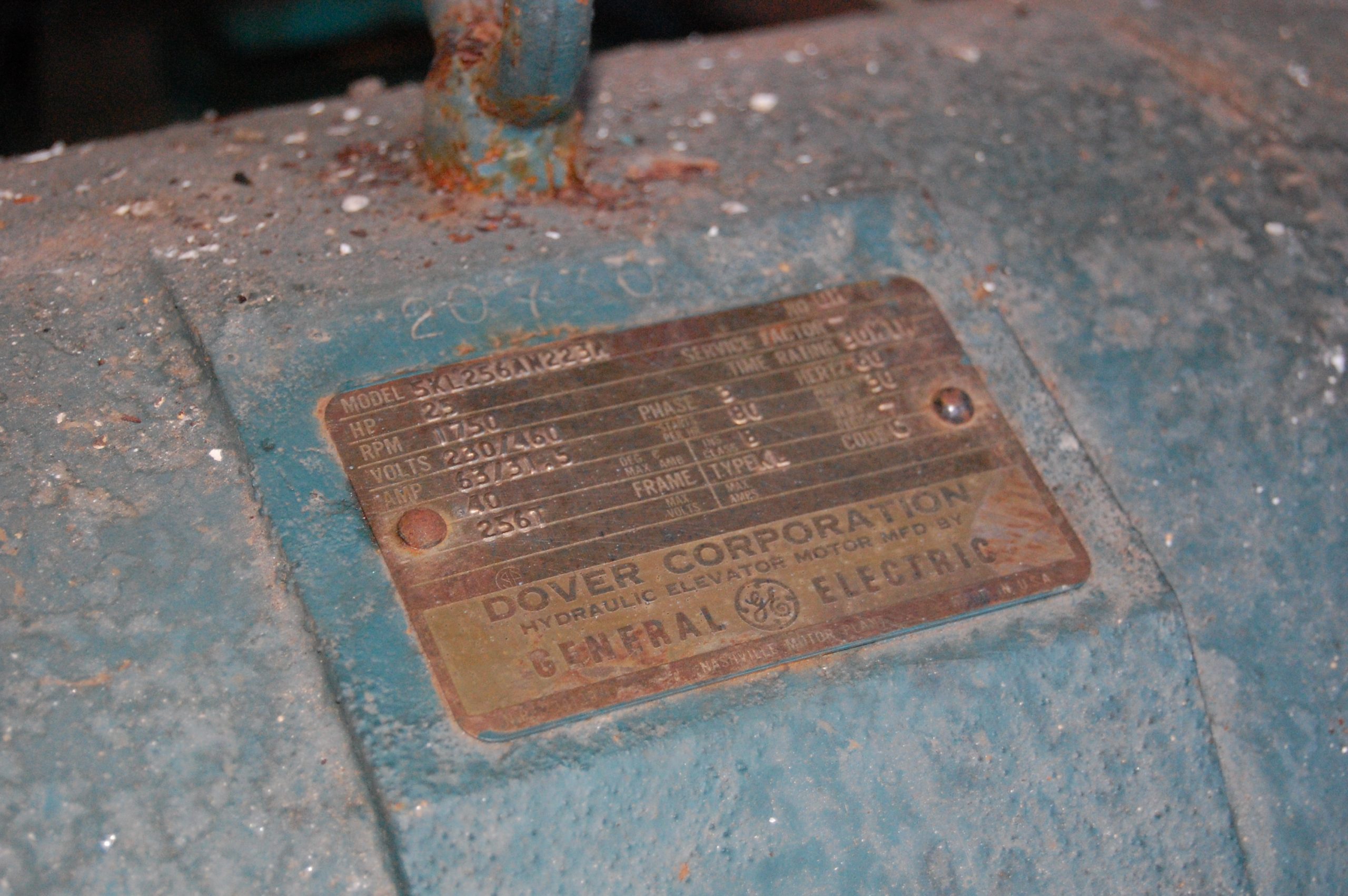
A nameplate on a real electric motor, the kind that records a motor’s ratings. The marked CODE letter G encodes the motor’s locked-rotor demand, the surge it pulls at a stalled start, set by a NEMA scale of kilovolt-amperes per horsepower. The AMP line, 63 and 31.5, gives the running current at each voltage. The starting current runs far higher. This is a 25-horsepower three-phase industrial elevator motor, far larger than any portable appliance, shown for where the starting spec lives on a nameplate.
Two motors starting together double the trouble. The surges stack when a fridge and a pump kick in at the same instant. The combined gulp can dwarf either one alone. Staggering the starts keeps the peaks apart, with a few seconds between each. Each surge passes before the next begins.
The spec sheet names the surge in watts and the seconds it lasts. A line reading 4000 watts of surge for several seconds tells what start the unit can cover. The time figure matters as much as the watts, since a slow start needs the headroom held longer. A surge figure with no time beside it tells only half the story of a start.
Starting a heavy appliance is a question of headroom, settled in a moment. A power station with surge watts above the heaviest start carries the appliance up and into a steady run. A reading of the surge rating, a soft starter where it helps and a staggered start for two motors together cover the hard half-second every heavy appliance asks for.
Frequently asked questions
How many watts does it take to start a refrigerator?
A household refrigerator runs on around 100 to 200 watts. Its compressor start pulls several times that, often 600 to 1200 watts, for under a second. A power station needs surge headroom above that figure to start the fridge cleanly. The running watts on the label understate what the start demands.
Why does a power station stall when a motor starts?
The start of a motor demands several times its running watts for a brief moment. A station sized only for the running load has no headroom for that gulp. The inverter meets its limit and trips, or the motor stalls short of the power it needs to spin up. Surge headroom above the start is what clears the moment.
What is a soft starter and does it help?
A soft starter ramps the voltage to a motor up over a second or two. The motor builds speed gently and pulls a much smaller peak at the start. A soft starter can bring a motor that sits just past a station’s surge rating into reach. It adds a small cost and a little wiring at the appliance.
Do inverter appliances need surge support?
An inverter fridge or air conditioner runs at variable speed and starts by ramping up from a crawl. It asks for little more than its running watts at the start. A power station starts an inverter appliance with almost no surge demand. The hard locked-rotor gulp belongs to older fixed-speed motors.