State of charge is the number a battery reports as the percent of energy it still holds. On a power station it shows as the figure on the screen, the fuel gauge a user checks before a long evening. No sensor reads that percent off directly. Working it out falls to the BMS, from the few things it can measure. Accuracy is won or lost inside that working-out.
Two signals a battery does hand over, the BMS reads straight off. Voltage at the terminals comes through on a wire. Current in and out shows up across a shunt. From those two raw numbers, plus a model of how the cell behaves, the system builds its estimate of the charge inside. Neither number is the answer on its own; each is only a clue the BMS has to read.
Lithium iron phosphate makes the job harder than other chemistries do. Across the middle of its range its voltage barely moves. The obvious clue, the terminal voltage, says almost nothing about how full a LiFePO4 cell is. Pulling an honest percent from such a pack takes more than a voltmeter. That is the whole subject here. Get it wrong, and a full pack can read half empty at the worst moment.
Why an accurate percent matters
Behind the accuracy chase lies a plain stake: a user plans around that number. Reach for a power station before an evening, and the percent on the screen is what says whether it will last the night. On that figure a user plans the whole night, rationing the battery hour by hour. The tighter the figure, the firmer the plan. Far from a socket, ten points of slack can be the difference between light and dark. A number a user can lean on is the whole point of carrying a gauge at all.
Down at the bottom of the range, the number guards the cells. To decide when a pack is nearly empty, a BMS leans on its own SOC estimate, easing the load off before the cells run too low. Let that estimate read high near empty, and a discharge can run clean past the safe floor, the kind of deep drain that wears lithium cells fast. A gauge honest at the bottom is what stands between a deep cycle and a damaged cell.
Runtime predictions ride on it as well. Hours remaining, the figure a station counts down, is the SOC times the capacity over the load of the moment. Feed that sum a soft SOC and the time estimate softens with it, promising an hour the pack cannot keep. Tighten the SOC and the hours-remaining figure tightens with it.
The flat curve that hides the charge
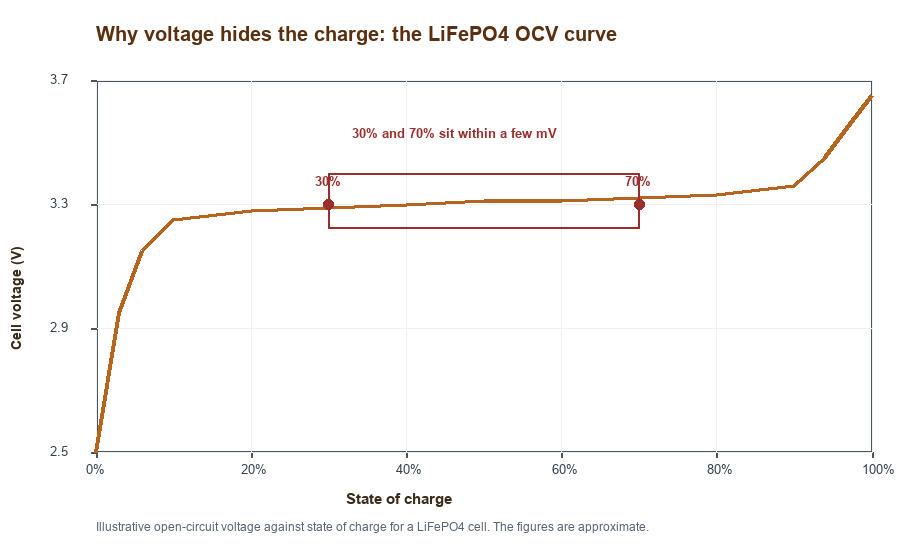
Open-circuit voltage against state of charge for a LiFePO4 cell, drawn to show the flat middle. The curve climbs steeply only in the last few percent at each end. From about 10 to 90 percent the voltage holds near 3.2 to 3.3 volts. A cell at 30 percent and one at 70 percent sit within a few millivolts of each other. The figures are illustrative.
Every cell carries a resting voltage that tracks its charge. Let one sit with no load, and its open-circuit voltage settles to a value that maps to a state of charge. For a chemistry with a sloping curve, reading that map is easy. A single voltage lands the SOC within a few percent.
LiFePO4 draws almost no slope at all. From roughly 10 percent charge up to 90, its resting voltage clings near 3.2 to 3.3 volts and hardly stirs. Put a cell at 30 percent beside one at 70, and the two look almost identical on voltage alone. Tens of percent of charge can hide behind one steady voltage reading.
That flat stretch covers the better part of the working range. Only right at the top and right at the bottom, in the last handful of percent, does the curve turn steep. Across the broad middle, where a pack spends nearly all its life, voltage and charge come uncoupled. Through that band a voltmeter barely answers for the charge at all.
Put numbers to it and the trap stands out. Spanning that whole middle band is a few tens of millivolts, less than the noise riding on many current and voltage readings. To read SOC from voltage there is to read a signal fainter than the static around it. No cheap voltmeter can pick a real signal out of that much fog.
Reading charge from voltage
Voltage is still the first method anyone reaches for. At rest, a cell’s open-circuit voltage maps to a charge. A lookup table turns the one figure into the other. Cost is barely a factor, since the BMS already reads every cell’s voltage for its safety checks. No new sensor, no new wire; the reading is already on hand.
The snag is that the cell has to be resting. Any current at all shoves the terminal voltage off its true value, low under a load and high on a charge. Caught mid-cycle, a reading reflects that current as much as the charge beneath it. Only after the pack settles can the BMS trust a voltage-to-SOC lookup. Minutes of rest, sometimes an hour, is what a clean reading asks for.
Even at rest, the flat curve caps what voltage can say. Near full and near empty, where the curve runs steep, a resting reading pins the SOC down tightly. Each steep end gives the voltage real bite. The middle of the range, where a user lingers longest, is where voltage helps least.
Voltage alone earns its keep as a spot-check at the steep ends. Where the curve runs steep, that spot-check is gold. Many designs keep it for the anchor points, where the curve turns steep and a reading carries weight. For the percent shown second by second, the work passes to another method. For a rough check at the ends, a rested voltage still does its job.
Counting the coulombs in and out
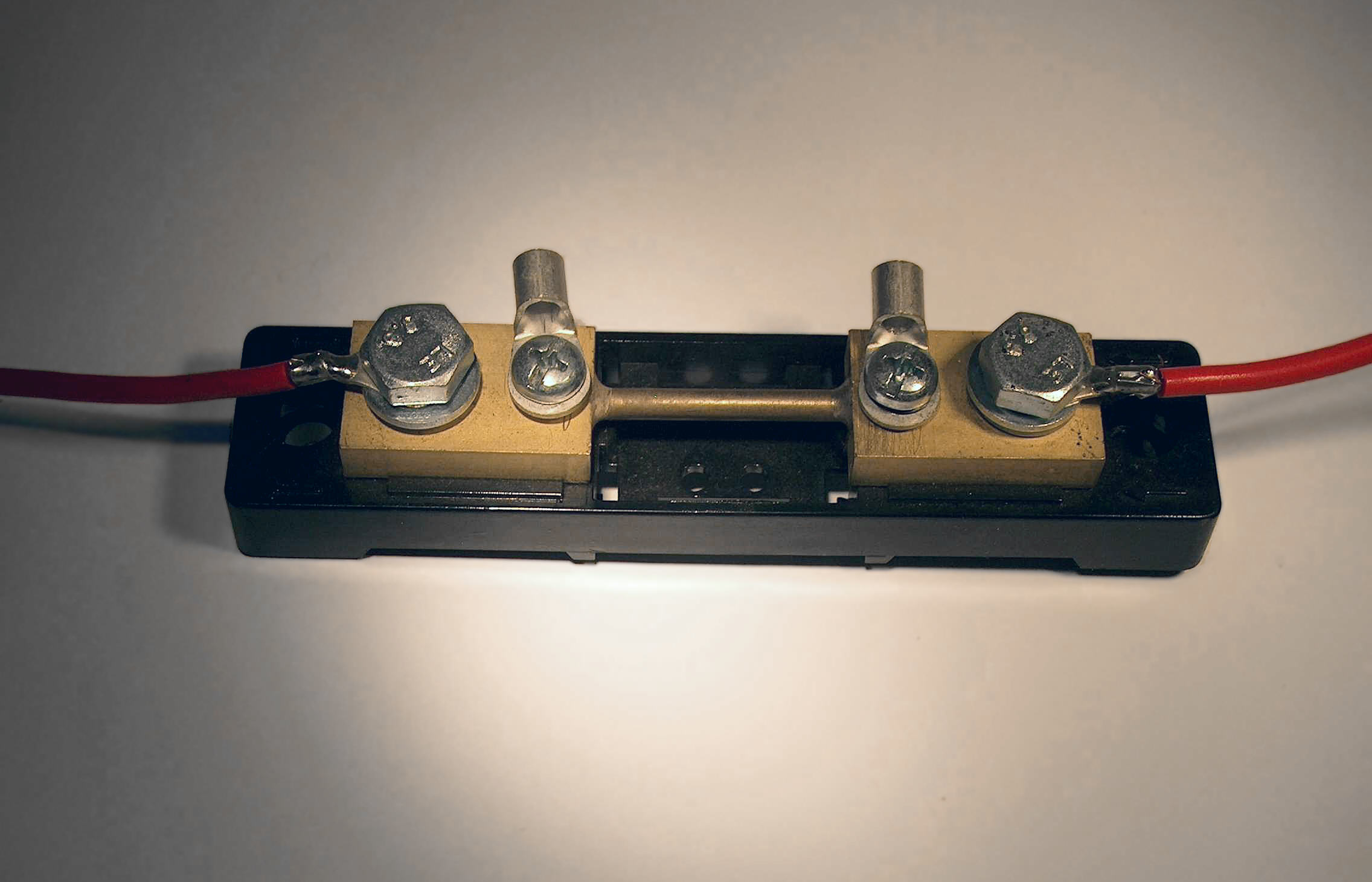
A real 50-amp current shunt, the sensor coulomb counting depends on. The heavy battery current flows through the brass bar between the two large bolt terminals. The two small screw terminals in the middle pick off the tiny millivolt drop across the bar, which the BMS reads as the current. A portable station uses a far smaller shunt on its BMS board, on the same principle.
The workhorse method counts charge as it moves. It keeps a running total of the charge, summing what flows in and what flows out. Measured against the pack’s full capacity, that total reads out as a live state of charge, good moment to moment. No rest, no settling; the count works straight through a busy load.
Current is the one signal this method needs. A shunt, a precise low-value resistor in the main battery lead, turns the current into a tiny voltage the BMS can read. The bigger the current, the bigger that millivolt signal. Sampling runs many times a second. Out of that stream of samples the running total grows, amp-second by amp-second.
Counting sidesteps the flat curve entirely. Never once does the method ask what the voltage means; it just tallies the charge that moves. Through the whole flat middle, where voltage is useless, the count tracks every amp in and out with the same precision it brings to the ends. Flat curve or steep, a coulomb is a coulomb to a counter.
In the short run, counting comes close to perfect. Give the BMS an accurate current reading and a true capacity figure, and the running total trails the real charge within a fraction of a percent across a single cycle. Take a pack from a known empty to a known full, count every amp on the way, and the charge ends with its SOC dead on. Strength comes from watching the one thing that does change the charge, the current itself. Nothing about the cell’s chemistry, its flat curve, or its quiet middle range troubles a count of amps. That is why nearly every modern BMS leans on coulomb counting for the live percent it shows. Down on the screen the figure slides smoothly under the load, each second’s draw shaving its share off the total. Whatever the load, light or heavy, the gauge mirrors the real drain in step. For the span of one charge and one discharge, a well-built counter hands a user a percent solid enough to plan a whole evening around. The trouble, the part the next section takes up, sets in once that single clean cycle stretches into many. A single clean cycle leaves the gauge as sharp as it ever gets. The cracks open only once that cycle has run a few hundred times over. Few packs ever see a clean run from full to empty anyway. Real use is a patchwork of partial charges and partial draws. That patchwork is the ground the counting has to hold. Hold it the counting does, for a while, with help from the resets the next sections describe. Each full charge hands the count a fresh truth to build on. Between those truths, the gauge rides on arithmetic alone. Each amp-second still counts, exactly as it did on the first clean cycle of the pack’s life.
Counting also needs a place to start. A running total is only a number stacked on wherever the count began. The BMS must know the SOC at the start to trust the SOC now. Begin from a wrong figure, and every later reading inherits the error. Pin the start at a full charge, where the SOC is known to be 100, and the count begins on solid ground.
Why the count drifts
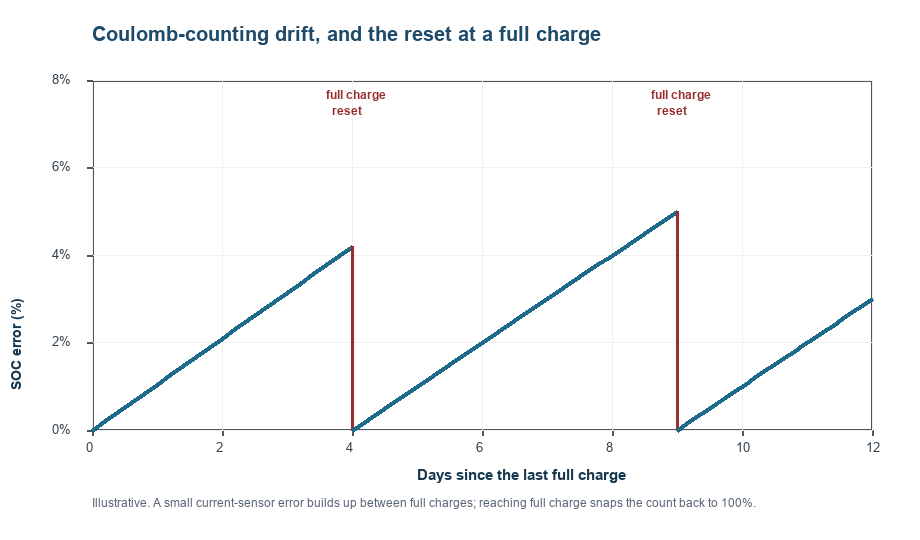
Coulomb-counting drift between full charges, drawn as the SOC error across days. A small current-sensor offset adds up steadily, the error climbing a few percent over several days. Reaching a full charge resets the count to 100 percent and drops the error back to zero. The figures are illustrative.
A perfect count would never drift. Trouble is, no current reading is ever perfect. The small errors in it pile up cycle after cycle. Every sample carries a tiny offset. Add millions of them, and those offsets stack into one slowly growing error. None of it shows in any single reading; the harm is in the sum.
Offset starts in the current sensor itself. Read the current off by even one percent, and that bias builds steadily across hundreds of cycles, a slow creep the count cannot feel as it happens. The longer a pack runs between resets, the further the figure wanders from the truth. Quiet days of partial use are exactly when the gap grows widest.
Capacity itself refuses to hold still. Cold, a cell holds less charge than warm. Worn, it holds less than new. So the full-capacity figure the count divides by is itself a moving target. A count weighed against last year’s capacity reports a percent that no longer fits the cell. A fresh capacity figure has to find its way into the math, or the count slowly lies.
Slowness is what makes drift slippery. Wandering a percent a day, a gauge looks right all week. By the next week its reading is several percent wrong. Long after the smooth number has quietly lost touch with the charge inside, a user goes on trusting it. By the time the error finally shows, it has been building unseen for a week.
Resetting at the anchors
At the two ends of the curve sits the cure for drift. Where the cell runs nearly full or nearly empty, voltage turns steep again. There it reads a true SOC, clear of the flat-curve fog. A BMS treats those moments as anchors: reach full charge and it snaps the count to 100 percent, reach the cutoff and it snaps the count to 0. Each reset wipes the gathered error clean and starts the count fresh. So an occasional full charge does a pack’s gauge a real service; left to count for weeks without one, even a good BMS slowly loses the thread.
Three ways a BMS estimates state of charge
Method
How it works
Strength
Weakness
Voltage / OCV lookup
reads the resting voltage, looks up the SOC
simple and cheap; sharp near full and empty
useless across the flat middle; needs the cell at rest
Coulomb counting
adds up the current in and out via a shunt
accurate moment to moment; ignores the flat curve
drifts from sensor error; needs a known start and capacity
Hybrid / Kalman filter
fuses count, voltage, and a cell model
best accuracy; self-correcting; tracks capacity
needs more processing and a good cell model
Blending the methods
The best gauges put both signals to work at once. Coulomb counting carries the percent moment to moment. A voltage check at the steep ends drags that count back to truth whenever the pack passes near full or empty. Neither signal alone does the whole job; paired, they cover each other’s blind spots. One holds the moment to moment; the other nails down the anchors.
Tying the two together takes a model of the cell. Inside the fanciest BMS chips runs a Kalman filter, a piece of math that holds a best guess of the SOC and nudges it each instant against the measured voltage and current. Where the curve is flat the filter leans on the count, where it is steep it leans on the voltage, trusting each signal exactly where it is strong. Steadier than either signal could manage alone, the blended estimate is what the screen ends up showing.
What changes under the count, the model tracks too. A good filter keeps a live figure for the cell’s true capacity, lower in a worn cell than a fresh one, lower in the cold than the warm, and holds the number it divides by close to the real one. Each cycle it watches, it learns the pack a little better. Years of cycles teach a good filter the exact pack it lives in.
All this math pays off hardest on a flat-curve chemistry. On a cell like LiFePO4, only the fusion of count, voltage, and model holds the percent honest through the broad middle. The better the blend, the closer the gauge stays to the real charge across a long, partial, real-world life.
Relearning the pack’s true capacity
A count is only as good as the capacity it measures against. To reach a percent, the BMS divides the charge it has counted by the pack’s full capacity. Hand it a wrong capacity and every reading after skews with it. Knowing the true, current capacity counts for as much as counting the amps. No matter how perfect the count, a wrong capacity figure lands a wrong percent.
Through a pack’s life, a good BMS relearns that capacity. Each time the pack runs from a full reset down to an empty one, the system has counted the whole usable charge. That count is a fresh measure of what the pack holds now. It folds that figure into its capacity estimate, tracking the slow fade of age. A pack a year old gets judged against a year-old capacity, fresh from its own last full cycle.
Here is where state of charge meets state of health. The capacity the BMS keeps relearning is the pack’s health written as a number, the same figure that tells how far the battery has aged. Track that capacity well, and the gauge reports an honest percent even on a pack years into its life. The figure that tracks SOC and the figure that tracks health are, at bottom, the same capacity.
What pulls the estimate off
Several real-world forces gnaw at any SOC figure. Each bends a different part of the calculation. A gauge runs only as honest as its weakest input. Knowing the culprits is half of reading one wisely.
Temperature moves the target two ways at once. Cold shrinks the capacity a cell can deliver. The same counted charge then reads as a different slice of a smaller whole. Cold drops the resting voltage as well, nudging any voltage-based check off its table. Bring the pack back to room temperature, and both effects ease off.
Age thins the capacity for good. A cell that held its full rating when new gives back less after a few years. Should the BMS never relearn that capacity, it divides by a number too big. The percent it shows runs optimistic, the gauge claiming more runtime than the cell can deliver. Relearning the capacity is the one cure. A BMS that skips it ages badly on paper.
Under the whole count sits the current sensor, setting a floor on accuracy. Its offset and its gain error feed straight into the running total. No amount of clever math fully undoes a sensor that reads the current wrong. Cheap shunts and rough amplifiers show up right here, in a count that drifts a little faster than it ought to. Spend on the shunt and the amplifier, and the whole gauge steadies.
Partial cycling starves a gauge of its resets. Live between 30 and 70 percent, charged and drained inside that band, rarely taken to either end, and a pack never touches the anchors that would set it straight. Its count can drift for weeks with nothing to pull it back, until a single run to full sets the record straight.
The gauge across a real day
Watch the gauge through a day off-grid, and the methods show their hands. Morning sun pours charge into the pack. Amp by amp the count climbs toward full. Hit full, and the BMS snaps the figure to 100 percent, wiping the night’s drift in one clean reset. From that one fixed point, the day’s counting starts over.
Through the afternoon the pack floats near full. With the panels carrying the light loads, the gauge barely stirs. Evening turns the flow around. Once the sun drops, the loads pull from the pack alone. Slowly the count walks down through the flat middle of the curve.
Across that long evening slide, voltage is barely any help. Down in the flat middle the cells hold near 3.3 volts whether the pack sits at 60 percent or 40. Only the count knows the difference. Whatever the gauge reads at midnight is the morning’s reset plus a night of careful counting. Come the next morning’s sun, the whole cycle resets and runs again.
What good accuracy looks like
Accuracy is a moving target for SOC.
On a LiFePO4 pack, a well-built BMS holds the percent within a few points of the truth, often two or three, with fresh resets to lean on. Without those resets, across a week of partial use, the figure can wander five or ten percent off. What sits on the screen is an estimate doing its honest best. It is no fuel gauge dipping a tank. Read as an estimate, it serves a user well for years.
The gauge a user sees
On the screen, all this machinery shows up as one tidy percent. The figure ticks down under a load and climbs on a charge, smooth enough to plan an evening around. Behind that calm number sit a count, a voltage check, a model, and a stack of corrections. All of it boils down to one figure a user can read at a glance.
A sudden jump in the percent is the gauge correcting itself. Reach a full charge after a long stretch of partial cycling, and the reading may leap by several points as the reset lands. The jump looks like a glitch. In truth it is the gauge shedding gathered drift in a single step. Smooth all week, then a leap at the top: that is the reset at work.
An occasional full charge keeps the whole thing honest. Run the pack up to full now and then, and the BMS gets a clean anchor to reset against. For days afterward the gauge repays it with a tighter figure. A pack never taken to full drifts the furthest of all. Ten minutes at full, once a week, buys a month of honest readings.
A SOC figure is a careful estimate. Reading it well means knowing its limits. Trust it closely near full and near empty, lean on it loosely through the flat middle, and run the pack to a full charge often enough to keep it honest. Read that way, the percent on the screen earns its place among the numbers a power station shows.
Frequently asked questions
Why is state of charge hard to measure on LiFePO4?
A LiFePO4 cell holds almost the same voltage from about 10 to 90 percent charge, near 3.2 to 3.3 volts. A cell at 30 percent and one at 70 percent read within a few millivolts of each other. Voltage alone cannot tell them apart. The BMS has to count the charge flowing in and out, and correct that count at the full and empty ends where the voltage turns useful again.
What is coulomb counting?
Coulomb counting is the method a BMS uses to track charge by adding up current. It measures the current flowing in and out through a shunt and keeps a running total against the pack’s capacity. The total reads out as a live percent, accurate moment to moment. Its one weakness is slow drift. A full charge resets the count and wipes that drift away.
Why does the battery percentage jump suddenly?
A jump is the gauge correcting drift. Coulomb counting wanders a little between full charges. When the pack reaches full, the BMS resets the figure to 100 percent in one step. That reset can move the reading by several points at once. The jump is the gauge catching up to the real charge. It is no fault.
How can I keep the gauge accurate?
Run the pack up to a full charge now and then. A full charge hands the BMS a clean anchor and clears the drift the count has built up. A pack kept always between a third and two-thirds, never taken to full, drifts the furthest. An occasional top to 100 percent keeps the percent on the screen close to the truth.