I started noticing silicone the day it clicked that the soft grip on my eight-dollar spatula and the skin on a companion doll a friend imports come out of one family of rubber. An eight-dollar supermarket tool and a four-figure doll, wig and all, poured from one bucket of silicon-and-oxygen goo and cured overnight into two objects that share nothing else about them. That odd gap bugged me enough to fall clean down a reading hole for the best part of a week, product datasheets and moulder forums and one patient friend, and this is roughly what I dragged back out of it.
Fair warning before any of it: I’m no chemist. Whatever I say here about the backbone or the way it cures, a materials engineer would read this and wince. My whole claim is hands-on time. I’ve handled the stuff plenty. Mould rubber, a tube of bathroom sealant, a menstrual cup, phone cases, one casting job I ruined and will get to. That’s enough to have opinions on where silicone earns its keep and where it gets sold harder than it deserves. Uses is the honest angle for someone in my position. I can tell you what the stuff does, which drawer of my house it hides in, and which job it quietly does better than the thing it replaced. The chemistry underneath all that, I’ll hand to a link and step aside.
What the stuff even is
The one fact I did nail down is that silicone’s backbone is silicon and oxygen, the bond that also holds sand and glass together. That backbone is the reason it laughs off heat and strong sunlight for a decade at a stretch, the sort of exposure that finishes off cheaper rubber inside a couple of summers. How the platinum catalyst knits the liquid into a solid, I can’t explain and won’t pretend I can. The part that earns silicone its spot is easy to say out loud: one backbone that pours as soft as a gel or sets as firm as a bottle cap, with the whole product world living somewhere on that line.
It helps to get the name straight too, since half the internet muddles it. The grey chip in a phone is silicon, an element. The rubbery thing round a bathtub is silicone, a made material built on silicon. You bake in one and etch circuits into the other, and mixing the words up marks you out fast in any workshop.
Soft as a gummy bear, hard as a lid
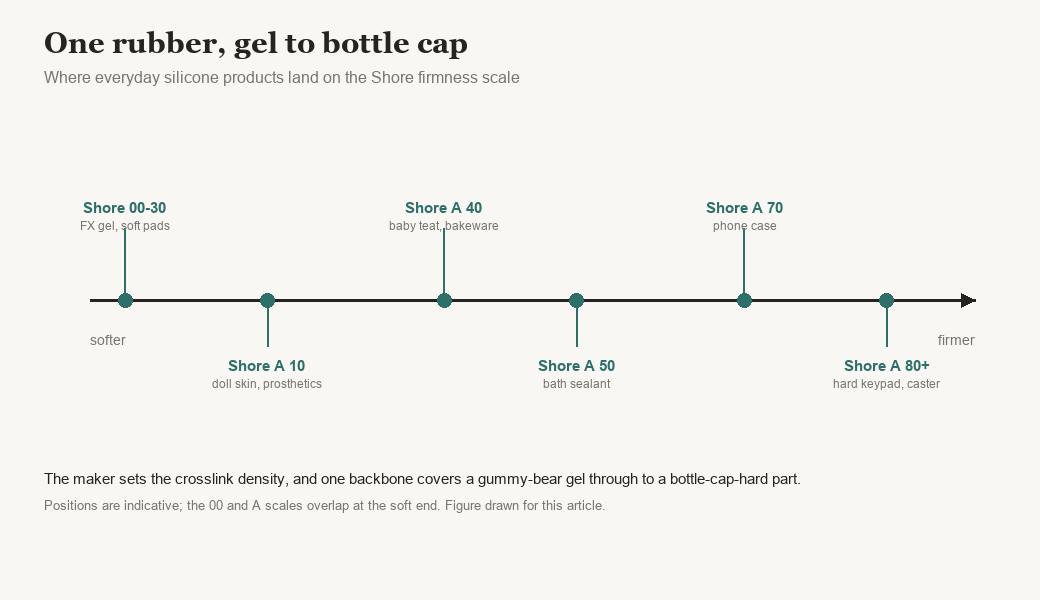
The same rubber, placed along the Shore firmness scale by product. FX gel and doll skin sit at the soft end, a baby teat and bath sealant in the middle, a phone case and a hard keypad up top. Positions are indicative; the 00 and A scales overlap where they meet.
Silicone gets sold by how firm it cures, on the Shore scale, and that one number tells the story better than any lecture on chemistry. Down at the soft end, Ecoflex 00-30 sets near a gummy bear, loose enough to sink a thumb into and watch it spring back. It exists so a film crew can fake a slit throat or a pregnant belly on a Tuesday, a job it does better than the wobbling gelatine the trade used before it, which sweated and sagged under studio lights inside an hour.
Push up the scale and that one rubber becomes other objects. A baby-bottle teat lands around Shore A 40, soft enough to give against a gum. A phone case sits up near A 70, firm under a knuckle with just a trace of spring left in it. The black gasket crushed inside a pressure-cooker lid is harder again, and it has to be, since it fights live steam every time the pot runs. Top to bottom it’s one chemistry. The maker dials the crosslink density to the job, stamps a Shore number on the tub, and one bucket of raw rubber walks out of the factory as a teat or a lid.
Where you meet silicone, by grade, hardness, and cure system (typical figures)
Where you meet it
Shore hardness
Cure system
Working temp
Inhibited by latex/sulfur?
FX gel (Ecoflex 00-30)
Shore 00-30
platinum (addition)
-53 to 232 C
yes
Doll skin (Dragon Skin 10)
Shore A 10
platinum (addition)
-53 to 232 C
yes
Baby teat, bakeware
Shore A 40
platinum (addition)
-60 to 230 C
yes
Bathroom sealant
Shore A 25–30
moisture (condensation)
-50 to 200 C
no
Phone case, keypad
Shore A 60–70
platinum or peroxide
-60 to 230 C
platinum only
That reach is the real trick, and it’s easy to walk past. No other cheap, skin-safe, pour-into-a-mould material spans gel to bottle cap on a single backbone. The spread is exactly why silicone keeps surfacing in corners of life that have nothing to do with one another, a spatula in one hand and a surgical drain in the other, and it’s the thing that sent me reading in the first place.
The kitchen, where we first meet it
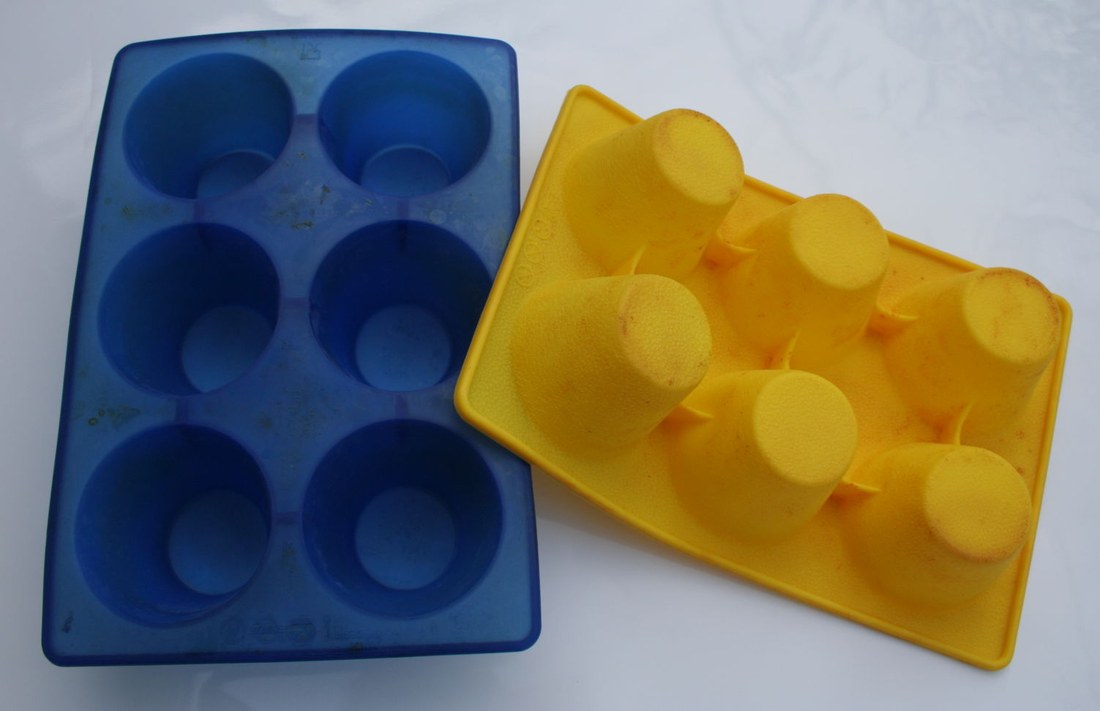
Two silicone muffin forms, the yellow one flipped inside out to show the point I keep making: the stuff is floppy. A tray of batter needs a rigid baking sheet under it or the whole thing folds on the walk to the oven. Photo: Gmhofmann, CC BY-SA 3.0.
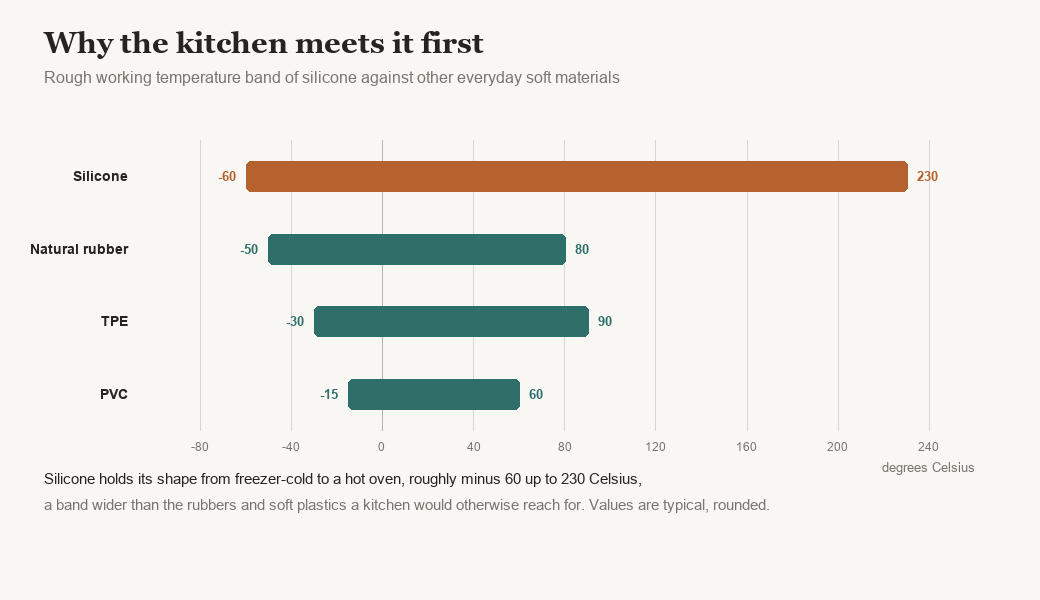
Bakeware and utensils are how silicone first got through the front door of ordinary houses, and heat is the reason. A silicone spatula keeps its edge and shape against a hot pan because the rubber sits happy from freezer-cold up to somewhere around 230 Celsius. That band runs wider than almost anything else a kitchen lets near food.
The other half of the appeal is that things let go of it. Cake and muffin batter peel off a cured silicone surface clean, since next to nothing forms a bond with it. That same slippery face makes it a joy to bake in. It also makes it near-impossible to glue, a headache I’ll come back to later. I’ve kept one silicone muffin tray going for six years and it still looks like the morning I bought it, having quietly outlived a metal one I bought the same week, which rusted through at the seams and went in the bin with a batch of scones welded to it.
There’s a catch no one mentions at the till. The stuff is floppy. A tray loaded with batter has no backbone of its own, so it wants a baking sheet underneath, and without one the whole slab folds on the walk to the oven and you wear the mix. I found that out the sticky way, twice, before it sank in.
Ice trays, stretch lids that suck onto a bowl, oven mitts, the pinch pads on tongs, those roll-up draining mats by the sink. All one rubber, all riding on two shared habits: it takes the heat, and it lets go of whatever you put in it.
Seals, sealant, and the day my mould refused to set
Sealing is the quiet trade silicone does better than anything near its price. The gasket ringing an oven door, the O-ring in a water bottle that survives a rucksack, the fat bead run around the base of a bath: all silicone, because it stays springy for a decade after a plain rubber seal has gone stiff and started weeping water past its edge. Engine bays lean on it hard too, in the coolant hoses and the spark-plug boots, where it lives an inch off a hot block and shrugs. The rubber hoses on my first car had perished and split by ten years old. Fit silicone ones and they tend to see the whole car scrapped around them, pulled off at the yard to serve a second life.
Sealing is also where the material showed me its one real temper, and it cost me a weekend I wanted back. I was pouring a silicone mould over a small clay figure, platinum-cure rubber, the pricey kind. Next morning the whole face that had lain against the clay was a sticky, wet ruin, the rest of the block around it cured firm as a superball. My first thought went straight to the mix ratio, since that’s the beginner mistake everyone warns about. The ratio turned out fine. The problem had never lived in the mixing cup at all.
The clay had sulfur in it. Platinum silicone flatly refuses to cure where it touches sulfur, and that is only the top of a longer list. Smooth-On, who make the rubber, spell it out in their support notes: a condensation-cure silicone will not cure when applied against an addition-cure one, and on their platinum Mould Star series a sealer coat won’t rescue you either. Latex gloves trigger it. Fresh epoxy, certain woods, sulfur modelling clay, the greasy trace left behind by a tin-cure mould, any of them can leave your rubber gummy right at the contact face for good.
The part that stings is that I did the exact same thing again months later, this time by wearing the wrong gloves, so the lesson plainly bounced off me the first round. That’s the true character of the material, once you’ve been burned by it. It plays the diva for the few hours it spends curing against other things, then settles into something rock-solid and forgettable for the years after. All the fragility lives up front, in the cure. It has nothing to do with careful weighing or slow stirring, the places a beginner assumes the danger sits.
So here’s the lopsided piece of advice I paid real money to learn, the kind with no balancing hand on the other side. If a casting comes out tacky in a single patch and firm everywhere else, leave the mix ratio alone. Go look at what that patch was resting against.
Against skin and inside bodies
Rough working temperature bands. Silicone runs from about minus 60 up to 230 Celsius, a good deal wider than the rubbers and soft plastics a kitchen would otherwise reach for, which is the trait that first got it onto the utensil rack. Values are typical and rounded.
The reason silicone ends up on skin and tucked inside people is that the platinum-cured, medical-grade version is close to the least reactive thing you can put against living tissue. It doesn’t leach anything a doctor loses sleep over. It won’t grow a bacterial film the way a scratched softer plastic will, since there is nothing porous for a colony to hide in. It takes boiling and steam autoclaving without clouding, cracking, or giving off a smell, which is the one property a hospital cares about above the rest.
So it shows up wherever the body is in the loop. Baby teats and pacifiers, menstrual cups, the cushions on a CPAP mask, the flat sheets people tape over a scar to press it down, ear plugs moulded to a swimmer’s own canal, the soft liner cushioning a prosthetic socket against a stump, the drain tubing that runs out of a fresh surgical wound. My own menstrual-cup run is the small warning in all this. A cheap one stained brown and turned tacky inside a year. The medical-grade cup I replaced it with is on year four and still reads clear as glass, boiled after every cycle and none the worse for it.
You get what you pay for with body-grade silicone, and the single thing to check on the packet is the grade itself. Food or medical, platinum-cured, stated in plain words. A tube that names nothing past the bare word “silicone” is telling you something real by staying quiet about the grade.
Companion dolls, where it gets pushed hardest
Companion dolls are the hardest skin job anyone hands silicone, and it pays to see why the good ones reach for it. Platinum-cure silicone holds detail that cheaper materials smear into mush: skin pores, the faint blue of a vein laid under a translucent top coat, the wet-looking edge of a lip. It also stays put where the budget materials drift, keeping clear of the tackiness and slow yellowing that creep into cheaper TPE blends after a year or two of handling.
Shore hardness carries the rest of the load, the same dial off the kitchen shelf. A maker runs a firmer silicone deep in the body for structure, then lays a much softer skin layer over the top, so the surface gives under a hand roughly the way real tissue gives. The material takes body warmth off a hand and holds it a moment, one of those small realism points that photographs badly and matters in person. It wipes down without fuss and puts up with a proper wash, and a removable insert can go in boiling water to sanitise, which is a plain hygiene fact ahead of any brochure line.
The bill lands on cost and weight, and neither is small. A full-silicone companion doll climbs well into the thousands, and it carries heavy enough that a first-time buyer badly underestimates lifting one off a bed. TPE is the cheaper, lighter material, and stacks of people pick it for exactly those two reasons. TPE does sweat a faint oily film in warm weather, a wipe-down chore that rides along with the lower price. For someone set on realism who wants the thing looking right in five years’ time, silicone is the material that still looks right five years in. The artisan houses that cast in it treat a body more like a bronze pour than a product off a line, one pour at a time, seams cleaned by hand, a face sometimes repainted three times before it ships.
One flag on the terminology, since the material crowd and the doll crowd use different words for the same parts. On a proper silicone doll the washable insert is a moulded, boilable piece, and treating it as the single item that needs real cleaning discipline keeps the whole thing sanitary without much fuss. The body itself wants little more than a wipe, a dusting of cornstarch to keep the skin from tacking, and a flat rest so a limb doesn’t set into a bend. Storage is the quiet half people skip, and a limb left folded for weeks takes a permanent shape.
Electronics and the long tail
Past the big uses runs a long tail of quiet ones, all of them leaning on one short list of habits. Circuit boards in outdoor kit get “potted”, drowned and sealed in a block of silicone so damp and vibration can never work a solder joint loose, and the marine sensor in my garage is full of it, which is the reason a cheap depth gauge tends to outlive the boat around it. The squishy keypad under a TV remote is one moulded silicone sheet with a tiny carbon puck below each button, and it is why an old remote still clicks after a decade of greasy thumbs. Aquariums get sealed with their own grade of it, safe for fish once it has cured, so long as you buy the tube labelled for tanks, since the general bathroom one carries a mould-killer that would foul the water. Then it just keeps going. Swim caps and goggle seals, watch straps that hold up in the sun, cake moulds and ice-sphere makers, the fat insulation on wiring that runs hot inside a kiln, thermal gap pads squashed between a chip and its heatsink to move warmth across and keep the two electrically apart, hearing-aid domes moulded to the shape of an ear, the grippy feet under a laptop stand, the soft second skin on a decent pair of tongs, and the plain spatula grip that set this whole ramble going. None of them is a headline. Every one of them is silicone for the same handful of reasons: it moulds cheap, it sits safe against food and skin, it ignores water and a heatwave with equal indifference. Once it has cured it asks nothing of anyone for years on end. I keep turning up more of them. A week after I reckoned I had catalogued the lot, I lifted the anti-slip mat from under the dish rack and caught that faint rubber smell off it, one more job the stuff had quietly taken over while I was looking the other way.
Glue, caulk, and the jobs it fights you on
Silicone is not all obedience, and the non-stick surface that empties a cake tin turns spiteful the moment you try to bond it. Almost no ordinary glue takes hold of cured silicone. To stick silicone to silicone you reach for a dedicated product like Sil-Poxy, and to stick it to anything else you often prime the other surface first and pray. I wasted an afternoon trying to superglue a torn silicone watch strap before I learned any of that, and the strap is still torn, sitting in a drawer, quietly mocking the effort.
Caulk is the everyday face of this. The tube of clear sealant sold for a bathroom is a moisture-cure silicone that skins over in minutes and cures from the outside in over a day or two. It bonds glass, tile, and glazed ceramic well, since those hard glossy surfaces give the cure something to key into. Raw plastic and a dusty edge give it nothing to hold, which is half the reason a home sealing job peels within a season. Older houses hide a nasty version of the cure-inhibition story here: run fresh silicone caulk over a bead of the old stuff that had latex or the wrong chemistry in it, and the new bead sulks and never fully sets. Strip the old line back to clean tile and the trouble goes away.
The reading on all of it is one-sided and easy to hold. Trust silicone to seal and to release, then reach for a purpose-made product like Sil-Poxy the moment you need it to bond for real. Fighting that by hand is a lost afternoon, and I have the drawer of failures to prove the point.
The silicone you never see
A fair slice of the silicone in a normal day never shows itself as rubber at all. The slip in a hair conditioner that makes a comb glide is usually dimethicone, a liquid silicone that coats each strand in a film thin as a breath. The same family smooths a face primer on before makeup, knocks the foam back down in a deep fryer or a brewing tank as an anti-foaming agent, and throws the shine onto a dashboard in a can of car-care spray.
Once you clock it, the stuff turns up in the oddest cupboards. The long-lasting personal lubricants are the silicone ones, since a silicone film holds its slip under friction for a long, long time before it needs a top-up. A drop of silicone oil frees a squealing hinge or a stiff zip and dries to a clean film that leaves no stain on the fabric around it. None of these look anything like the springy rubber I started with, and every one of them rides on the same run of silicon and oxygen doing what it quietly does.
What it comes down to
If a single thread runs through the whole pile, it’s that silicone is boring in the finest possible sense. It won’t rust, rot, melt, freeze brittle, or feed bacteria. It takes a shape and holds it through a decade of rough handling. Every scrap of its fussiness gets crammed into the curing hours, and I’ve now binned two batches proving it, both times by letting the wrong thing lie against the rubber before it set.
Once it’s cured, it drops out of your attention and just gets on with the job, from an eight-dollar spatula to a companion doll that costs like a used hatchback, and you forget the two are even cousins. For a material almost nobody stops to think about, that’s a quietly enormous innings. About the highest thing I know how to say for a lump of cured rubber, and I’ve said it now, so I’ll leave it there.
Questions I get asked
Is silicone the same thing as silicon?
No, and the slip is everywhere. Silicon is the grey element inside computer chips and beach sand. Silicone is the rubbery, mouldable polymer built on a silicon-and-oxygen backbone, closer to a soft plastic than to any metal or mineral. You bake a cake in one. You etch a processor into the other. Say it wrong to someone who works with either and watch their face do a small thing.
Is silicone genuinely food safe?
Good-grade cured silicone is, which is the whole reason bakeware and baby teats get made from it. It takes oven heat and passes nothing nasty into the food sitting on it. The grade is the catch. Platinum-cured food or medical silicone is the safe pick. A cheap tin-cured import is the kind that can weep a trace of residue once it gets hot, so the certification on the box carries the answer, never the bare word “silicone”.
Why won’t my silicone mould set in one spot?
Cure inhibition, nine times in ten. Platinum silicone digs its heels in where it has touched latex, sulfur-based clay, fresh epoxy, or a tin-cure rubber. Smooth-On lists the usual suspects on their site. Keep those away from the uncured pour, seal a doubtful model with acrylic lacquer first, and the rubber sets the way the tin promises.
Silicone or TPE for a companion doll?
Silicone costs more and weighs more. It also keeps its skin feel and colour far longer down the years. TPE is the budget material, noticeably lighter to move about, and it suits plenty of buyers fine. For a doll meant to still look and feel right many years from now, silicone is the safer place to put the money.