Ask what a hundred watt panel produces in a day and most answers multiply two numbers. Rated watts times hours of daylight. Ten hours of summer sun suggests a kilowatt-hour. No hundred watt panel has ever delivered that. Output through a day traces a curve. Power climbs from zero at sunrise, peaks somewhere near solar noon, falls back to zero at sunset. Nothing about that curve is rectangular. The area beneath it is the energy reaching the battery. Approximate the curve as a half sine and the arithmetic becomes exact enough to trust. The average of a half sine equals two divided by pi, which is 0.637. A panel peaking at 85 watts across a twelve hour day delivers about 85 times 12 times 0.637, which is 650 watt-hours. A rectangle would have promised 1,020. That single factor accounts for a third of the gap between expectation and meter.
Day length sets the width of that curve and latitude sets day length. A site at 50 degrees north sees about 16 hours of daylight in late June and under 8 in late December. That site’s noon sun stands 63 degrees above the horizon in June and 16 degrees in December. Cosine loss and air mass both change with it. Latitude squeezes the curve from two directions at once. The December penalty runs far worse than the change in day length alone suggests.
That half sine answers a more useful question: how much of the day is worth protecting from shade. Integrate the curve across its middle third and the answer is exactly half the day’s energy. Widen to the middle two thirds and it reaches 87 percent. Four hours either side of noon carry almost everything. The first and last hours of daylight carry almost nothing.
Peak sun hours is the industry’s way of collapsing that curve into one number. A location described as having 4.5 peak sun hours received the equivalent of 4.5 hours at full test irradiance, spread across whatever the actual day looked like. The convention exists because the curve is awkward. Area under it is the quantity that matters.
Air mass, and why morning light is thinner
Sunlight at eight in the morning is weaker than sunlight at noon for two separate reasons. Panel angle is only one of them. The other is atmosphere. Light arriving at a low angle travels a longer path through air before reaching the ground. Air absorbs and scatters along the way. The industry measures that path with air mass, defined as the ratio of the actual path length to the vertical one. Air mass equals one divided by the cosine of the solar zenith angle. Put numbers through that. Sun directly overhead gives a zenith angle of zero and an air mass of exactly 1. At 48.2 degrees from vertical the cosine is 0.667 and the air mass reaches 1.5, which is the condition the whole industry rates panels against. At 60 degrees the cosine is 0.5 and air mass doubles to 2. At 75 degrees it reaches 3.9. Every one of those multiplications is more atmosphere for the light to cross.
Spectrum shifts along with intensity. Atmosphere scatters short wavelengths hardest, which is why a low sun looks red. Silicon responds across a broad band. The shift costs less than the intensity loss. A panel under a red sunset is short of photons more than short of the right kind. Cloud produces an asymmetry worth deriving, because it explains why a panel keeps working under a grey sky. Current from a cell tracks the photon supply almost exactly. A tenfold drop in light gives a tenfold drop in current. Voltage sits inside a logarithm. Open-circuit voltage runs as the thermal voltage multiplied by the natural log of light-generated current divided by saturation current. Thermal voltage is about 26 millivolts at room temperature.
Push a factor of ten through that logarithm. The natural log of ten is 2.303. A tenfold fall in light costs roughly 26 times 2.303, which is 60 millivolts per cell. Multiply by 36 cells and a whole panel loses about 2.2 volts out of 22.6, under a tenth of its voltage, while giving up 90 percent of its current. That asymmetry is the reason overcast light still charges anything. A panel at a tenth of full sun still presents voltage well above what a battery needs. The controller can still transfer the small current on offer. Voltage collapse waits for genuine darkness. The useful part of a cloudy day runs longer than it feels.
How hot the cells actually get
Panel temperature runs above air temperature by more than most owners assume. A datasheet publishes the number needed to predict it, usually called nominal operating cell temperature and measured at 800 watts per square metre, 20 degrees ambient, one metre per second of wind, with the module on an open rack. The standard estimate follows in one line. Cell temperature equals ambient temperature plus the quantity nominal operating cell temperature minus 20, divided by 800, multiplied by the actual irradiance in watts per square metre. Work an ordinary summer afternoon. A module rated at 45 degrees nominal, sitting in 30 degree air under 900 watts per square metre, reaches 30 plus 25 divided by 800 times 900, which comes to 58 degrees. That figure is 33 above the 25 degrees the rating assumed. At a power coefficient of minus 0.35 percent per degree the panel has already given up 11.6 percent. Nothing else in the chain has taken its share yet.
Two variables in that equation are within an owner’s control. Irradiance is not one of them. Ambient air is not one of them either. Mounting is. A panel lying flat on a hot roof or a car bonnet runs several degrees above one standing in open air on a frame. Sandia’s refinements to the model add explicit terms for wind speed and for mounting standoff. That standoff correction reaches 18 degrees for a module fixed close against a surface.
Angle, and the reflection nobody counts
Irradiance on a panel falls with the cosine of the angle between the sun and the panel’s perpendicular. Thirty degrees off aim costs about 13 percent. Sixty degrees off costs half. That much is arithmetic every solar guide repeats. Reflection adds a second loss on top. That one gets forgotten. Glass reflects around 5 percent of light arriving straight on. That share is already inside the panel’s rating. Reflectance climbs slowly with angle, then sharply past about 60 degrees of incidence. The air-glass interface starts turning light away in earnest. Modelling packages carry a correction for exactly this, called the incidence angle modifier. Published values sit between 0.96 and 0.98 across the useful range. Standard parametrisations overestimate the modifier above 60 degrees. Real panels do worse at extreme angles than the simple models predict.
The practical consequence is that early and late output falls faster than the cosine alone suggests. A panel aimed at midday collects most of its energy in the four hours around noon. The ends of the day contribute comparatively little, which is a second reason the half sine beats a rectangle. Diffuse light changes those rules on a grey day. The standard spectrum carries a letter for it: AM1.5G, where the G stands for global and covers direct beam plus everything scattered by the sky. Under heavy cloud almost all of the remaining light is diffuse. It arrives from the whole hemisphere in place of one direction. Aim stops mattering much once that happens. A panel tilted 30 degrees away from where the sun would be loses little under overcast, since there is no beam to miss. Owners notice the effect as a panel that seems insensitive to position in poor weather and fussy about it in good weather. Both observations are correct. What separates them is the ratio of beam to diffuse in the light of the moment.
What your location supplies
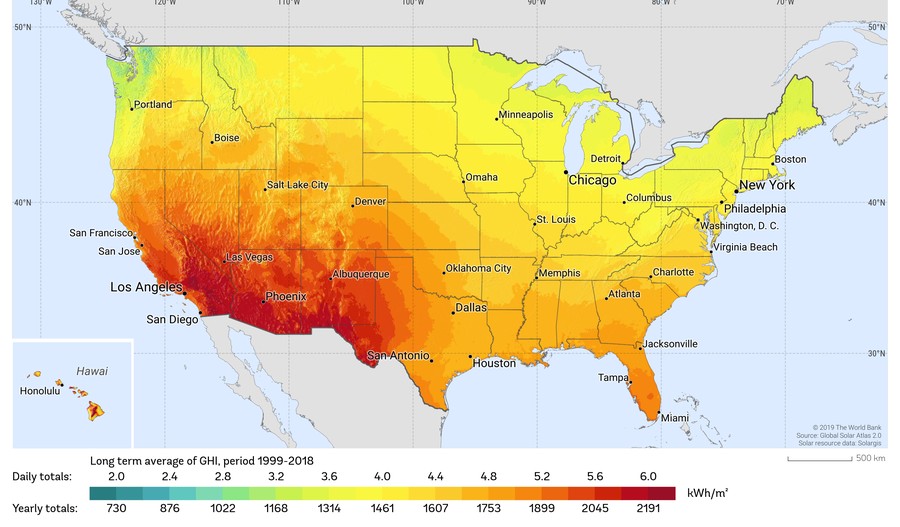
Long-term average daily irradiation across the United States. The daily totals scale along the bottom is the peak sun hours figure under another name, running from under 3 in the Pacific north-west to over 6 in the desert south-west. Map by Solargis for the World Bank Group and ESMAP, CC BY 4.0.
Everything above describes physics that applies anywhere. How much light arrives is the part that differs by location, and that quantity is mapped in detail worldwide. Read the scale along the bottom. Daily totals in the United States run from about 2.8 kilowatt-hours per square metre in the Pacific north-west to over 6 in the desert south-west, with most of the country between 4 and 5. Those figures are long-term averages across two decades of measurement. Multiply the local figure by the panel rating for a theoretical daily energy. A hundred watt panel at 4.5 kilowatt-hours per square metre gives 450 watt-hours. At 6 it gives 600. At 2.8 it gives 280. The whole continental spread is a factor of about two. That gap matters more to a portable owner than any difference between two panels of one rating.
Season splits each of those numbers further. A site averaging 4.5 across the year commonly sees 6 in June and 2 in December. December decides whether a setup works through winter. Annual averages describe a year that never actually happens.
Dirt, dew and the slow losses
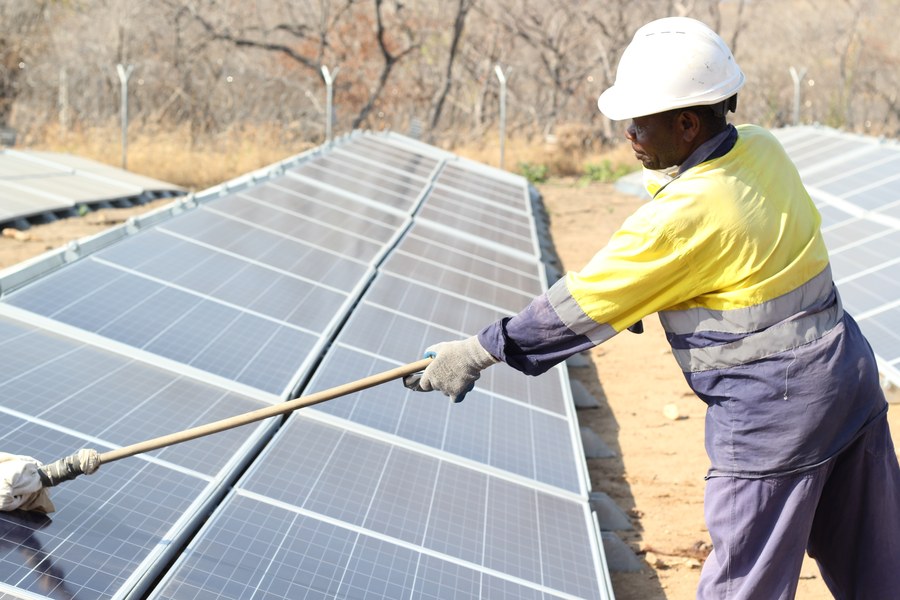
Cleaning a ground-mounted array in a dry climate. Optical soiling loss has been measured at an annual average around 0.24 percent per day of accumulation, which rain resets and drought does not. Photo by Deo photographer, CC BY-SA 4.0.
Soiling accumulates quietly. Published measurements put the optical loss at an annual average near 0.24 percent per day, which sounds negligible until it runs unchecked. Three weeks without rain at that rate costs 5 percent. Two months costs 14. Sites under trees, beside gravel tracks or downwind of farmland accumulate faster than the average. Coastal salt films build in their own way. Rain resets most of it on a tilted panel. Flat mounting holds water and the dust it carries, drying into a film that rain no longer clears. Tilting a portable panel earns its keep for that reason alone. Dew behaves differently and matters less than dust does over a season. Morning condensation scatters light for the first hour, then evaporates as the panel warms. The energy lost sits at the low-irradiance end of the day where output is small anyway. Bird droppings and leaf litter are the exception worth acting on. Both arrive suddenly and stay until removed, which puts them in a different class from dust that builds over weeks and washes off in an afternoon of rain. Those block a cell completely in place of dimming a whole surface. A fully blocked cell forces its bypass diode to conduct, which removes a third of the output on a 36-cell module. A single dropping can cost far more than a season of dust.
Shadows move, which makes them harder to notice than dirt. A pole, a mast or a branch throws a stripe that crosses a panel over the space of an hour, taking a large bite of output while it sits on a cell and giving it back when it leaves. Owners who check the display twice a day rarely catch it. Size matters less than position. A shadow covering 5 percent of a panel’s area costs far more than 5 percent if it falls across one cell in a string, because that cell limits every other cell wired with it. That shadow spread thinly over many cells costs close to its area. Anything narrow and dark, a washing line or an aerial, is worse than its width suggests.
Deployment fixes most of it for free. Walk the site once at mid-morning and once at mid-afternoon before settling the panel, and put it where nothing crosses it during the four hours around noon. Those hours carry the majority of the day’s energy. Protecting them beats any amount of cleaning.
A measured day, hour by hour
Assemble the effects and a real day appears. Take a hundred watt panel, tilted toward the midday sun, in clear July weather at a site averaging 4.5 peak sun hours, with ambient air at 28 degrees and a module rated 45 degrees nominal. Early morning delivers very little. Irradiance near 150 watts per square metre puts the panel at roughly 15 watts, cells barely above air temperature, incidence angle steep enough that reflection is taking a visible share. Mid-morning brings 500 watts per square metre and about 48 watts from the panel. Cells sit near 44 degrees by then, losing about 6.7 percent to heat.
One clear July day on a tilted 100 W panel, worked from irradiance, cell temperature and the power coefficient
Time
Irradiance
Cell temperature
Heat loss
Panel output
07:00
150 W/m²
33 °C
2.8 percent
about 15 W
09:00
500 W/m²
44 °C
6.7 percent
about 47 W
11:00
800 W/m²
53 °C
9.8 percent
about 72 W
13:00
950 W/m²
58 °C
11.6 percent
about 84 W
15:00
750 W/m²
51 °C
9.1 percent
about 68 W
17:00
350 W/m²
39 °C
4.9 percent
about 33 W
19:00
80 W/m²
31 °C
2.1 percent
about 8 W
Sum the curve and the day comes to roughly 460 watt-hours at the panel terminals. The table steps two-hourly for readability. A finer interval adds a little at each shoulder without moving the total far. Cable and connector losses remove a few percent. The charge controller removes a few more converting to battery voltage. Somewhere between 400 and 430 watt-hours reaches the cells, against a rated 100 watts and a theoretical 450. Notice which line does the damage. Peak output never reached the rating, because the cells were 33 degrees too hot at exactly the moment the light was strongest. Heat and full sun arrive together. The panel gives up most of its temperature loss during the hours that matter most.
Measuring your own panel honestly
Two instruments answer two different questions, and mixing them up wastes an afternoon. A watt meter reads power at this instant, useful for checking aim and for spotting shade. A watt-hour meter totalises energy across a day, which is the number that fills a battery. Panels get judged on the second, aimed on the first.
An inline watt-hour meter on the panel lead settles the question in one day. Fit it between panel and machine, start it at sunrise with the battery well below full, and read the total after sunset. Battery state decides whether the number means anything. A machine that reaches full charge at two in the afternoon stops accepting current. Everything after that moment is sunlight the panel could have delivered. Any honest measurement needs the battery hungry from dawn to dusk.
Timing the start matters as much as reading the total. A meter switched on at nine has already missed the morning shoulder, and one left running overnight collects the controller’s idle draw as a negative that some meters cannot show. Start at first light and stop after dark. Record four things alongside the total. The day’s weather in plain words. Peak ambient temperature. Panel tilt and rough aim. Whether the machine hit full at any point. A watt-hour figure without those four describes nothing that can be repeated.
Compare against the theoretical figure. The rating is the wrong yardstick. Rated watts times local peak sun hours gives the ceiling. A measured figure landing at 60 to 75 percent of that ceiling is a panel working correctly. A figure under half points at shading, a hot flat mount, a controller limiting early, or a battery that filled. Portable owners have a second figure to calculate. No datasheet prints it. Divide the day’s measured watt-hours by the mass carried. A folding hundred watt panel at 4 kilograms returning 300 watt-hours has delivered 75 watt-hours per kilogram for that day. A rigid module of the identical rating at 7.5 kilograms returns 40. The figure changes what counts as a good panel. Two panels of one rating at one price stop being equivalent objects once one of them has to be carried up a hill. Rate them by watt-hours per kilogram per day at the site you actually use. The box lid stops deciding the answer.
What to expect across a year
Summer and winter are different machines. A hundred watt panel at 4.5 annual peak sun hours can return 400 or more watt-hours in June. December brings under 150, on a shorter day with a lower sun and more cloud. Snow behaves in its own way. A dusting slides off a tilted panel within an hour of sun. A settled layer stops output completely. Even thin snow blocks nearly all light, which leaves the panel producing nothing to warm itself with. Clearing it by hand is the only fix. Anything harder than a soft brush costs more in scratched glass than the recovered energy is worth. Cold weather does return something. A panel at 5 degrees ambient under bright winter sun runs cells near 15 degrees. That is 10 below the rating condition. The power coefficient works in the owner’s favour for once. Peak output can exceed the nameplate on a clear cold morning. Daily energy still falls. The sun sets at four. Cloud is the larger seasonal variable in most climates. Overcast light around 200 watts per square metre leaves a panel producing near a fifth of its rating. A week of it produces less than a single clear day. Averages hide that pattern completely. Controllers add a small start-up delay at each end of the day. Most need panel voltage some margin above battery voltage before they begin. They also consume a little themselves while idling. The voltage side is rarely the obstacle, since a panel at a tenth of full sun still shows most of its voltage. What ends the day is current too small to overcome the controller’s own draw, which happens well before the light disappears. Plan against the worst month. Anybody depending on solar through winter needs more panel than the summer requires, or a charging route that skips the sun. Finding that out in December is the expensive way.
Common questions
Why does my 100 watt panel peak at 75 watts?
Cell temperature explains most of it. At 900 watts per square metre and 30 degree air a module rated 45 degrees nominal runs near 58, which removes about 11 percent on its own. Angle, reflection and dirt take the remainder. Peaks of 75 to 90 percent of rating are normal.
How many watt-hours should I get in a day?
Multiply 100 watts by the local peak sun hours for the ceiling, then expect 60 to 75 percent of it. At 4.5 peak sun hours that means roughly 270 to 340 watt-hours reaching the battery.
Does aiming the panel through the day help?
Enough to notice. A fixed panel aimed at midday collects most of its energy in the four hours around noon. Moving it two or three times catches the morning and evening hours that cosine loss and reflection would otherwise take.
Is my panel faulty if it never reaches its rating?
Almost certainly not. Reaching the rated figure needs 1,000 watts per square metre on the glass with the cells at 25 degrees. Cold bright days manage it. Summer almost never does.
Why did output stop rising in the afternoon?
Check the battery before the panel. A machine at full charge stops drawing current whatever the light is doing. A low input figure on the display describes demand. Supply is a separate question.