A battery holds direct current, a steady push in one direction. A wall socket delivers alternating current, a push that swings back and forth fifty or sixty times a second. An inverter is the part that turns the battery’s DC into the AC a device expects. It builds that AC in one of two shapes, the pure sine wave and the modified sine wave. The shape is the heart of what an inverter does. It decides how clean the power looks to a device. It decides which devices run well on the inverter. The two shapes come from two ways of switching the battery’s power on and off. This page sets out each shape on its own, then lines them up in a table. The two shapes, named and described, are the whole of the choice.
The shape matters because devices read the wave. A device draws power shaped by the curve the inverter feeds it. A simple heater reads only the energy in that wave. A sensitive charger reads the shape of the wave as well as its energy. The cleaner the shape, the wider the range of devices that run on the inverter without complaint. The choice of shape comes down to the devices an inverter has to run. A buyer who knows the load knows the wave to look for. The wave is the quiet language an inverter speaks to every device it feeds.
The pure sine wave
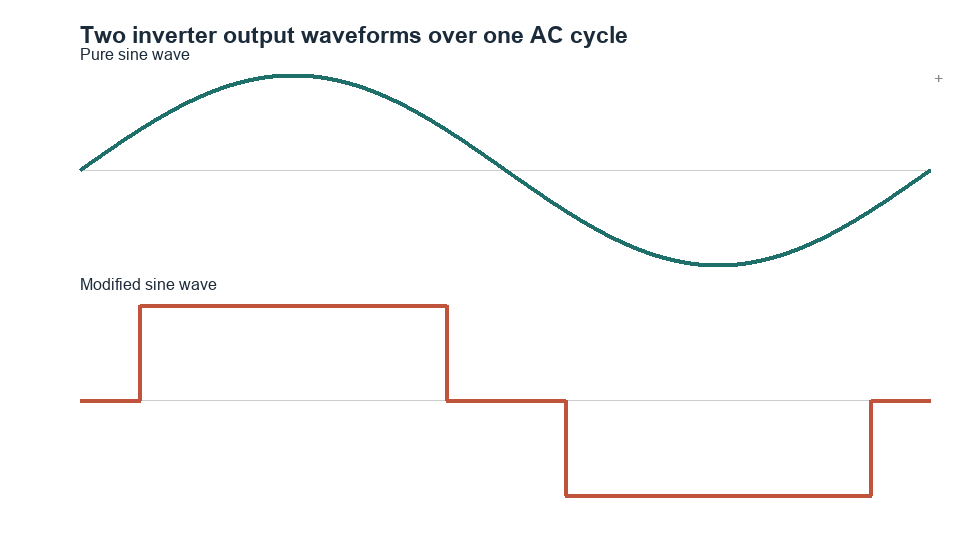
Two inverter output waveforms over one AC cycle, drawn to show the shapes. The pure sine wave is a smooth curve from peak to trough. The modified sine wave is a set of flat steps with a pause at the zero line. The drawing is illustrative.
The pure sine wave is a smooth rolling curve. It rises from zero to a peak, eases back through zero to a trough, and returns to zero, fifty or sixty times a second. This is the shape of the power in a wall socket, the standard the whole electrical world is built around. A pure sine inverter copies that grid shape closely. A device plugged into it sees power it cannot tell from the mains. The curve has no sharp corners and no flat steps, only a steady rise and fall. A pure sine inverter speaks that standard wave fluently.
A pure sine inverter builds the smooth curve through fast switching. It chops the battery voltage on and off thousands of times a second, a method called pulse-width modulation. Each pulse is a thin slice of the full voltage, wide near the peak of the wave and narrow near the zero crossing. A filter of coils and capacitors averages those fast pulses into a smooth line. The control circuit shapes every pulse to trace the sine, cycle after cycle. A good pure sine inverter holds its total harmonic distortion under a few percent, close to the figure for grid power. The fast switching is the trick that turns blocky pulses into a smooth line.
The smooth shape carries a cost in parts. The fast switching needs a quick controller and sturdy switches. The filter adds coils and capacitors to the board. Those parts raise the price of the build over a bare design. The pure sine inverter earns that price back on the range of devices it can run. A pure sine wave runs anything built for a wall socket, from a heater to a medical pump. The extra parts are the reason a pure sine unit weighs and costs more than a bare design.
The clean power is the whole point of the pure sine inverter. It hands a device the wave that device was designed around. A motor sees the smooth current it expects and turns at its rated speed. A charger sees the clean timing it reads and counts the cycles right. An audio amplifier sees a wave free of buzz. The pure sine inverter takes the wave off the list of things that can go wrong. The clean wave is the quiet partner a sensitive device wants.
Grid power itself is a pure sine wave. The power company spins generators that produce a smooth curve by their nature. Every appliance sold for the home is designed for that curve. A pure sine inverter brings the same curve to a battery system. A device moved from the wall to the inverter notices no change in the power it draws.
A pure sine wave also lets several devices share the inverter cleanly. Each load on one inverter draws its slice of the smooth wave without fouling it for the others. A charger, a laptop, and a fan run together on the clean curve. The wave stays smooth as the load rises and falls through the day. The pure sine inverter holds its shape from a light load to a full one.
The smooth wave suits a long run as much as a short one. A pure sine inverter feeds a fridge for days without stressing its motor. It runs a breathing machine through every night with no buzz. It powers a workshop of mixed tools through a full shift. The clean wave asks nothing extra of the devices over the hours.
The modified sine wave
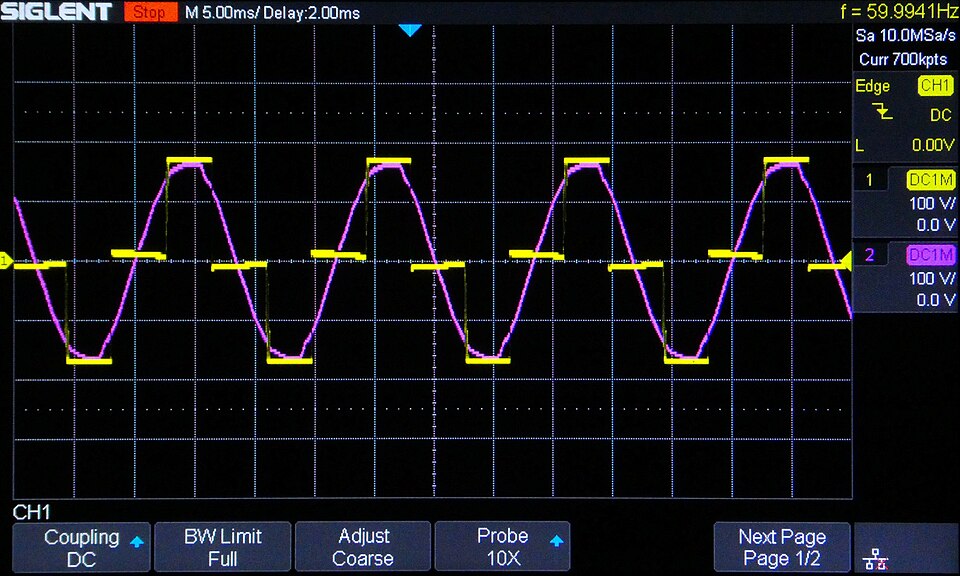
A real oscilloscope capture of a low-cost UPS output, on a Siglent scope reading 59.99 hertz. The trace sits in flat steps with sharp jumps and a pause near the zero line, the stepped shape of a modified wave. The on-screen menu, the frequency reading, and the grid are the scope own display.
The modified sine wave is a stepped shape. It holds flat at zero, jumps up to a level, holds there for part of the cycle, drops back to zero, pauses, then steps down to a level below zero. The wave climbs and falls in flat steps. One reference describes the modified wave as the sum of two square waves, one delayed a quarter of a cycle from the other. The output is a blocky, staircase line. The shape holds its level, then jumps, in a fixed pattern each cycle.
A modified sine inverter builds that shape with simple switching. It flips the battery voltage to the output in a few big steps each cycle. It needs no fast pulsing and no heavy filter. The simpler circuit uses fewer parts and a slower controller. That keeps the inverter small, light, and low in cost. The whole design is a handful of switches and a transformer. The slow switching makes little heat of its own.
The flat steps leave the wave with sharp corners. A sharp corner in a wave is the same as a pile of extra frequencies stacked on the main one. Those extra frequencies are called harmonics. They ride on top of the fifty or sixty hertz the device wants. The harmonics are energy at frequencies a device never asked for. They show up as heat in a transformer, as a buzz in an audio circuit, and as a misread in a timing chip. A transformer fed a stepped wave hums and warms from the harmonics it cannot use. A clock that counts the wave’s crossings can run fast or slow when the steps confuse its count. A dimmer or a speed control that reads the wave can jitter on the sharp edges. The same reference puts the lowest total harmonic distortion of a three-step modified wave at 30 percent. That figure means a large share of the wave sits at the wrong frequencies. A motor wastes some of that share as heat. A simple heater turns all of it into heat and never notices the difference. A filter could smooth those edges. The cheap inverter leaves the filter out to save cost. The edges stay sharp, by the design’s own plan. The harmonics are the price of the simple circuit, paid only by the devices that read the wave. A plain resistive load collects the full energy of the stepped wave and stays unbothered by its shape. The share of energy in the harmonics is the total harmonic distortion in plain terms. A three-step wave at 30 percent puts nearly a third of its energy off the main frequency. That third is the part a sensitive device struggles to use. A resistive load uses the same third as heat and asks no more. The thirty percent is the distortion of the stepped shape, set down as one number.
The modified wave does real work for many loads. It carries the same average energy as a sine wave at the same voltage. A device that turns power into heat or light takes that energy and runs. The stepped shape costs nothing for those loads. The trouble shows only with devices that read the shape of the wave. A plain resistive load is the easiest customer an inverter has.
The stepped wave is a practical shape for a cheap, light inverter. It comes from a handful of switches and skips the filter entirely. A small car inverter often uses it to keep the size and the price down. The shape carries the energy a simple load needs. It leaves the cost of a clean curve out of the box.
The modified wave was the first cheap inverter on the market. Early portable inverters used it because the parts for a clean curve were dear. Many small inverters still use it today for simple loads. The shape has a long record of running lights, heaters, and basic tools. The newer pure sine designs grew from the drop in the cost of fast switching. The two shapes have shared the market for decades.
The modified inverter has a clear place in a kit. It powers a campsite of lights and a fan at a low price. It runs a simple tool on a job far from the grid. It backs up a heater or a kettle in a power cut. The shape fits any load that turns power into heat, light, or plain motion. A buyer who needs only those loads has no reason to pay for more.
Harmonic distortion, the number behind the shapes
Total harmonic distortion is one number that captures the two shapes. It measures how far a wave strays from a clean sine, written as a percentage of the main wave. A figure near zero marks a smooth wave with little energy off the main frequency. A figure of tens of percent marks a wave with a large share of its energy in harmonics. The number is the single clearest read on the quality of an inverter’s output. The table below sets the percentage and the traits for the two shapes side by side, as one place to read the whole comparison. A low number is the badge of a clean inverter.
The two inverter waveforms, side by side
Property
Pure sine wave
Modified sine wave
Total harmonic distortion
under 3%
about 30%
Waveform
smooth sinusoid
flat steps, three levels
Built by
fast PWM switching, then a filter
a few big switching steps
Match to wall-socket power
close
approximate
Relative inverter cost
higher
lower
The devices that want a clean wave
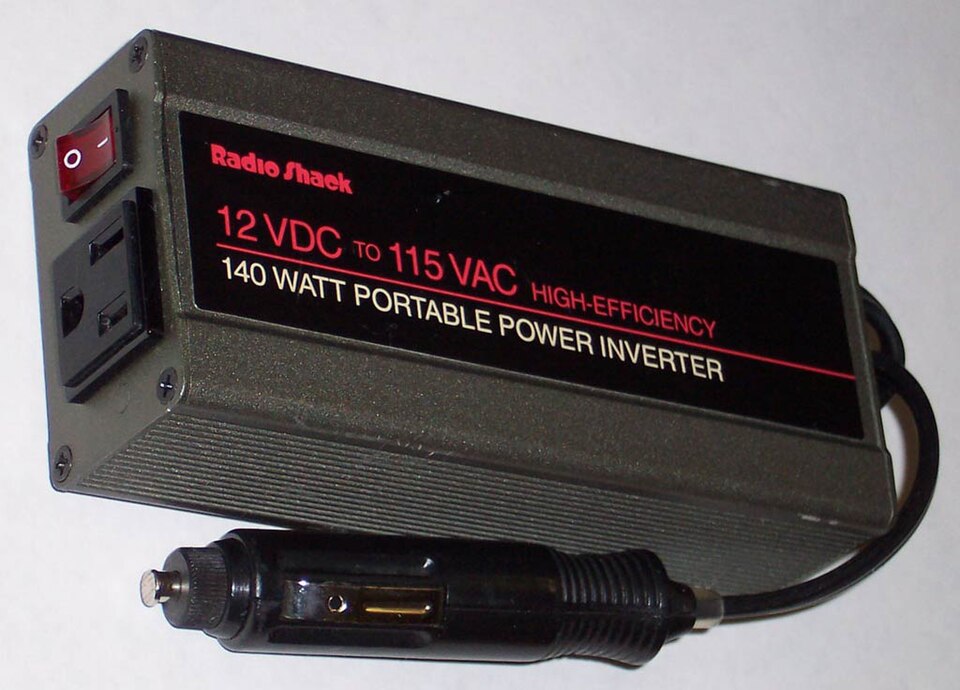
A small portable inverter, 12 volts DC to 115 volts AC at 140 watts, of the kind that usually puts out a modified wave. The text 12 VDC TO 115 VAC and 140 WATT PORTABLE POWER INVERTER is the maker own label. The red switch and the cigarette-lighter plug are the unit controls and input.
Some devices ask for a clean sine wave by name. A device with a motor that changes speed reads the wave to set that speed. A medical device at home, like a breathing machine, lists a sine wave in its manual. A sensitive charger, an audio amplifier, and a laser printer run their best on the smooth shape. A microwave oven cooks slower and noisier on anything else. These devices read the shape of the wave, beyond its raw energy. The shape is the part of the power they cannot do without.
The clean wave keeps these devices cool and quiet. A motor on a smooth wave draws a clean current and holds its rated temperature. An amplifier on a smooth wave stays free of hum. A charger on a smooth wave reads its timing from the wave without error. A screen on a smooth wave shows no lines and no flicker. The clean shape lets sensitive parts work the way their makers intended. The clean shape shows up as silence and a steady running temperature.
A pure sine inverter is the safe choice for a mixed load. It runs the simple devices and the sensitive ones alike. A buyer who cannot list every device ahead of time leans to the pure sine wave. The clean shape removes the question of what will run. A home backup system, with its mix of fridge, electronics, and chargers, calls for the clean wave. One inverter then covers the whole house without a second thought.
The signs of a wave-reading device are easy to spot. A device that hums, heats, or runs rough on cheap power is reading the wave. A device with a digital display, a variable motor, or a fine sensor falls in this group. A tool that holds a steady speed under load reads the wave to do it. These are the devices a pure sine inverter protects.
The list of clean-wave devices grows with the electronics in a home. A modern fridge with a variable compressor reads the wave. A pellet stove with a control board reads it. A breathing machine, a printer, and a games console read it. The trend in appliances runs toward boards and motors that want a clean curve. A pure sine inverter keeps pace with that trend.
The devices that run on either shape
Many everyday loads run on either shape. A resistive load turns the wave into heat. The stepped shape heats just as well as the smooth one, since heat cares only for energy. A kettle, a heater, an incandescent bulb, and a soldering iron fall in this group. These loads read the energy in the wave. Both shapes carry that energy in equal measure. A resistive load is blind to the corners in the wave.
Simple motors and basic tools often run on the modified shape too. A drill or a fan with a plain universal motor turns on it. The motor may run a little warmer on the stepped wave. A short job on a basic tool takes the modified shape in stride. The modified inverter suits a kit of simple loads at a low price. A worksite with lights, a fan, and a basic drill runs on it well. A simple motor forgives the rough wave for a short run.
Heat does not care about the shape of the wave.
Telling the two apart and choosing
The label is the first place to look. A pure sine inverter says pure sine or true sine on the box. A spec sheet that lists a total harmonic distortion under a few percent points to a pure sine wave. A modified inverter often leaves the wave figure off the sheet entirely. The wording on the box is the quickest read on the shape inside. A figure for total harmonic distortion is the clearest clue of all.
A running inverter gives a sign through nearby devices. A faint buzz from a fan, a transformer, or a fluorescent light hints at a modified wave. A clock that gains or loses time on the inverter hints at the same. A device that runs silent and cool gives no such sign. The ear and the eye read the wave through the load it feeds. A trained ear hears the wave in the hum of a cheap load.
The choice starts with a list of the devices the inverter must run. A buyer writes down every load, from the largest to the smallest. One sensitive device on the list points to the pure sine wave. A list of only simple, resistive loads keeps the cheaper modified inverter in play. The list of loads leads the decision, ahead of the price on the shelf. The devices on the list, taken together, name the wave to buy.
A meter settles any doubt about a wave. A power-quality meter reads the total harmonic distortion straight off the output. An oscilloscope shows the wave shape on a screen, a smooth curve or a set of steps. A buyer rarely needs either tool, since the label and the load tell the tale. A reading under a few percent confirms a clean sine at a glance.
Mistakes with the two waves
A few mistakes follow from skipping the wave question. The first is treating every inverter as the same. Two inverters at the same wattage can carry two different waves inside. A buyer who reads only the watt figure can land on the wrong wave for the load. The wattage tells the size of the inverter, never the shape of its wave. The same wattage sits on two boxes that look the same from the outside.
The second is running a sensitive device on a modified wave. A variable-speed motor or a sensitive charger can run hot, run noisy, or misread its timing on the stepped shape. The fix is to match the device to the clean wave it asks for. The device manual names the wave it wants. A minute spent reading the manual saves a damaged device.
The third is paying for a pure sine inverter for a load that never needs it. A heater or a work light takes the modified wave and runs. A buyer with a fixed, simple load keeps the saving of the modified inverter. The match of wave to load is what saves money, in both directions. The cheaper wave is the right wave when the load is simple.
The fourth is ignoring a buzz or a warm motor. Those signs mark a load that reads the wave under it. A device that hums or heats on a modified inverter is asking for a clean wave. The early sign is a chance to move the device before harm builds up. A warm motor left on the wrong wave wears out before its time.
The fifth is buying on price alone. The cheapest inverter on the shelf is often a modified one. It serves a simple load well at that price. It falls short the moment a sensitive device joins the load. The price is a fair guide only once the wave matches the devices. A cheap inverter on the wrong load is no bargain.
The sixth is trusting a vague label. A box that reads high efficiency or smart power names no wave at all. A buyer reads past the slogans for the words pure sine, or for a distortion figure. A label with neither word often hides a modified wave. The plain wave name is the one word that settles the shape.
The seventh is forgetting the wave when the load grows. A kit bought for simple tools may later run a laptop or a charger. The modified inverter that suited the old load can fall short on the new one. A buyer who plans to add loads leans to the clean wave early. The wave chosen for today should fit the load of next year. A little headroom in the wave choice saves a later swap.
Common questions
What is the real difference between pure sine and modified sine?
The pure sine wave is a smooth curve that matches wall-socket power, with total harmonic distortion under a few percent. The modified sine wave is a stepped shape with distortion near 30 percent. The smooth wave runs every device. The stepped wave runs simple resistive loads and many basic tools.
Can a modified sine wave damage electronics?
A simple resistive load runs on a modified wave with no harm. A sensitive device with a motor or fine electronics can run hot, hum, or misread its timing on the stepped shape. The device manual names the wave it wants. A pure sine inverter removes the risk for sensitive gear.
Why does a pure sine inverter cost more?
A pure sine inverter switches the battery thousands of times a second and adds a filter to smooth the wave. Those extra parts raise the build cost. A modified sine inverter uses a few big switching steps and no heavy filter, which keeps it cheap. The price gap pays for the clean shape.
How can the wave type be told from the box?
A pure sine inverter prints pure sine or true sine on the label, often with a low total harmonic distortion figure. A modified inverter tends to leave the wave figure off the sheet. A buzz from a fan or a transformer on the running inverter also points to a modified wave.