Obese Patient Vein Finder Difficult Venipuncture Infrared
An infrared vein finder helps a clinician find a vein in a heavier patient, whose veins lie buried under a layer of fat. The eye cannot see them, and the finger cannot feel them through the padding. A stick on a large arm often takes several tries. The device shines near-infrared light through the skin and draws the veins it reaches as dark lines. The shallower ones come into view before a needle goes in. For such a patient, that early sight turns a blind search into a guided one.
Why a heavy arm hides its veins
Body fat sits between the skin and the veins. On a heavier arm a thick layer of subcutaneous fat covers them. That padding hides the veins from both the eye and the hand. The more fat lies over a vein, the harder it is to find by the usual means. A vein that would show at a glance can vanish under enough fat. The forearm and the back of the hand, the usual sites for a drip, are often the worst hit.
The fat does two things at once. It buries the vein deeper below the surface, out of reach of a searching finger. It also blurs the surface, so the small dips and ridges that usually mark a vein are smoothed over. A clinician feeling for a vein on a large arm is often pressing into soft tissue where the fat has smoothed every landmark away.
This is why heavier patients are a well-known group for difficult access. The veins are there, as good as anyone’s underneath. The trouble is reaching them through the fat that hides them. Difficult intravenous access is recorded more often in patients with a high body-mass index. A missed first stick is a common start to the visit.
When the eye and finger both fail
Finding a vein the old way leans on sight and touch. A clinician looks for the bluish line of a vein under the skin and feels for its soft bounce. On a heavy arm neither sense finds it. The vein lies too deep under fat to show colour at the surface. It lies too cushioned to bounce under a finger.
What follows is the blind search every clinician knows. The needle goes in on a best guess and pokes about, hunting for a vein by feel below the skin. Each pass hurts. Each miss uses up a site. On a large arm a skilled hand can fail several times before a lucky pass. The patient winces through every miss. A way to see the vein first would change the whole attempt.
How deep the veins sit
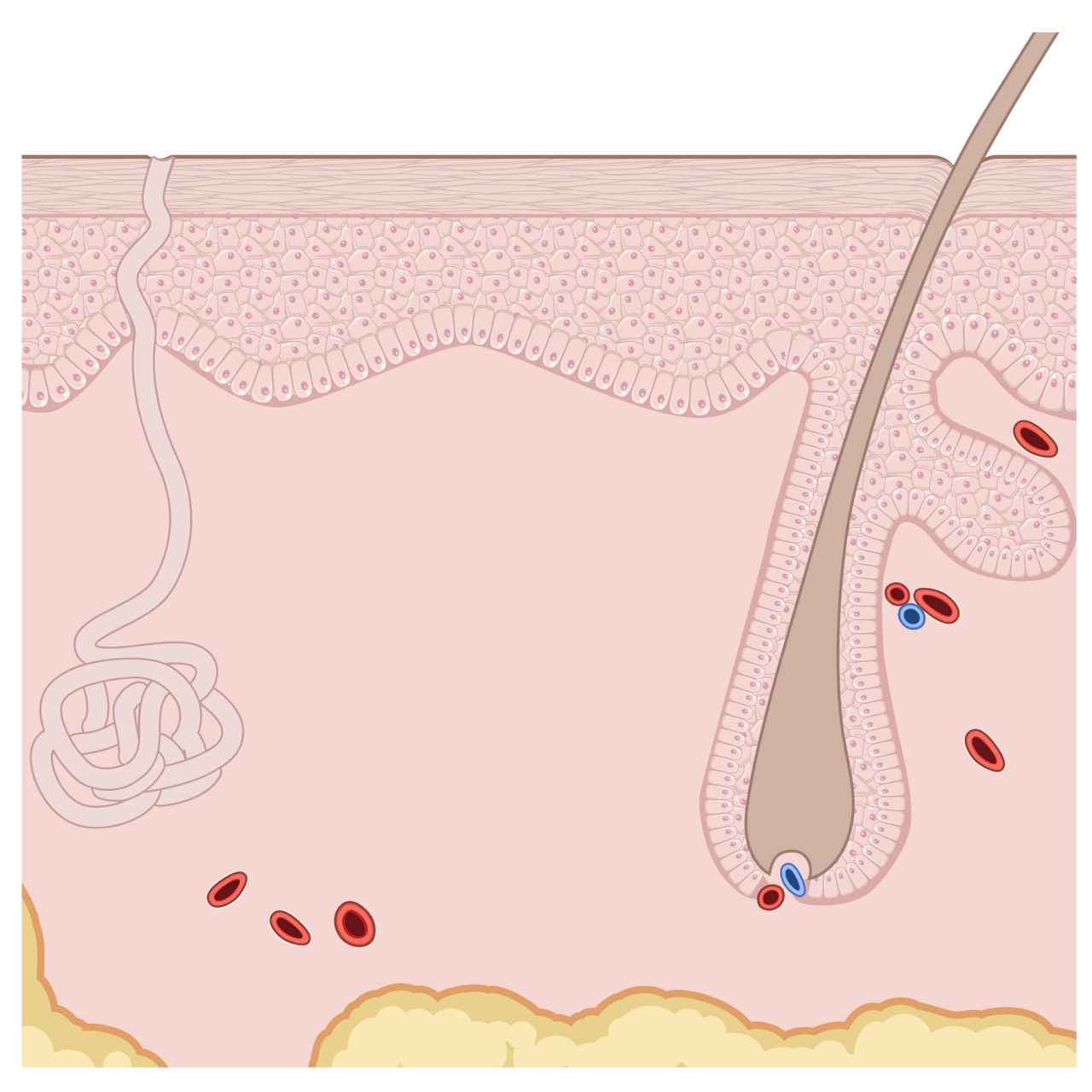
The layers of the skin in cross-section. The small vessels sit in the dermis, above the yellow band of subcutaneous fat at the bottom. In a heavier patient that fat layer is far thicker. It sinks the usable veins deeper below the surface.
Depth is what makes a heavier arm difficult. The veins themselves are normal. The fat over them is what varies. It can run from a few millimetres to a couple of centimetres or more. The vein sits at the bottom of that layer, as deep as the fat is thick.
Those numbers decide what any vein finder can do. A reflection device reads a few millimetres down. The better projecting systems reach around a centimetre. A vein deeper than that lies beyond the light. No infrared finder will show it. The depth of the fat sets the line between a vein a finder can reach and one it cannot.
Here is the honest part. How much the device helps depends on how deep the fat runs. When the veins sit within its reach, it brings them up clearly, far deeper than the eye could ever see. The deepest veins, under the thickest fat, are a job for ultrasound. Knowing how deep the fat runs on the arm in front of you is part of using the tool well.
None of this is a fault in the device. A vein finder reads light. Light only travels so far into tissue. The fat that hides a vein from the eye also stops the light at depth. The device does what light can do: it finds the veins the light can reach, which on most heavy arms is enough for a drip.
What an infrared finder reaches
Within its depth, an infrared finder does on a heavy arm exactly what it does on any other. It floods the skin with near-infrared light. The blood in the veins soaks the light up, so the veins read as dark lines against the brighter tissue. The clinician sees a map of the veins the device can reach, drawn on the arm.
The gain on a heavy arm is large, because the eye and finger give so little to start with. The device reveals veins that were completely hidden, the difference between a guess and a target. The harder the arm is to read by hand, the more the device adds. This is why the device shows its strongest results on exactly these patients.
The map also shows what to avoid. A vein that branches, a valve, a stretch that dips too deep: the picture lays them out before the needle commits. On an arm where every landmark was hidden a moment ago, that much information turns a blind stick into a planned one. The clinician picks the best shallow vein and aims along it. A mark on the skin holds the spot while the device is set aside for the stick.
The shallower veins it brings up
The veins a drip actually uses sit near the surface. The back of the hand, the wrist, the forearm: the standard sites all carry veins in the first centimetre of tissue. On most heavy arms those veins still sit within an infrared finder’s reach. The device brings exactly those into view.
That is the everyday win on a larger patient. The device does not need to reach the deepest veins to help. It only needs to show the shallower ones the eye and finger missed, the veins a routine cannula was always meant for. Bringing those few into view, on an arm that looked blank, is often all it takes for a clean first stick.
Nothing presses on the arm
The non-contact design pays off again on a larger patient. A vein finder reads from above the skin, by light alone, so it never presses on the arm. That helps on soft tissue, where pressing a probe down would only push a deep vein deeper and flatten the soft veins a clinician is hunting for. The device leaves the arm untouched and the veins where they are. It can be held over the hand or the forearm and moved along to follow a vein. A harmless light costs the patient nothing, so the reading repeats as often as the search needs. On an arm where the veins are already hard to reach, a tool that does not disturb them is worth having.
Where the light runs out
It is worth being plain about the limit. Near-infrared light fades the deeper it goes into tissue. By a centimetre or so down, depending on the device, too little returns to draw a vein. A vein below that depth is invisible to the finder, the same as it is to the eye. On a very large arm, the best veins can sit in exactly that out-of-reach zone.
A clinician has to read the device honestly here. A blank patch on the picture does not prove there is no vein. It can mean the veins there lie deeper than the light can reach. Treating a blank screen as proof of no vein, and stabbing blindly anyway, undoes the whole point of looking first. The device shows the veins the light can reach. A blank patch only means the light went no deeper.
This limit is not a reason to skip the device. On most heavy arms it still finds a usable vein, since the everyday sites sit within its reach. The limit only marks the point where a different tool takes over. A clinician who knows where the light runs out reaches for that tool at the right moment. No tries are wasted on veins the finder was never going to show.
When ultrasound takes over
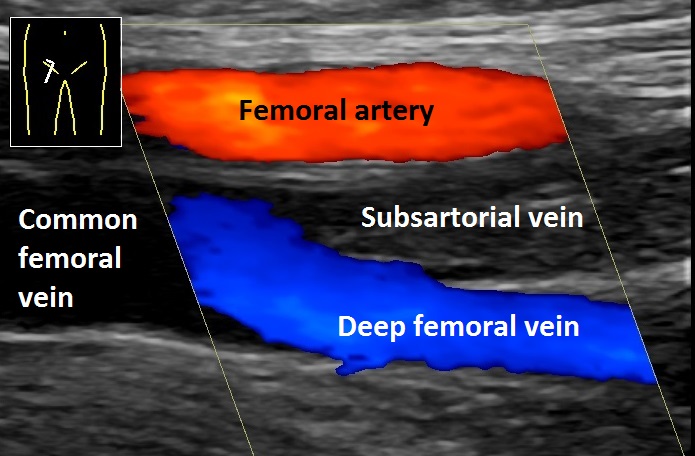
The deep vessels of the groin on a colour ultrasound scan, the artery in red and the veins in blue. Ultrasound reaches veins that lie far below an infrared finder’s depth, which is why it takes over once the fat sinks the veins below the light’s reach.
For the veins an infrared finder cannot reach, ultrasound is the tool. Ultrasound uses sound, which passes deep through fat and tissue. A scanner shows a vein centimetres down, far below the reach of any light. On the largest arms, ultrasound finds access where the infrared device has reached its limit.
Ultrasound comes into its own at depth. It reaches the deep veins, shown one cross-section at a time. A clinician turns to it on the largest arms, where the fat runs thickest. Ultrasound-guided cannulation is a skill of its own, kept for the deepest sticks.
This is why the depth limit of an infrared finder is not the end of the matter. The finder and ultrasound together cover the whole range of depth, shallow or deep. A clinic with both can reach a vein on almost any heavy arm.
A clinic does not have to choose one tool for all patients. An infrared finder is quick, cheap and easy, a sensible first reach on most difficult arms. Ultrasound is the next step when the finder cannot reach. Using the simple tool first, and the deeper tool when it is needed, gets most patients cannulated with the least fuss.
So the limit of the light is a handoff. The infrared finder takes the patient as far as light can go. Ultrasound carries on from there. For a heavy patient, that pairing means a vein gets found, whether it lies a few millimetres down or a few centimetres.
What the evidence shows
The evidence for vein finders is strongest in exactly this group. In patients with a high body-mass index, studies have found a real gain from using a near-infrared device. One reported that a device made a successful first stick around three and a half times more likely on heavier patients. Another, on patients with a high BMI, saw access within two attempts rise from about half to nearly all. The gain held after adjusting for skin colour and the quality of the vein.
That fits the logic of the situation. Where the eye and finger give almost nothing, anything that shows the veins is a large step up. The harder the arm is to read by hand, the more a vein finder adds. The device answers exactly the kind of difficulty a heavy arm presents. A review of difficult intravenous access places obesity among the main reasons a vein is hard to find. The device meets that reason directly.
Obesity and venous access, by the numbers
Measure
Figure
Linked to difficult access
a body-mass index of 30 or above
First stick with a finder, BMI 30+
about 3.5 times more likely
Access in 2 sticks, BMI 40+
rose from about 50 to 96 percent
Depth an infrared finder reads
a few mm, up to about 10 mm
Veins deeper than that
a job for ultrasound
Reading a heavy arm well
Good technique gets the most from the device on a large arm. A tourniquet helps more here than anywhere, since it swells the deeper veins toward the surface and brings them up into the light’s reach. Warmth does the same, opening the veins and lifting them. A vein that sat just beyond the device can rise into view once the arm is warmed and the tourniquet is on. Lowering the arm below the heart for a moment fills the veins further before the stick.
The angle of the stick changes on a deep vein. A vein under fat needs a steeper approach and a longer reach with the needle than a surface vein. The device helps here too, since it shows how deep the vein runs, letting the clinician set the angle for the depth before starting. Seeing the target guides the hand as much as it guides the eye.
The clinician’s skill still decides the outcome. The device shows where a usable vein runs and how deep it sits. The nurse reads that, sets the angle, and threads the cannula the extra distance a deep vein needs. On a heavy arm the device gives the picture. The trained hand does the work the picture calls for.
First line, then escalation
On a difficult heavy arm, the sensible order is simple. Try the eye and hand first, as always. When they fail, reach for the infrared finder, which is quick and costs the patient nothing. It will find a vein on most heavy arms within a stick or two. Most heavy arms never reach the ultrasound stage at all.
When the finder comes up empty, the veins lie deeper than light reaches. Ultrasound is the next step. This order spares the patient the long blind search, since each tool is tried where it works best and dropped the moment it cannot reach. A heavy patient moves from sight, to light, to sound, with the fewest failed sticks along the way.
Where the finder fits
An infrared vein finder reveals the surface veins that fat hides from the eye and finger, on the many arms where those veins still sit within reach of light. It does not reach the deepest veins. Those it leaves to ultrasound. Within its depth, on a heavier patient, it does real and useful work.
For the patient, the gain shows at once. Fewer blind stabs into soft tissue. Fewer failed attempts on an arm that is hard enough already. A first-attempt success where the old way meant a painful hunt. The studies put a first stick several times more likely. For the patient, that shows up as fewer needles.
For the clinic, it is a quick answer to a common problem, at low cost. A heavy arm turns up on every ward. The blind search wastes time and kit and patience. A vein finder in the drawer gives the team a fast first move, ahead of the slower ultrasound, on a patient they meet all the time. It proves itself by how often that problem walks in.
A heavier patient will always be harder to cannulate. The fat that hides the veins will not go away. A vein finder does not pretend to solve all of it. It does the part it can: it brings the shallow veins the fat hid back into view, before the needle moves. For the deeper veins, it points the way to ultrasound. Where fat has buried the veins, the device brings back the ones the light can still reach.
Common questions
Why is it hard to find a vein in a heavier patient?
Body fat lies between the skin and the veins. On a heavier arm a thick layer of subcutaneous fat covers the veins, sinking them deeper and smoothing away the surface signs a clinician reads. The eye cannot see the bluish line of a vein through the padding. The finger cannot feel its bounce. Difficult intravenous access is recorded more often at a high body-mass index. A missed first stick is common.
How does a vein finder help on a large arm?
It shows the veins through the skin, before a needle goes in. The device shines near-infrared light into the arm. The blood in the veins absorbs it. The veins read as dark lines. On a heavy arm, where the eye and finger find almost nothing, this reveals veins that were completely hidden. The clinician picks a usable one and aims for it on the first try.
Can a vein finder reach a vein under thick fat?
Up to a point. An infrared finder reads veins within a few millimetres to about a centimetre of the surface, depending on the device. On a moderately heavy arm, many usable veins still sit within that reach, deeper than the eye can see. The deepest, under very thick fat, are a job for ultrasound.
When should a clinician turn to ultrasound?
When the veins lie deeper than light can reach. If an infrared finder comes up empty on a very large arm, the usable veins are likely below its reach. Ultrasound uses sound, which travels through fat and deep tissue, and shows a vein centimetres down. The sensible order is to try the infrared finder first, quick and hands-free, and turn to ultrasound when the depth defeats the light.
Does the evidence support vein finders in obese patients?
Yes, more clearly than in most groups. Studies of patients with a high body-mass index have found a real gain from a near-infrared device. One found a successful first stick around three and a half times more likely on heavier patients. Another saw access within two attempts climb from about half to nearly all on patients with a very high BMI. The benefit is largest where the veins are hardest to find by hand.
Does pressing the device on the arm help find a deep vein?
No. Pressing only makes it worse. Pushing a probe or a finger down on a soft arm sinks a deep vein deeper and flattens the surface veins a clinician is hunting for. An infrared finder reads from above the skin, by light alone, so it never presses on the arm. It leaves the veins where they are. Nothing touches the skin. The reading can be repeated as often as the search needs.
About the Author
Julien Mercier
Senior R&D Engineer · Medical Ultrasound Transducer Development
Senior R&D Engineer with an M.S. in Applied Physics and over 15 years of experience in medical ultrasound transducer development, specializing in the design verification and performance testing of high-frequency imaging transducers. Currently leading the development and verification of the company’s next-generation high-frequency linear-array transducer, responsible for imaging performance evaluation and reliability analysis in preclinical testing. Brings extensive hands-on experience in piezoelectric element tuning, beamforming parameter optimization, and system-level performance testing.