Nursing Infrared Vein Finder Clinical Application Protocol
An infrared vein finder is bought for a whole nursing unit and shared across the ward. A clinical protocol sets out when the staff reach for it, who uses it, and how it fits the steps of getting a line into a patient. Written into the ward’s routine, the device becomes part of how the team handles a difficult stick. A protocol turns one shared device into a steady gain in first-attempt success across the unit.
Why a unit brings one in
Drawing blood and starting lines is the daily work of a nursing ward. A vein finder is the tool a unit reaches for when that work runs into a vein it cannot see or feel.
Nurses place most of the lines in a hospital. Drawing blood, starting a drip, giving a drug: the peripheral stick is one of the commonest things a ward does, dozens of times a day. A steady share of those sticks are difficult, on patients whose veins are hard to see or feel. Those difficult sticks are where a unit loses time and where patients suffer extra needles. Difficult access turns up in a sizeable share of hospital patients, by some counts as many as one in four.
A vein finder is the unit’s answer to exactly those sticks. It shows the veins through the skin, so a nurse can find one when look and touch fall short. A unit invests in the device for the hard cases its staff meet every shift, the repeat patients and the difficult arms that swallow time. The aim is fewer failed sticks across the whole ward.
The case for a unit rests on volume. A busy ward meets dozens of difficult sticks a day, spread across many nurses and many patients. Shared across that volume, the device earns its cost on the time it saves and the re-sticks it prevents, counted over a year of hard arms. The more a ward sticks, the more a vein finder gives back. One avoided escalation also frees the vascular access team for the cases that truly need it. A lead nurse who owns the device and its figures keeps the effort alive past the first enthusiastic month.
There is a patient side to it as well. A ward known for getting the line in first time, with fewer jabs, is a ward patients trust. Repeat patients, the ones who dread the needle, feel the difference most. A vein finder, used well across a unit, is part of how a ward turns a feared procedure into a quick one. Word travels among patients. A unit that gets the line in cleanly earns a quiet reputation for it.
When the protocol says to use it
A good protocol says plainly when to use the device. The common rule is the number of attempts. A nurse tries for a vein the usual way. After two failed sticks, the protocol says to stop and reach for the vein finder. The two-attempt rule spares the patient a run of failed jabs. It brings the device in while veins remain. Many hospitals cap a single nurse at two sticks before the task passes on, to spare the patient a fifth and sixth jab.
Known difficulty is the other trigger. A patient with a history of hard access, a course of chemotherapy behind them, or veins a nurse can already see will be trouble, calls for the device on the first attempt. There is no sense in two blind jabs on an arm a nurse knows will be difficult. The protocol lets staff skip straight to the tool that helps. It saves the patient two jabs that were never going to work. It also keeps a wary patient on side, since the first move is the one that lands.
A clear trigger takes the guesswork out of when to use it. With no clear rule, a device sits unused, or comes out too late after the veins are spent. One line in the protocol, two sticks then the finder, or known-difficult from the start, makes the choice automatic. Every nurse on the ward follows the same step at the same point.
Writing it into a protocol
Putting it in writing turns a good idea into standard practice. It names the device, states when to use it, and says who is trained to use it. It sets out where the device lives, how it is cleaned, and where the reading is recorded. A page or two, agreed by the unit, is what moves a vein finder from one nurse’s habit to the ward’s routine. A protocol agreed by the team also gives a new nurse one place to learn how the ward expects the device to be used.
The trigger comes first in the protocol. It states the two-attempt rule and the known-difficult exception in plain words, so every nurse applies them the same way. It names who makes the call to escalate. Spelled out, the trigger reads the same to every nurse who picks up the page. A protocol that leaves the trigger vague leaves each nurse to guess. The device then gets used unevenly across the ward.
The escalation path comes next. The protocol says what happens after the finder. It names the next step when the device cannot find a vein: a call to a senior nurse, the vascular access team, or an ultrasound-trained clinician. Writing that path down means a difficult stick moves up the ladder in order. No patient stays stuck under a nurse who has run out of options. The path names who to call, so the next step is a single call away. Every nurse then knows that step without stopping to ask who handles it.
Competency goes in the protocol too. It states that a nurse is signed off on the device before using it on patients. It points to the short training that teaches the working distance, the skin settings, and the reading of the map. Naming a competency keeps the standard even, so a patient gets the same quality of reading from any nurse on the ward. The sign-off need not be long, just enough to show a nurse can hold the distance and read a vein before working unwatched.
Cleaning and care close the protocol out. It states how the device is wiped between patients, where it is stored, who charges it, and who checks it is working. These housekeeping lines look small. They decide whether the device is ready when a nurse needs it, or flat in a drawer. A protocol that covers them keeps the tool in service. Set down once, these duties stop being anyone’s afterthought.
Training and competency
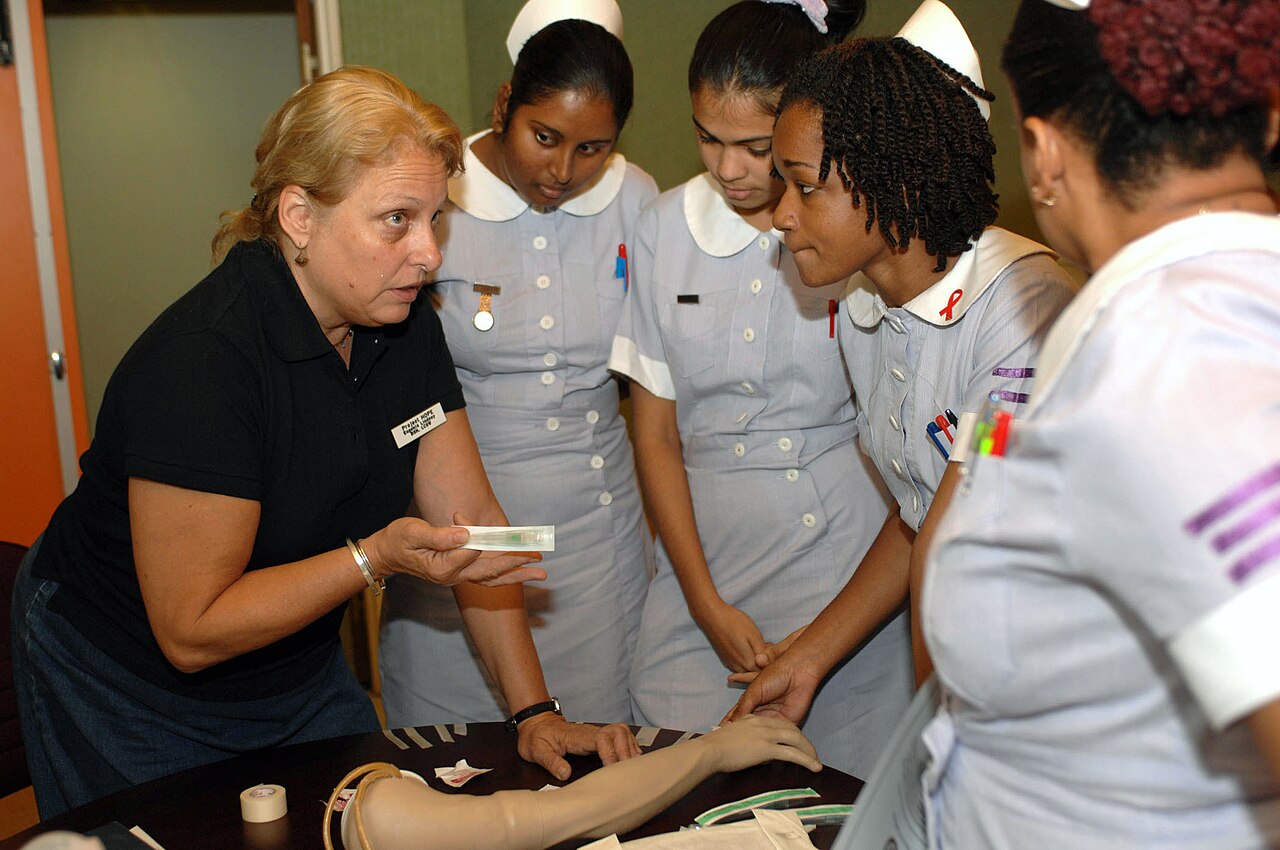
A nurse teaching the steps of starting an intravenous line, here on a practice arm. A vein finder enters a unit’s training the same way. A short sign-off comes before a nurse uses it on patients.
A vein finder is simple to learn. A short training covers it. A nurse picks up the working distance to hold it at, the settings for different skin, and how the veins show as dark lines. A practice session or two on willing colleagues, then a sign-off, brings most nurses up to speed. The device is far easier to learn than ultrasound. A laminated card kept by the device, showing the distance and the settings, refreshes a nurse who uses it rarely.
Training pays off most where staff turn over. A ward that takes new nurses often gains from a tool that takes minutes to teach. A new starter can be reading veins on the first day. The confidence on a difficult stick that once took months to build comes sooner. The simpler the tool is to learn, the more a changing team gets from it. A unit that trains every nurse keeps the skill on the ward through every shift, on nights and weekends alike.
Where it sits in the access pathway
Every difficult stick should follow a known order. The vein finder has a fixed place in that order. The first step is the ordinary one: look and feel for a vein, and try. Most sticks end there. The pathway only moves on when the ordinary way has failed.
The vein finder is the second step, the first escalation. After two failed sticks, or on a known-difficult arm, the nurse reaches for the device before calling anyone or going to a deeper tool. It is the quick, cheap, hands-on move that solves most difficult sticks on the ward itself. No referral is needed. Many patients who once went straight up the chain are cannulated right there. Solving the stick on the ward keeps the patient with their own nurse. It spares a wait for a team to arrive.
When the finder cannot help, the pathway goes on. A vein deeper than the light reaches, or an arm with no usable vein left, is the signal to escalate: to a senior nurse, the vascular access team, or ultrasound-guided access. The device marks that point clearly. A blank screen tells the nurse to call for help. No more time is wasted on blind sticks.
Set in a pathway, the device does one part of the job. It handles the middle ground, the difficult sticks the ordinary way cannot manage and a specialist need not see. That middle ground is most difficult sticks. A nurse who follows the pathway uses each tool where it works, and reaches the right help at the right time. The patient moves through the steps with the fewest sticks the access allows.
A device the whole ward shares
A vein finder on a ward is shared property, passed from nurse to nurse through the day. That shared use shapes what makes a good one. It has to be simple, so every nurse can pick it up and use it the same way. It has to be quick to clean, since it moves between patients all shift. It has to hold a charge and live somewhere everyone can find it. A device that is awkward, or always flat, or hidden in a locked cupboard, gets left behind for the blind stick the protocol meant to replace. The practical side of a shared tool decides whether it gets used at all. A ward that gets these small things right is a ward where the device is in a nurse’s hand when a hard vein turns up. The same care goes for the gel and the wipes, kept stocked beside it so a nurse never breaks off mid-stick to hunt for them.
Keeping it ready to use
Every shared device needs a clear owner for its upkeep. Someone on the unit is named to charge it, check it, and keep it where it belongs. A vein finder left for everyone to mind is minded by no one. It turns up flat on the morning a nurse needs it most. Either a named keeper or a docking station that charges it between uses keeps it ready. Logged like any other piece of ward equipment, a weekly check catches a failing battery before it strands a nurse. Keeping a spare battery, or a second unit on a busy ward, means a flat device never halts the work.
Cleaning has to be fast. The device touches no one, so it needs only a wipe with the ward’s usual surface cleaner between patients. The protocol says which wipe and how, so no nurse has to wonder. A simple wipe-down keeps the device moving from patient to patient without holding up the work.
Storage settles where it lives. A vein finder kept in one known spot, on its charger, is one a nurse can grab the moment a difficult stick comes up. Kept in a fixed home, known to the whole ward, the device stays in the flow of the work. A tool that is always in the same place is one a nurse can reach for without a search.
What a unit can measure
The device gives a unit something to measure. First-attempt success is the plain one: the share of sticks that land on the first try. A ward can count it before the device and after, and see the change. Studies of near-infrared finders show that number rising, often sharply, on the patients the device is meant for. A rising first-attempt rate is the clearest sign a protocol is working.
The numbers from studies are worth knowing. One found first-attempt success rising from around 59 percent to 88 percent with a near-infrared device. Others report the number of attempts cut by about half, and the time to place a line falling from around 94 to 53 seconds. A clinical pathway for difficult venous access builds those gains into a ward’s routine.
Attempts per patient is the next measure. A unit can track how many sticks a patient takes before a line goes in. Fewer attempts means less pain, fewer blown veins, and less kit used. A pathway with a vein finder in it pulls that number down, since the device ends many searches that would have run to a fourth or fifth jab. Each failed cannula thrown away is a small cost. Across a year of sticks, those small costs add up.
Time and escalations round out the picture. A ward can measure the minutes spent on access, and the share of patients sent up to the vascular access team. A finder used well cuts both: it gets lines in faster and solves on the ward the sticks that would have been referred. The team’s own numbers show whether the device is paying its way. A short audit each quarter, setting the figures before against the figures after, turns a hunch into something a manager can act on.
A vein finder on the ward, by the numbers
Measure
Figure
First-attempt success with a finder
about 59 to 88 percent in one study
Number of attempts
cut by about half
Time to place a line
about 94 down to 53 seconds
Common protocol trigger
after two failed attempts
When the finder finds nothing
escalate to the vascular access team
Measuring also keeps the protocol honest. Numbers show whether the device is being used at the right point, or sitting idle, or coming out too late. Watching its first-attempt rate, a unit can see a protocol working, or see where it is breaking down and fix it. Tracked month on month, the rate shows plainly whether the protocol has taken hold. The device proves itself on the ward’s own evidence, gathered from its own patients.
Documenting the access
A line into a patient is recorded. The device is part of that record. A nurse notes the site, the size of the cannula, and the number of attempts, the same as for any stick. Where a unit tracks difficult access, the note says the vein finder was used, and whether it helped. That record feeds the unit’s numbers and the patient’s history. A clean record also protects the nurse, showing the steps that were followed when access was hard.
The record also flags the difficult patient for next time. A note that an arm was hard, and that the finder found a vein at a certain spot, saves the next nurse the same search. Over many visits, a patient’s record builds a map of what works on them. The device helps write that map, one documented stick at a time. A patient flagged once as difficult arrives, the next time, to a nurse who already knows to reach for it.
What it gives a nursing team
For a nursing unit, an infrared vein finder is a shared tool with a defined job. It is a ward’s answer to the difficult stick, shared by the whole team, written into a protocol, taught to every nurse, and set at a fixed point in the access pathway. Used that way, it lifts the first-attempt success of the whole unit. The gain is spread across every nurse and every shift. No single nurse carries the hard stick alone.
The protocol is what makes the difference. Written into a clear pathway, with a trigger, a trained staff, an escalation route, and a charger it lives on, a vein finder becomes a steady part of how the ward works. The tool is only as good as the protocol around it. A clear rule, followed by everyone, is what turns one device into a ward-wide gain. A protocol short enough to remember is one a nurse can follow under pressure.
A difficult stick will always turn up on a busy ward. An infrared vein finder, used under a good protocol, is how a nursing team meets it the same way every time: look and feel first, the finder when that fails, and the right help when the finder cannot. The device and the protocol together turn a ward’s hardest sticks into ones it can handle on its own. Between them, they carry a struggle that used to fall on one nurse alone.
Common questions
When should a nurse reach for a vein finder?
When the usual way has failed, or when the patient is known to be difficult. A common protocol rule is two attempts: a nurse tries for a vein the ordinary way, and after two misses, reaches for the finder. On a patient with a history of hard access, or veins that clearly will be trouble, the device comes out on the first attempt. A clear trigger means every nurse uses it at the same point.
Why buy one for a whole unit?
Because the gain is spread across a whole ward. A busy unit meets dozens of difficult sticks a day, across many nurses and patients. A shared device, written into a protocol and used by everyone, lifts the unit’s first-attempt success and saves time across all those sticks. The cost is repaid over a year of hard arms.
How much training does a nurse need to use one?
Very little. A vein finder is simple to use. A short session teaches it: the distance to hold it at, the settings for different skin, and how the veins show as dark lines. A practice or two, then a sign-off, brings most nurses up to speed. It is far quicker to learn than ultrasound, which is part of why a ward reaches for it first.
Where does a vein finder fit in a difficult-access pathway?
As the first escalation, after the ordinary way fails. The pathway runs: look and feel for a vein and try; after two misses, reach for the vein finder; if the device finds no usable vein, call for help, a senior nurse, the vascular access team, or ultrasound. The finder solves most difficult sticks at that second step, on the ward itself. It also marks the point to escalate, by showing plainly when no vein is there.
What can a unit measure to see if it is working?
First-attempt success is the main one: the share of sticks that land on the first try, counted before and after the device. A unit can also track attempts per patient, the time to place a line, and the share of patients escalated to the vascular access team. Studies show first-attempt success rising, attempts cut by about half, and insertion time falling with a near-infrared finder. A ward’s own numbers show whether its protocol is working.
About the Author
Julien Mercier
Senior R&D Engineer · Medical Ultrasound Transducer Development
Senior R&D Engineer with an M.S. in Applied Physics and over 15 years of experience in medical ultrasound transducer development, specializing in the design verification and performance testing of high-frequency imaging transducers. Currently leading the development and verification of the company’s next-generation high-frequency linear-array transducer, responsible for imaging performance evaluation and reliability analysis in preclinical testing. Brings extensive hands-on experience in piezoelectric element tuning, beamforming parameter optimization, and system-level performance testing.