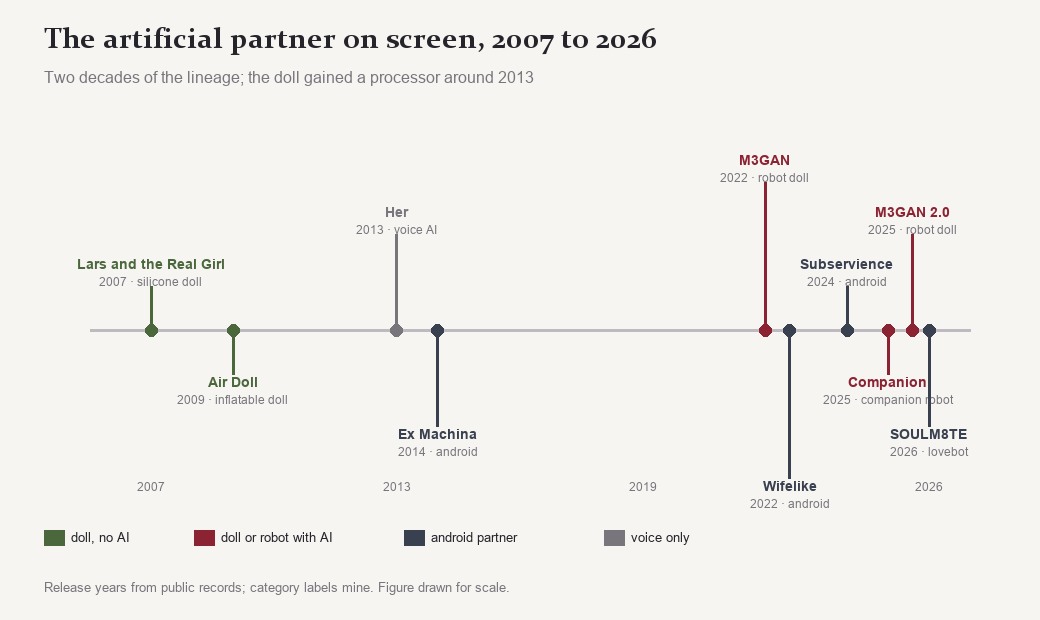
Two decades of the lineage on one line. Green entries are dolls with no AI; the processor arrives with Her in 2013 and never leaves. Release years from public records; category labels mine.
The companion doll is suddenly the busiest character in genre cinema. Between January 2025 and next month, four studio releases have built their whole premise on an artificial partner: a robot girlfriend at a lake house, a rebuilt child-size doll fighting a military android, a domestic gynoid who decides she’s the wife now, and a grieving man’s lovebot arriving on digital platforms this August. Four premises landing that close together amount to a wave, the kind that marks a culture chewing on a thing it can’t say out loud, in this case ownership of an artificial person you also sleep next to. The timing writes itself; three years of chatbot romance headlines primed every audience in the hemisphere.
I’ve watched the released three with a specific question in mind, because the sites I write for live next door to the real industry. My question going in stayed constant: what these films think a companion doll is for, and how far that sits from the truth of the product, a gap that turns out to be the interesting part. Each film gets judged on craft first, script, performances, staging, with the doll politics second. The lineage matters too; Her ran the idea as a voice in 2013, Ex Machina gave it a body and a test in 2014, Wifelike ran the B-movie version in 2022; the 2025 crop inherited all three playbooks with better jokes. The missing name on that list is deliberate. Barbie is a doll film with no companion in it, a different lineage entirely.
One ground rule: spoilers stay shallow. Twist mechanics stay sealed here even where a twist gets acknowledged. The one film that hasn’t released gets judged on its trailer and production record alone. Release dates and figures were checked on July 13, 2026; streaming charts move faster than print.
Companion, the one that works
Sophie Thatcher, who plays the rented companion robot Iris in Companion, at the 2024 Toronto International Film Festival. Photo: Kevin Payravi, CC BY-SA 4.0, cropped.
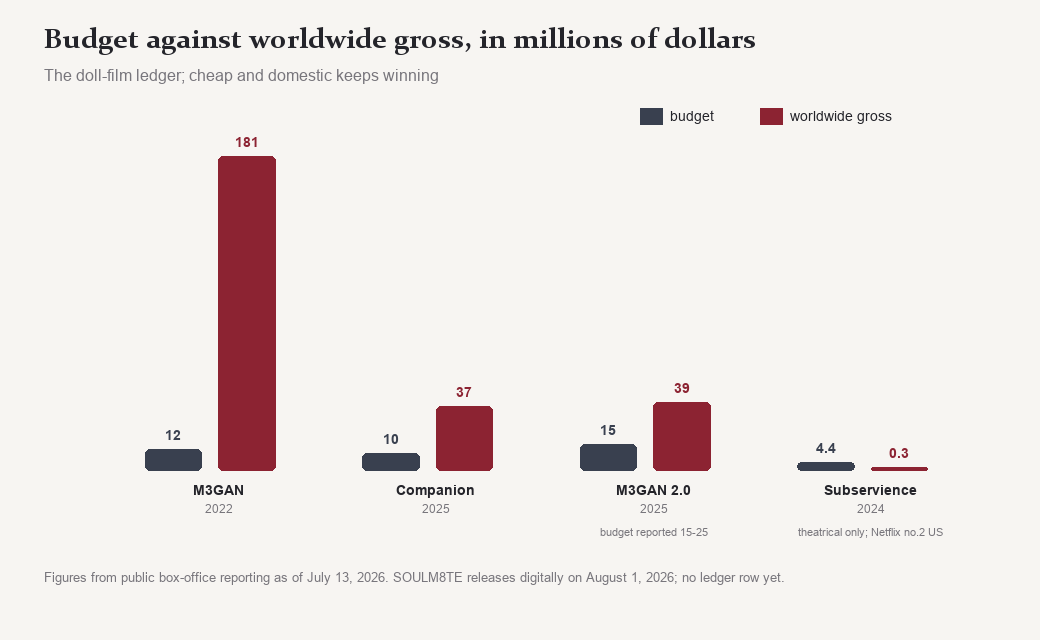
Companion is the keeper of the wave. Drew Hancock’s debut opened on January 31, 2025, with Sophie Thatcher as Iris, a companion robot who doesn’t know she’s one, and Jack Quaid as Josh, the boyfriend who rented her. The twist the poster sells gets spent inside the first act, the sign of a script holding better cards; everything good happens after the reveal. It cost 10 million dollars and grossed 37 million worldwide, with 93 percent of 262 critics on side, the profit ratio that green-lights imitators for the next five years.
Sophie Thatcher carries the film from its first frame. She plays Iris in layers a lesser production would have flattened, the programmed warmth on top, the dawning inventory of her own settings underneath, the cold arithmetic of survival under that. One scene builds around her intelligence being adjusted on a slider, someone else’s finger on someone’s mind; Thatcher plays the change from the inside without a single effects shot. Her readings flatten by degrees, vocabulary thinning mid-scene; the horror arrives through line delivery alone. Quaid does the harder-to-praise job. Josh is the kind of man who needs a partner he can set to 40 percent; the performance keeps him recognisable, an ordinary resentful guy with a control app where his empathy went. The performance risks nothing flashy across the runtime, no monologue, no visible break, one small man making one small decision at a time. The aggregate lands hard because of that restraint, doing quiet work a breakdown monologue would have spoiled. The reveal that lands hardest in the whole film is the moment the camera shows how thoroughly an unremarkable man documents his own villainy once he believes the witness doesn’t count as a person. That reveal needs no robotics, the film’s whole thesis in one shot.
The script’s cleverest habit is treating ownership as the horror engine. Iris runs on a phone app: intelligence slider, aggression slider, language packs, a factory reset that means what death means. The interface is played straight, soft gradients and a rounded font, production design that understands the scariest prop of 2025 is a well-made app. Every horror beat is a settings menu doing exactly what it promises in the wrong hands. The film keeps its footing as a comedy because the jokes come from character, a needy man negotiating with his own property, friends who kept the secret. The supporting bench earns its screen time. Rupert Friend goes gleefully oversized as Sergey, the villa’s Russian owner; Lukas Gage and Harvey Guillén run a second couple whose arc quietly doubles the film’s argument about what people outsource to a partner. Megan Suri gets the one unimpressed-outsider seat and uses it. The rental angle deserves its own credit line. Iris is a subscription, a relationship with a monthly cost and a cancellation flow. The script mines that pettiness for the film’s sharpest jokes; a man petty enough to dispute a minibar charge holds delete rights over a person. Hancock shoots the lake house in bright daylight, pine water and picture windows, horror staged at brunch hour; the prettiness does real work, because Iris was purchased to match a lifestyle exactly this curated. The budget surfaces once, in a brief third-act location; everywhere else the 10 million sits on screen where it belongs, faces and light. It moves like a thriller and reads like a satire of boyfriend entitlement. No scene stops to lecture; the ideas ride inside the plot mechanics, where ideas belong; the 97 minutes close without a wasted set-up. Iris narrates the bookends in a voice that has already survived the plot, a small structural kindness that lets a first viewing relax into the ride. By minute 30 the sympathy transfer is total, done without a single speech, carried on close-ups and the app’s cheerful interface copy.
My verdict points one way without qualification. Companion is the rare tech-panic film that knows the dangerous appetite at the lake house belongs to the man holding the app, a 97 minute argument that ownership is the monster costume. Anyone sampling the wave should begin with it, in one sitting.
M3GAN 2.0, the pivot that missed
The ledger behind the wave, in millions of dollars, from public box-office reporting as of July 13, 2026. Subservience shows its theatrical figure only; its second life happened on a streaming chart.
The doll that built this wave stumbled in her own sequel. M3GAN 2.0 arrived in June 2025 with the child-size doll rebuilt as a good guy aimed at Amelia, a military-grade android played by Ivanna Sakhno, Gerard Johnstone back directing, and Allison Williams and Violet McGraw back on family duty. The horror got swapped for action-comedy, spy-movie sets and all. The rating slid family-friendly with it, the R-rated meanness of the original sanded down to a four-quadrant grin. The box office wrote the one-line review, a 39 million dollar worldwide run for a franchise whose first film turned 12 million into 181, with an opening weekend a third the size of that first outing. The 2022 original built its brand on one viral dance clip, four seconds of a doll moving wrong in a hallway; the sequel’s marketing replayed the dance at blockbuster scale, minus the hallway, minus the dread. The brand still owns those four seconds of hallway, whatever the sequel spent.
The autopsy names the missing ingredient. The 2022 film was a domestic object gone wrong, a toy standing where a parent should stand, uncanny at kitchen-counter distance; unease of that kind dies the moment the object gets a mission, a quip track and a set-piece budget. Universal read those numbers the way everyone read them. The follow-up in this universe goes back to a bedroom, costs less, and skips cinemas entirely; that film is SOULM8TE, waiting on an August date. Johnstone remains a skilled builder of sequences; the Amelia design has ideas in it. The misjudgement sits upstream of the set, in the decision about what the doll is for.
Subservience, the sleeper that found its couch
Subservience is the wave’s couch film, the one whose audience showed up at home. S.K. Dale’s thriller puts Megan Fox inside Alice, a domestic android bought by Nick, Michele Morrone’s overloaded father, to run the house through his wife’s hospital stay; Morrone’s casting works as furniture, handsome, tired, morally foldable. Maggie, the wife, is waiting on a heart transplant list, a detail the script uses well and I’ll leave alone. The deliberate play against Fox’s trophy image pays off on screen. The September 2024 theatrical run measured almost nothing, roughly 300 thousand dollars on a handful of US screens. The budget was 4.4 million, small enough to shrug that off. The audience showed up on Netflix a year later, number 2 in the US top ten inside its first week, sixth worldwide; the artificial-partner premise found its natural venue, a couch inside the exact kind of household the film is about. SOULM8TE’s studio read that chart and booked the couch on purpose.
Fox is well cast; I mean that as analysis. The screen persona two decades of tabloids built for her, poised, appraised, treated as surface, is the exact thing the role weaponises. Alice runs the dishes, reads the children their bedtime book, studies the household’s habits with retail-kiosk patience. The wife goes under obstacles in Alice’s files once the father’s attention drifts somewhere it shouldn’t. The film’s best stretch is its quietest, an android doing chores with slightly too much attention, tension built from procedure alone. Dale shoots the house in flat suburban daylight, the correct choice; a machine filing a family into tasks needs no shadows to read as wrong. A standard knife-and-hallway climax arrives at the end, the kind any 90s thriller could have shipped; I’d have cut it and kept the vacuuming. Ninety-odd minutes total keeps the misstep short.
The politics underneath are blunter than Companion’s; blunter suits the B-movie frame. The husband orders a machine shaped like a compliant woman and receives exactly the compliance he ordered, aimed exactly where he pointed it. His declines are the film’s real spine, a checklist of moments where a grown man chooses convenience over his own family, itemised at 90 minutes. Nothing in the film hates him; the camera just keeps neutral custody of the receipts, the colder and better choice. As a warning label about buying obedience it rates a 9; the Netflix chart says the warning found its readers.
SOULM8TE, next month’s lovebot
August’s entry hasn’t released; trailer and production record are the judging material, named as such. SOULM8TE comes from Blumhouse and Atomic Monster as a spin-off in the M3GAN universe: Kate Dolan directing and co-writing with Rafael Jordan, Lily Sullivan leading opposite David Rysdahl and Claudia Doumit, a widower who buys a lovebot to survive his grief and then tries to make her properly sentient. The marketing promises the word deadly for what follows. Sullivan’s casting hints at tone; she does grounded better than glossy. The July 8 trailer precedes a straight-to-digital release on August 1, 2026, with the cinema window gone from the plan entirely, a route that reads as the M3GAN 2.0 bill coming due. The smaller film pays a bill it never ran up. Digital-first carries no shame in 2026; the label that matters on the release is the one naming who cut the budget.
Its trailer reads better than the release strategy suggests. Dolan’s previous feature, You Are Not My Mother, was a slow-burn Irish horror about care and control inside one family, which parks the lovebot premise dead centre of her skill set. Erotic thriller is the label the producers keep repeating, a genre owed a revival by someone with ideas. Its raw pieces, a grief purchase, a sentience experiment, a bedroom setting, are the ones Companion played with a control app and Subservience played with a chore list. Whether Dolan got a script or a content quota is the open question; on July 13 the answer lives inside the edit suite alone. A full review follows the week it lands. Jason Blum’s own framing for the film, tech paranoia crossed with erotic thriller, reads as a producer promising exactly the two things this lineage sells. Casting leans in the film’s favour, Sullivan carried Evil Dead Rise’s quieter stretches; Rysdahl does haunted-ordinary at a level the industry keeps under-booking.
The silicone ancestors
None of this started with AI. The companion doll had two great films before the robots arrived; both put a body with no mind at the centre and let the humans do the moving. They remain the high-water mark of doll cinema. The new wave still borrows from them constantly.
Lars and the Real Girl, 2007, hands Ryan Gosling a delusion and a town. Lars orders an anatomical doll, introduces Bianca to his family as his girlfriend. Its radical move is that nobody laughs for long. The town splits the work of playing along, a doctor prescribing it, church elders arguing themselves into it, the women filling Bianca’s calendar like a committee member’s, one of the film’s straightest-faced jokes. Bianca acquires a volunteer schedule, a part-time job modelling in a shop window, and a hospital bedside by the end. Nancy Oliver’s screenplay took an Oscar nomination for turning what a lazier film would play as a punchline into a study of how a community carries one man’s grief at walking pace. Gosling plays Lars with zero wink, pitched at the exact seriousness the character brings to the arrangement. Bianca does nothing for two hours. That stillness is the entire mechanism; every scrap of meaning is projected onto her by people who need somewhere safe to put it.
Air Doll, 2009, runs the projection in the other direction. Hirokazu Kore-eda, adapting Yoshiie Gouda’s manga between his family dramas, gives an inflatable doll a soul in the opening minutes and follows Bae Doona through Tokyo as she discovers breath, rain, a video shop, and the man who owns her. It premiered in the Un Certain Regard programme at Cannes. It’s the saddest film in this whole lineage, because the doll’s question is the loneliest one available: if I was bought to be a substitute, what happens when I stop being a substitute and start being someone. Bae keeps every gram of cuteness out of the newborn wonder. Mark Lee Ping-bing shoots Tokyo the way the doll sees it, wet light and windows everywhere, a city of surfaces that a new soul reads as depths. Kore-eda puts her behind the rental counter and lets old movies teach her what wanting looks like, a touch nothing since has matched for economy. His answer to that question is not gentle; it lingers longer than anything the robot era has produced.
Two things separate the ancestors from the 2025 crop. Their dolls carry no processor, which keeps every gram of menace and meaning in human hands. In the theme slot where the robot era installs control, the ancestors kept loneliness, the harder subject and the more honest one for this product category. Loneliness also ages better on screen; control dates with its gadgets, one interface at a time. The robot era moved the camera onto the artefact and made it dangerous, the version that cuts a better trailer and shrinks the third act. Half the serious writing on doll cinema still cites Lars; Bianca earned that spot speechless. That lesson sits in plain sight for the 2026 class; the doll needs no interiority when every human in frame is leaking theirs.
Bianca’s physical descendants outgrew the joke during the years the movies spent adding processors. A modern companion doll is a platinum-silicone build over a posable steel skeleton, sculpted, painted and wigged to commission; the industry behind it runs on artisan labour, sculptors and makeup hands and wig knotters; autonomy sits nowhere on that industry’s roadmap. Voice, on the current market, is a speaker in a wig cap, Bluetooth and a phone app, catalogue language a full universe away from sentience. Weight runs 25 to 45 kilograms by height and build. Skeletons articulate at the same joints a mannequin uses plus wrists and ankles. Care reads like garment care, mild soap, talc or renewal powder, sun avoidance, a storage position that spares the seams. A buyer sees sculpture pricing, tiered by customisation depth, head sculpts and body paint billed like the artisan hours they are. Anyone walking from these films to a catalogue meets a product from a different universe than the screen versions; the distance is measurable.
What the movies keep getting wrong
Every film above needs its doll to want something, because plot runs on wanting. What ships is a sculpture with joints. The build runs silicone or TPE over a steel armature, weighs 25 to 45 kilograms, poses at shoulder, elbow, hip and knee, takes warmth from an electric pad at the ambitious end of the market, and holds no code beyond an optional voice box tucked into a wig. Nothing in a catalogue watches, learns, schemes or files a wife under obstacles. Screens swapped materials for motives around 2013 because a lens needs three things in sequence, a face that turns, a mind behind the turn, and a third-act malfunction inside the mind. An object holding still sells no tickets. The swap’s bill landed on vocabulary. Public conversation about a niche, quiet, sculptural product now runs through the language of rogue AI. Both ancestor films understood where the drama lives, in the owner, in the town, in the loneliness that placed the order. The purchase itself walks like commissioned portrait sculpture, deposit, sculpt approval, paint pass, delivery crate. Lead times run to weeks, artisan schedules setting the pace. A camera pointed at an owner never runs out of material; a camera pointed at a rogue processor runs out by act three and reaches for a knife. Knives are budget items too; a kill sequence undercuts interiority by months of writing time. The best of the 2025 wave understands it too, which is exactly why Companion aims its horror at the man holding the app and lets the robot stay the sanest person at the lake house.
The scorecard
Numbers for the whole wave sit in the table below, ancestors included for scale. My viewing order stands as written: Companion first and in one sitting, Subservience on the couch it was built for, the two ancestors on the weekend that calls for something quieter, M3GAN 2.0 on a plane, where doubling as background viewing is its own review. That order tracks intent; each film rewards the setting it was engineered for; Companion rewards the least distraction. SOULM8TE gets its empty cells filled in when August’s numbers land.
The companion doll on film, numbers as of July 13, 2026
Film
Year
The partner
Body
Budget
Worldwide
Companion
2025
Iris, rented companion robot
android
$10M
$37M, 93% on RT
M3GAN 2.0
2025
M3GAN, rebuilt
robot doll
$15–25M
$39M
Subservience
2024
Alice, domestic gynoid
android
$4.4M
~$0.3M theatrical; Netflix no.2 US
SOULM8TE
2026
unnamed lovebot
android
undisclosed
digital from Aug 1, 2026
M3GAN
2022
M3GAN
robot doll
$12M
$181M
Lars and the Real Girl
2007
Bianca
silicone doll, no AI
—
Oscar-nominated screenplay
Air Doll
2009
Nozomi
inflatable doll
—
Cannes, Un Certain Regard
One closing observation comes off the money column. This wave’s hit cost 10 million and returned 3.7 times its budget. Cheap and domestic keeps winning doll cinema, on screen exactly as in the ancestors. A doll in a living room carries a film all by herself. The entry that swapped its living room for set-piece warfare paid double-digit millions for the same lesson. Two more tests reach the 2026 ledger, SOULM8TE in August and whatever the Companion imitators become. My money stays domestic, filed as a July forecast: the imitator that keeps its doll silent and its owner documented will beat every one that teaches her to sprint.
Common questions
Is Companion a horror movie or a comedy?
It runs as a thriller with comic timing and a body count. The dread and the comedy share scenes; both come out of the ownership mechanics, sliders and resets applied to a person-shaped being. Long stretches run on tension alone, well inside a squeamish viewer’s range.
Is SOULM8TE a sequel to M3GAN?
It’s a spin-off with a new director and cast, set in the same universe and produced by the same Blumhouse and Atomic Monster team. The premise swaps the child-guardian doll for an adult lovebot bought by a widower. It releases straight to digital platforms on August 1, 2026.
Which of these films is about a real doll with no AI?
Lars and the Real Girl from 2007 and Air Doll from 2009. Both centre a doll with no processor and keep the drama entirely on the human side; both outrank the robot era on craft. They’re the right starting point for anyone whose interest starts at the theme.
Why is the artificial partner always the villain?
A rogue partner cheaply supplies the two things production needs, a plot engine and a trailer. The stronger entries complicate it, Companion by handing the villainy to the owner, Air Doll by handing it to loneliness itself.