Intrauterine growth restriction is a baby failing to grow as it should in the womb, usually because the placenta cannot feed it well enough. An ultrasound measures the baby and plots its size against its age, a measurement below the tenth line on the chart the first sign of a baby falling behind. A handheld probe runs the growth scan at the bedside, the size read and the placenta’s work judged where the mother sits. The scan’s hard task is to find the baby that is being starved among the many that are only small.
Measuring the growth
The scan measures the baby in four places, across the head, around the head, around the belly, and along the thigh bone. The four feed a sum that estimates the baby’s weight, the figure plotted on a chart against the weeks of pregnancy. A weight that falls below the tenth line on that chart marks a baby small for its age. A growth scan is run on any pregnancy a reason marks out, a mother who smoked, a mother with high blood pressure, a baby that measured small once before, the scan looking hardest at the babies likeliest to be held back. The symphysis-fundal height, a tape from the pubic bone to the top of the womb, is the cheap first screen, a measure falling behind the weeks sending a mother for a scan, the tape catching many small babies and the scan sizing them. The chart is drawn from thousands of healthy pregnancies, the lines marking where babies of each age fall, a baby below the tenth line smaller than nine in ten of its peers. The weight is an estimate, four lengths fed into a formula that lands within a tenth or so of the truth, the true weight able to sit a little above or below it, the trend across scans firmer than any single number. The customised chart sets the lines to the mother herself, her height and build shaping what a normal size is for her baby, the tailored chart sparing some babies a needless label. The growth scan is read against the dating set early in the pregnancy, the age fixed then the ruler every later size is read against, a baby small for a wrong date no finding at all.
The belly is the telling measurement in growth. A baby short of food draws on the store of fat and sugar in its liver, the belly the first thing to shrink. A belly that falls behind the rest of the baby is the early mark of a baby going short. The liver sits behind the belly measurement, a store of sugar laid down in the last weeks of a well-fed pregnancy. A baby running short spends that store, the liver shrinking and the belly with it, the measurement falling first of the four.
One measurement tells little on its own. A baby small at a single scan may be a baby that was always going to be small, healthy and on its own steady curve. The truth shows over time, a baby measured again two or three weeks on, the line it draws across the scans the thing that matters. A baby that has slipped from one scan to the next is a baby a reader watches. A single small scan asks for a second, set two or three weeks on, the gap long enough for real growth to show. The baby that has fallen from its line is the one flagged.
The starved baby
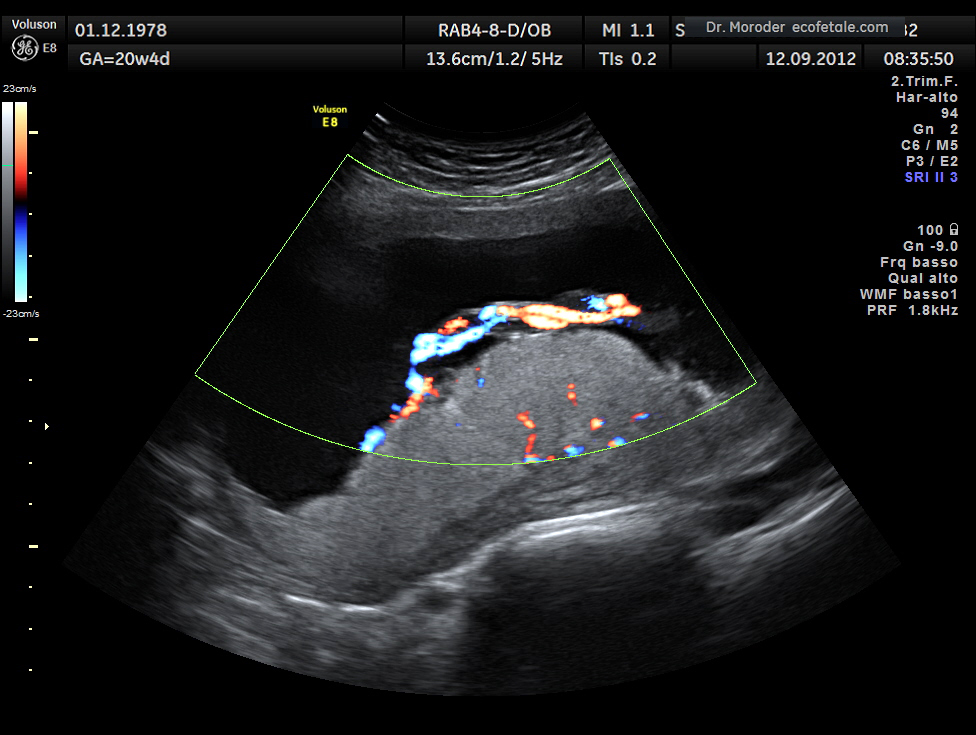
The placenta and the umbilical cord on colour Doppler at twenty weeks, the blood flowing between them where the baby is fed. A placenta that tires passes less across this join, the strain showing in the flow through the cord.
Small is not the same as starved.
Nearly all small babies are well. A baby of small parents, built small from the start, grows steadily along its own low line and arrives healthy, small by birthright. The baby a reader hunts for is the other one, the baby that should have been bigger and has been held back, starved by a placenta that cannot pass enough food and oxygen across. This baby is the one growth restriction names, and the scan exists to find it among the small. The commonest cause is a placenta that never grew well, its roots set shallow in the womb in the first weeks, the supply it can give capped from the start, the baby outgrowing that cap in the last months. The word restriction means held back from a size the baby was built to reach, the gap between what it should be and what it is the measure of the harm, a reader reading toward that gap. The placenta carries no nerves to feel its own failing, the first sign of it the baby it can no longer feed, the growth scan the window onto a silent organ. The scan that finds the starved baby early gives a team the time to plan, the weeks before the birth its real gift. The clue is in the way the smallness comes. A baby being starved falls away from the curve it was on, its growth slowing scan after scan, the belly leading the drop, the liver’s store run down first. The scan reads that slowing as the warning it is, a baby losing ground the baby to watch. The placenta tells its own part of the story. A placenta failing to feed a baby shows in the flow through the cord, the resistance climbing in the vessels of a tiring placenta. A reader reads the growth and the flow together, the size and the cord each telling a part of the same story. A small baby still slipping down a strained cord is the starved baby the scan was built to catch. The supply can fail in many ways, a placenta too small, a placenta scarred, a placenta seated over old damage, each passing less than a baby needs. The growth scan reads none of these directly, only their result in the size and the flow, the failing supply written in the baby it could not feed. The starved baby carries a risk a reader never forgets, the chance of dying in the womb higher in a baby the placenta has stopped feeding, the watching there to catch the failing early and bring the baby out before that risk comes due.
The constitutionally small baby is the trap. It reads small at every scan, a worry to a parent and a puzzle to a quick eye. The proof of its health is in the steadiness, a baby holding its own low curve, its cord flow normal, its fluid full. A reader who reads the whole picture spares such a baby a needless alarm. A small mother and a small father make a small baby in good health, low on the chart from the start. The scan reads such a baby as small by make, the steady curve and the easy cord flow the proof, a reader who calls every small baby starved frightening families for nothing. The healthy small baby moves well, its fluid full, its heart tracing lively, every sign beyond the size pointing to health, a reader leaning on those other signs with the size alone never the verdict.
The cause behind a starved baby shapes how it is read. A placenta worn out by a mother’s high blood pressure starves a baby late, the growth good until the last weeks and then slowing. A baby small from the first scans, whole-body small, points to a cause in the baby itself, a fault in its making or an infection caught in the womb. The late pattern, the belly fallen well below the head, points to a placenta giving out in the last weeks, the commonest kind of growth restriction. The reader reads the pattern for the steer it gives, the timing of the smallness a clue to where to look. Pre-eclampsia, the mother’s pressure climbing and her own vessels straining, is a common cause of a placenta that gives out, the baby small as a sign of the same disease that threatens the mother, with smoking starving a baby the same way. A twin can be growth-restricted with its partner thriving, the shared placenta feeding one twin less than the other, the smaller of the two watched against the larger, the gap between them its own warning.
The scan sorts the small into the well and the watched. The baby that slips from its curve, fed by a cord working hard, is the one watched closely toward an early birth. The reading turns on the growth over time and the flow in the cord, never on a single small number. The scan reads the small baby in three layers, the size, the trend, and the flow, the worrying baby the one that keeps slipping on a strained cord, the three signs stacking into the read of a starved one. The signs come in an order, the growth slowing first, the fluid falling, the cord flow worsening, the wellbeing score dropping last, a reader reading the order as a clock with the further along it the nearer the birth.
The signs of trouble
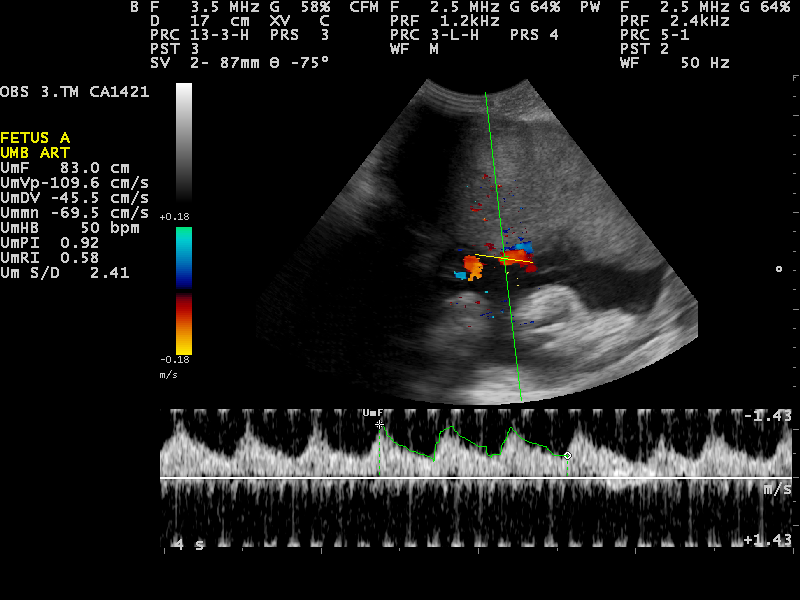
An umbilical artery Doppler. The colour over the cord marks its vessels, the waveform below tracking the blood through one heartbeat. The readouts give the resistance in the cord, the S/D ratio 2.41 and the pulsatility index 0.92, the figures a reader follows across the scans.
The clearest sign is growth that falters. A baby measured every two or three weeks shows its trend, the weight failing to climb the steady curve it should. A drop across the scans, the belly leading, is the sign of a baby no longer fed enough to grow. The first sign a mother brings is often a belly that has stopped growing, the tape falling behind the dates, a scan called for a small belly finding the baby behind it. A baby on a failing placenta grows quiet as well as small, its movements fewer, its strength spared for growing, a mother who feels less movement bringing two signs at once. Growth is read as a line across the scans, the trend the thing that matters, never a single point alone. A baby that has dropped from the fiftieth line to the tenth has fallen far, the fall the finding, read only over time. Growth velocity is the reading behind the trend, the centimetres a baby adds between scans, a belly that adds little or nothing across three weeks a belly stalled, the velocity a sharper sign than the size on any single day. A baby measured the same at two scans three weeks apart has not grown at all, a finding graver than a low number on either day.
The fluid around the baby falls when the placenta fails. A baby short of blood sends less to its kidneys, the kidneys making less water, the pocket of fluid around the baby shrinking. A low pocket on a small baby adds its weight to the worry, a sign the placenta is failing the baby in more ways than one. The pocket of fluid is read against a mark, a depth below it the sign of a placenta short on the water it should make. A small baby on a low pocket is read harder than a small baby in plenty, the two signs together heavier than either alone, the placenta’s shortfall shown in the space around the baby itself.
A starved baby protects its brain. The little blood it has is steered to the head, the brain fed first of all, the head holding its size longest. This head-sparing is the body’s own triage, read by a reader as a sign of a baby already going hungry. A reader who finds the belly fallen well below the head reads the gap as the body’s own rationing, the wider the gap the longer the baby has been going short. The brain-sparing shows in the flow as well as the size, the vessel to the brain opening wide to draw more blood, the falling resistance in it a sign of a body steering its blood to the head. The flow to the brain and the flow through the cord are read as a pair, the ratio of the two a finer reading than either alone, a brain drawing hard on a placenta giving little the picture that ratio catches early.
The flow in the cord is the surest reading of the placenta’s strain. The blood pushed through the cord meets the rising resistance of a closing placenta, the flow between the baby’s beats falling, then stopping, then reversing in the worst case. A cord flow that has lost its forward push between beats is a baby a team moves to deliver. The cord Doppler worsens in steps, the forward flow between beats fading first, then stopping, then reversing in the last stage, each step a deeper warning a reader reads off the trace. The resistance is put to a number, the pulsatility index, read higher in a placenta closing down and tracked across the scans, a rising index the early warning weeks before the flow fails outright. The vessel deep in the baby’s liver, the ductus venosus, is read in the last extreme, its faltering flow the sign of a heart beginning to give, a reader who reaches that vessel reading a baby at its limit.
Watching to the birth
A growth-restricted baby is watched to its birth. The growth is checked every two or three weeks, the cord flow more often, a wellbeing score run when the worry grows. The watching tightens when the signs worsen, the scans pulled closer together toward the day of the birth, a daily check on a baby whose cord flow has begun to fail. A growth-restricted baby earns a place on a watch list, the scans booked ahead and the cord flow read at each, the list running to the birth. The growth-restricted pregnancy ends in a planned birth far more often than a chance one, the day chosen on the evidence and set ahead of nature’s own. The mother is part of the watch, her count of the baby’s movements a daily reading between scans, a baby gone quiet bringing her in early. The cord flow is read as often as the signs demand, from twice a week up to daily when the worsening speeds up, a reader reading the pace of the worsening to set the pace of the watch.
The hardest call is when to bring the baby out. The cord flow and the wellbeing score guide the day the baby is safer out than in, the team holding on as long as the placenta keeps feeding and acting the moment it fails. An early birth is its own trouble, weighed each time against the danger of leaving a baby in a placenta that has given up, the call held to the evidence in hand. Steroids are given before an early birth, two doses to ready the baby’s lungs for the world, the growth-restricted baby brought out early arriving small, the weeks of care ahead the price of a placenta that failed too soon. The earlier a baby is brought out, the longer the road in the nursery, a reason a team holds on for every safe day it can, a cord flow still pushing forward earning another week of growth inside. There is a week past which a growth-restricted baby is brought out whatever its flow, the risk of staying climbing too high to leave it longer.
What it cannot settle
The scan cannot always tell the starved baby from the small one. A baby low on the chart with a normal cord flow sits in the doubt, watched until its growth and its flow declare it. The scan reads the size and the flow and the trend, the call made on the weight of all three, the doubtful baby kept under a close eye and named only when the picture is clear. Time and the next scan settle what a single look cannot. The scan and time together do what neither does alone. The growth-restricted baby born small carries its troubles into the nursery, low blood sugar and a hard time holding its warmth among them, the scan that catches it early sending it to a place ready to meet them. A small baby read once and let go is a small baby half-read, the second scan the half that matters. The scan reads what it can measure, the size and the flow, the baby’s true potential inferred from the parents and the curve, the call always a judgement built on what the scan can see. The miss that matters is the starved baby called only small, the reason a reader leans toward watching every doubtful one, a few extra scans a small price against that miss. The scan reads the body of a baby, the years ahead beyond its sight, a baby grown small caught and watched without a word on how it will fare in time. A baby found small and left under watch, its flow and its growth holding, is more often than not a baby that was only ever small, the watching proving the health it could not prove at a glance.
On a handheld
The growth scan suits a handheld well. The measurements need no fine detail, only a clean view of the head, the belly, and the thigh, the figures plotted against the weeks. A clinician with a pocket probe sizes a baby at the bedside, the weight read and the cord flow checked in one visit. The work asks for patience and a steady view, both within reach of a probe in a pocket, the same lengths read off the same views a cart would use. A baby tracked on one probe across many visits builds a clean line, the same machine and the same hand keeping the readings true. The pocket probe turns the growth check into a thing a clinic can do for itself, the baby sized and tracked without a referral, a small belly answered in the room it is found in.
The reach carries the growth scan to where care is thin. Growth restriction is read the same the world over, the same four lengths and the same cord flow, the chart the one thing that changes from place to place, a handheld carrying the whole method to where the scanners never reached. A mother whose belly seems small is scanned where she lives, the baby sized and the placenta’s work judged without a journey to a city, a starved baby caught early enough to plan its birth. The figures save to the phone, the growth tracked across scans, ready for a specialist to read from afar, the scan turning a small belly from a worry into an answer. The growth check belongs in the pocket now, the growth scan, once the work of a hospital round, riding in a coat pocket.
Common questions about growth restriction
What is intrauterine growth restriction?
It is a baby that has not grown to the size it should have for its age, usually because the placenta cannot feed it well enough. On ultrasound it shows as an estimated weight or a belly measurement below the tenth line on the growth chart, with the growth slowing across scans.
How is growth restriction different from a small baby?
Many small babies are built small and are perfectly well, growing steadily along their own low curve. A growth-restricted baby is one that should have been bigger and has been held back, its growth slipping scan after scan and its cord flow strained. The scan tells the two apart over time and with Doppler.
Why is the belly measured so closely?
The belly is the first part of the baby to shrink when food runs short and the liver gives up its store of fat and sugar. A belly that falls behind the rest of the baby is an early sign of growth going wrong, which is why it carries the greatest weight in the growth scan.
What does the cord Doppler show?
It shows how hard the placenta is working to feed the baby. When the placenta tires, the blood pushed through the cord meets more resistance, and the flow between the baby’s heartbeats falls, then stops, then in the worst case reverses. A loss of that flow sends a team to deliver the baby.
Can a handheld ultrasound assess growth?
Yes. The growth scan needs a clean view of the head, the belly, and the thigh, fine detail counting for less, which suits a handheld. A clinician sizes the baby and checks the cord flow at the bedside, which brings the growth scan to mothers far from a scanning centre.
About the Author
Julien Mercier
Senior R&D Engineer · Medical Ultrasound Transducer Development
Senior R&D Engineer with an M.S. in Applied Physics and over 15 years of experience in medical ultrasound transducer development, specializing in the design verification and performance testing of high-frequency imaging transducers. Currently leading the development and verification of the company’s next-generation high-frequency linear-array transducer, responsible for imaging performance evaluation and reliability analysis in preclinical testing. Brings extensive hands-on experience in piezoelectric element tuning, beamforming parameter optimization, and system-level performance testing.