IEC 62471 Photobiological Safety Vein Finder Infrared LED
IEC 62471 is the international standard for the photobiological safety of lamps and lamp systems, the light sources that shine on people. An infrared vein finder is one such source: it lights the skin with near-infrared light to show the veins. The standard sets out how to judge whether that light is safe for the eyes and skin. Most vein finders fall in its lowest, no-hazard groups. This is the rule that makes a device shone on patients all day safe to use.
What IEC 62471 is
IEC 62471 covers the safety of the light that lamps and LED sources put out. It looks at the light itself: whether shining it on a person can harm the eyes or the skin. Electrical safety and the build of a device fall to other standards. Any product that emits light at people, from a room lamp to a medical device, can be judged against it. The standard is part of a wider family covering everything from streetlights to projectors. Medical light sources are held to the same method. Across its parts, it gives both the exposure limits and the laboratory method for testing a lamp against them.
The standard exists because some light can hurt. Bright sources, certain wavelengths, and long exposures can damage the eye or burn the skin. IEC 62471 sets the limits and the method for measuring a source against them. A device that stays inside the limits is safe to use the way it is meant to be used. Sunlamps, projectors, and camera flashes all face the same kind of test.
The light a vein finder emits
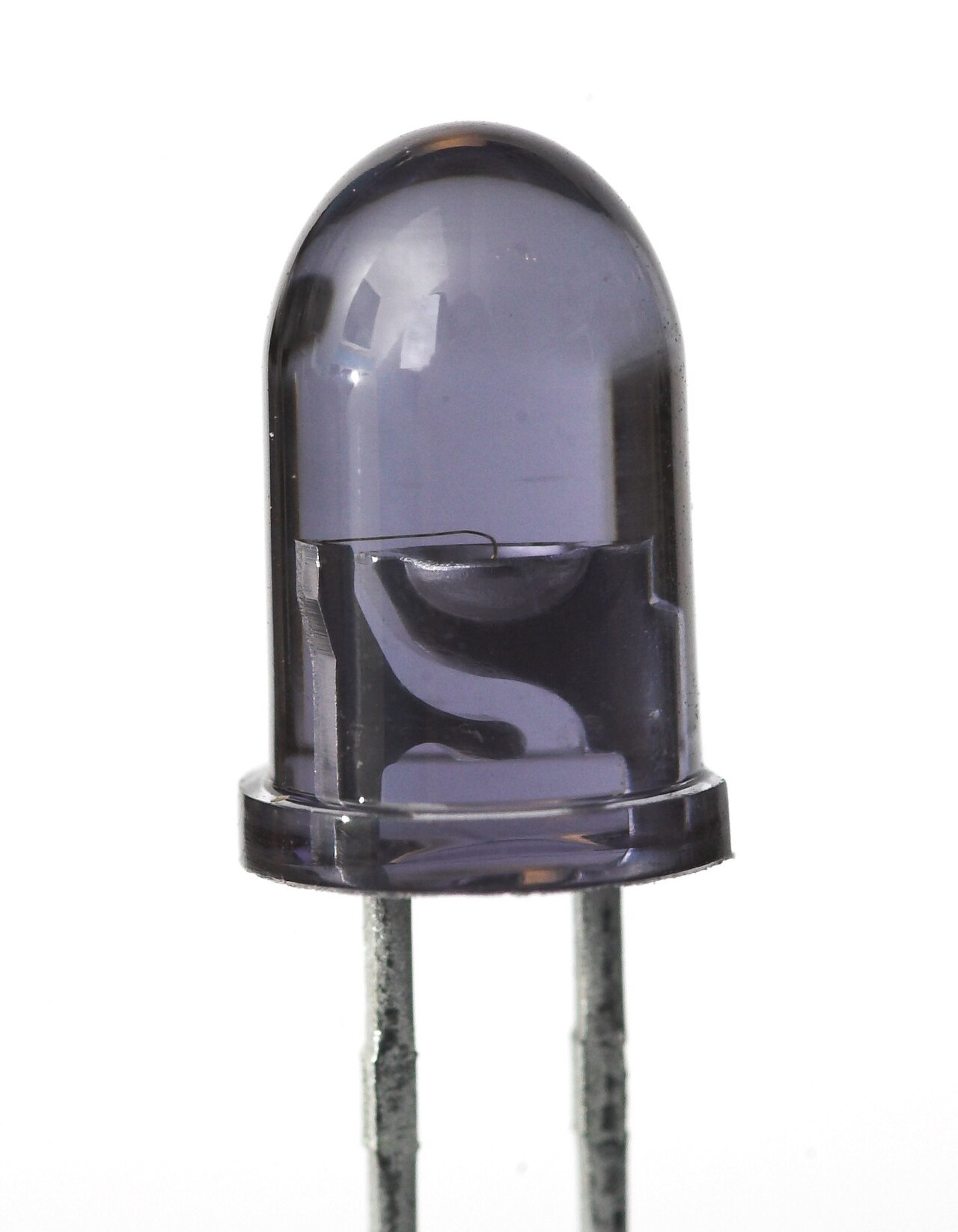
An infrared light-emitting diode, the kind of low-power source a vein finder uses. Its near-infrared light is invisible to the eye. It shines onto the skin to reveal the veins beneath.
A vein finder works with near-infrared light. The wavelength sits around 740 to 940 nanometres, just past the red the eye can see. That light is invisible. It comes from low-power light-emitting diodes, the same kind of source as a remote control or a night-vision illuminator. The device floods a patch of skin with it and reads what comes back. At those wavelengths the light passes a little way into the skin before it scatters back, which is what lets the device read the veins below the surface.
The power is low. The aim is the arm. A vein finder lights the skin of a limb. Its light points at the arm, away from anyone’s eyes. It runs at a low output, enough to read the veins a few millimetres down. The light spreads over a patch of skin. These are the things the standard weighs when it judges a source.
Some projecting finders draw the map on the skin with a laser. A laser falls under its own safety standard, the one for laser products. The projecting finders are built to its eye-safe class. The detecting light, the near-infrared that reads the veins, is the part IEC 62471 covers. Either way, the light a vein finder puts out is held to a published safety limit. Both standards trace back to the same exposure science.
The hazards it is measured against
The standard checks a source against the ways light can harm an eye. Different wavelengths carry different risks. Ultraviolet light burns the surface and harms the lens. Blue light can stress the retina. Near-infrared, the band a vein finder uses, carries two risks the standard names: heating of the lens, and heat reaching the retina. A vein finder is judged against those two. Each band has its own limit in the standard, set to the way that light reaches and harms the eye.
Heat to the lens is the slower risk. Near-infrared light is soaked up by the lens and the cornea, the clear parts at the front of the eye. A great deal of it, over a long time, can warm those parts and cloud the lens, the change called an infrared cataract. This is a risk for someone staring into a strong infrared source for years, like a furnace worker of old. The eye clears most of that heat by its own blood flow, so harm needs both a strong source and a long span of years. Modern sources made for the eye and skin sit far below the level where that slow heating begins.
Heat to the retina is the sharper risk. The eye focuses near-infrared light onto the retina the same way it focuses visible light, drawing it to a small bright spot. A strong enough beam, focused that way, could warm the retina and damage it. The snag is that infrared raises no blink and no pain, so the eye does not defend itself the way it does against bright visible light. The standard sets its retinal limit with that in mind.
Both risks turn on how much light, how focused it is, and how long the eye takes it in. A faint source, spread over skin and seen only for a moment, stays far inside the safe limit. IEC 62471 puts numbers on where the line falls, so a maker can measure a source and know which side it is on. The judgement comes down to dose: the light’s strength, its focus, and the time of exposure. Lowering any one of the three pushes a source further inside the limit.
How the standard sorts a source
IEC 62471 sorts every source into one of four risk groups, RG0 to RG3, as a national-laboratory safety guide sets out. The group depends on how its light measures against the exposure limits. The measurement is done at a set distance, the distance a person would normally be from the source. A source’s group is its safety label: it tells a user, at a glance, how much care the light needs. A medical device carries its group in the safety section of its manual, where a buyer or a hospital’s engineers can find it. Distance matters in the test, since a source read from farther off delivers less of its light to the eye.
The lower the group, the safer the source. A source in the lowest group can be shone freely. It needs no warning and no limit on viewing time. That group is a safety label. It tells a user at a glance how much care a light needs.
The risk groups, exempt to high
The four groups run from no risk to high. The lowest is the exempt group, sometimes written RG0: a source that poses no photobiological hazard at all, safe under any normal use. Next is risk group one, low-risk: safe in normal use, with no limit on how long it is viewed. These two groups cover the everyday light sources a person meets, room lights and screens and the like. A vein finder shares that everyday company, no more hazardous than the reading lamp on a desk.
The higher two groups are for stronger sources. Risk group two, moderate-risk, covers a source that could harm with a long direct stare, held in check by the natural urge to look away from a bright light. Risk group three, high-risk, covers a source that can harm even briefly, the kind kept out of everyday products. A bright industrial lamp or a powerful spotlight sits up here. Anything in those groups carries a warning label and a stated limit on how long it may be viewed.
A vein finder has no business in the higher groups. It is a low-power reader of the skin, aimed at an arm, far from the bright industrial sources those groups are meant for. Its place is at the safe end of the scale, in the exempt or low-risk group. It sits alongside the everyday sources a person meets without a thought. Nothing about its light asks a user to take care the way a strong lamp would.
Where a vein finder sits
A well-made infrared vein finder sits in the exempt or low-risk group, the safe end of the scale. Its near-infrared light is too low-powered, too spread out, and too brief in any one spot to reach the exposure limits the standard sets. A maker tests the device against IEC 62471 and classes it accordingly, the same as for any light source sold for use on people. That classification is the device’s plain statement that its light is safe to shine, on patient after patient, through a full working day. The test is run at the distance a clinician actually holds the device, so the rating reflects real use.
Why the device is safe
The safety of a vein finder rests on plain physics. The first reason is power. The light-emitting diodes in a vein finder run at a low output, far below the level that could warm the eye or skin. There is simply not enough energy in the beam to do harm, however long it runs. The output is measured in milliwatts spread across the emitter, a tiny fraction of what a hazard assessment flags. Held against the skin, it warms nothing a hand would notice.
The second reason is spread. A vein finder lights a whole patch of skin, so its energy is shared over a wide area. A spread-out light is gentle. No single point gets a strong dose of it. Its light stays diffuse, never gathered to the point that carries a risk. Wider spread means a lower dose at any one point on the skin or in the eye.
The third reason is aim. A vein finder is held over an arm and pointed at the skin. It is not aimed at anyone’s eyes in normal use. The light goes down onto the limb, where the veins are. The eye is never in its path. A device used as intended keeps its light well away from the one part of the body the standard most protects.
The fourth reason is time. A reading takes seconds. The device passes over the arm, then comes off. No part of the body, least of all an eye, takes a long steady dose. Even repeated through a day, each reading is a brief flood of gentle light on skin, nowhere near the long exposure a hazard would need. There is no standing exposure of the kind the standard worries about, where an eye rests in a beam for minutes on end.
Put together, these add up to a wide margin. The light is low-powered, spread out, pointed away from the eyes, and brief. Each factor alone keeps it well inside the limit. Together they put a vein finder so far into the safe zone that the exempt or low-risk classification is no surprise. The device is safe by a margin, used the way it is meant to be used. Sitting this far inside the limit, it leaves no room for ordinary use to push it over.
The eye, the part guarded most
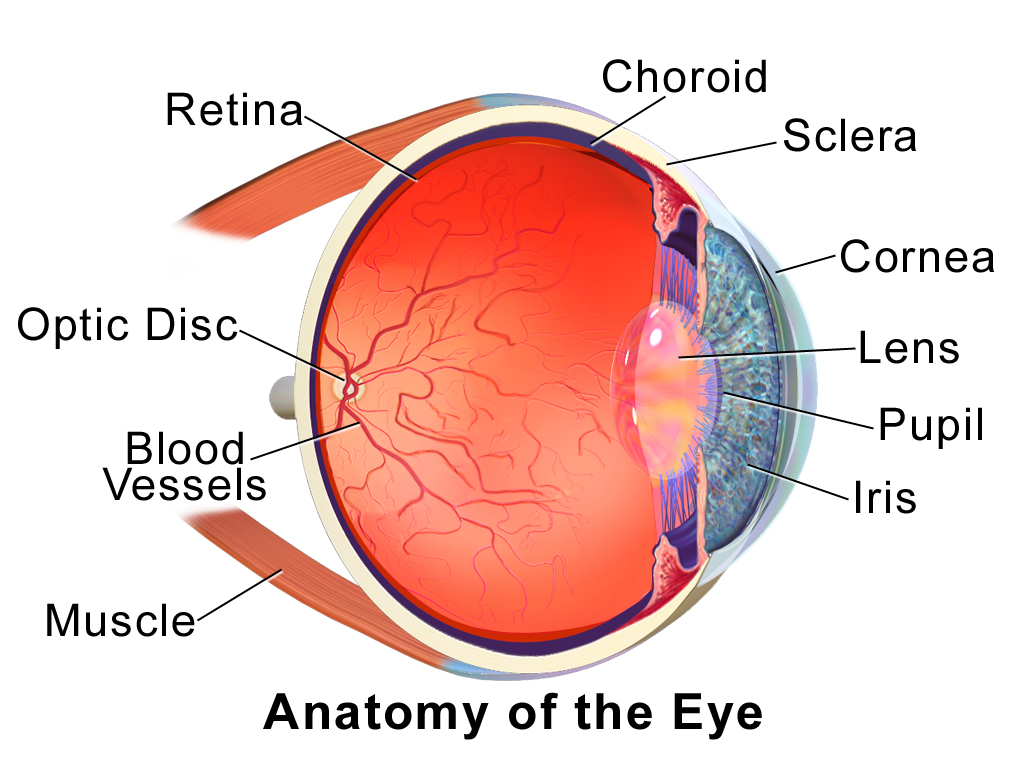
A cross-section of the eye. The cornea and lens at the front focus near-infrared light onto the retina at the back, the same as they focus visible light. That focusing is why the standard sets its tightest limit for the retina.
The eye is the reason the standard is careful with near-infrared light. The cornea and the lens, the clear front of the eye, focus this light onto the retina, the same as they do with visible light. That focusing is what could, with a strong source, concentrate energy on a small spot of the retina. The standard sets its tightest limits to guard that spot. The retina cannot feel heat or repair a burn, so the standard treats it as the part to protect first.
Near-infrared raises no warning in the eye. That is why the standard does the watching. The light cannot be seen. It causes no pain. The eye does not squint or look away from it the way it would from a bright visible light. The standard stands in for that missing reflex. It sets a limit low enough that no harm is done even with the eye held still.
What the rating means for a buyer
For a buyer, the safety classification is a box to check. A vein finder sold for clinical use should be tested to IEC 62471 and classed in the exempt or low-risk group. A projecting model with a laser should carry an eye-safe laser class. The maker states the classification in the device’s documents. A reputable one has the testing to back it. On the label it shows as a single line, naming the group the device was tested into.
A shared clinical device makes the rating worth checking. A vein finder on a ward is used many times a day, by many staff, on many patients, for years. A safe classification means none of that use adds up to a hazard, for the patients or the staff. The device can be used as often as the work needs. No dose has to be tracked. No exposure has to be limited. A hospital’s safety officer can sign the device off once, knowing the rating holds for every use that follows.
A low classification also settles the questions staff might raise. A nurse using the device dozens of times a day, or a patient asked to hold still under it, may wonder about the light. The exempt or low-risk rating is the plain answer: the light is safe, by a published standard, used the normal way. Nothing needs weighing up each time the device comes out.
A vein finder against IEC 62471
Item
Figure
What the standard covers
photobiological safety of lamps and LEDs
Risk groups
RG0 (exempt) to RG3 (high)
Where a vein finder sits
exempt or low-risk (RG0 / RG1)
Light used
near-infrared, about 740 to 940 nm
Retinal thermal hazard band
380 to 1400 nm
Eye protection in normal use
none
Using it safely
A vein finder asks only a little common sense in use. The plain rule is to point it at the arm. The light is made to read skin, so the skin is where it should go. Aiming the emitter at the skin, the way the device is designed to be held, keeps the whole question of eye safety academic. Held the normal way, the device puts its emitter against or just above the skin, where stray light into a face is barely possible.
One sensible habit is to keep the emitter out of the eyes. No one should hold a vein finder up and stare into the source, any more than they would peer into any light. The light is gentle. A glance does no harm. The habit of pointing it down at the arm, away from faces, costs nothing and removes even the small question.
Children and babies need no extra caution beyond the obvious. The same low-power light is safe on the smallest patients, used the same way. A clinician points it at the little hand or foot, well away from the child’s face, the same care any sensible person takes with any light. The classification covers the smallest patients the same as anyone. Parents sometimes ask. The honest answer is that the light is as safe for an infant as for an adult.
None of this is heavy procedure. There is no protective eyewear to don, no dose log to keep, no exposure clock to watch. The device is, by its classification, the kind a person can use freely. A little common sense, point it at the skin, is all the care a safe-classed vein finder asks.
What the standard gives
IEC 62471 is what turns a claim of safety into a tested fact. Under it, a vein finder’s light is measured against published limits and placed in a known group. A buyer reads the safety off the label, backed by testing. The standard replaces a promise with a number. Under it, a vague reassurance becomes a group a lab has measured.
For a vein finder, the number is reassuring. The device sits at the safe end of the scale, in the exempt or low-risk group, by every measure the standard takes. Its near-infrared light is too low, too spread, and too brief to reach the limits the standard sets. The safety holds by a wide margin, confirmed by test. That margin is what lets a clinician forget about the light entirely and think only about the vein.
A vein finder shines an invisible light on people, many times a day, for years. IEC 62471 is the standard that says, in tested terms, that the light is safe to shine. The near-infrared a vein finder uses is gentle, spread, and pointed at the arm. It sits in the standard’s no-hazard groups. For a device whose whole job is to shine light on patients, that clean safety classification is the quiet assurance behind every reading.
Common questions
Is the light from an infrared vein finder safe for the eyes?
Yes. The near-infrared light a vein finder uses is low-powered, spread over a patch of skin, and pointed at the arm, away from the eyes. A well-made device is tested to the photobiological safety standard, IEC 62471, and classed in its exempt or low-risk group. The light is safe to shine many times a day, for years. No eye protection is needed.
What is IEC 62471?
It is the international standard for the photobiological safety of lamps and LED light sources, the light they shine on people. It sets exposure limits for the eyes and skin, and a method to measure a source against them. A source is then placed in one of four risk groups, from exempt to high. Any device that emits light at people, a vein finder among them, can be judged by it.
Why is near-infrared light assessed for eye safety at all?
Because the eye focuses near-infrared onto the retina, the same way it focuses visible light. A strong source could concentrate energy on a small spot there. The light cannot be seen. It causes no pain. The eye does not blink or look away from it. The standard sets a low limit to cover that missing reflex. A vein finder is held well inside it.
What risk group is a vein finder in?
A well-made one sits in the exempt or low-risk group, RG0 or RG1, the safe end of the scale. Its near-infrared light is too low-powered, too spread out, and too brief to reach the standard’s limits. Those low groups need no warning label and put no limit on viewing time. The higher groups are kept for bright industrial sources, far from anything a vein finder emits.
Do staff or patients need eye protection?
No. A vein finder in the exempt or low-risk group is safe to use with the naked eye, for patient and operator alike. There is no protective eyewear to wear, no dose to track, and no limit on how often it is used. The whole point of the low classification is that the light needs no special handling. Pointing the device at the arm, the normal way, is all the care it asks.
Is it safe to use on babies and children?
Yes. The same low-power light is safe on babies and children, used the same way as on an adult. A clinician points it at the small hand, foot, or scalp, well away from the child’s face. The exempt or low-risk classification covers the smallest patients the same as anyone. No extra eye protection or precaution is needed for a child.
About the Author
Julien Mercier
Senior R&D Engineer · Medical Ultrasound Transducer Development
Senior R&D Engineer with an M.S. in Applied Physics and over 15 years of experience in medical ultrasound transducer development, specializing in the design verification and performance testing of high-frequency imaging transducers. Currently leading the development and verification of the company’s next-generation high-frequency linear-array transducer, responsible for imaging performance evaluation and reliability analysis in preclinical testing. Brings extensive hands-on experience in piezoelectric element tuning, beamforming parameter optimization, and system-level performance testing.