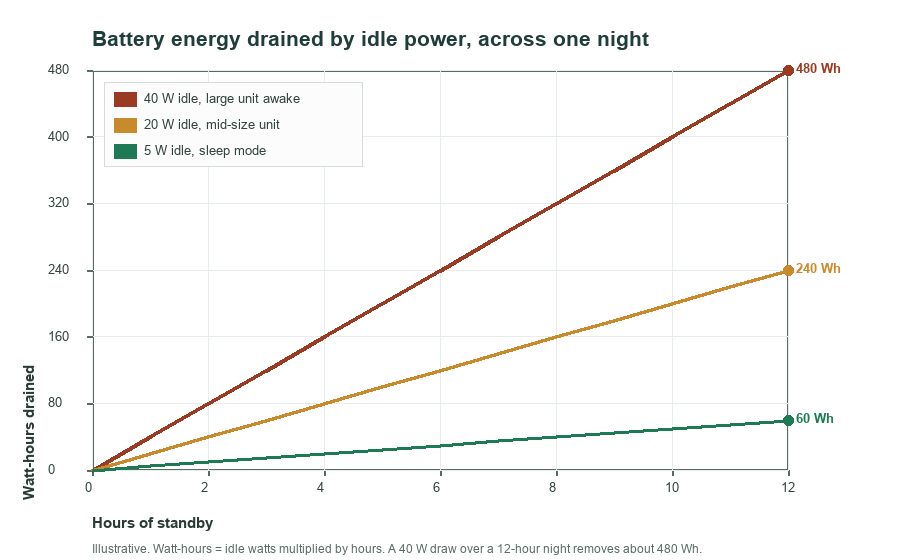
Battery energy drained by idle power across a night, drawn for three idle levels. A 40-watt draw, common in a large unit left awake, removes about 480 watt-hours over a 12-hour night. A 20-watt draw removes 240. Sleep mode at 5 watts removes 60. Each line is watt-hours equal to idle watts times hours. The figures are illustrative.
An inverter spends power the moment it is switched on, before any device draws a single watt. That quiet draw is the idle power. Over a long evening or a slow weekend it is the cost that empties the battery between real jobs. A power station left on with nothing plugged in can lose a real part of its charge between dusk and morning.
The number behind this looks small on paper. A portable inverter idles at a few watts. A large 5000-watt unit idles at twenty to fifty watts. Set against a 5000-watt rating, that figure reads like a rounding error. It earns little attention on a busy spec sheet.
Runtime turns the small number into a large one. Idle power runs around the clock, hour after hour. A single watt left on for a day removes twenty-four watt-hours from the pack. Across a full night of standby the idle draw becomes a real share of the stored energy, the part of the runtime that quietly disappears.
What the inverter spends on itself
The idle watts pay for the work of staying ready. An inverter holds a 110-volt or 220-volt wave at its output at every moment the switch is on. Building and holding that wave costs power, even when no device takes it. The cost is the price of readiness, paid for every second the output stays live.
The control board runs first. A small processor watches the output, times the switching and reads the temperature and the battery. This circuitry draws a steady trickle the whole time the unit stays awake. The trickle looks like nothing on a meter. It never stops as long as the power is on.
The power stage adds the next share. The transistors that chop the DC into AC switch tens of thousands of times a second. Each switch loses a little energy as heat. Those switching losses run whether the output carries a load or sits empty, since the switching itself never pauses on a live inverter. The loss is the tax a switching converter pays on every hour it stays powered.
A transformer, in a unit that uses one, draws its own idle current. A magnetic core takes power to stay magnetized through every cycle. That core loss continues with the output open. The core hums along on the battery the whole time the inverter holds its wave.
A cooling fan can join the list. Some inverters spin the fan on a timer or a temperature step. The fan pulls several watts each time it runs. On a warm day the fan lifts the idle figure well above its quiet-room value, since the unit works harder to shed heat in the warmth.
The standby draw beyond the inverter
The inverter is not the only part awake during standby. A modern power station runs a small computer of its own. That computer stays partly awake the whole time the unit is on. Its draw adds to the inverter’s idle on the same battery. An honest runtime estimate for the unit counts this draw beside the inverter’s own.
The screen takes a share whenever it lights. A bright display can pull a couple of watts on its own. Many stations dim the screen after a minute and wake it on a touch, which trims the cost during the long idle hours. The reading on that screen costs a little energy each time a hand wakes it.
The battery management system draws a steady sip of its own. This circuit watches each cell, balances the pack and reads the temperature at all times. Its draw is small, in the range of a watt or less. It runs even with the inverter switched off, since the pack needs watching whenever charge sits inside it.
A wireless radio adds the last sip on a connected unit. A station that holds a Bluetooth or Wi-Fi link for its app keeps a radio listening around the clock. Turning the radio off in the app removes that part of the standby draw for anyone who skips the phone link. The link is a convenience that carries a small standing cost. A unit kept fully offline trims its standby draw to the lowest it can reach.
Inverter design and the idle floor
The build of the inverter sets where the idle floor sits. A heavy low-frequency design uses a large mains transformer. That transformer draws a magnetizing current every cycle. The current holds the idle floor higher on this kind of unit, even before any other part wakes.
A high-frequency design swaps the heavy transformer for small parts that switch at tens of kilohertz. The smaller magnetics draw less standby current. Many portable stations use this design for a lower idle floor and a lighter case. The result is a no-load figure measured in single watts on many of these compact units, low enough to leave the unit ready for hours at little cost. The choice of topology shapes the no-load number long before a buyer ever sees it.
Either design still spends something at idle. The control logic and the switching never reach zero on a live output. The floor depends on the design, the size and the quality of the parts. A careful maker trims each piece of it, since the sum decides how a unit holds charge overnight.
A draw that does not scale down
Idle power does not shrink to match a light load. The control board, the switching and the core loss run at much the same level whether the inverter feeds a 2000-watt tool or a 5-watt phone charger. The floor stays where it sits, no matter how small the job riding on top of it. The floor sits at the same height for a heavy tool and a single phone charger.
A bigger inverter sets a higher floor. A 5000-watt unit carries larger transistors and a heavier transformer than a 1000-watt unit. Both raise the idle draw. The common rule of thumb across mid-size inverters places the no-load figure near one percent of the rated power. A larger rating tends to carry a larger standing cost. The pattern holds from small units up to the largest portable packs.
Idle draw and what it costs over time
Idle draw
Over a 10-hour night
Over 24 hours
Share of a 1000 Wh pack per night
Days to empty a 2000 Wh pack, idle only
5 W (sleep)
50 Wh
120 Wh
5%
~16.7 days
20 W
200 Wh
480 Wh
20%
~4.2 days
30 W
300 Wh
720 Wh
30%
~2.8 days
40 W
400 Wh
960 Wh
40%
~2.1 days
60 W
600 Wh
1440 Wh
60%
~1.4 days
Putting idle power into the runtime sum
Runtime follows one short sum. The usable energy in the battery, in watt-hours, divides by the total draw in watts. The answer is the hours the pack lasts. Idle power sits inside that total draw at all times, in the denominator of every runtime figure a unit can claim. The same short sum governs a phone charger and a refrigerator alike, since both pull their watts from the one battery through the one inverter.
With nothing plugged in, idle power alone sets the runtime. A 2000-watt-hour pack behind an inverter that idles at forty watts drains in about fifty hours, a little over two days, before any device has run. The same forty watts running through one night removes close to 480 watt-hours, near a quarter of the pack.
A real load shares the sum with the idle draw. A 100-watt load on the same forty-watt inverter pulls 140 watts from the battery. The runtime falls in step with the larger total. The idle adds forty percent on top of the work the load itself needs. That surcharge rides along for the whole session.
The lighter the load, the louder idle power speaks. A few extra watts barely touch a 100-watt load. On a 10-watt load behind a 40-watt inverter, the total draw reaches fifty watts. The inverter itself claims four-fifths of that fifty. Only the last fifth reaches the device.
The cost of leaving it on overnight
A unit left on through the night is the clearest case of idle drain. Eight hours of standby at forty watts removes about 320 watt-hours before breakfast, energy that powered nothing. A power station switched off at bedtime and back on at dawn keeps that 320 watt-hours for the morning coffee. The habit of switching off between real jobs is the single largest idle saving a user controls. A single forgotten night can cost more charge than a careful day of real use saves. The number repeats every night the switch stays on, a standing charge against the morning reserve.
Why a light load wastes the battery
The waste at light load comes from a fixed cost meeting a small job. Idle power is that fixed cost. It runs at the same forty or fifty watts whether the load is large or close to nothing. A heavy load spreads the fixed cost across a lot of useful work. The share lost to idle then stays small. A light load has little useful work to spread it across. The fixed cost swallows a large slice of every watt-hour the battery gives up. Picture a phone charger that needs five watts. On its own the charger would empty little of a power station across a night. Placed behind an inverter that idles at thirty watts, the charger now travels with a thirty-five-watt total draw. The battery sees thirty-five watts leave it for every five watts that reach the phone. Seven units of energy go out of the pack for one unit of charging. A 1000-watt-hour station that might hold the charger for a week on a clean five-watt draw now lasts a little over a day, because the inverter spends the rest. The same pattern shows up with any small overnight load. A 10-watt router, a 3-watt clock and a 15-watt string of lights each ride on top of the idle draw. Each one pays the same fixed toll. The cure is rarely a bigger battery. A bigger battery feeds the idle draw for longer at the same level of waste. The cure is a lower idle draw, a small power path for small loads, or an inverter that sleeps between jobs. A portable station that carries USB and 12-volt outputs can run a phone or a router straight from the battery. The AC inverter stays off. Its idle cost disappears for that job.
Heat makes the light-load waste a little worse. A transformer-based inverter runs least efficiently when it is barely loaded. A small share of even the load’s own watts turns to heat on the way through. The battery covers the idle draw, the conversion loss and only then the device.
The lesson points at every watt that runs through the inverter overnight. A load that genuinely needs the AC wave has a reason to be there. A load that could run from a DC outlet pays a heavy premium for the inverter underneath it.
Numbers make the case concrete. A 30-watt idle draw over a 10-hour night is 300 watt-hours. On a 1000-watt-hour station that is near a third of the pack, gone before any device counted. Cutting the idle draw to 5 watts in sleep mode brings that night down to 50 watt-hours.
The waste also hides from a quick check. A user who plugs in a small load, watches it run, then unplugs it never notices the idle draw underneath. The drain shows only across hours of standby, on the morning charge reading.
A runtime plan that leaves the idle number out gives a figure that always reads too high. A sum that counts only the load promises more hours than the pack delivers. Folding the idle draw into the total brings the estimate back to the figure the morning will show.
Idle power through a night off-grid
A night away from the grid shows idle power in plain numbers. A camper plugs a 12-volt fridge into the inverter at dusk. The fridge cycles on and off through the night and averages perhaps forty watts of real work. The inverter underneath it idles at thirty watts the whole time.
The idle draw runs every one of those hours, awake behind the fridge. Over a ten-hour night the fridge itself might use 400 watt-hours. The inverter adds close to 300 watt-hours of idle on top. The night costs near 700 watt-hours. Almost half of that paid for the inverter staying ready. The battery meter counts both draws together as one falling number through the night.
Solar hides the idle draw by day. Panels in the sun can pour in more than the inverter spends. The pack holds its charge or climbs through the daylight hours. The standing cost barely registers during the hours the input runs ahead of it.
The dark hours send the bill. After sunset the battery carries the fridge and the idle draw alone. A camper who moves the fridge to its own 12-volt socket, away from the inverter, drops the idle cost from the night entirely. The same fridge then runs straight off the pack for a longer stay. The move costs nothing in setup. It adds hours to the cold box by morning.
Why the idle figure gets overlooked
Idle power slips past many buyers for a simple reason. A spec sheet leads with the headline numbers, the peak watts and the battery size. The no-load draw sits far down the list, in small type, named in a way that hides its weight.
The draw also hides in normal use. A device plugged in and running masks the idle underneath it, since the meter shows the total and never splits out the inverter’s share. The idle only steps forward in the quiet hours. Nothing else draws then. The battery still falls. A long night of slow drain is the one time the idle draw stands alone on the meter.
The habit of reading runtime from the load alone makes the gap worse. A buyer multiplies the battery size by the load and reads a runtime from that figure alone. The field delivers fewer hours than the sum promised. The missing hours went to the idle draw that never entered the calculation.
Sleep mode and the search threshold
Many inverters answer idle drain with a sleep mode. The unit drops much of its circuitry to a low-power state. It sends out a short pulse every second or so to check for a load. Search mode, eco mode and standby are the common names for the same trick. The pulse is brief enough to cost almost nothing on its own across an idle hour.
Sleep mode cuts the idle draw hard. A unit that idles at forty watts awake can sit at five to ten watts asleep. That change turns a 960-watt-hour daily idle loss into something near 150. It buys days of extra standby on the same battery.
The threshold sets the limit of the trick. The inverter wakes only when the pulse detects a draw above some minimum, often in the range of ten to fifty watts. A load lighter than that minimum can fail to wake the unit, or can make it stutter between sleep and wake. A tiny device sometimes needs the inverter held fully awake, at the full idle cost, to run at all.
Cutting the idle drain in practice
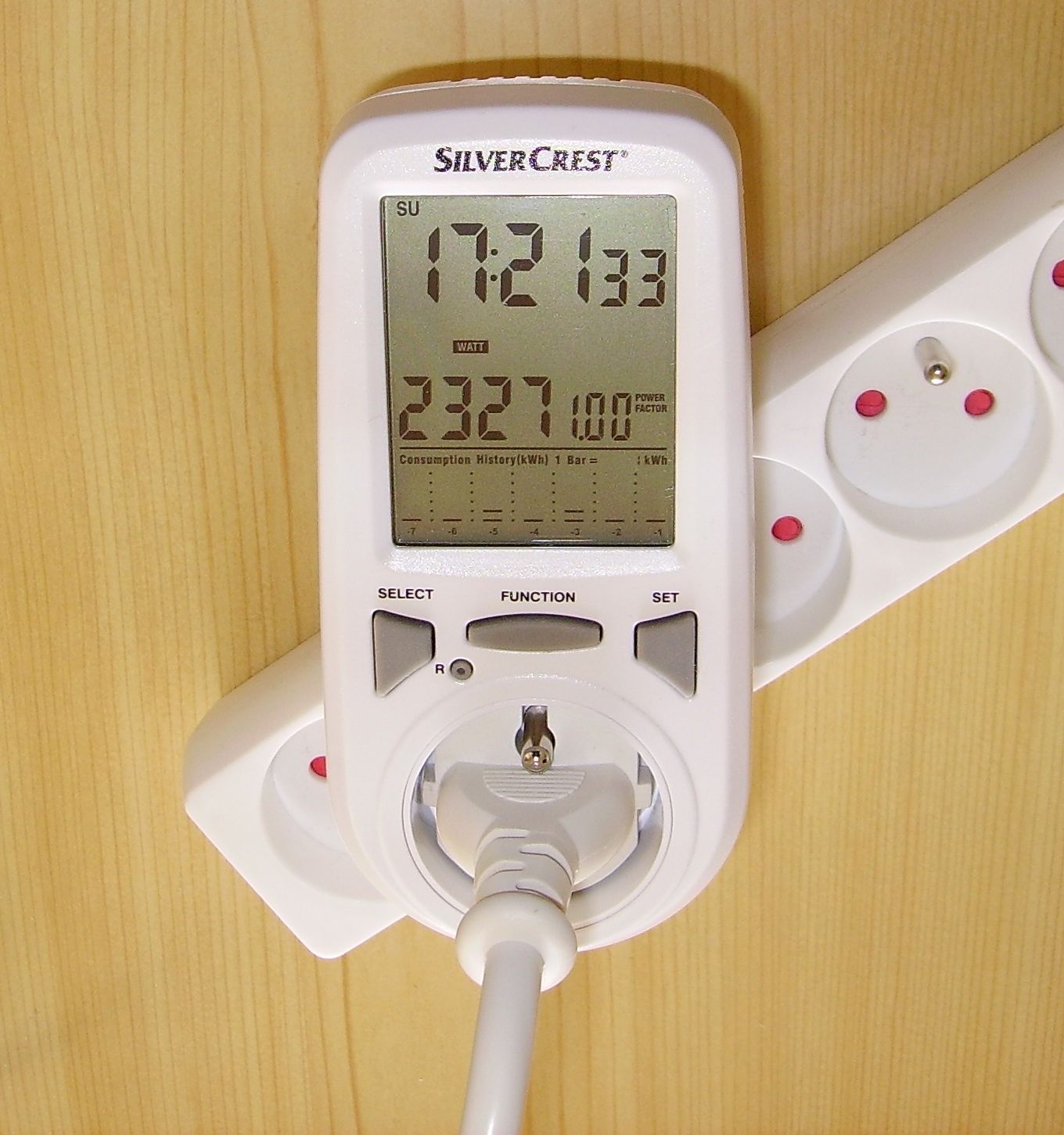
A plug-in mains energy monitor of this kind reads the watts a device pulls from an outlet. An inverter’s own idle draw shows on the power station’s battery or input display, since the idle current is spent before the AC outlet. The screen here reports live power in watts, the kind of small reading idle power produces. A meter like this can log the draw over a night for a real figure.
A few habits keep idle power from quietly draining a pack. Each one chases the same goal of fewer idle watts.
Switching off between jobs is the first and largest. An inverter draws nothing when its main switch is off. The idle cost falls to zero for every hour the unit rests. A power station used in bursts through the day gains the largest cut from this one habit. A unit that sits off for the afternoon spends nothing at all in those hours.
Enabling eco or search mode is the second. The setting lives in the menu or on a switch on many units. It holds the inverter in its low-power state until a real load appears. A user who leaves the unit on for convenience still saves much of the idle cost this way.
Matching the inverter to the load is the third. A 5000-watt inverter run for a 50-watt load carries a high idle floor for a tiny job. A smaller inverter, or a second small one kept for light duty, sets a lower floor for the hours the big loads sleep.
Running small loads on the DC outlets is the fourth. A portable station feeds its USB and 12-volt sockets straight from the battery. No inverter sits in that path. A phone, a fan, a router, or a light on those outlets escapes the idle cost of the AC wave.
Grouping the AC loads in time is the fifth. Running the AC jobs together in one window spends the idle cost across a single busy hour. Switching the inverter off after that window ends the idle draw for the rest of the day.
Measuring the real idle draw is the sixth. The station’s own battery or input display, read with nothing plugged in, shows the watts the inverter spends on itself. A cheap plug-in energy meter can log the same draw over a night for a clearer picture. A measured idle number turns runtime planning from a guess into a sum.
Reading the idle figure on the spec sheet
The idle draw hides in the fine print of the spec sheet. The line reads no-load current, no-load power, standby consumption, or quiescent draw, in watts or in amps from the battery. A figure given in amps multiplies by the battery voltage to reach watts.
A no-load current in amps tells the same story as a watt figure. A reading of 0.8 amps from a 48-volt battery works out to about 38 watts of idle draw. The same 0.8 amps from a 12-volt battery is under 10 watts, because the lower voltage carries less power at the same current.
Two inverters of the same wattage can list idle figures far apart. A unit built for off-grid life often shows a low no-load draw and a strong sleep mode, since its makers know the figure decides the overnight drain. A reading of the standby line before buying separates a unit that sips at idle from one that gulps. The gap between a frugal unit and a thirsty one shows up only after many nights on the same charge.
Idle power is the quiet line on the runtime ledger. It runs whenever the inverter is awake. A larger unit carries a larger idle draw. The figure decides how much charge survives a night of standby. A buyer who reads the no-load figure, switches off between jobs and leans on sleep mode keeps the battery for the work that matters.
Frequently asked questions
How much power does a portable inverter use with no load?
A small portable inverter idles at a few watts. A mid-size unit sits near twenty to forty watts. A large 5000-watt inverter can reach forty to sixty watts. The common rule of thumb places the no-load draw near one percent of the rated power. Sleep mode can bring the figure down to five to ten watts.
Does idle power change runtime by much?
Across a night it does. A forty-watt idle draw over ten hours removes 400 watt-hours, close to half of a 1000-watt-hour station. On a light load the idle draw can take more energy than the device it sits under. The smaller the load and the longer the standby, the larger the share idle power claims.
Should the inverter be switched off when nothing is plugged in?
Switching off ends the idle draw for that time, which makes it the simplest way to save the charge. A unit left on overnight can lose a quarter of its pack to idle alone. A user who needs the outlets ready can enable sleep mode for a middle path that keeps the unit responsive at a low draw.
What is search or eco mode on an inverter?
Search mode holds the inverter in a low-power sleep and sends a short pulse every second or so to look for a load. The draw falls from tens of watts to a handful during the wait. The inverter wakes to full power when a load above its threshold appears. A load lighter than that threshold may not trip the wake. It sometimes needs the mode switched off to run.