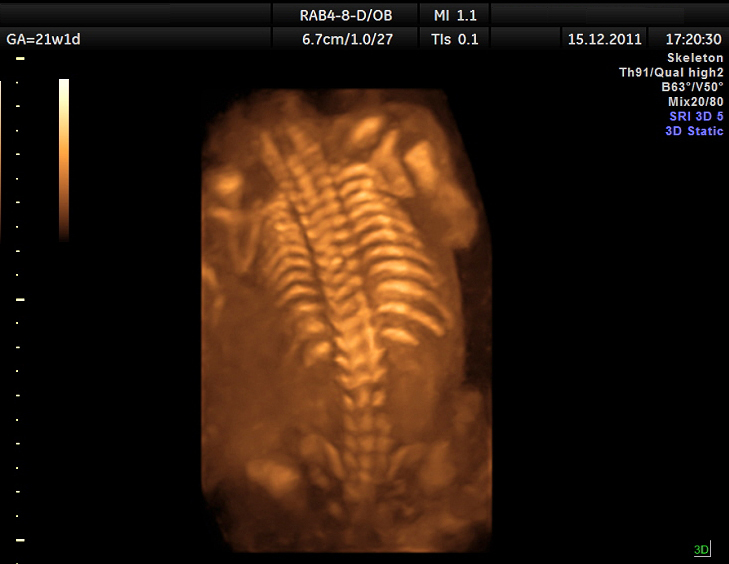
A 3D fetal render; a live scan is a video stream the radio has to deliver frame after frame without stutter.
A wireless ultrasound probe has no screen of its own; it makes the image inside its head and then has to throw that image, live and without stutter, across the air to the phone or tablet in the clinician’s other hand. The radio that does this is usually built on the WiFi standard known as 802.11n, run in dual band, meaning it can speak on both the crowded older frequency near two and a half gigahertz and the faster, cleaner band near five. This sounds like a networking detail and is in fact one of the things that decides whether the probe is pleasant or maddening to use, because a scan is a moving picture that has to arrive in step with the hand that is steering it, and a link that lags or drops frames turns a diagnostic instrument into a slideshow. The wireless link is the invisible cable, and how well it is engineered shows the moment the probe is moved.
The probe makes the picture; the radio has to deliver it before the moment it shows has passed.
What the link has to carry
It helps to grasp how much data a live scan amounts to, because the radio is not sending a few snapshots but a continuous video stream that has to keep flowing for as long as the probe is imaging.
Each frame is a grid of pixels, each pixel carries a depth of grey, and the probe produces many frames a second, so the raw stream coming off the beamformer is a torrent that would swamp any consumer radio if it were sent uncompressed. The probe compresses each frame before it goes out, trading a little image quality for a stream the radio can carry, and the art is in compressing enough to fit the link without softening the picture a clinician needs to read. The link has to sustain that compressed stream continuously rather than in bursts, since a scan is only useful if the picture keeps arriving frame after frame, and a radio that can manage a quick file transfer may still fail at a steady real-time feed. Two qualities matter more than raw speed here: throughput that holds up without dipping, and latency, the delay between the probe capturing a frame and the phone showing it. A link with high average speed but unpredictable timing produces a picture that is sharp but laggy, and a clinician steering a probe by a laggy image is aiming at where the anatomy was a moment ago. The radio is judged less by its peak number than by whether it holds a steady, prompt stream while the hand keeps moving.
A live scan is a video feed, not a photo, and a video feed forgives a slow link far less.
Why two bands instead of one
The dual-band design is not a luxury but a way of coping with the fact that no single radio band is good in every situation, and being able to choose between two is what keeps the link usable across the places a handheld goes.
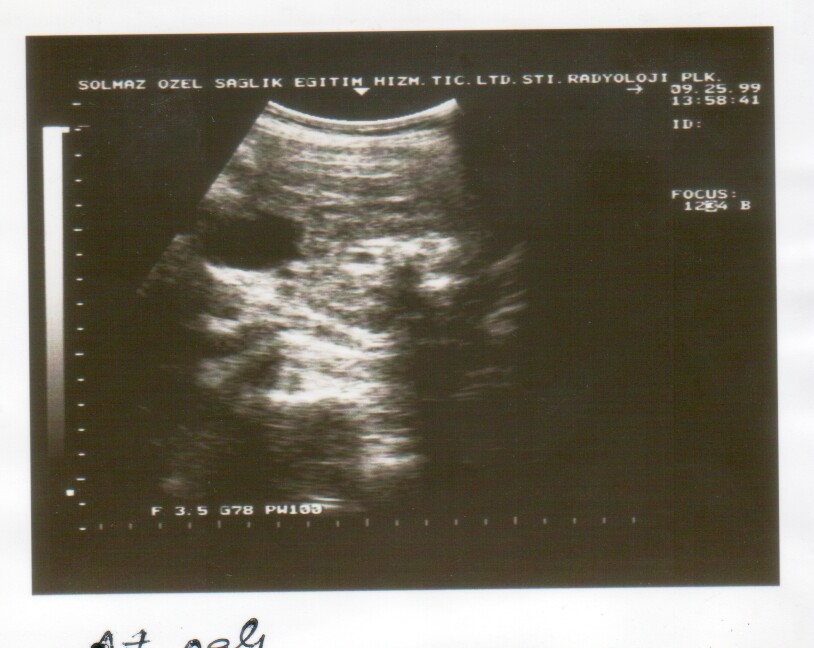
A grayscale scan; the wireless link has to carry this picture to the phone in step with the moving probe.
The lower band near two and a half gigahertz travels farther and passes through walls and bodies more readily, but it is the band every phone, router, and microwave oven also crowds into, so it is often congested and slow precisely where a clinic is busiest. The higher band near five gigahertz carries far more data and is usually much less crowded, which suits the heavy continuous stream a scan demands, but its signal fades faster with distance and is blocked more easily by obstacles. A probe that can use only the lower band is tied to the congested frequency and will struggle to hold a clean stream in a busy hospital, while one fixed to the higher band may lose the link the moment the phone is a room away. Dual band lets the device take the fast, clean higher band when the phone is close and the air is clear, which is the usual case for a probe and the screen in the same pair of hands, and fall back to the longer-reaching lower band when distance or obstruction demands it. The choice is not a marketing tier but a genuine engineering hedge against an unpredictable radio environment, and a probe that can work both bands has two ways to keep the picture flowing where a single-band device has one. The clinician never sees the band in use, and feels it as a link that simply keeps working as they move.
One band reaches farther, the other carries more, and the probe that can pick between them keeps the picture alive in more rooms.
The direct link and the question of latency
How the probe and the phone are connected matters as much as which band they use, and the cleanest arrangement is usually a direct link between the two rather than a detour through the building’s network.
Many handhelds form their own direct connection to the phone, the probe acting as its own access point so the image travels straight from probe to screen without passing through a hospital router that may be busy, distant, or locked down. That direct path keeps latency low and takes the unpredictable congestion of the building network out of the picture, and that is why a probe that insists on joining the hospital WiFi can feel laggier than one that talks straight to the phone in the same hand. Latency is the quantity a clinician feels the soonest, since the whole point of real-time imaging is that the picture moves when the probe moves, and even a fraction of a second of delay makes fine positioning frustrating and fast procedures unsafe. A well-built link keeps the round trip short enough that the lag is below what the hand can notice, and a poorly built one lets the delay creep up under load until the operator is fighting the picture. The connection design, the band choice, and the compression all serve this single felt quality, the sense that the image is happening now rather than a beat behind, and a probe that gets latency right disappears into the task while one that gets it wrong reminds the user of itself with every sweep.
What happens when the link is poor
The failures of a weak wireless link are telling to name, since they are the symptoms a buyer will live with daily and the ones a demonstration in a quiet room will hide.
The commonest failure is dropped frames, where the radio cannot keep up with the stream and the picture skips, so a smooth sweep becomes a series of jumps and a moving structure stutters across the screen in a way that makes fine tracking impossible. The next is creeping latency under load, where the picture stays detailed but falls steadily behind the hand, so the operator moves the probe and waits a beat to see the result, an experience that turns a quick scan into a clumsy negotiation. A third is outright disconnection, the link dropping entirely when the phone moves a little too far or another device floods the band, which forces the clinician to stop, reconnect, and lose the thread of the exam. A fourth, subtler still, is silent quality reduction, where the probe quietly compresses the image harder to keep the stream alive, so the picture stays smooth but loses the fine detail a diagnosis may rest on without the operator being told the trade was made. Each of these is invisible in a brochure and obvious within a minute of real use, which is exactly why the wireless link rewards a hands-on trial more than any other part of the device. A probe whose radio was an afterthought betrays itself the moment the room is busy or the phone is across the bed.
A weak link does not announce itself; it skips, lags, drops, or quietly blurs, and only use reveals which.
Why the handheld depends on it utterly
For a cabled probe the image travelled down a wire that never dropped a frame, so the link was a solved problem; for a wireless handheld the radio is the whole nervous system, and its quality sets the ceiling on everything else.
A probe can carry a superb beamformer and a fine array and still be unpleasant to use if the picture those parts produce cannot reach the screen smoothly, since the clinician interacts with the image on the phone rather than with the electronics in the hand. This is the quiet trap of judging a wireless probe by its imaging specification alone, because the finest image in the world counts for little if it arrives a beat late or a frame short, and the radio is the part that decides whether the imaging engine is felt at its full quality or through a veil of lag. A maker that understands this invests as much in the wireless link as in the beamformer, treating the radio as a clinical component rather than a commodity module bolted on at the end, and a maker that does not ships a probe that images beautifully on the bench and frustrates in the ward. The wireless link is where the handheld either delivers on the promise of its other parts or quietly squanders it, and the buyer who treats the radio as seriously as the array is judging the probe by the experience it will in practice give. The picture is only as good as the path it takes to the eye, and the path is a piece of engineering the buyer should weigh as carefully as the lens or the array.
The radio is the handheld’s nervous system, and a brilliant probe behind a poor link is a brilliant probe a clinician never quite gets to see.
What the buyer should weigh
The wireless link is hard to judge from a brochure, since the figure that gets printed is peak speed and the qualities that decide the experience are steadiness and delay, so the buyer has to ask better questions than the spec sheet answers.
The first thing to confirm is dual-band capability, since a probe that can use only the lower band is committed to the busiest frequency and will struggle in any busy clinical setting. The second is whether the probe forms a direct link to the phone or relies on the building network, since the direct path is what keeps latency low and predictable, free of a router the buyer does not control. The third is how the probe behaves at the edges, when the phone is across a room, when the band is congested, when several devices are imaging nearby, because that is where a thin radio design reveals itself in dropped frames and creeping lag. The fourth is whether the maker speaks about latency at all, since a maker that has engineered the link for real-time use will talk about delay and frame stability, while one that quotes only a megabit figure has measured the easy thing and left the hard one untested. A buyer who watches a live scan while walking the probe away from the screen learns more in a minute than the data sheet says in a page, since the link either holds the picture steady and prompt or betrays its limits the moment it is asked to work.
Peak speed is the number on the box; steadiness and low delay are what the hand truly feels, and a probe that holds a prompt, unbroken picture while the operator walks the room has passed the only test of a wireless link that truly counts.
About the Author
Julien Mercier
Senior R&D Engineer · Medical Ultrasound Transducer Development
Senior R&D Engineer with an M.S. in Applied Physics and over 15 years of experience in medical ultrasound transducer development, specializing in the design verification and performance testing of high-frequency imaging transducers. Currently leading the development and verification of the company’s next-generation high-frequency linear-array transducer, responsible for imaging performance evaluation and reliability analysis in preclinical testing. Brings extensive hands-on experience in piezoelectric element tuning, beamforming parameter optimization, and system-level performance testing.