How to Choose Portable Ultrasound for OB GYN Clinic
A portable ultrasound for an obstetric and gynecology clinic is chosen by one test: does it cover the exams the clinic actually runs, at a price the clinic can carry? The answer is a short list. The right probes, enough depth to reach a third-trimester fetus, fetal Doppler, and the measurements an obstetric study is built on. Everything past that list is comfort.
Start with the exams the clinic runs
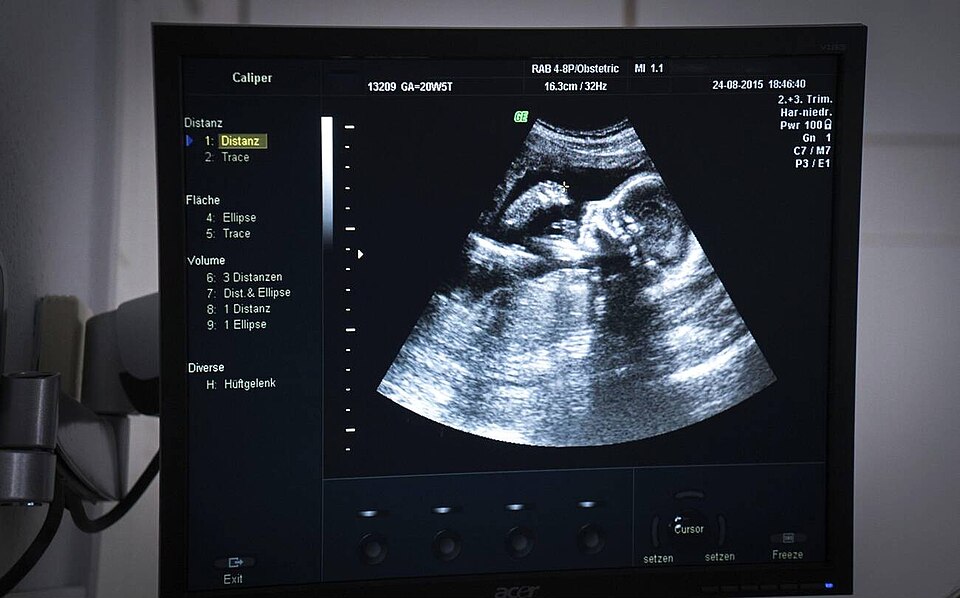
An obstetric scan on the monitor, a fetus at twenty weeks. The machine’s own menu, down the left, offers the distance, area, and volume measurements an obstetric study runs on, and the top line carries the obstetric preset with the gestational age it has worked out. This is the everyday work a clinic buys a machine to do. Image: Goleisureintl, CC BY 4.0.
The machine does not set the spec. The clinic does. Before any model is compared, the first move is to write down the exams the clinic runs in a week, and how often each one comes up. That single list, written before any sales call, is the spec the clinic buys against, and it keeps the choice honest when a glossy brochure tries to widen it.
A practice that confirms early pregnancies and dates them lives in the first trimester, where a transvaginal view does the work. One that follows pregnancies to term needs to reach a full-grown fetus through the mother’s wall. A gynecology service spends its days on the uterus and the ovaries, near and far. Each of these asks something different of the machine. A clinic that does all three needs a machine that covers all three. A narrow practice can buy narrow and pay less.
Buy for the exams that fill the day. The rare one can be sent onward to a hospital. A clinic that dates a pregnancy ten times for every fetal-anomaly scan should weight its choice toward the everyday view and refer the rare deep study out. The spec follows the workload, never the other way around. The commonest mistake is to buy the machine a salesperson admires, loaded with modes the clinic will never open, and to pay for them every month in the price.
The two probes that decide it
For the bulk of obstetric and gynecology work, two probes carry the load. Get these right and the rest is detail. The other features matter. None of them rescues a clinic that picked the wrong pair of probes. Probes are also the part hardest to add later, so getting them right at the purchase saves a costly second buy.
The first is a convex, or curvilinear, probe. Its curved face and low frequency send sound deep, through the abdominal wall to a fetus, across the pelvis to the far ovary. This is the probe for an obstetric scan past the early weeks, for the third-trimester biometry, for the wide survey of the pelvis. A clinic that sees pregnant women cannot do without it. It doubles, too, as a general abdominal probe, reading a kidney, a gallbladder, or a full bladder when the question turns up, which widens the value of a single transducer.
The second is an endocavity probe, the transvaginal one. It sits close to the uterus and the ovaries and trades depth for fine detail, the view that finds an early gestational sac, a small ovarian cyst, a thin endometrial line. For the first trimester and for gynecology, it is the probe that does the close work. It is the probe that shows whether a pregnancy sits in the womb or in a tube, the one answer that early-pregnancy care turns on, and a clinic that sees women of childbearing age should treat it as essential.
A device that offers both, whether as two transducers or as one head that switches, covers the bulk of an OB and gynecology clinic on its own. A machine with only the convex probe leaves the early-pregnancy and the close gynecology work half done. That pair is the heart of the choice. A third probe, a linear one for the breast or a superficial vein, is a useful extra for some clinics. The convex and the transvaginal pair still settle the bulk of the work on their own.
Reaching the deep fetus
Depth is where a cheap machine shows its limits. A third-trimester fetus, in a larger mother, can sit fifteen or twenty centimetres from the probe. The picture has to hold together all the way down. A machine that gives a crisp image on a slim early pregnancy can dissolve into grain on a deep one. The deep view is the harder, more telling test.
A convex probe running near three to five megahertz reaches that depth, with the lower frequencies kept for the deepest views. A clinic that scans late pregnancies should test a candidate machine on a real third-trimester abdomen, the kind of belly the machine will meet in practice, since that is the view that separates a scanner that copes from one that fades into noise at depth. Harmonic imaging, a feature that cleans up the deep picture, is a thing to ask after for a clinic that scans late pregnancies in larger mothers. The depth controls themselves matter as much: a machine that lets the operator push depth and focus to where the fetus sits, with one quick control, beats one that buries the setting three menus deep.
The picture, not the spec sheet
In the end, a clinic buys a picture. A list of numbers is not the same thing. Two machines with the same printed specification can give quite different images. The only honest test is to put a probe on a real patient and look. A printed number tells what a machine might do in a lab. The image on a real belly tells what it will do in the clinic, and only the second one signs the cheque.
A spec sheet boasts of its element count, its frequency range, its processing power. These set a ceiling on what a machine can do. They do not promise it. The software that turns echoes into a picture matters as much as the hardware. That part rarely fits on a sheet of numbers. A buyer who reads only the sheet trusts the part of the machine the maker chose to advertise. The part that actually draws the picture goes unread.
So the rule for any serious purchase is to scan before buying. A demonstration on a slim, easy patient flatters every machine. The test that tells the truth is a hard one: a larger mother, a deep third-trimester fetus, a difficult pelvis, the kind of case the clinic meets on a bad day. The demonstration to ask for is one on the clinic’s own patients, in its own rooms, before a single form is signed.
What to look for is plain enough once the probe is down. A sharp line where tissues meet, a fetal heart that moves cleanly, an ovary that holds its shape at depth. A picture that stays clear in the hard case is the picture a clinic can trust through a working year. A blurred image is more than a nuisance. It hides the finding the scan was run to catch, and a machine that hides findings is no bargain, however low its price. The picture is the product. Everything else is the wrapping it comes in.
The modes an OB study needs
Beyond the plain gray picture, an obstetric machine has to do a few particular things. None of these can be bolted on after the machine is bought, so a mode left out at purchase is a mode lost for good.
M-mode is the one not to skip. It is how a fetal heartbeat is documented and counted, a single line of motion plotted against time, the proof that the heart beats and the record of how fast. A machine sold for obstetrics without M-mode is missing a basic tool. The fetal heart rate it yields is a number every obstetric report carries, the first reassurance a parent is given, and the machine should produce it cleanly. A flickering, uncertain heartbeat trace on a cheap machine can frighten a parent for no reason. A clean trace is part of what the clinic pays for.
Color Doppler paints flow onto the picture, and pulsed-wave Doppler measures its speed at a point. Together they read the umbilical artery, the vessel whose flow pattern tells of a struggling placenta, and they check the flow in an ovary twisted or inflamed. A clinic that follows high-risk pregnancies leans on these. A clinic that only dates and sizes pregnancies can manage with less. Color flow still helps in spotting an ovarian torsion or a molar pregnancy when one walks in.
A dedicated obstetric preset ties it together. It sets the machine up for the exam at a touch, with the depth, the gain, and the safety limits a pregnancy needs, and it opens the door to the measurements that follow. A good preset turns a general scanner into an obstetric one. Without it, the operator sets every parameter by hand on each patient, a slow path that invites mistakes on a busy morning. The right preset is the difference between a machine a whole clinic can use and one only its calmest operator will touch.
Measurements that come built in
An obstetric report runs on numbers, and the machine is expected to produce them. The work is far faster when the calculations live inside the device. A figure the machine computes lands in the report without a second device, a second step, or a second chance to mistype it.
The core set measures the fetus: the width of the head, the circumference of the head, the circumference of the belly, the length of the thigh bone. From these the machine estimates the fetal weight and the gestational age, and it plots them against the growth charts. A clinic that types these into a phone calculator is doing by hand what the machine should do at the press of a key. Speed matters in a full clinic, and a machine that measures and calculates in seconds gives a clinician more time with the patient and fewer numbers to copy out by hand. Each hand-copied number is a chance for an error to slip into a pregnancy’s record, and the built-in path quietly closes that gap.
Gynecology brings its own measurements: the size of the uterus, the thickness of the endometrium, the volume of an ovary or a cyst. A machine built for the specialty carries these too. The question to ask of any candidate is plain: does the obstetric and gynecology calculation package come built in, or is it an upgrade sold separately? A package that costs extra after the sale can quietly add a large sum to a low headline price, so the question comes up before the purchase, with time to weigh it. The base price on the brochure is rarely the price the clinic ends up paying.
Who will hold the probe
A machine is only as good as the hands it lands in, and those hands vary. A specialist sonographer wrings detail out of a basic scanner. A midwife or a general practitioner, scanning between other duties, needs the machine to meet them halfway. The same machine is a different tool in different hands, and a buyer who forgets this buys for a user who does not exist.
For the less specialized user, ease counts as a feature. Presets that set the machine up for an obstetric scan with one touch, on-screen guides, automatic measurements that drop the calipers in the right place: each of these turns a hard tool into a usable one. The simpler the path from probe to answer, the more of the clinic’s staff can walk it. A machine that only a specialist can drive sits idle when the specialist is away. One the whole team can use is scanning every day it is needed. A machine many hands use daily returns its price far faster than one that waits for the single trained operator to be free.
The training behind the machine belongs in the decision too. A supplier that teaches the staff to scan, and stays reachable when a question comes up, sells more than a device. For a clinic far from a teaching hospital, that support can weigh as much as the hardware in the box. A device with no one to call when it falters is a device that gathers dust the first time a setting goes wrong. The best suppliers treat the sale as the start of a relationship and stay close long after it.
Built for a clinic day
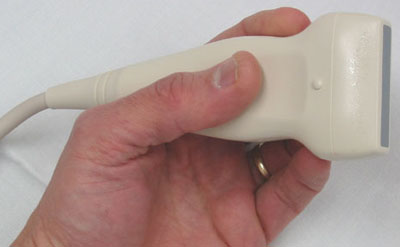
A curved-array probe in the hand. This is the kind of transducer an obstetric clinic holds through a full list of scans, so its weight, its shape in the hand, and the seal that lets it be cleaned all count toward the choice. A convex probe like this one reaches the depth a fetus needs. Image: Drickey, CC BY-SA 2.5.
A clinic machine lives a hard life, and the build has to take it. A machine chosen on its picture alone, with no thought to the life it will lead, often disappoints inside the first year.
Weight is felt by the end of the day. A probe of a few hundred grams, held through a full list of scans, spares the wrist what a cart’s bulk never will. The lighter the device, the easier the twentieth scan of the morning. Fatigue in the scanning hand is real, and a heavy probe held at an awkward angle for a transvaginal study tells on the operator by midday. A balanced, well-shaped probe is kinder to the hand across a long list than a heavier rival. The hand, after all, is the part of the clinic that tires first.
Battery is the quiet dealbreaker. A handheld that dies halfway through a clinic is worse than useless. The figure to ask for is a full session on one charge, a few hours of real scanning, backed by a spare battery or a quick top-up for the long day. A machine tethered to a wall socket loses the freedom that made it portable in the first place, so the battery counts as a core spec, on the level of the probes themselves. A clinic running a full morning list cannot pause to recharge, and a weak battery quietly caps how many patients a machine can see in a day.
Cleaning weighs more in this specialty than in any other, because of the transvaginal probe. That probe is covered for each patient and disinfected between them, so the device has to survive repeated cleaning intact. A sealed, water-resistant body, rated for wipe-down or soak by the maker’s instructions, is no luxury here. A device that cannot survive the disinfectant a transvaginal probe demands will crack, cloud, or corrode within a year, and the saving on the cheap machine is spent twice over on its replacement.
Durability closes the list. A dropped probe, a busy room, a thousand cycles a year: the machine that survives this is the one with the build and the seal to take it, and the warranty standing behind it is part of what is being bought. A long warranty, with a local repair path, is the maker’s own vote of confidence in the build, and it is the cushion a small clinic leans on when something fails.
The price, against a cart
The price is where handheld changes the math. A cart-based obstetric system runs into the tens of thousands. A capable handheld with both probes lands at a fraction of that, low enough that a small clinic, a rural outpost, or a single midwife can own one outright. The saving is real, on one condition: the cheap machine must still cover the exams that fill the clinic’s day. A device bought on price alone, missing the transvaginal probe or the depth for a late fetus, is no bargain, because the exams it cannot do still have to be sent somewhere and paid for twice. The right buy is the least costly machine that covers the real workload, and for a great many clinics that machine is now a handheld. The math is plainest for a new or small practice, the kind a cart’s price has always shut out. For them, a handheld brings real obstetric imaging within reach for the first time.
The rules that let the clinic scan
A machine that cannot be used legally is no machine at all. Whatever the clinic buys has to carry the clearance its country demands, the regulatory mark that says the device was tested and allowed for medical use. A scanner sold without it is a risk no clinic should take, however good the picture. The mark to look for depends on the market, since a clearance for one country does not carry to the next, so the clinic checks for the one its own regulator demands. An off-market device with no valid clearance can also void the clinic’s insurance and its standing, a cost that dwarfs any saving on the price.
The last piece is what happens after the scan. The images and the measurements have to leave the device, into a report, a record, a referral. A handheld that stores a study, attaches it to a patient, and sends it on, by cable or by wireless, fits a real clinic. One that traps its pictures on a screen does not. The way a machine hands off its work is part of choosing it, easy to forget against the probes and the price. A study locked inside a device cannot be shown to a colleague, sent to a specialist, or kept as a record, and an obstetric scan that cannot be shared has lost half its use. Modern handhelds send a study to a phone, a cloud record, or a colleague in seconds, and that reach is part of what makes them fit a busy clinic.
Matching the machine to the clinic
Strip the choice to its frame and it is an act of matching. The longest spec sheet is not the goal. The clinic’s exams set the requirements, and the machine that meets them at the lowest cost wins. A longer feature list is not a better machine. It is often a dearer one, carrying modes a clinic pays for and leaves unopened.
Run the list in order. The two probes, convex and transvaginal, that cover the everyday work. The depth to reach a late fetus. The modes and presets an obstetric study needs. The measurements built in. A body that survives a clinic day and a transvaginal cleaning. A price the clinic can carry. The clearance to scan, and a way to save and send the work.
A machine that answers yes down that list is the right one, whatever its badge. For a growing number of obstetric and gynecology clinics, the device that says yes to all of it, and asks the least in return, is a handheld that fits in a coat pocket. The badge on the front matters less than the answers down the list. A clinic that buys to the list, leaving the brochure aside, rarely buys wrong. The right machine, in the end, is the one the clinic stops noticing, because it quietly does the day’s work and stays out of the way.
Common questions about choosing an OB/GYN portable ultrasound
What probes does an OB/GYN clinic need on a portable ultrasound?
Two. A convex (curvilinear) probe reaches deep, through the abdomen to a fetus and across the pelvis, and a transvaginal (endocavity) probe gives the close detail an early pregnancy or a gynecology scan needs. A device that carries both covers the bulk of the specialty. One with only the convex probe leaves early-pregnancy and close gynecology work undone.
Can a handheld ultrasound do obstetric scans?
Yes, within its range. A handheld with a convex and a transvaginal probe handles dating, growth, fetal heart rate, amniotic fluid, and the common gynecology scans. The deepest studies, a full fetal anomaly scan, still suit a high-end system. For everyday obstetric and gynecology work, a capable handheld covers it.
Which features matter for fetal scanning?
Enough depth to reach a third-trimester fetus, M-mode to document the fetal heartbeat, color and pulsed-wave Doppler for the umbilical artery, and a built-in obstetric measurement package. An obstetric preset that sets all of this up at a touch saves time on every scan.
How much does a portable OB/GYN ultrasound cost?
Far less than a cart. A cart-based obstetric system runs into the tens of thousands. A capable handheld with both probes lands at a fraction of that, within reach of a small clinic or a single practitioner. The saving holds only if the cheaper machine still covers the clinic’s real exams.
Is a handheld ultrasound accurate enough for pregnancy dating and biometry?
For routine dating and growth, yes. A handheld measures the head, the abdomen, and the femur, and its built-in package estimates weight and gestational age from them, the same way a cart does. Accuracy rests on the operator’s measurements as much as on the machine. The hardest, finest studies are still sent to a specialist system.
What should a clinic check before buying a portable ultrasound?
Match the machine to the clinic’s exams first. Confirm the two probes the clinic needs, the depth for its patients, the modes and measurements an obstetric study uses, a battery that lasts a clinic session, a body that takes repeated transvaginal cleaning, the regulatory clearance for the country it serves, and a way to save and send the study. The right machine is the least costly one that answers yes to all of these.
About the Author
Julien Mercier
Senior R&D Engineer · Medical Ultrasound Transducer Development
Senior R&D Engineer with an M.S. in Applied Physics and over 15 years of experience in medical ultrasound transducer development, specializing in the design verification and performance testing of high-frequency imaging transducers. Currently leading the development and verification of the company’s next-generation high-frequency linear-array transducer, responsible for imaging performance evaluation and reliability analysis in preclinical testing. Brings extensive hands-on experience in piezoelectric element tuning, beamforming parameter optimization, and system-level performance testing.