A diagnostic scan of the kind a cleared probe produces; the 510(k) argues the device is as safe and effective as one already on the market.
The FDA 510(k) is the route the majority of diagnostic ultrasound probes take to reach the United States market, and it rests on a single idea that surprises people the first time they meet it: the maker does not have to prove the device is safe and effective from scratch, but that it is substantially equivalent to a device already legally on the market. That earlier device is the predicate, and the whole submission is an argument that the new probe is as safe and as effective as the predicate, with the same intended use and the same technological character, or with differences that raise no new questions of safety. For acoustic output the agency lets a probe follow what it calls the Track 3 route, a single global ceiling that applies whatever the clinical application, paired with the on-screen indices that let the operator manage the dose. The clearance is a finding of equivalence rather than a stamp of approval, and understanding that distinction is the start of reading a 510(k) honestly.
Clearance is not approval; it is the agency agreeing the device is as safe as one already trusted.
Substantial equivalence, and what it truly demands
The phrase substantial equivalence sounds like a loophole and works as a discipline. A maker has to name a predicate, show the same intended use, and then account for every way the new device differs from it.
The predicate is a device already cleared, and the new probe has to share its intended use, the clinical purpose it is sold for, since a probe cleared for abdominal imaging cannot lean on a predicate cleared only for something else. Once the intended use matches, the maker turns to technological characteristics, the design and the materials and the energy the device uses, and where the new probe differs from the predicate the maker has to show that the difference raises no new question of safety or effectiveness. A wireless handheld claiming equivalence to a cabled cart probe differs in obvious ways, the battery, the radio, the sealed body, and each of those differences is a place the agency will ask what new hazard it introduces and how the maker has addressed it. The argument is built from performance data, from conformance to recognized standards, and from testing that shows the new probe performs as well as the predicate on the measures that matter. A submission that names a predicate and waves at equivalence without working through the differences is a submission the agency sends back, since the differences are the entire substance of the review. The discipline is that equivalence has to be demonstrated difference by difference rather than asserted as a family resemblance. A clever choice of predicate can shorten the argument, since a handheld that names an earlier handheld as its predicate has fewer differences to defend than one reaching back to a cart, and the predicate a maker selects quietly reveals how close to the existing market its device sits.
Naming a predicate is easy; accounting for every difference from it is the work.
The Track 3 acoustic route
Acoustic output is the part of an ultrasound submission with the deepest physics behind it, and the agency offers a route that keeps the rule simple while keeping the patient protected.
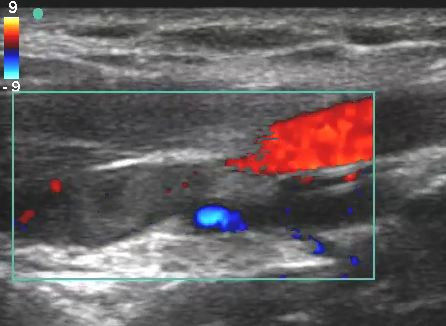
A color Doppler scan; under the Track 3 route one acoustic ceiling covers every application the probe is cleared for.
Under the Track 3 route a probe may run up to a single global ceiling on derated intensity, the same figure regardless of whether the exam is abdominal, vascular, or anything else, in exchange for displaying the mechanical and thermal indices on the screen so the operator can see and manage the dose. The older approach set a different limit for each application, which meant a probe was boxed into the use it was tested for, and the global route trades that rigidity for a single ceiling plus the discipline of the on-screen indices. The ceiling is the familiar derated spatial-peak temporal-average intensity at or below seven hundred and twenty milliwatts per square centimetre, with the mechanical index held below the established line, and the eye kept to a far lower limit because it cannot shed heat. The route does not loosen safety; it relocates part of the responsibility onto the operator the indices inform, and the display requirements travel with it for that reason rather than being optional. A submission taking this route has to bring the full acoustic output tables, measured by the recognized method and derated by the fixed rule, and the agency reads those tables against the ceiling exactly as it would for any probe. The Track 3 route is the reason a modern probe can be sold for many applications on one clearance rather than returning for each, and it works only because the measured output and the live indices hold up their end. A maker that takes the route and then ships a screen where the indices barely move, or lag the controls, has kept the freedom the route grants while abandoning the duty that pays for it, and that gap is one a careful reviewer and a careful buyer can both notice.
One ceiling for every application, paid for with indices the operator has to watch.
Special controls and recognized standards
A diagnostic ultrasound probe sits in a device category the agency governs with special controls, the particular requirements layered on top of the general ones that every device meets. Those controls are where the narrower standards enter the submission.
The special controls for this category point to the acoustic output limits, the labelling the device has to carry, the biocompatibility of the patient-contacting materials, the electrical and electromagnetic safety, and the software considerations for a device driven by code. A maker satisfies the bulk of them by conforming to the standards the agency recognizes, the particular safety standard for diagnostic ultrasound, the acoustic field measurement standard, the electromagnetic compatibility standard, and the biocompatibility family, each recognized as an acceptable way to meet a requirement. Conformance to a recognized standard lets the maker submit a declaration rather than the full underlying data in many cases, which streamlines the review while keeping the bar where it belongs, and it ties the United States submission to the same measurements that serve the European file. The submission threads each special control to the evidence that answers it, the standard met or the test passed, so a reviewer can trace the safety argument the same way a European notified body would. A maker that treats the special controls as a checklist without understanding what each one guards has assembled paperwork rather than a safety case, and the agency’s reviewers are practised at telling the two apart. The recognized standards are the bridge that lets one body of testing satisfy several regulators rather than forcing a maker to start over in each market.
What it means for a wireless handheld
A wireless handheld probe entering the United States through a 510(k) carries the same differences from its predicate that make it interesting and make the review harder.
If the predicate is a conventional cart-based or cabled probe, the handheld has to answer for its battery, its wireless link, its sealed thermal design, and its software in ways the predicate never had to, and each is a difference the agency examines for new questions of safety. The battery raises thermal and electrical questions, the radio raises questions about data integrity and dropout during a scan, the sealed body raises questions about surface heating and cleaning, and the software raises questions the agency treats with growing seriousness as more of the device’s behaviour lives in code. A maker that has done the work presents a 510(k) summary naming the predicate, the intended use, and the differences resolved, with the acoustic output tables and the recognized standards behind them, and that summary is a public document a buyer can read. A maker that has not offers a vague claim of FDA clearance with no 510(k) number to look up, or a registration that is not a clearance at all, since merely listing a facility with the agency is not the same as clearing a device. The buyer who knows the difference asks for the 510(k) number and reads the summary, and the summary either shows the work or reveals its absence.
A facility registration is not a device clearance, and a maker that blurs the two is counting on a buyer who cannot tell.
The kinds of 510(k), and how long it takes
Not every 510(k) is the same animal, and the version a maker files says something about how far the device sits from its predicate.
A traditional submission is the full argument, used when the device is new to the maker or differs from the predicate in ways that need the complete dataset. A special submission is the lighter path a maker uses when it modifies its own already-cleared device in a way that does not change the intended use or the fundamental technology, letting the agency review a focused change rather than the whole device again. An abbreviated submission leans heavily on conformance to recognized standards and agency guidance, trading bespoke data for the assurance those standards already carry. The route chosen shapes the timeline, since a clean abbreviated or special submission can clear in a couple of months while a traditional one with novel differences runs longer and draws more questions, and a maker that has prepared the file well shortens the back-and-forth that stretches a review. For a handheld claiming equivalence to a conventional probe, the traditional route is the honest one, since the differences are real and the agency will want them addressed in full rather than waved past on a lighter track. A buyer does not need to know which route a maker took, yet the existence of a cleared number at the end of any of them is the fact that matters, and the route mostly explains why one maker reached the market faster than another. The submission that took the work seriously is the one whose summary reads as an argument rather than a hope.
The lighter the filing, the closer the device sits to something already cleared.
Reading a 510(k) clearance
The clearance leaves a public trail, and a buyer who knows where to look can verify in minutes what a brochure only claims.
Every clearance carries a number that can be looked up in the agency’s public database, where the 510(k) summary lays out the predicate, the intended use, and the performance data that supported equivalence. A buyer can confirm that the number exists, that it covers the device being sold rather than a cousin of it, and that the intended use on the clearance matches the use the seller is promoting, since a clearance for one purpose does not stretch to cover another. The summary names the recognized standards the device was tested against, so a reader can see that the acoustic and safety standards are accounted for, and it states the acoustic output route the device followed. A seller who cannot produce a number, or whose number covers a different device, or whose clearance describes a narrower use than the sales pitch implies, has told a careful buyer nearly all of what needs knowing. The handheld a buyer should trust is the one whose clearance number resolves cleanly to the device in hand, with an intended use that matches the sale and standards that cover the hazards, and a maker confident in its submission points to that number rather than hoping the question never arrives.
The clearance number either resolves to the device in your hand or it does not, and that single check settles the bulk of the question. Everything else in the submission is the maker proving a case to the agency; the number is the agency agreeing the case was made, and a buyer who confirms it has borrowed the scrutiny the agency itself applied for free.
About the Author
Julien Mercier
Senior R&D Engineer · Medical Ultrasound Transducer Development
Senior R&D Engineer with an M.S. in Applied Physics and over 15 years of experience in medical ultrasound transducer development, specializing in the design verification and performance testing of high-frequency imaging transducers. Currently leading the development and verification of the company’s next-generation high-frequency linear-array transducer, responsible for imaging performance evaluation and reliability analysis in preclinical testing. Brings extensive hands-on experience in piezoelectric element tuning, beamforming parameter optimization, and system-level performance testing.