Fetal heart rate monitoring reads the speed and the pattern of a baby’s heartbeat to judge how well it is coping. A healthy baby’s heart runs between a hundred and ten and a hundred and sixty beats a minute, the rate never wholly still, wavering moment to moment around its baseline. A handheld probe finds the beat and times it, the rate and its swings read where the mother sits. The beat is the clearest live sign of how a baby is faring in the womb.
The normal beat
A baby’s heart beats faster than a grown person’s, settling into a range a reader knows by heart. Between a hundred and ten and a hundred and sixty beats a minute is the band of a healthy baseline, the rate a reader reads first on any trace. A steady beat is the quiet good news a scan brings again and again. A heart holding steady in that band, hour after hour, is the picture of a baby at ease. A reader new to the trace learns the band first, the feel of a normal rate the ground the rest is built on. A rate that strays from the band is the first thing the trace flags, the number too high or too low pulling the eye at once, a reader reading the band as a fence with the heart at ease inside it. The number is read first because it is the quickest to read, a count over a minute or a glance at the screen, the frame the rest of the trace is read in. The rate counts off the beat in the old way too, a listen of six seconds with a nought added on, or a fuller minute counted whole, the number landing the same however it is reached. A rate that climbs and holds above a hundred and sixty is a tachycardia, a fast heart that can follow a mother’s fever or an infection reaching the baby, the cause hunted behind the speed. The rate eases a little over the weeks of pregnancy, a reader reading the number against the age the baby has reached. The band is wide for a reason, a healthy heart roaming freely within it through the day, a rate of a hundred and twenty as normal as one of a hundred and fifty.
The rate is never a flat line. A healthy heart wavers within a few beats from one second to the next, the squiggle of a beat under the constant nudge of the baby’s own nerves. That waver, the variability, is read as closely as the rate itself, a lively squiggle the mark of a brain and a heart talking to each other. A trace gone flat and smooth, the waver lost, is the sign a reader watches for. The heart is the first organ to form and the first to be checked, beating before the body around it is built, a reader who finds the beat finding the surest sign a pregnancy is alive and going on. The waver grows surer over the weeks, the nerves learning their grip on the heart. A full, lively waver near term is the sign a reader looks for, the proof a baby’s controls are up and running. The waver is measured in the beats it spans, a healthy band running six to twenty-five beats wide, the swing of the rate the thing counted over a stretch. A baby asleep lets its waver narrow for a spell, the rate smoothing through the rest, the waver back once the baby wakes. A heart that skips or doubles a beat now and then is common and harmless in the womb, the odd extra beat passing on its own before birth, the steady rhythm returning in time.
Reading the rate
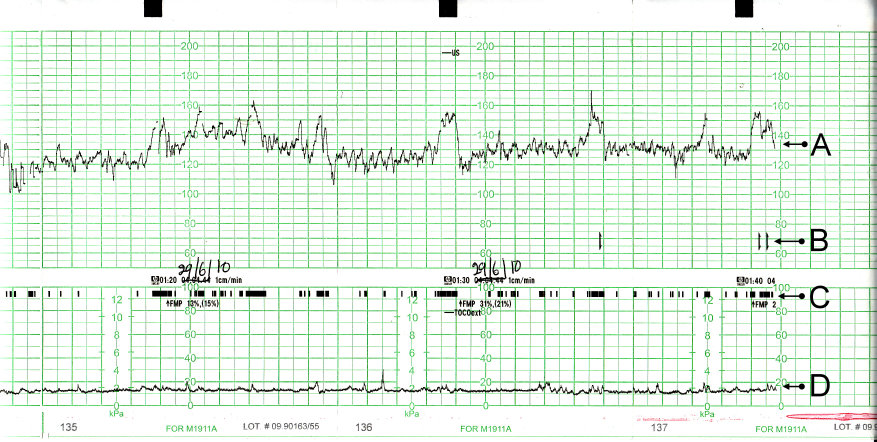
A fetal heart-rate trace on a cardiotocograph. The upper line, marked A, holds a baseline near a hundred and forty, the fine waver along it the variability and the upward spikes the accelerations. The lower trace records the womb’s squeezes. The A, B, C, and D labels were added to the printout.
Four things on the trace tell the story.
The first is the baseline, the rate the heart holds when it is left alone, read across a stretch of minutes and settled on a single number. A baseline that sits in the normal band is the first reassurance a trace gives. The second is the variability, the fine waver around that baseline, a band of a few beats up and down that proves the nerves are awake and steering the heart. The third is the acceleration, a brisk climb in the rate that comes when the baby moves, fifteen beats above the baseline held for fifteen seconds the mark of one. An acceleration is the heart answering the body, the surest live sign that a baby is well oxygenated. A trace with a normal baseline, a healthy waver, and accelerations that come with movement is a trace a reader reads as a baby doing well, the three together the picture of plenty. The fourth is the deceleration, a dip in the rate, read for its shape and its timing against the squeezing of the womb. A dip is the one of the four that can carry a warning, its meaning set by when it falls and how it returns. A reader reads all four as one, the baseline, the waver, the rises, and the dips building a single read of how the baby is fed. The trace is watched over a long stretch, the trend the thing that matters, never a single minute snatched alone. The baseline itself is read across a stretch, the eye settling on the rate the heart keeps returning to, a short look able to mislead where a baby mid-acceleration reads high for a moment. The four are read in a fixed order, the baseline first, the waver second, the rises third, the dips last, each laid over the one before, the order the habit that catches the quiet warning. The baseline drifts a little over the hours, a slow climb of it across a long watch a sign of its own, the heart working harder over time.
The waver is the quiet hero of the trace. It springs from the two halves of the baby’s nervous system pulling gently against each other, a tug that only a well-fed brain keeps up. A heart that wavers a healthy amount is a heart with its controls intact, the variability telling a reader more than the bare rate does. A flattening of the waver, more than any single odd beat, is the early sign a reader chases. A heart at a normal rate with no waver at all is read with real worry, the flat line a sign the nerves have gone quiet. The waver is the hardest of the four to fake and the truest to read, a sign the body cannot hold up when it is short. A baby short of oxygen loses its waver among the first things to go, the flat trace the early word a reader reads.
An acceleration is the heart’s way of cheering. When a baby kicks or rolls, a healthy heart jumps a little and holds the jump, then settles back, the brisk rise the sign of a baby awake and well. A trace that shows these rises needs little more, the accelerations alone near enough to call a baby well. A trace without them over a long watch is read with more care, the absence chased to its cause. The accelerations come in clusters when a baby is awake and busy, a run of them over the watch near enough on its own to send a mother home easy. A sleeping baby is slow to show them, the reader waiting a quiet stretch out before reading the trace low. The rise of an acceleration is brisk, the rate climbing fast and holding the climb before easing back, two of them in twenty minutes near enough to call a trace reactive. A short watch of the rate has a name of its own, the non-stress test, a half-hour reading of the heart for its baseline, its waver, and its rises. A quiet trace can be coaxed, a buzz on the belly or a nudge waking a sleeping baby into a burst of accelerations, a heart that answers the buzz with a rise a heart a reader can trust.
The four read together tell more than any one alone. The same rate can mean different things, the waver beneath it deciding which. A reader who reads only the number misses the half of the story the pattern holds. The reactive trace is the goal, a trace with a normal rate, a lively waver, and a pair of accelerations, asking nothing more of the reader. The trace read whole says in a glance what a page of numbers never could, the four landing on a trained eye as one impression.
The dips
A deceleration is a dip in the rate, the heart slowing for a spell before climbing back. Not every dip is a worry, the meaning of one set by its shape and by when it falls against the squeezing of the womb. A reader reads the timing of a dip with care, the timing the thing that sets its meaning. A dip is timed by where its lowest point falls against the peak of the squeeze, the heart-rate line above and the squeeze line below lined up on the paper. A dip read without the squeeze beside it cannot be named, the reading a skill a midwife hones over many traces. Two dips can look alike for a moment, the timing the only thing that parts them, the clock the key to the read. The dip is the only one of the four that points to a cause outside the heart, the squeeze of the womb or the pinch of the cord pressing on the baby. The three dips are told apart by their timing against the squeeze, the early matched to it, the late lagging it, the variable ignoring it, the name following from the timing. The three carry three causes, the head, the placenta, and the cord, each pressing on the baby in its own way.
An early dip mirrors the squeeze of the womb, its lowest point matched to the height of the squeeze. This dip comes from a gentle press on the baby’s head when the womb tightens around it, a harmless thing that needs no act. A reader names it and moves on. It comes from a head pressed in the birth canal, the dip gone by the time the squeeze passes, the baby none the worse. It is the one dip that asks nothing of the team, the gift of the trace to a reader who reads it right.
A late dip is the one a reader fears. It falls after the squeeze has peaked, the rate sagging once the womb has already tightened, slow to come and slow to recover. This lag is the sign of a placenta failing to keep the baby fed through the squeeze, a warning of a baby short of oxygen. A late dip, repeating with each squeeze, sends a reader to act. The deeper and the later the dip, the graver the read, a reader watching a run of them with a hand on the call. The late dip is read with a cold eye, its lag the mark of a baby running out of air at the worst moment, a run of them on a trace already flat a baby a team brings out without delay.
A variable dip falls without a pattern, sharp and sudden, its shape changing from one to the next. It comes from a squeeze on the cord, the baby’s lifeline pinched for a moment, the rate dropping fast and climbing back. The variable dip is the commonest of the three, the cord caught for a beat between the baby and the womb, the flow cut for the length of the pinch. A reader reads the depth and the run of the dips, a flurry of deep ones the sign of a cord pressed hard. The shape of the dip points the reader to the cause behind it.
What a worrying trace means
A worrying trace is read by what it has lost. A baseline that has climbed too high or sunk too low, a waver gone flat, accelerations vanished, late dips repeating, each is a step away from the picture of a well baby. The more of these a trace shows, the harder a reader looks. The trace tells its trouble by losing its signs one by one, the accelerations going first, the waver flattening next, the dips turning late, the rate drifting from its band. One pattern frightens a reader on sight, a smooth, regular wave in the rate with the waver gone, the sinusoidal trace that can mean a baby badly short of blood and is read as an emergency. A rate that sinks and stays below a hundred and ten is a bradycardia, a slow heart from a cord pressed hard or a fault in the heart’s own wiring, a lasting one sending a reader to act at once. The trace is read as a trend, a single bad stretch read against the hours around it, a trace that worsens across the watch the one that moves a team. A reader reads the direction as closely as the moment. The trace is one voice among several, read beside the fluid, the growth, and the flow in the cord, a worrying trace on a baby already small and short of fluid read harder than the same trace on a thriving one.
A trace gone bad is acted on, the noting only its first step. A baby whose heart has lost its waver and its rises, late dips on each squeeze, is a baby a team moves to deliver. The trace turns from a watch into a reason to act when its signs stack up. A single odd feature on an otherwise lively trace earns a closer watch. A stack of them, late dips on a flat trace, earns a delivery, a reader weighing the trace whole before the call. The call to deliver weighs the trace against the cost of acting, an early baby weighed with far more care than one near term. The trace that leaves no doubt makes the call easy.
A trace is read with the whole picture, never alone. A flat waver can mean a sleeping baby as easily as a struggling one, the watch kept up until the cause is clear. A reader reads a worrying trace as a reason to look harder, the action weighed with everything else known. The rate is one window on a baby, the fullest and the fastest, never the only one, read beside the movements, the fluid, and the growth, the heart’s beat the opening word of a longer look. Patience reads the trace right, the sleeping baby given time to wake before any call. The reader reads the trace beside the labour too, a long labour wearing a baby down, the trace read against the hours the baby has been pushed. The reader sets down plainly what the trace shows, the report an honest account of the heart’s state, a clear report guiding the team that acts on it.
How the beat is caught
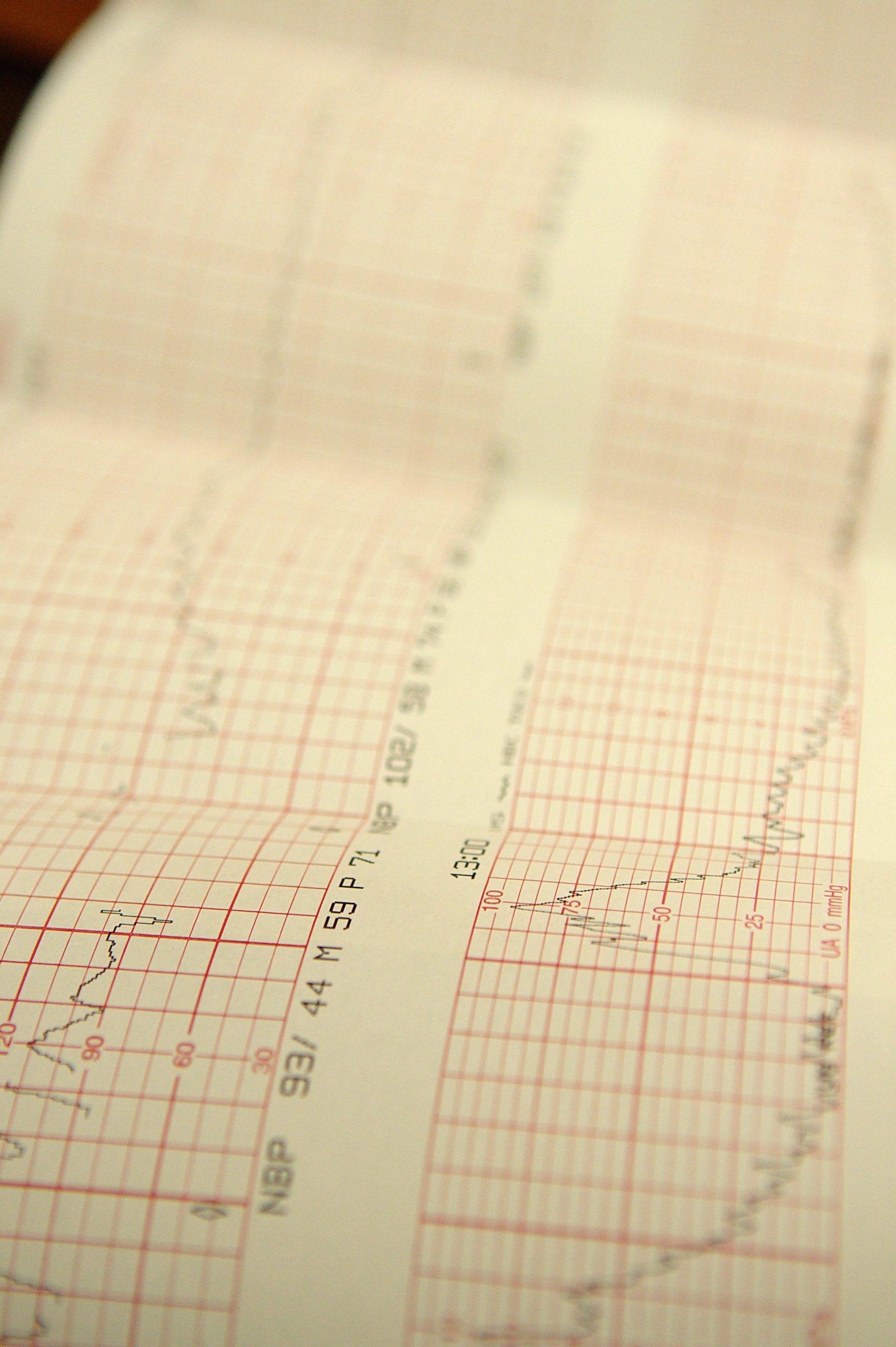
A fetal monitoring trace running on paper through a labour, both the heart rate and the womb’s squeezes printed across it for reading together. The trace runs without a break for as long as the labour lasts.
The beat is caught in more than one way. A handheld Doppler finds it as a sound, the whoosh of the heart counted by ear or read off a number. An ultrasound probe shows it on the screen, a flicker timed on a motion trace or a colour box laid over the heart. A continuous monitor straps to the belly and prints the rate over time, the trace a reader reads as a record. Each finds the same beat, the choice set by what the moment asks. The handheld Doppler is the simplest of the tools, a small probe that turns the heartbeat into a sound a mother can hear, the number read off the whoosh in seconds, the tool a midwife reaches for first. The sound of the beat is the oldest reading of all, a heart counted by ear long before a screen could show it, the number off a Doppler the same number a monitor prints. During labour the heart is watched without a break, the monitor running through every squeeze, the trace read for how the baby stands the work of being born. A reader takes care not to count the mother’s own pulse by mistake, the fetal beat far quicker than hers and found low over the womb. A finger on the mother’s wrist, the probe reading at the same moment, tells the two apart at a glance.
On a handheld
The fetal heart is made for a handheld. The beat is loud and easy to find, a probe laid on the belly catching it in seconds, the rate read off the screen or the sound. The beat found and counted is the answer many worried mothers come for, the heart the headline of the scan. A clinician who wants to know how a baby is doing reads the heart on the spot, the answer there in the time it takes to listen. The heart is the first thing checked in a worried pregnancy, the quickest answer the body gives, the beat loud enough to find by sound alone. The probe asks nothing of the mother beyond a bared belly, no wait and no booking, the answer there in the room she walks into. Nothing in obstetric scanning is faster. The fetal heart found in a pocket-probe sweep is the simplest good news in all of pregnancy care.
The reach carries the heartbeat to where the worry is. A mother who feels her baby still, far from a hospital, hears the heart in a moment, the beat the fastest reassurance there is. The rate saves to the phone, the trace filmed, ready for a specialist to read from afar. The fetal Doppler has reached the home, a parent listening for the beat between visits, a comfort in the long wait, the deeper read of the waver and the dips left to the trained eye. A mother who comes in frightened leaves reassured in minutes, the heart found and counted and shown to her, the sound of the beat doing more for her than any number. The pocket probe carries the heartbeat to the home, the clinic, the field, a worry that once meant a trip to a hospital answered where she stands. A heart checked at the bedside is a worry settled or a problem caught, a clinician with a probe holding the fastest test in obstetrics in one hand. A handheld probe catches the fetal heartbeat and its pattern at the bedside, the rate read in the moments of a check.
Common questions about fetal heart rate monitoring
What is a normal fetal heart rate?
Between a hundred and ten and a hundred and sixty beats a minute is the normal baseline. The rate is faster than a grown person’s, and it wavers a few beats from second to second in a healthy baby. A steady rate in that band, with a lively waver, is the picture of a baby at ease.
What does the waver in the heart rate mean?
The waver, called variability, is the small up-and-down of the rate from one second to the next. It proves the baby’s nerves are awake and steering the heart, the mark of a well-oxygenated baby. A trace that goes flat and smooth, with the waver lost, is an early sign a reader watches closely.
What is a deceleration?
A deceleration is a dip in the heart rate, read for its timing against the squeeze of the womb. The dip that matters is the late one, falling after the squeeze has peaked, a sign of a placenta struggling to feed the baby and the one a reader acts on.
Why do accelerations matter?
An acceleration is a brisk climb in the rate, fifteen beats above the baseline held for fifteen seconds, that comes when the baby moves. It is the heart answering the body, the surest live sign that a baby is well oxygenated. A trace with accelerations is read as a reassuring one.
Can a handheld ultrasound monitor the fetal heart?
Yes. The fetal heart suits it well. The beat is loud and easy to find, caught in seconds with a probe on the belly and read off the screen or the sound. A clinician reads the rate and its pattern at the bedside, which brings the heartbeat to mothers far from a hospital.
About the Author
Julien Mercier
Senior R&D Engineer · Medical Ultrasound Transducer Development
Senior R&D Engineer with an M.S. in Applied Physics and over 15 years of experience in medical ultrasound transducer development, specializing in the design verification and performance testing of high-frequency imaging transducers. Currently leading the development and verification of the company’s next-generation high-frequency linear-array transducer, responsible for imaging performance evaluation and reliability analysis in preclinical testing. Brings extensive hands-on experience in piezoelectric element tuning, beamforming parameter optimization, and system-level performance testing.