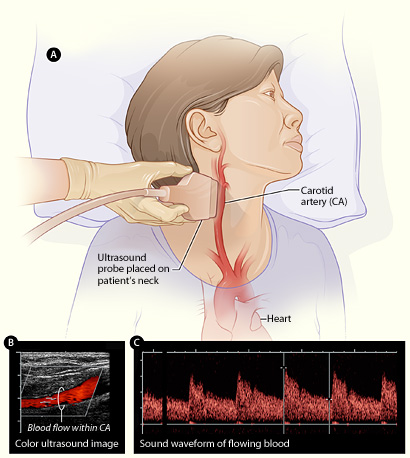
A carotid scan; a long clinical study draws steadily on a battery that has no cable to refill it.
A wireless ultrasound probe carries its own power, since it has no cable to draw from, and how that power is arranged decides whether the device can work through a busy day or stops to recharge in the middle of it. Some handhelds run on a single sealed battery; others carry two, designed so one can be swapped while the other keeps the probe alive. The brochure tends to quote a single figure, a number of minutes of scan time, as though battery were a simple matter of capacity, but the arrangement matters as much as the number, because a probe that must stop dead to recharge interrupts the work in a way a probe with a spare cell never does. The question is not only how long the battery lasts but whether running out means a pause in the patient’s care or a five-second swap, and that difference is built into the design rather than printed on the box.
The figure on the box is minutes of charge; the design decides whether running low means a swap or a stop.
What the single figure hides
A quoted scan time sounds precise and is one of the slipperier numbers a buyer meets, because what counts as scanning, and at what settings, changes the figure enormously.
A probe draws very different power depending on what it is doing, since a deep scan in a demanding mode with colour flow running pulls far more current than a shallow grayscale sweep, so a scan time measured on the gentlest setting can be double what the device delivers in real clinical use. The figure also depends on whether the clock counts only active imaging or the idle time between patients, since a probe left awake on a table drains slowly even when it is not scanning, and a number measured under continuous imaging means something very different from one measured with generous pauses. Heat enters here too, because the same electronics that drain the battery also warm the probe, and a device pushed hard enough to shorten its battery may also be approaching the surface-temperature limit, so the honest scan time is bounded by both charge and heat together. A maker that states the conditions, the mode, the depth, whether imaging was continuous, has given a figure a buyer can trust, while one that quotes a bare number of minutes has measured the easy case and left the buyer to discover the real one. The first thing to ask of any scan-time figure is the question the figure alone never answers: under what conditions. A figure quoted as continuous imaging at clinical depth is a number a buyer can plan a day around, while one quoted with no conditions at all is closer to a maximum than an average.
A scan-time number without its conditions is a best case wearing the clothes of a promise.
Why two batteries change the day
The difference between one battery and two is not mainly about total capacity but about continuity, since a second cell turns a hard stop into a brief pause and lets a probe work as long as the day demands.
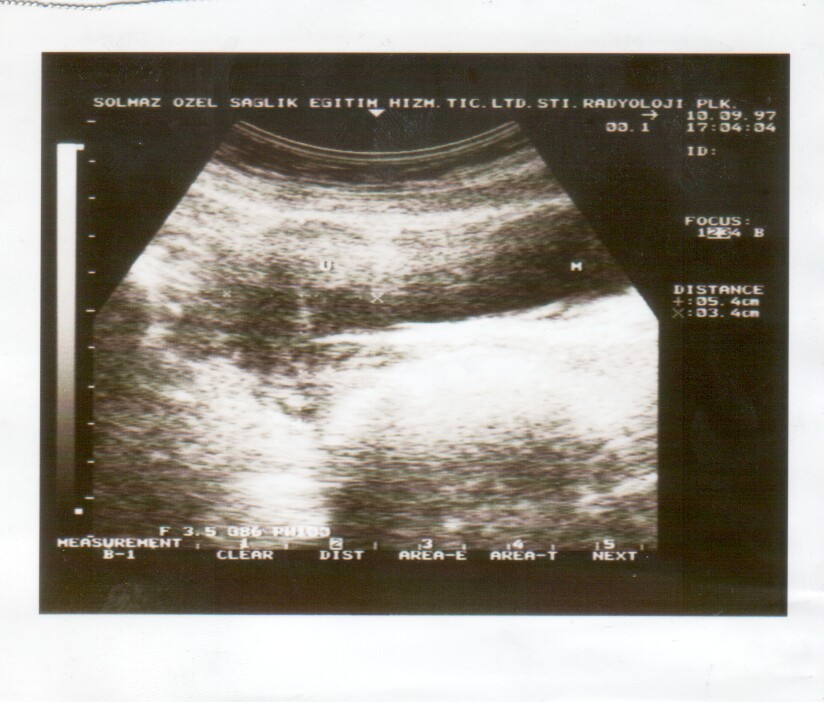
A grayscale scan; a dual-battery probe lets the operator swap a cell and keep imaging without a pause.
With a single sealed battery, a probe that runs flat has to be put on a charger and waited out, so a clinic either keeps a second whole probe on hand or simply stops scanning until the device recovers, and that downtime falls in the middle of a working day rather than at a convenient break. A dual-battery design, by contrast, lets the operator swap a depleted cell for a charged one in seconds while the second battery keeps the probe powered through the change, so the device never fully shuts down and the session continues uninterrupted. This hot-swap capability is the difference between a probe that can run a full clinic list or a long field shift and one that is rationed by its charge, since charged spares can be cycled through the device all day while drained ones sit on a charger. The two batteries can also simply give more total runtime when both are fresh, but the continuity is the larger gain, because a clinic that cannot tolerate a mid-list pause needs a device that never stops rather than one that merely lasts a little longer. A maker that built for hot-swapping understood that a probe used in real clinical flow cannot afford to halt, while one that sealed in a single cell built a device that works until it does not.
One battery lasts until it stops; two batteries let the probe keep going while one of them rests.
What it costs to carry two
The second battery is not free, and an honest account of the choice has to name what the dual design gives up to win its continuity.
Two cells and the mechanism to swap them add weight and bulk to a device whose whole appeal is being small and light in the hand, so a dual-battery probe is often a little heavier or a little larger than a single-cell rival, and for a clinician scanning for hours that difference is felt. The swap mechanism is also a moving part and a potential ingress point, since a battery door that opens has to seal again to keep the device’s waterproof rating, and a poorly designed hatch can become the weak spot in an otherwise sealed probe. The dual arrangement costs more to build and adds complexity to the power management, since the device has to handle two cells, balance their use, and swap power between them without a flicker in the image. For a clinic whose work comes in short bursts with natural breaks, a single well-sized battery may be entirely sufficient and the lighter, simpler probe the better choice, so the dual design is not universally superior but suited to particular patterns of work. The buyer who scans in long unbroken sessions values the swap above the weight, and the one who scans in short visits may rightly prefer the lighter single cell, so the right answer follows the work rather than the larger number.
The battery, the heat, and the scan that slows down
The battery does not act alone, since the current it supplies becomes both the image and the heat, and the two limits, charge and temperature, often arrive together in a way the scan-time figure never shows.
Every milliamp the battery delivers to the beamformer and the radio ends up partly as the picture and partly as warmth in the sealed body, and a probe pushed hard enough to drain its cell quickly is also a probe warming toward the surface-temperature limit the safety standard guards. When the lens approaches that limit, the firmware lowers the output to stay safe, and the picture dims at the same moment the battery is running low, so a hard session can run into both walls at once, the charge falling and the image throttling. A dual-battery probe helps with the charge but not directly with the heat, since swapping a cell refreshes the power but does not cool the electronics, so the thermal design still has to be good enough to sustain the output the spare battery now allows. This is the quiet reason a long scan time and a steady image are both functions of efficient electronics, because a probe that wastes power as heat shortens its own battery and throttles its own picture, while one with efficient silicon runs cooler, lasts longer, and holds its output. A buyer reading a scan-time figure should remember that the same heat that the figure ignores is the limit a long study often meets first, and that a probe engineered to run cool is the one that delivers both the minutes and the picture it promised. The battery and the thermal design are two views of the same engineering, and a probe weak in one is usually weak in the other.
Charge and heat are the same current seen twice, and a long scan often meets both walls together.
Battery health over the device’s life
A battery is not a fixed quantity but a part that wears, and the scan time a probe delivers in its second year may be well short of the figure it shipped with, which is a question the brochure never raises.
Rechargeable cells lose capacity with every charge cycle, so a battery that gave a full session when new gives less after a year of daily charging, and a probe whose scan time was already marginal at purchase can drift into inadequacy as the cell ages. A design that lets the battery be replaced cheaply protects the buyer against this decline, since a worn cell can simply be swapped for a fresh one, while a probe with a sealed, unreplaceable battery ages into a shorter and shorter working life until the whole device has to be retired over a part that costs little. The dual-battery design carries a quiet advantage here as well, since spare cells are already part of how the device works and replacing a tired one is routine rather than a repair. A maker that treats the battery as a serviceable consumable, replaceable and available for years, is selling a device that stays useful, while one that seals the cell in for the life of the product has tied that life to the weakest, fastest-ageing part inside. The buyer who asks whether the battery can be replaced, and for how long replacements will be sold, is reading past the launch-day figure to the device’s real working life. A probe is only as long-lived as the cell it cannot do without.
The scan time on the box is the new-battery figure, and the battery does not stay new.
What the buyer should weigh
The battery question is at bottom a question about the shape of the working day, and a buyer who pictures that day honestly chooses better than one who compares only the minutes on the box.
The first thing to establish is the conditions behind the scan-time figure, since a number measured at a gentle setting with idle pauses tells little about a long continuous study, and a maker confident in its battery will state the mode, the depth, and whether imaging was continuous. The second is whether the design allows a swap without shutting down, because for a clinic that cannot pause mid-list the hot-swap counts for more than any number of extra minutes on a single cell. The third is whether the spare cells and the charger are part of the package or an extra purchase, since a dual-battery probe is only as continuous as its supply of charged spares. The fourth is the weight and the seal, since the second battery and its hatch cost something in both, and a buyer scanning for hours should feel the device in the hand rather than read its mass off a sheet. A buyer who matches the battery arrangement to the rhythm of the work chooses a probe that fits the day rather than one that merely sounds long-lived, and a maker that asks how the buyer scans is more useful than one that simply quotes the bigger figure. The battery is bought for the day it will live, not for the line on the brochure, and the buyer who has imagined a full clinic list or a long shift away from a charger has already answered the better part of the question the specification leaves open.
Match the battery to the rhythm of the work, and the right arrangement is the one that never makes the patient wait.
About the Author
Julien Mercier
Senior R&D Engineer · Medical Ultrasound Transducer Development
Senior R&D Engineer with an M.S. in Applied Physics and over 15 years of experience in medical ultrasound transducer development, specializing in the design verification and performance testing of high-frequency imaging transducers. Currently leading the development and verification of the company’s next-generation high-frequency linear-array transducer, responsible for imaging performance evaluation and reliability analysis in preclinical testing. Brings extensive hands-on experience in piezoelectric element tuning, beamforming parameter optimization, and system-level performance testing.