An inverter spec sheet carries two power numbers, the continuous rating and the surge rating. The continuous rating is the power the inverter holds without a time limit. The surge rating is a higher power the inverter holds for a brief moment. A spec might read 5000 watts continuous and 10000 watts surge. The two numbers serve two different jobs. This page sets out each one on its own, then lines them up against a load. The two figures together describe what an inverter can carry. Both numbers belong to the same inverter. The two figures together describe what an inverter can carry. Both numbers belong to the same inverter. One unit carries both, the steady and the brief.
The continuous rating answers one question, how much the inverter runs hour after hour. The surge rating answers another, how big a brief spike it can survive. A load brings a steady draw. Some loads also bring a short spike at startup. The inverter has to cover both with room to spare. A good fit clears the steady draw and the brief spike alike. The match is read on the two figures together. A buyer who reads both sizes the inverter right.
The continuous rating
The continuous rating is the power an inverter holds for as long as the load runs. A 5000-watt continuous rating means 5000 watts, hour after hour, with no time limit. The inverter is built to carry that power and stay cool. The cooling, the wiring, and the switches are all sized for it. The continuous figure is the one a steady load lives under. It is the number an inverter is named by. A 5000-watt inverter wears that figure as its name.
The continuous rating is the figure a maker leads with. It marks the inverter’s class and its price. A 3000-watt unit and a 5000-watt unit sit in different tiers by their continuous figure. The number names the steady work the unit was built for. A buyer reads it first to size the everyday load. The figure sets the buyer’s expectation of the unit. The continuous watts head the spec for a reason. The figure is the first line a buyer reads.
This rating sets the size of the everyday job. A fridge, a few lights, a laptop, and a fan add up to a steady draw. The total of those running watts has to sit under the continuous rating. An inverter rated 5000 watts continuous runs any mix of loads that totals under 5000 watts, all day. The steady total is the first thing to check against this number. The running total is the daily measure of the load. Every device on at once adds into that total.
The continuous rating is the honest measure of an inverter’s size. It names the work the unit does for hours on end. A higher continuous rating runs a heavier steady load. The figure rests on the parts that carry the power and shed the heat. A 5000-watt continuous inverter is a 5000-watt machine at its core. The figure names the size in one clean number. A buyer compares units by this one figure first.
A load held at the continuous rating runs warm and steady. The inverter sheds the heat of that power through its cooling. A load below the rating leaves headroom and runs cooler. The continuous figure is a limit the inverter can sit at indefinitely. A steady load planned under it never troubles the unit. A steady load under the rating is the inverter’s easy day. The unit runs cool with a load below its rating.
The continuous rating rests on the inverter’s power to shed heat. A unit at its rating sheds the heat of that power without a pause. The heatsink and the fan are sized to keep up at the full continuous load. A unit that could not shed the heat would have to throttle below its rating. The cooling sets the ceiling the continuous figure sits at. The fan and the heatsink hold that ceiling in place. The cooling is what lets the rating stand all day. Without the cooling, the rating would have to drop.
The surge rating
The surge rating is a higher power the inverter holds for a brief moment. A 10000-watt surge rating means the inverter can pass 10000 watts for a short spell. The spell runs from a fraction of a second to a few seconds, by the design. The surge figure runs near twice the continuous one. It exists for the brief spikes a load can throw. The figure is the inverter’s reserve for a sudden demand. The reserve waits idle until a spike calls on it. It costs nothing until a load needs it. The reserve sits ready for the next startup.
The surge holds for seconds, never for the long haul. The inverter pushes near twice its power for a moment, on its margin and its capacitors. The heat of that power would build past safe limits in more than a brief spell. The surge is a sprint, run for a second or two and then over. The brief window is the whole nature of the surge number. The window is measured in seconds, never in hours. Seconds are all the surge ever lasts. No surge runs into minutes.
The surge figure covers the moment a load switches on. Some loads draw far more power in their first instant than in steady running. The surge headroom catches that opening spike. A load that spikes high at startup needs an inverter whose surge clears the spike. The surge rating is the inverter’s answer to a sudden, brief demand. The opening instant of a load is what the surge is for. A load draws on the surge only at its first instant. After that instant, the load lives on the continuous figure.
The surge rating is set by what the inverter can survive briefly. Its switches and capacitors can carry a heavy current for a short burst. A controller watches the current and cuts off if a surge runs too long or too high. The surge figure is a tested limit with a fixed window. The inverter holds it for the rated window and no longer. The controller enforces that window on every surge. A surge that overruns the window meets a cutoff. The cutoff guards the inverter from a long overload. A long overload is stopped at the window’s end.
Why the surge headroom exists
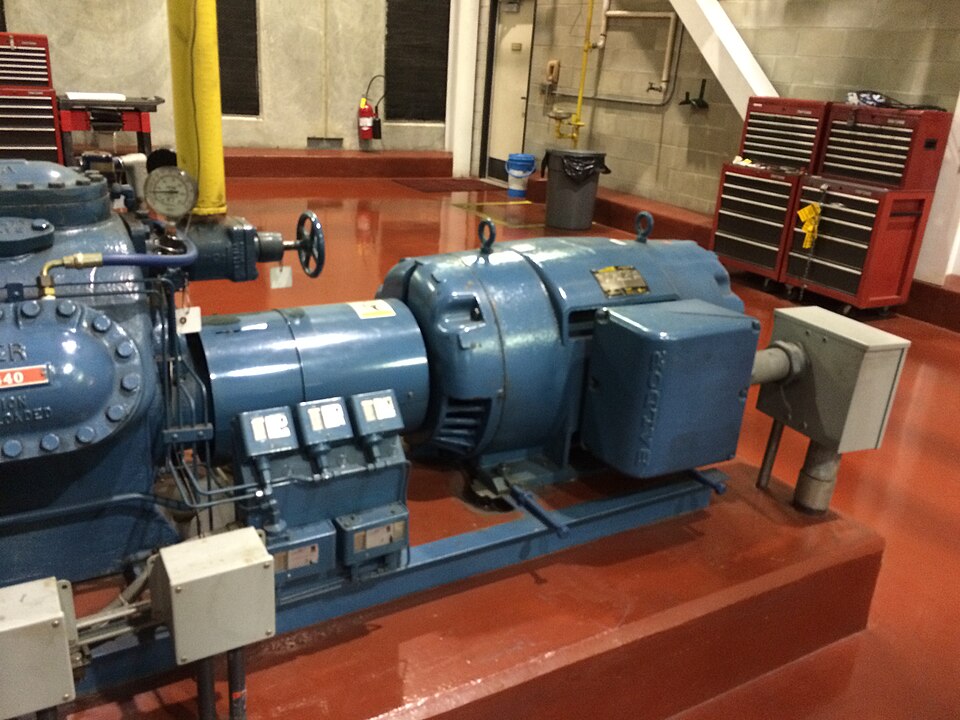
A real motor-driven reciprocating compressor in an engine room. A compressor motor draws a large inrush surge when it starts, the spike the surge rating covers. This unit is industrial-scale, far larger than a portable inverter would run, shown as an example of the motor type. The blue body is the compressor and the coupled cylinder is the motor.
The surge headroom covers the inrush of motors and similar loads. A motor draws a heavy current the moment it starts, before it spins up. One reference on inrush current notes that AC motors and transformers may draw several times their normal full-load current when first energized, for a few cycles. That heavy opening draw is the spike the surge rating covers. The surge is the inverter’s room for that first heavy moment.
The inrush comes from a motor at a standstill. A stopped motor offers little resistance to the current, so a large current rushes in at switch-on. The current falls once the motor picks up speed. The whole spike lasts a fraction of a second to a second or so. The inverter’s surge has to ride out that spike and hold steady. The spike passes in a breath and the load runs on.
The inrush deserves a closer look, since it sets the whole reason for the surge number. A motor at rest behaves almost like a short circuit for an instant. Its windings present only their bare resistance, with none of the opposing voltage that a spinning motor builds. The supply sees that low resistance and pushes a large current through, several times the current the motor draws once it runs. The rotor begins to turn. A turning rotor builds a voltage of its own that opposes the supply. That opposing voltage throttles the current back down. The whole rise and fall plays out in a fraction of a second to a second or so, faster than the eye can follow. A compressor adds its own twist, since it has to start against the pressure already in its lines. A pump starts against the water in its pipe. A saw or a grinder starts against the inertia of its blade or its wheel. Each of these loads asks the supply for a heavy opening pull before it settles into its steady draw. The inverter behind them has to meet that pull and hold its voltage. The surge rating is the size of the pull the inverter promises to meet. A surge well above the spike lets the motor start clean and the inverter hold steady. The brief spike barely shows on a meter that reads slowly. The surge number was built to answer that hidden demand. A motor never asks for that pull twice in the same start. The supply meets it once, at the opening instant. The motor runs quiet after. The continuous parts of the inverter never feel the spike, since the surge parts and the capacitors absorb it for that brief moment. The whole event is a heartbeat in the life of a running motor. A motor spends almost all its life past that first beat.
The size of the inrush spike depends on the load. A motor throws a spike of several times its running power. The spike is brief in every case, gone within a second or so. The surge rating has to top the largest spike the load will throw. A bigger motor calls for a bigger surge margin. The largest motor on the load sets the surge a buyer needs. A buyer sizes the surge to the worst startup on the list. The worst startup sets the surge the load needs.
Not every load draws a surge. A heater, a kettle, or a bulb takes its rated power from the first instant. These resistive loads have no startup spike to cover. A load of only resistive devices fits under the continuous rating alone. The surge rating matters for the loads with a motor or a transformer inside. A purely resistive load leaves the surge rating idle. A heater calls on the continuous rating and nothing more. Its draw is flat from the first instant to the last. A flat draw never tests the surge at all.
The time behind the numbers
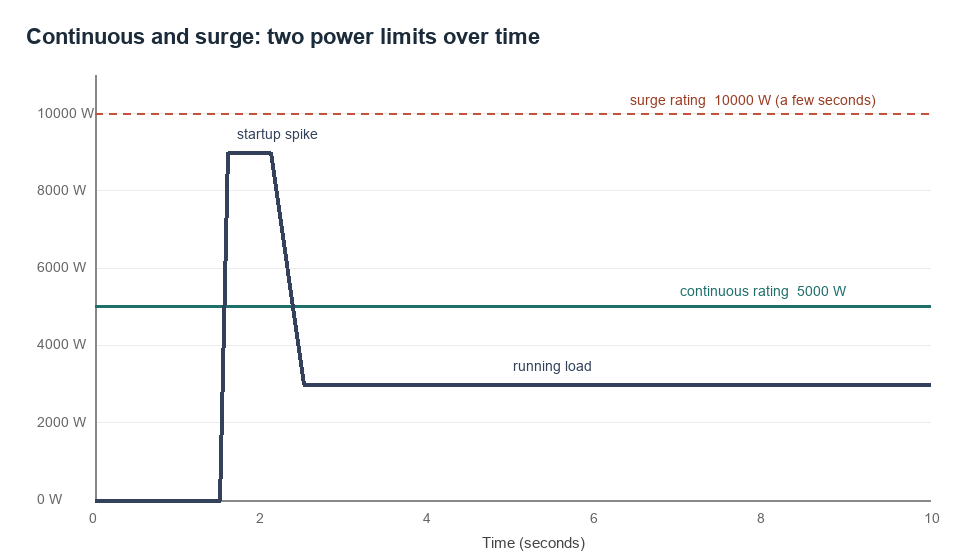
Continuous and surge over time, drawn to show the two limits. The solid line at 5000 watts marks the continuous rating, held with no time limit. The dashed line at 10000 watts marks the surge rating, held for a few seconds. The load trace rises to a startup spike under the surge line, then settles to a running draw under the continuous line. The figures are illustrative.
The two ratings live on two timescales, the long run and the brief moment. The chart shows a load’s power over time. A startup spike rises under the surge line for a second or two. A steady draw then settles under the continuous line. The shape of that trace ties the two numbers together, the brief peak above and the steady level below. The trace reads the same story the two numbers tell. Time is the axis that sets the surge apart from the continuous. The chart reads left to right as the load starts and settles. The spike sits at the left edge, the steady draw fills the rest.
Continuous and surge ratings, side by side
Property
Continuous rating
Surge rating
Power, example
5000 W
10000 W
Held for
hours, no limit
0.5 to 5 seconds
Typical level
the base figure
about twice the continuous
Covers
the steady load
the startup spike
Matters for
every load
loads with a motor
Reading both numbers
A spec sheet lists both numbers, side by side, often as one figure for continuous and one for surge. A reader takes both from the sheet. A load tests both, so both matter to the match. The table sets the two ratings against a load’s two demands. A number missing from the sheet is a number to ask after. A full spec carries the continuous watts, the surge watts, and the surge seconds. A reader looks for all three before trusting the claim. The three figures together describe the inverter’s reach. A reader who has all three can size any load.
The surge number rewards a careful read of its window. A surge figure means little without the seconds it holds for. A spec that names the surge and its duration tells the whole story. A surge with no time behind it is a soft claim. A reader checks for both the surge watts and the surge seconds. Both halves of the surge claim matter to a hard start. A surge claim without its window is half a figure.
The ratio between the two numbers hints at the design. A surge near twice the continuous is the common build. A buyer reads the surge against the size of the spike it must clear. A surge with the watts and the window both named is the honest figure. The ratio alone is a start. The window finishes the read. A buyer reads the ratio and the window as one claim. The two together tell what the surge can do.
Sizing a load to both numbers
A load fits an inverter when it clears both numbers. The steady draw has to sit under the continuous rating. The startup spike has to sit under the surge rating. A load that clears both runs and starts on the inverter. A load that fails either one is too big for the unit. The fit is a pass on both numbers at once. A load that clears only one of the two does not fit.
The steady total comes first. A buyer adds the running watts of every device on at once. The sum has to fit under the continuous rating, with a margin. A running total near the continuous limit leaves the inverter no room. A total well under the limit runs cool and steady. The steady sum is the floor the continuous rating has to clear. The continuous rating sits above that floor with room. Room over the floor keeps the inverter steady.
The startup spike comes next. The largest single spike is the one to size against. A device with a motor adds its startup surge on top of the steady draw of the rest. The peak of the running total plus the largest startup has to clear the surge rating. The worst moment is one big motor starting on top of the others already running. That single moment is the surge a load asks for in the end.
A worked case shows the two checks. A toolkit runs a 1500-watt saw, a 500-watt light rig, and a 300-watt fan, for a steady 2300 watts. The saw’s motor throws a startup spike near 4500 watts for a moment. Both totals clear their limits, the steady 2300 watts under the 5000-watt continuous rating and the 4500-watt spike under the 10000-watt surge rating. The toolkit clears both numbers, so it runs and starts. The two checks pass. The toolkit works. Both numbers have headroom over the load.
Resistive loads make the sizing simple. A load of heaters and bulbs has no startup spike. Its total draw is the same at the first instant as at the steadiest hour. A resistive load only has to clear the continuous rating. The surge rating sits unused for a load with no motor in it.
A margin on both numbers is the safe build. A buyer sizes the continuous rating above the steady total. The buyer sizes the surge rating above the largest spike. The margin covers a surprise load or a hard startup. An inverter chosen with headroom on both numbers starts and runs the load without strain.
A buyer builds the margin into the choice from the start. A continuous rating a step above the steady total holds a surprise load. A surge rating well above the largest spike starts a stubborn motor without strain. The two margins cost a little more inverter for a lot less tripping. A unit sized with room on both numbers earns its keep over years.
Mistakes with the two ratings
A few mistakes follow from the two numbers. The first is sizing only to the continuous rating. A load that fits the continuous figure can still trip the inverter at startup. The startup spike has to clear the surge rating too. A buyer who checks only the steady draw misses the spike. The startup is a test the steady draw never runs.
The second is treating the surge as a second continuous rating. The surge is a brief window of seconds. A load run steadily at the surge figure overheats the inverter fast. The surge is for the opening spike alone. A steady load belongs under the continuous number. The surge has no place holding a steady load.
The third is forgetting that some loads have no surge. A heater or a kettle draws its full power from the first instant. A buyer who pads the surge for a resistive load buys headroom that load never uses. The resistive total only needs to clear the continuous rating. The surge matters for the loads with a motor inside. A resistive load asks nothing of the surge.
The fourth is ignoring the surge window in the spec. A surge figure with no seconds behind it is half a number. A long-running motor that needs a full second of surge tests a short window. A buyer reads the surge watts and the surge time together. The window is part of the surge claim. A surge with no window named is hard to size against.
The fifth is summing startup spikes that never overlap. Two motors rarely start in the same instant. A buyer who adds every startup spike at once oversizes the inverter. The real worst case is the largest single spike on top of the steady draw. The surge needs to clear that one worst moment. The worst case is the single largest spike. One single spike sets the surge to plan for.
Two numbers, two checks, one fit. Two numbers, two checks, one fit.
The sixth is reading the surge as a continuous boost. The surge adds nothing to the steady power the inverter can hold. A load that needs more steady power needs a bigger continuous rating. The surge raises only the brief peak. The continuous number is the one that grows the daily capacity.
The seventh is buying a big surge on too small a continuous rating. The surge starts a motor the inverter cannot then keep running. The motor spins up on the surge. It stalls once the continuous limit takes over. The two numbers have to fit the load together. A big surge needs a continuous rating to match. Each number alone tells half the story of the fit. A fit needs both numbers in proportion. The right pair starts and runs the load.
Common questions
What is the difference between continuous and surge power?
Continuous power is the watts an inverter holds for as long as the load runs. Surge power is a higher figure the inverter holds for a brief moment, often a few seconds. The surge is usually near twice the continuous rating. Continuous power runs the steady load. Surge power covers a brief startup spike.
Why does an inverter need surge power?
Some loads draw a large current the moment they start. A motor or a compressor pulls several times its running power for a fraction of a second at switch-on. The surge rating gives the inverter the headroom to pass that brief spike. Without the surge, a heavy startup would trip the inverter.
How much higher is surge than continuous?
A surge rating near twice the continuous rating is the common build. A 5000-watt continuous inverter often carries a 10000-watt surge. The exact ratio and the surge duration change from one design to the next. A spec names both the surge watts and the seconds it holds.
Do all loads need surge power?
No. A resistive load like a heater, a kettle, or a bulb draws its rated power from the first instant, with no startup spike. A load of only resistive devices fits under the continuous rating alone. The surge matters for loads with a motor or a transformer inside.