















Canine Pregnancy Ultrasound Puppy Count and Heart Rate Handheld
A canine pregnancy scan reads a pregnant bitch for the life and the size of her litter. The flicker of a fetal heart shows that a puppy is alive. The count of how many is the harder question, one an ultrasound estimates early in the pregnancy. A handheld probe does all of it at the breeder’s own pace, in the clinic or on the kennel floor.
Scanning the pregnant bitch
The scan asks little of the bitch. She lies on her back or her side on a padded table, a nurse steadying her, the belly clipped from the navel to the groin and soaked with warm gel. A pregnant bitch is rarely troubled by the probe. A calm one gives the cleanest picture. The whole study takes only a few minutes once the puppies are found.
The probe works through both horns of the womb. It starts low, near the bladder, where the two horns meet, then follows each horn up its own side of the belly toward the kidney. The sacs sit strung along these horns like beads. The probe counts and reads them one by one as it climbs. The right horn runs deep under the last ribs, harder to reach than the left, so the probe is angled up under the rib edge, the bitch rolled to bring it into view. A sac tucked high under the ribs is the one a quick scan leaves out of the tally.
A full bladder helps here, the same as in any belly scan. It lifts the womb up out of the deep pelvis and opens a clear window onto the lowest sacs, the ones easiest to miss. A bitch scanned with an empty bladder hides her lowest puppies behind the gas of the gut.
The high-frequency curved probe suits the work, shallow for a small bitch and dropped lower for a deep-chested one. The depth is set to hold a whole sac on the screen at once. The focus is parked at the level the puppies sit, so each fetal heart comes up sharp enough to count. A still image of each heart trace is saved, the rate written beside it for the next scan to read against.
The weeks of a pregnancy
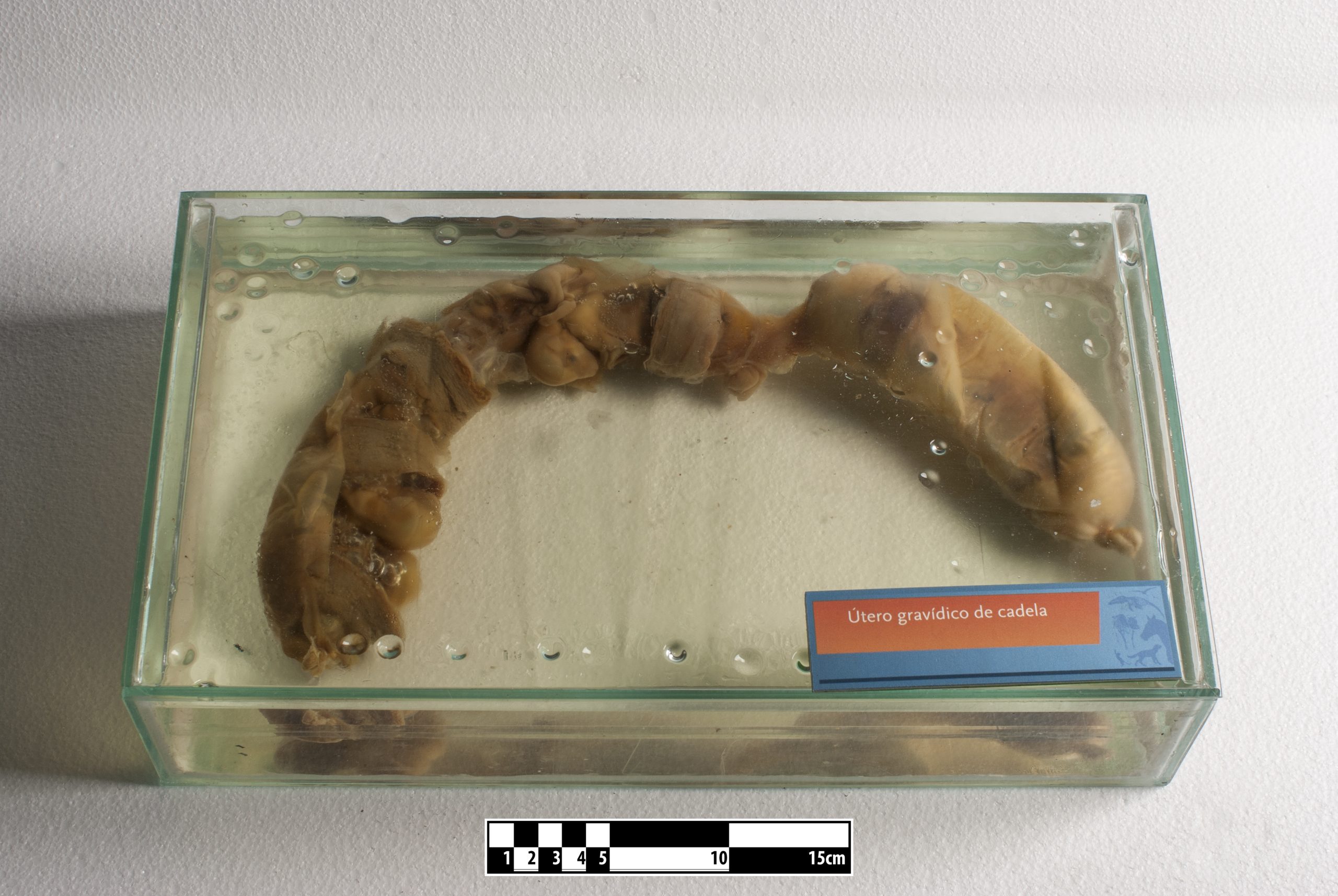
A dog carries her litter for around nine weeks from the day she ovulates. The scan shows a different picture in each part of that span, so the date of the mating sets what the probe looks for.
The first sign comes early. From about day twenty to twenty-five after mating, small dark sacs appear in the horns of the womb, each one a pocket of fluid around an embryo no bigger than a speck. A row of these dark beads strung along the uterus is the first proof a bitch has caught. The sacs grow rounder by the day, each holding its own puppy-to-be.
By around day twenty-five the embryo inside each sac grows large enough to see, a tiny grey smudge against the black fluid. The heart starts to beat at about the same time, a fast flicker the probe picks up before the shape of a puppy means anything. That flicker is the moment a sac becomes a living puppy on the screen.
Through the fifth and sixth weeks the puppy takes shape. The head, the body, and the buds of the limbs come up one after another. A faint band of denser tissue rings the sac, the zonary placenta that feeds the puppy. The fluid around each one stays a clean black, the puppy curled within it. A scan in this middle stretch reads each puppy for steady growth and a steady heart.
In the last fortnight the picture crowds. The puppies grow large, their skeletons hardening into bright lines, packing the belly so tightly that one hides behind another. Late in pregnancy the probe reads movement and heartbeats clearly. Counting stays the weak point right to the end. The bones the scan now sees are the same bones an X-ray reads to settle the number. Movement fills the picture by now, the puppies stretching and kicking inside their sacs, a sign of life as plain as the heartbeat. A litter that moves and beats strongly in the last week is one close to ready.
The first scan and the early answer
The earliest useful scan is run from about day twenty-five, once the sacs and the first heartbeats are there to find. A scan run sooner than that risks a false empty reading on a bitch who has in fact caught, since the sacs are not yet large enough to show. A breeder anxious for an early answer is steered toward the end of the fourth week.
The first question the scan settles is simple. A row of sacs, each with a beating heart, confirms a live pregnancy and turns the breeder’s planning real. An empty uterus on a bitch thought to be in whelp sends the search back to the dates, the mating, and the hormone tests.
A pregnancy lost early leaves its own picture. A sac without an embryo, or an embryo without a heartbeat, is a puppy that has stopped. The body often draws these back in over days, the sac shrinking and fading between one scan and the next. A bitch can carry living puppies alongside one that has resorbed. One dead sac does not end the pregnancy. The living puppies around it are what the scan reads on.
The early scan settles the false alarms as well. A bitch can show the signs of pregnancy, the swelling and the changed appetite, on a false pregnancy that carries no litter at all. The scan tells a true pregnancy from a false one in a glance. A breeder is spared weeks of planning around puppies that were never there.
The heart is the whole answer
A beating heart means a living puppy. The scan finds it in a single glance, the surest reading the whole study gives.
The fetal heartbeat and its rate
The fetal heart is the heart of the scan. It is the one finding that says, beyond doubt, that a puppy is alive. Its rate is the readout of how well that puppy is doing.
The probe holds on a single fetal chest and counts the flicker, or reads it on a tracing the machine draws from the moving wall. That tracing, an M-mode line, turns the beat into a row of peaks the eye can count against a clock. Colour flow laid over the heart paints the blood moving through it, a second proof of life in a puppy that shows little else this early.
A healthy puppy’s heart runs fast, well over two hundred beats a minute, roughly twice the rate of its mother. A rate up in that high range is the sign of a puppy in good shape. The number is read off each puppy the probe can settle on.
When the heart rate falls
A heart rate that falls is the warning the scan exists to catch. A puppy under stress slows its heart. A rate that has dropped below about one hundred and eighty marks a puppy in trouble. A rate down near one hundred and fifty, or lower, is a puppy in danger, one whose mother may need surgery to save the litter. The number carries more weight than almost anything else the scan reads.
This is why the heart rate is checked near the end of the pregnancy and through a long or stalled labour. A bitch straining for hours has her litter read puppy by puppy, the strong hearts left to come on their own, the slowing ones the reason a vet calls for a caesarean. The scan turns a tense wait into a set of numbers a decision can rest on.
Each puppy is read on its own. One slow heart among a row of fast ones flags a single puppy in trouble, perhaps the one stuck in the birth canal. A whole litter slowing together points to a problem in the mother, a drop in her own blood supply or a labour gone on too long.
A rate read once is a single point. Read again twenty minutes later, it shows a trend, a puppy holding steady or one sliding down. A rate that falls across two readings is the clearer call for a vet to act, the line between a puppy resting and a puppy failing.
Reading more than the heartbeat
The heartbeat is the first read on a puppy. The movement of its body is the second. A healthy puppy stirs and kicks within its sac, a sign of a nervous system alive and working. A puppy that lies still through a long look, its heart slow, is one the vet watches with care. Movement builds through the pregnancy, a faint twitch in the early weeks growing into the strong stretch of a near-term puppy. A scan that catches a puppy moving holds its strongest single proof, after the heart, that the puppy is well.
The fluid around each puppy reads as well. Clear black fluid is the mark of a healthy sac. Fluid gone cloudy or thick, speckled with debris, points to a puppy in trouble or one already lost. The probe weighs the look of the fluid alongside the heart and the movement. A sac running low on fluid, its puppy crowded against the wall, is another quiet sign of a pregnancy in trouble.
No single reading stands alone. A strong heart, a moving body, and clear fluid together say a puppy is well. The same three read the other way, a slow heart, a still body, cloudy fluid, warn of a puppy failing. The vet reads them as one picture, weighed against the day of the pregnancy.
Counting the litter
Counting is the part of the scan a breeder hopes for above all. It is also the part ultrasound does worst. The probe sees one slice of the belly at a time. The puppies lie curled and overlapping through a folded womb. A puppy counted in one sweep is easily counted again in the next, or missed altogether behind its neighbour.
Early on the sacs can be tallied with some hope, since they sit apart along the uterus. The count turns unreliable once the puppies grow and crowd together. By the last weeks the litter is a jumble of bodies the probe cannot pull apart into a firm count.
For a number a breeder can plan a whelping around, an X-ray near term does the job ultrasound cannot. From about day forty-five the puppy skeletons harden enough to show on a film. The skulls and spines are counted across one clear picture. The honest word to a breeder is that the scan confirms the litter and reads its health, leaving the headcount to the X-ray near term. Knowing the number matters at the whelping. A bitch left with a puppy still inside after the rest are born is the danger a firm count near term guards against. A single-puppy litter, the one at greatest risk of a hard birth, should be flagged early so the whelping is watched closely.
Even a rough count has its uses. A breeder who knows the litter is large lays on more help and more room. One who knows it is small watches each puppy the closer. The scan gives a range to plan within. The X-ray gives the firm number to whelp by.
Dating the pregnancy
A scan can place a pregnancy in time when the mating dates are unsure. The size of the sacs and embryos early on, the length of a puppy from head to rump later, both track the age of the litter against known charts. The earlier the scan, the tighter the date it gives.
A due date set this way matters for the whole pregnancy that follows. A bitch carried past her time, or one rushed to a caesarean too early, both put the litter at risk. A scan that pins the dates early gives the vet a clock to read the rest of the pregnancy against, with a window to expect the whelping in.
The crown-rump length, the puppy measured from head to tail-base, is the steadiest single number for age in the middle weeks. The machine carries charts that turn that length into a day of pregnancy and a date to expect the whelping. The earlier the measure is taken, the tighter the date, since early puppies grow at much the same rate and drift apart in size only later.
The tests that go with the scan
Ultrasound is one of a handful of ways to read a canine pregnancy. It does some jobs the others cannot. A blood test for the hormone relaxin turns positive from around the fourth week and tells whether a bitch is pregnant. That test counts nothing and reads no puppy’s health. A skilled hand can feel the sacs through the belly wall in the second month, a rough confirmation the scan then makes certain.
An X-ray earns its place late. From about day forty-five the puppy skeletons harden enough to show. A single film counts the skulls a scan cannot pull apart. A careful breeder leans on each in its turn, the scan all through the pregnancy, the film near term for the headcount.
Each test answers a different question: the relaxin blood test gives a yes or no, the hand a rough sense of how many sacs, the scan the life of the litter, the X-ray the count of heads. A breeder after the whole answer uses them in turn across the weeks.
The scan sits in the middle of all this, the one test that reads a pregnancy as it happens. It confirms the litter early, watches it grow through the weeks, and stands by at the whelping to flag a puppy in trouble. No other test follows a pregnancy the way the moving picture does.
When to scan, and how often
A pregnancy is rarely read just once. A first scan around day twenty-eight to thirty confirms the litter and dates it. The puppies have grown big enough to read easily by then, the heartbeats simple to count, the early losses already shown. That scan is the one a breeder books as a matter of course.
A second scan in the last fortnight checks growth and reads the hearts again, the point a slowing puppy first shows. A breeder of a watched line, or a bitch with a history of trouble, has the litter read more than twice across the weeks, each scan set against the one before.
The X-ray is timed for the end of the pregnancy, from around day fifty-five, once the bones are hard enough to count. The whelping itself brings the scan back out, the probe reading the labouring litter puppy by puppy as each one comes.
Breed and the hard birth
Some breeds need the scan more than others. A toy breed carrying one or two large puppies, or a flat-faced breed whose pups have broad heads, runs a high risk of needing help to give birth at all. The scan reads the litter early so the owner and the vet can plan around it.
A single large puppy is its own warning. A litter of one often grows large enough to block its own birth. The bitch never builds a strong enough labour around it. A singleton found early on the scan lets the vet plan a caesarean before the bitch runs into trouble.
A giant breed faces a large litter the bitch may tire partway through delivering. The scan counts what it can and reads the hearts. The plan made around it watches for the litter that gets stuck partway through the birth. The breed is read into the plan long before the whelping night.
When something is wrong
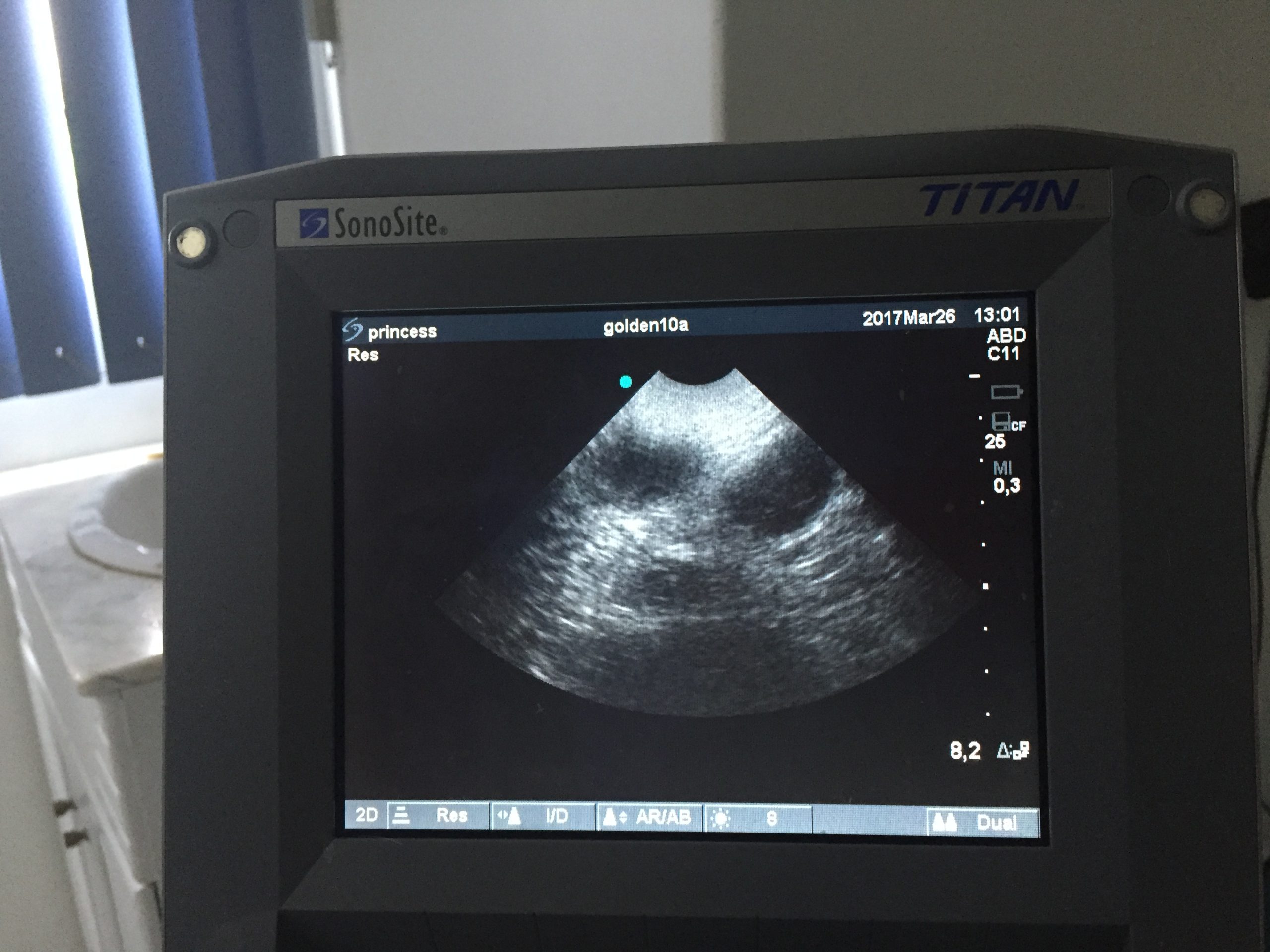
Nearly every scan confirms good news. The ones that do not are the reason the scan earns its place. A bitch off her food, feverish, or bleeding when she should not be is scanned for the trouble behind it.
A dead puppy shows as a sac with no heartbeat, sometimes with gas tracking through a body that has begun to break down. A pregnancy that has stalled, the puppies grown still and the sacs gone ragged, calls for a quick decision before infection sets in. A bitch carrying a mix of living and lost puppies is watched closely, the living ones the reason to hold on.
A swollen womb is not always a litter. A uterus packed with fluid and no sacs, no hearts, on a bitch ill a few weeks after a season is the picture of pyometra, a womb filling with pus. The scan settles that question in the time it takes to look, since the call between a pregnancy to nurse and an infection to operate on cannot wait.
Timing decides the outcome in these cases. A dead puppy left in the womb can poison the bitch within days. A scan that catches the trouble early, the still sac or the ragged womb, buys the vet time to clear it before the bitch turns septic. A week of delay turns the same finding into a sicker dog and a harder fix.
What the scan does not settle
A pregnancy scan answers what it answers well. It stays quiet on the rest. It cannot promise a healthy puppy, only a beating heart on the day of the scan. A puppy alive at four weeks can still be lost before term, so a single good scan speaks only for the day it was taken.
The scan reads the mother only so far. The size of her pelvis, the room a large-headed puppy will have to pass, the strength of a labour still to come: these sit beyond what the probe can call. A breed prone to hard whelpings is watched with the scan and planned for with the vet, the picture one part of a larger plan. The scan is the eyes on the pregnancy. The judgement of when to step in, and the hands that deliver or operate, belong to the people around it.
The picture a breeder can act on
A canine pregnancy scan turns a hopeful guess into a row of beating hearts. It confirms the litter, reads each puppy’s life, and flags the one in trouble in time to act.
Common questions about the pregnancy scan
How soon can ultrasound confirm a dog is pregnant?
From about day twenty-five after mating, once the sacs and the first fetal heartbeats are large enough to find. A scan run earlier risks reading empty on a bitch who has in fact caught, so the end of the fourth week is the usual time.
Can ultrasound count the puppies?
Only roughly. A large, crowded litter is the hardest to count. The puppies overlap in a folded womb and are easily missed or double-counted. For a firm number near term, an X-ray that shows each fetal skeleton does it far better.
What is a normal fetal heart rate in puppies?
A healthy puppy’s heart runs fast, well over two hundred beats a minute, roughly twice the mother’s rate. A rate that drops below about one hundred and eighty marks a puppy under stress. A rate near one hundred and fifty or lower is a puppy in danger.
Why is the heart rate checked during whelping?
A slowing fetal heart is the clearest sign of a puppy in trouble. Through a long or stalled labour the litter is read puppy by puppy. The slowing hearts are often the reason a vet calls for a caesarean to save them.
Does the dog need to be clipped and fasted for a pregnancy scan?
A small clipped patch on the belly and a good soak of gel give the cleanest picture. A light fast helps clear the gut, though a pregnancy scan reads well enough that many are run without one.

About the Author
Julien Mercier
Senior R&D Engineer · Medical Ultrasound Transducer Development
Senior R&D Engineer with an M.S. in Applied Physics and over 15 years of experience in medical ultrasound transducer development, specializing in the design verification and performance testing of high-frequency imaging transducers. Currently leading the development and verification of the company’s next-generation high-frequency linear-array transducer, responsible for imaging performance evaluation and reliability analysis in preclinical testing. Brings extensive hands-on experience in piezoelectric element tuning, beamforming parameter optimization, and system-level performance testing.