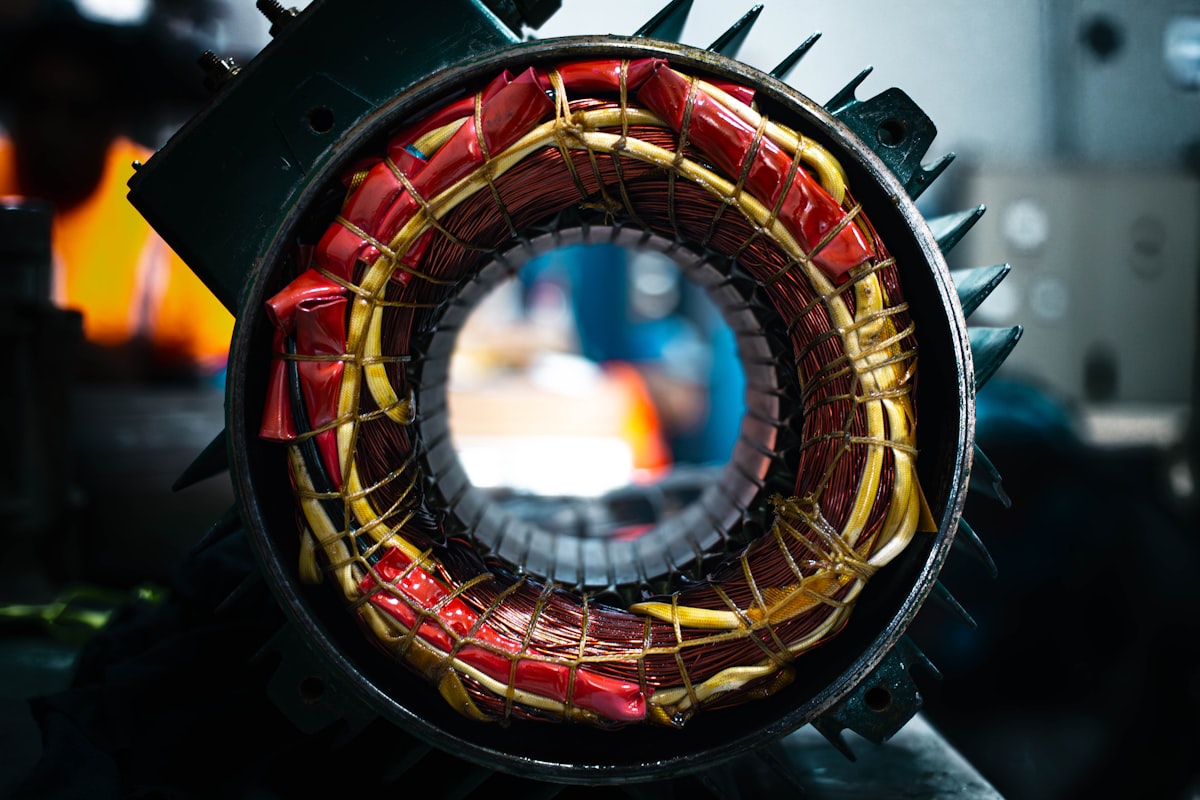
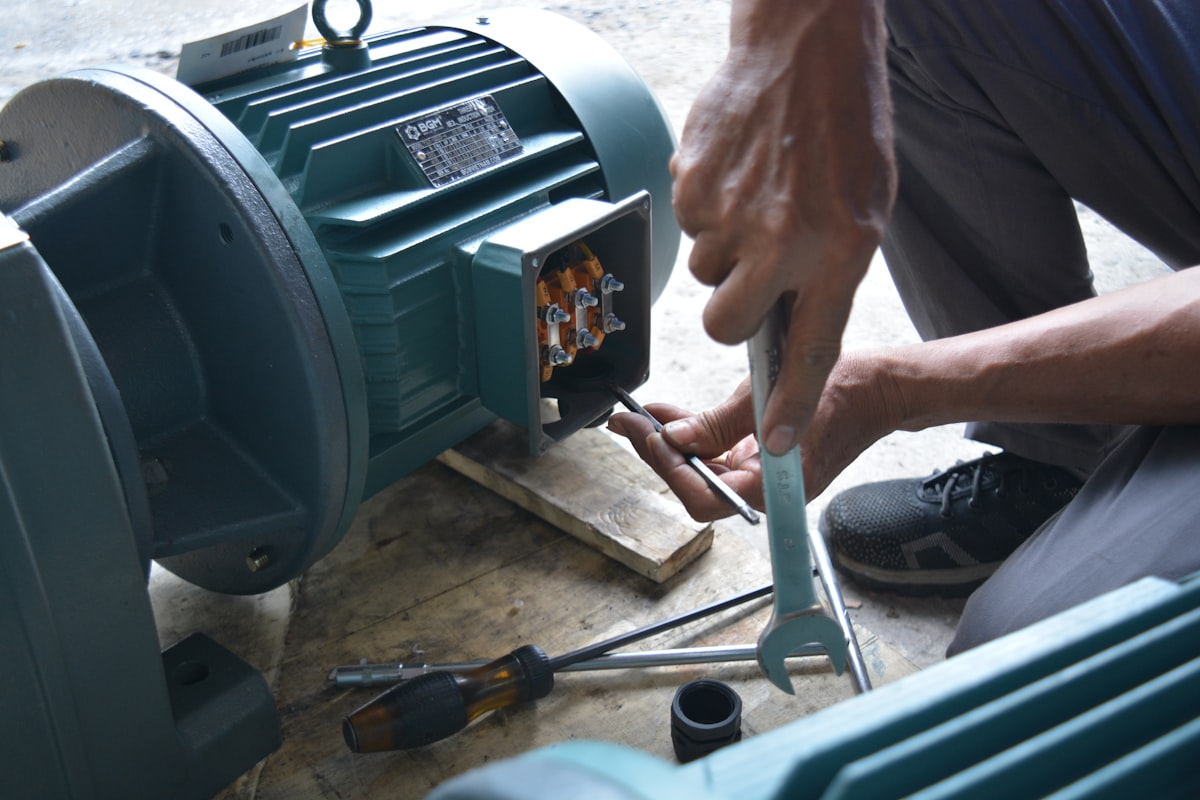
FLA and SFA on the nameplate map to the calculation here. I = P / (√3 × U × cosφ × η). At 380V, cosφ 0.87, η 0.92, a 22 kW motor ≈ 42A (YE3-180M-4 nameplate: 41.8A).
Below about 40% load, both cosφ and η fall off a cliff and the formula becomes useless. At 30 Hz on a VFD compressor the power factor might be 0.62, might be 0.71, depends on the motor design and magnetizing current. Don’t bother plugging partial-load numbers into this formula. Just clamp the cable and read what the meter says.
| Power (kW) | Rated Current (A) | Starting Current (A) |
|---|
| 7.5 | 15 | 90 |
| 11 | 22 | 132 |
| 15 | 29 | 174 |
| 18.5 | 36 | 216 |
| 22 | 42 | 252 |
| 30 | 57 | 342 |
| 37 | 70 | 420 |
| 45 | 85 | 510 |
| 55 | 103 | 618 |
| 75 | 140 | 840 |
| 90 | 167 | 1002 |
| 110 | 204 | 1224 |
| 132 | 244 | 1464 |
| 160 | 295 | 1770 |
| 200 | 368 | 2208 |
| 250 | 460 | 2760 |
| 315 | 580 | 3480 |
Starting current at 6x. Old Y-series can be 7.5x. IE3/IE4 premium motors sometimes come in at 5.2x or 5.5x. If the nameplate is readable, use it.
Cable Sizing
This is the topic that causes the most grief on compressor installations, so it gets the most space here. Breakers and VFDs are comparatively simple to get right. Cables are where corners get cut because copper is expensive and conduit routing is a pain.
IEC 60364-5-52 Table B.52.4 gives the reference ampacities. For single-core PVC copper in free air at 30°C: 35 mm² is 126A (not 130A, the round number that gets passed around), 50 mm² is 153A, 70 mm² is 196A, 95 mm² is 238A. XLPE insulation bumps these numbers up by about 20%. GB 50055-2011 section 4.6 says motor feeder cable ampacity shall be no less than 1.25 times motor rated current. So that’s the floor.
55 kW motor, 103A, times 1.25 is 129A. 35 mm² at 126A doesn’t pass even on paper with IEC numbers. Need 50 mm² at 153A. This is where using the rounded “130A” from memory instead of looking up the table causes problems. 129A versus 130A looks like a pass. 129A versus 126A is a fail.
Now put that cable in a real installation. IEC 60364-5-52 Table B.52.17 gives grouping correction factors. Three circuits in one conduit: correction factor 0.70. Four circuits: 0.65. That 50 mm² at 153A in free air becomes 153 × 0.70 = 107A with two other circuits in the same conduit. A 55 kW motor at 103A technically passes at 107A. Four amps of margin. In a 30°C environment.
In reality, compressor rooms in Guangzhou or Chennai or Monterrey hit 42-45°C for four months of the year. The temperature correction factor at 45°C for PVC is 0.87 (IEC 60364-5-52 Table B.52.14). So 107A × 0.87 = 93A. The motor needs 103A. The cable is 10% undersized.
This is how a 50 mm² cable that “should be fine” ends up overheating in a compressor room in summer. The catalog says 153A. The installation conditions bring it down to 93A. There’s a 39% gap between catalog and reality. Most of that gap comes from grouping, not temperature. One cable alone in that same hot conduit would still carry 133A (153 × 0.87), plenty for a 103A motor. It’s the other cables sharing the conduit that kill it.
Going to 70 mm² gives 196A in free air, 196 × 0.70 × 0.87 = 119A after derating. 16A of margin over 103A. That holds up. The price difference between 100 meters of 50 mm² and 70 mm² four-core is maybe ¥3,000-4,500 depending on the supplier and copper prices that month. That’s nothing compared to the cost of pulling the cable out and replacing it after a thermal failure.
XLPE insulation changes the math. Same 50 mm² cable but XLPE instead of PVC: free air rating is about 185A. After grouping and temperature derating: 185 × 0.70 × 0.94 (XLPE correction at 45°C is better than PVC) = 122A. Passes with margin. XLPE costs 15-25% more per meter than PVC but has higher ampacity and better thermal resistance. For compressor rooms that are consistently hot, XLPE cable on a 50 mm² cross-section can be cheaper than PVC cable on a 70 mm² cross-section because the copper weight is less.
Voltage drop. The standard says under 5% at the motor terminals. By the resistivity method: copper resistivity at operating temperature (let’s say 70°C for a loaded cable) is about 0.0213 Ω·mm²/m. A 50 mm² cable carrying 103A over 120 meters, one way, voltage drop per phase is I × 2L × ρ / A = 103 × 240 × 0.0213 / 50 = 10.5V. As a percentage of 220V (phase voltage): 4.8%. On the edge. And that’s running current. During star-delta starting at 3x rated, the drop triples. Motor terminal voltage during starting drops to maybe 345V line-to-line. Starting torque drops with the square of voltage: (345/380)² = 82% of normal starting torque.
A parallel cable run solves the problem without pulling new cable. Two 35 mm² cables give roughly 70 mm² effective cross-section and half the voltage drop of a single 35 mm² run. Each cable carries about half the current. The installation requires a junction box at each end to combine the two cables onto the terminal. This is common on retrofit jobs where the existing conduit is full and a second conduit is being run on a cable tray or in a new trench.
Circuit Breakers
1.2-1.3 times motor rated current, round up. D-type for motor feeders. Size to protect the cable and motor, not to survive the starting surge. An MCCB like an ABB Tmax XT3 160A on a 55 kW motor at 103A provides 1.55x margin on the thermal trip, which is within the acceptable range per GB 50055-2011 section 4.3. A Schneider NSX160F at 160A frame with a 125A thermal magnetic trip unit would be tighter, at 1.21x, and that’s fine too. Either one needs D-curve or motor-rated trip characteristic.
C-type ahead of VFDs. D-type for direct motor feeders. That’s the whole story on breaker trip curves for compressor circuits.
Oversizing breakers is common in old plants and it means the motor has no overcurrent protection. A 250A breaker on an 85A motor, a configuration that exists in more facilities than anyone would like to admit, won’t trip until the motor is drawing 200A+ sustained. The motor stalls at 120A. The winding burns. The breaker doesn’t know.
VFD Sizing
Match to output current, not kW label. The kW label is a marketing number.
Danfoss FC302 series: the 55 kW model has a rated output current of 106A in normal duty and 90A in high overload duty. Siemens G120 PM240-2 at 55 kW does 110A. ABB ACS580-01-106A at 55 kW does 106A. Yaskawa GA700 at 55 kW does 112A. So “55 kW” gives you anything from 106A to 112A depending on the manufacturer.
A 55 kW motor at 103A on a Danfoss FC302 P55K at 106A has 3A of margin. At 40°C ambient, 1000 meters altitude, that’s fine. At 45°C it’s not fine. The FC302 derates by about 1.5% per degree above 40°C. At 45°C the output drops to about 98A. The motor needs 103A. The drive faults on thermal overload.
Going up one frame: the Danfoss FC302 75 kW does 147A. That’s 43% margin over the motor’s 103A. It’ll never derate into trouble. The price difference between the 55 kW and 75 kW FC302 is somewhere around $800-1,200. A single production shutdown from a VFD overcurrent trip costs more than that.
For compressor applications specifically, the VFD needs heavy-duty overload capability. The Danfoss FC302 in high overload (HO) mode gives 160% for 60 seconds and 180% for 0.5 seconds. In normal duty (ND) mode it’s 110% for 60 seconds. Compressor loading needs HO mode because the pressure spike when the solenoid opens sends a torque transient through the airend. If the VFD is configured for ND mode (the default out of the box on most drives), the first loading event after startup may trigger an overcurrent trip. Change the application mode from ND to HO in the VFD parameters and it goes away.
There’s a whole separate issue with VFD output cables. The VFD output is a PWM waveform. Voltage pulses with rise times in the hundreds of nanoseconds on modern IGBT drives. When a fast pulse travels down a cable, the cable has characteristic impedance determined by its geometry. The motor has a different impedance. At the impedance boundary, part of the pulse reflects. On a 380V system the DC bus is about 540V. The reflected pulse adds to the incident pulse at the motor terminals. Peak voltage can hit 2x bus voltage: 1080V. A standard Siemens motor on a long cable from a VFD is seeing voltage spikes 27% above its rating. That erodes insulation.
Below 50 meters of cable, the pulse propagation time is short enough that the reflected wave doesn’t build up to full amplitude. 50-100 meters, a dV/dt reactor at the VFD output slows the pulse edges to 2-5 μs and limits the peak to about 800V. Above 100 meters, a sine wave filter converts the PWM output to a near-sinusoidal waveform. Motor terminal voltage stays below 450V peak.
The failure mode from running a long cable without a reactor is a motor winding fault that shows up 8-18 months after commissioning. The insulation erodes at the first turns of each phase coil where the voltage stress is concentrated. Turn-to-turn short develops. Eventually a phase-to-ground fault trips the breaker. The motor gets rewound. Goes back in. Fails again in less than a year.
VFD-duty motors have reinforced insulation rated for 1300V peak and phase insulation paper between the first turns. They can handle long cable runs without a reactor up to maybe 100-150 meters. They cost 10-20% more than the standard frame.
Using Current for Diagnosis
| State | Reading | Meaning |
|---|
| Full load | 90-100% of nameplate | Steady, normal operation |
| Unloaded | 25-40% | Twin screws higher than single; creeping up means unloader valve leaking |
| Imbalance | Within 5% | Three-phase balance limit |
Discharge pressure set too high is the overwhelming majority of high-current complaints on compressor service calls. A machine rated 0.8 MPa / 8 bar running at 10 bar overloads the motor. The operator set it there because the production floor is getting 5.5 bar instead of the 6 bar they need, and instead of fixing the distribution piping, they cranked the compressor up 2 bar. The compressor draws 112% rated current. The overcurrent relay trips. The maintenance electrician raises the relay from 105% to 115% to stop the trips. Now the motor runs continuously at 112% with no protection. Insulation class F is rated for 155°C. At 175-180°C the insulation degradation rate is roughly 4x the rate at 155°C.
The fix is not at the compressor. The fix is in the piping. Replace the 2″ header with 3″. Clean the strainer. Fix the elbows. At 0.8 MPa with proper piping the production floor gets its 6 bar. The motor runs at 95% rated current.
Oil separator differential pressure. New element: 0.02-0.05 MPa. Service limit: 0.1 MPa. Atlas Copco GA series calls for element replacement at 1.0 bar differential. Ingersoll Rand R-series says 15 psi. Running an element past 0.1 MPa differential to stretch its service life is a false economy. At 0.15 MPa the motor pulls maybe 5-8% more current. On a 55 kW machine running 6000 hours a year, 8% more power consumption is 4.4 kW × 6000 hours = 26,400 kWh. The element saves its own cost in electricity in about five weeks.
Bearing wear in screw compressor airends is gradual. Rotor-to-housing clearance is 0.04-0.08 mm. As bearings wear, the rotors shift position. The leakage path between the high-pressure and low-pressure sides gets larger. Internal recirculation increases. Current creeps up, maybe 0.5-1% per month once the wear becomes measurable. If current, vibration, and discharge temperature are all trending up together over months, the airend bearings need inspection. Early bearing replacement based on trending data pays for itself many times over versus waiting for catastrophic failure.
Low current with adequate pressure is just light load. Not a fault. Low current with poor pressure: intake valve problem. The motor spins, draws no-load current, and produces very little air. Clogged air filter is the same symptom, milder. Supply voltage below 360V on a 380V system, current goes up noticeably. Cooling degradation, blocked cooler, failed fan, ambient above 40°C all raise winding temperature and current. Same compressor, same load, might draw 101A in January and 108A in August.
Starting Methods
| Method | Range | Starting Current | Notes |
|---|
| DOL | Under 15 kW | 6-8x | Direct-on-line, simple, fine on small machines |
| Y-Δ | 15-75 kW | 2-3x | Star-delta; switchover transient is the weak point |
| Soft starter | Any size | 2-4x adjustable | Thyristor ramp, smooth, bypass after full speed |
| VFD | Any size | Under 1.5x | Frequency ramp, minimal grid disturbance |
The star-delta switchover deserves more detail. The motor disconnects for 50-80 ms during contactor changeover. When delta reconnects, the phase angle mismatch between supply voltage and the motor’s back-EMF determines how bad the transient is. Bad luck on the phase angle and the transient spike is as bad as a direct start. Timer setting for the switchover is empirical: start around 6-8 seconds for a 30 kW unloaded compressor and adjust based on the ammeter reading during switchover.
Soft starter details: an ABB PSTX or Siemens 3RW55 on a 55 kW motor dissipates about 500-600W through the thyristors during running. With the bypass contactor engaged, zero. If the bypass contactor fails, the soft starter stays on thyristors and dumps that 500W as heat into the MCC panel indefinitely. Panel temperature climbs. This is a failure mode that doesn’t cause an immediate trip but degrades everything in the panel over months.
Power Supply Capacity
Three compressors: 55 + 37 + 22 = 114 kW. At cosφ 0.87, η 0.92, simultaneity 0.8: 178 kVA. A 200 kVA transformer covers it on paper. A 250 kVA covers it in reality. A 315 kVA covers it plus the 37 kW machine that gets added in three years when the production line expands.
The 55 kW motor on star-delta start draws about 200 kVA during starting. On a 200 kVA transformer, that’s 100% of the transformer’s rating consumed by one motor starting. Voltage drops 15-20% on the secondary. The other two compressors see their current jump as they try to maintain torque at reduced voltage. A sequencer with 30-60 second delay between starts prevents simultaneous starting and is standard on any multi-compressor installation.
Capacitor bank for power factor correction. Bringing cosφ from 0.87 to 0.95 frees up 9% of transformer capacity and eliminates the utility surcharge for low power factor. A 50 kvar capacitor panel costs ¥8,000-15,000 installed. Payback period: three to six months.
Harmonics from VFDs. A 6-pulse VFD rectifier generates 5th and 7th harmonic current primarily. With three VFD compressors on one transformer, the total harmonic distortion on the bus can reach 12-15% THDv. IEEE 519-2022 recommends THDv below 5% at the PCC for general systems. At 12-15% the transformer heats significantly above its nameplate loading. Line reactors on VFD inputs, 3% impedance, reduce the 5th harmonic from about 25-30% of fundamental to about 10-12%.
Size the incoming feeder cable for the maximum foreseeable transformer size, not the one being installed today. A 250 kVA transformer at 380V draws about 380A on the secondary. If the transformer gets upgraded to 400 kVA later, it draws about 608A. Oversizing the feeder from the start by one cable size adds a few thousand in copper cost and avoids a six-figure retrofit later.