Active balancing is the work a battery management system does to keep many cells, wired in series, charged to the same level. Stack a dozen lithium cells nose to tail and they will not stay matched on their own; small differences pull them apart, cycle by cycle. Balancing is how the pack closes that gap and keeps every cell in step. Without it, a long string is only ever as good as its poorest cell.
In a series string, the same current runs through every cell from end to end. What differs is where each cell lands afterward, its own charge settling a little above or below its neighbours. Left alone, those small gaps widen until the weakest cell holds the whole pack back.
The fix is to move charge around inside the pack, or to bleed a little off the top, leaving the cells level. A BMS watches the spread between cells and steps in when it grows too wide. Done well, balancing turns a stack of slightly mismatched cells into one that behaves like a single battery.
Why cells drift apart
No two cells leave the factory exactly alike. Even cells from the same batch differ a little in capacity and in internal resistance, by a percent or two the eye would never catch. Every imbalance that follows grows from a seed that small. One percent of spread at the start is all the cells need to drift from.
Heat drives the cells apart once they are working. A cell at the warm end of a pack ages faster and self-discharges quicker than one kept cool. Over the months it drifts away from the rest, set on a different path by nothing more than where it happened to sit.
Self-discharge does its own slow work. Every cell loses a trace of charge just sitting on the shelf, each at its own slightly different rate. Park a pack for a month and the cells come back spread a little wider than they went in.
Age widens whatever gaps have already opened. Once the cells have racked up many cycles, the weaker ones lose capacity faster. A pack that started nearly matched can drift noticeably apart after a few years. What balancing fights, in the end, is this steady pull toward disorder.
Matching the cells from the start
Good balancing begins before the cells are ever wired together. A careful pack maker sorts new cells by capacity and by internal resistance, grouping cells that measure nearly the same into one string. Cells matched this way start their life close together. The balancer then has far less to chase later on.
Matching trims the spread a pack starts with. Cells pulled from the same production run, then sorted into tight groups, sit within a percent or so of each other on day one. The closer the match at the start, the longer a pack holds together before any cell wanders far.
Even a perfectly matched pack drifts in the end. Matching sets a good starting point. From the first cycle, the slow forces of heat, self-discharge, and age go to work. This is the gap a balancer is built to close, day after day, for the life of the pack.
Capacity matching and live balancing work hand in hand. One sets the cells close at the factory; the other keeps them close through every cycle that follows. A pack that is both well matched and well balanced behaves, for years, as though it were a single large cell.
The cost of an imbalance
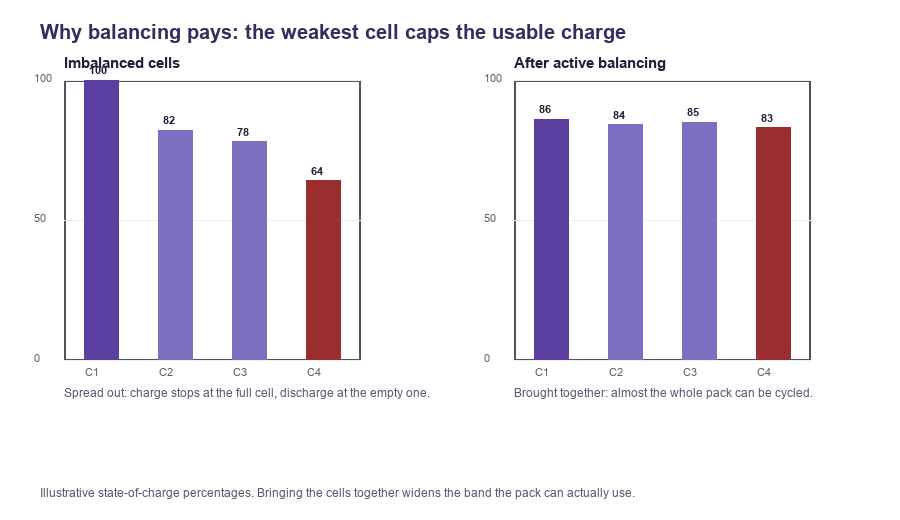
Why balancing pays. The left panel shows four imbalanced cells. Charging stops when the fullest fills; discharging stops when the emptiest empties; much of the pack’s charge stays out of reach. The right panel shows the same cells brought close together by balancing, where nearly the whole pack can be cycled. The state-of-charge figures are illustrative.
An imbalance costs the pack at both ends of every cycle. Charging has to stop the moment the fullest cell reaches its ceiling, even if the others still have room. Discharging has to stop the moment the emptiest cell hits its floor, even with charge left in the rest. The wider the spread, the more capacity sits locked away, untouchable at either end. Squeeze the cells far enough apart and a healthy pack can act half its size.
The weakest cell sets the limit for all of them. A pack is only as usable as its lowest cell on discharge and its highest cell on charge. One outlier drags the whole stack’s capacity down to its own. Four cells at 100, 82, 78, and 64 percent leave the pack behaving as though it were far smaller than its rating.
Runtime is the first thing a user loses. Whatever charge sits in cells that never fill or never empty is charge the load never sees. A pack rated for a long evening can come up short, delivering fewer hours than its rating promises.
The outlier cell takes a beating, too. Forced to the edges of its range each time the others coast, a weak cell works harder on every cycle and ages faster still. Left unchecked, the imbalance feeds on itself, the worst cell falling further behind the longer it runs.
Balancing exists to break that spiral. By pulling the cells back toward a common level, it frees the capacity that would otherwise stay locked away and spares the weakest cell the worst of the strain. A balanced pack spends its whole rated charge, cycle after cycle, with no cell carrying more than its share. Year after year, that even sharing is what keeps the pack near its rated capacity. Spread the work across matched cells and not one of them has to carry more than its share.
Passive balancing: bleeding the high cell
Passive balancing is the simpler of the two methods. When a cell climbs above the others near the top of charge, the BMS switches a resistor across it and lets the extra charge drain away as heat. The cell holds at the threshold until its neighbours catch up. Held there cycle after cycle, the high cells wait for the rest to come level.
The hardware is about as plain as it gets. Each cell gets a small resistor and a switch, a MOSFET the controller turns on when that cell runs high. A row of these bleed resistors sits right on the BMS board, one per cell, costing only pennies apiece.
All of this happens at the tail end of charging. Passive balancing does its work in the constant-voltage phase, up near 70 to 80 percent of charge and above, where the cells running ahead can be trimmed back down. Below that, with the cells far from full, there is little to balance and the resistors stay idle.
What passive balancing gives up is the energy it burns. The charge bled off a high cell turns into heat and leaves the pack for good. The method works by trimming the top cells down to meet the rest. For a pack that drifts only a little, that small loss buys an easy way to hold the cells in line, year in and year out.
Active balancing: moving the charge
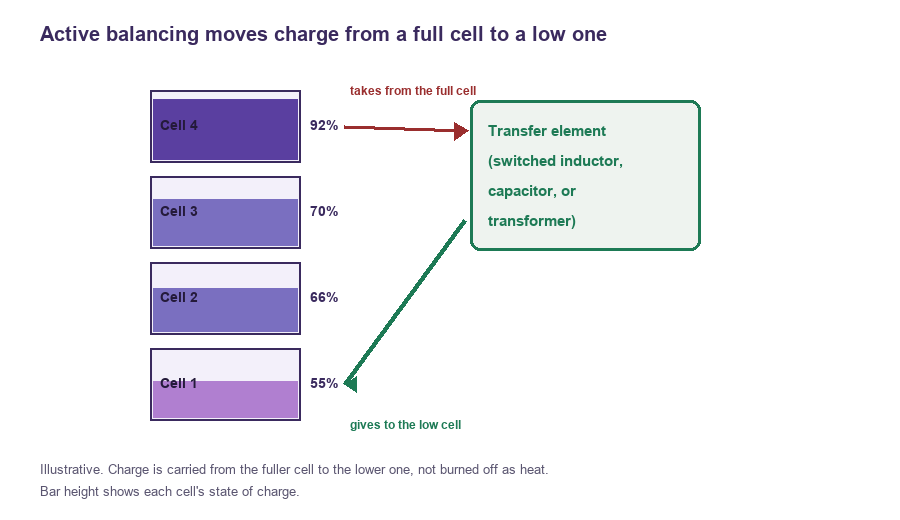
Active balancing in concept: when one cell sits fuller than the rest, a transfer element, a switched inductor, capacitor, or transformer, carries the surplus charge across to a cell that sits lower. The charge stays in service inside the pack. Bar heights show each cell’s state of charge. The figures are illustrative.
Active balancing keeps the surplus charge inside the pack. When one cell holds more than the rest, the BMS carries that extra across to a cell that holds less. Energy travels from the full cell toward the low one. Battery University describes it plainly: active balancing shuttles the extra charge from higher-voltage cells to those with a lower voltage. Nothing is thrown away as heat; the charge that leaves a high cell lands in a low one and stays in service. Because the energy is conserved, active balancing can work in both directions of use. It lifts the laggards toward the leaders on the way up. It props the weak cells up from the strong on the way down. Either direction, the whole string is held together as the pack works. A controller running this scheme can keep the cells within a few millivolts of one another through an entire cycle. The closer it holds them, the more of the pack’s rated charge comes back out at the plug. On a large series string, that recovered capacity adds up to real extra runtime. The method asks more of the hardware than a bank of resistors does. What it returns is charge that would otherwise have been stranded or burned. Keeping that charge in play is what lets every cell pull its weight. The wider the spread it has to close, the more the method gives back. A pack that has drifted far benefits more from a balancer that can carry whole amps of correction where it is needed. On a hard-driven pack the balancer works the whole cycle through, quietly holding the string as one. Even at rest, it can nudge a high cell down toward its neighbours before the gap has a chance to grow. The work is never dramatic. This constant trimming is what keeps a big series pack whole over thousands of cycles.
Which cell gives and which cell takes shifts from one moment to the next. Many times a second, the controller reads the stack and sorts the cells with charge to spare from those that need it. Charge then flows wherever the spread calls for it, always from the fuller side toward the emptier. No cell stays a donor or a taker for long; as the pack works, the roles keep trading. Trace any single cell over an hour and it will have given and taken many times over.
Watch a pack under active balancing and the cells stay together. Held in a tight band, they keep the gaps between them small from the first cycle to the last. Even as each cell ages at its own rate, the balancer keeps drawing them back toward the middle. The spread that would build in an untended pack never gets a chance to open here.
The real muscle of active balancing lies in its current. Hundreds of milliamps, or whole amps on a large pack, is what an active balancer can move. That kind of current corrects a wide spread quickly and keeps pace with even the fastest-drifting cells. What a slow trickle would need many charges to fix, it can pull back into line within a cycle or two. That speed is what sets a redistributive balancer apart on a fast-drifting pack.
At any point in a cycle, active balancing can do its work. Charge, steady use, the long slide toward empty: the balancer acts through all of them, never waiting for a full battery first. Free to step in at any moment, it can hold a hard-working pack in tight order.
Inside the transfer element
At the heart of an active balancer sits a small energy store. A capacitor or an inductor takes on a packet of charge from one cell, then hands it to another, over and over, thousands of times a second. The store never holds much at once; it works by moving many tiny packets fast. Run fast enough, a small store can shift a surprising amount of charge over a cycle. Thousands of hand-offs a second add up to a steady current between the cells.
Simplest of all is the switched-capacitor balancer. To move charge, the controller wires its capacitor across a high cell to fill it, then flips it across a low cell to pour it out, step by step, until the two cells match. Just a few switches and one capacitor do the whole job, which is why small packs of a handful of cells so often use it.
An inductor sets a different rhythm. Charge from the high cell pours into the inductor’s magnetic field, then collapses back out into the low cell, a push and release that repeats at high speed. Because an inductor shrugs off larger currents, it suits a pack that needs a strong correction. The price is a little more circuitry wrapped around each one.
Transformers come in where many cells must be served at once. Through magnetic coupling, a transformer-coupled balancer can draw from the whole stack to feed a single weak cell, or move charge between groups of cells. All those extra windings and switches cost more to build, which is why transformers tend to show up in the largest packs, where one core can serve dozens of cells at once.
When balancing runs
Active balancing answers to the spread, whatever the hour. The moment the cells begin to drift, at any state of charge, on charge or discharge alike, it steps in to pull them back. Waiting for a full pack is never part of the deal. How hard the pack is driven decides how busy the balancer stays. The harder the work, the more constantly it runs.
What active balancing wins back
Usable capacity is the clearest thing active balancing wins back. Charge that would otherwise sit stranded in half-full cells stays in reach. More of the pack’s rating then reaches the load. On a power station that reads as real extra runtime. Over a deep overnight cycle, the reclaimed charge can be what carries the load all the way to morning.
Charging can run quicker, too. Holding the cells together as they fill, an active balancer keeps any single cell from racing ahead and forcing an early stop. The whole stack reaches full closer to the same moment. None of the cells has to idle at the top waiting for a laggard to crawl up and meet it. Shave even a few minutes off each charge and the saving mounts over a battery’s life.
Less heat comes off a pack that carries its charge across. The energy an active balancer shifts stays in the cells, with little left over to warm the board. Running cooler means less stress on the cells, and one fewer heat source for the BMS to track. Through a long charge, a cool-running balancer can keep working. The pack’s own warmth barely rises.
Over years, the gentler treatment shows in longer life. A pack whose cells stay matched shares the work evenly. No single cell wears out far ahead of the rest. Steady balancing, kept up over thousands of cycles, is part of what lets a good lithium pack last a decade. Spared the worst of the strain, every cell in the string ages at a gentler pace. Across thousands of cycles, that gentler pace is what separates a pack that fades early from one that goes the distance.
Signs a pack has fallen out of balance
An imbalance announces itself first as lost runtime. The pack begins to quit early, dropping the load well before its gauge reads empty. That gauge tracks the average cell. The weakest one hits its floor first and trips the cutoff for the whole string. To the user, the battery just seems to have shrunk.
Charging that quits too soon is the other tell. With one cell already high, charging hits its cutoff before the others are full; the gauge stalls short of 100 percent and will not climb. The fuller that one outlier runs, the sooner charging ends for everybody.
A smart BMS names the problem outright. Reading every cell on its own, the controller watches the spread widen and flags the imbalance long before anyone would notice the lost capacity. On the app the cells stand side by side, one short bar among the tall ones giving the whole thing away at a glance.
Caught early, an imbalance is easy to walk back. A balancer given a few cycles can close a modest spread on its own, with no hand from anyone. The sooner the drift is caught, the lighter the work of pulling the cells back into line. A balancer asked to close a spread it has fallen behind on works through several cycles to bring it in.
Passive and active balancing compared
Aspect
Passive balancing
Active balancing
What it does
bleeds the high cell through a resistor
shuttles charge from a high cell to a low one
The surplus charge
dissipated as heat
moved to a low cell, kept in the pack
Balancing current
~tens of mA
hundreds of mA to several A
When it runs
top of charge (CV phase, ~70–80% SoC and up)
any time, on charge or discharge
Heat produced
more
less
Usable capacity recovered
limited
higher
Hardware per cell
resistor + switch
inductor, capacitor, or transformer + switches
Cost and size
low, small
higher, larger
The price of active balancing
All of this carries a cost.
Energy-storage parts, extra switches, a controller clever enough to route charge cell by cell: an active balancer needs them all. The board and the bill both grow to fit. For many packs that cost is hard to justify. Active balancing pays for itself only where a pack runs large, works hard, or has to give back every watt-hour it holds. Between that demand and an easy life lies a wide middle ground where either choice can be defended.
Balancing in a real pack
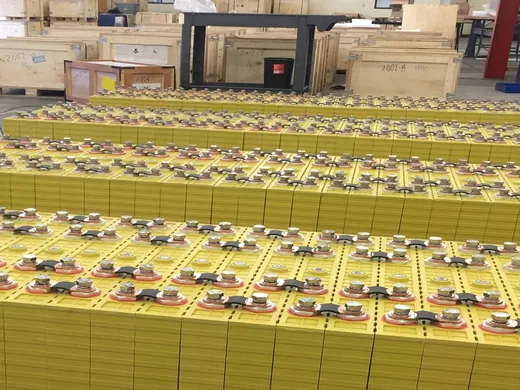
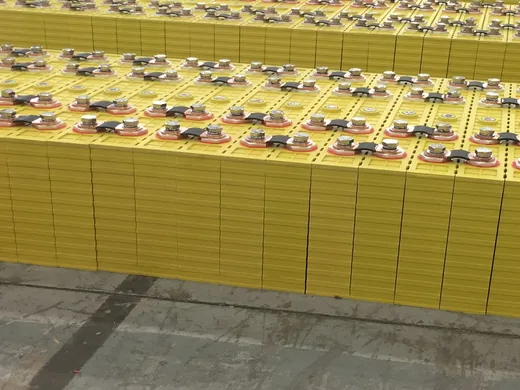
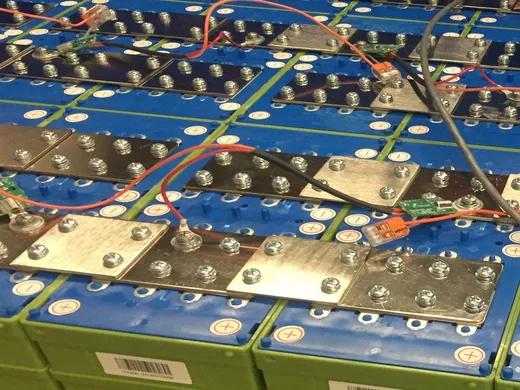
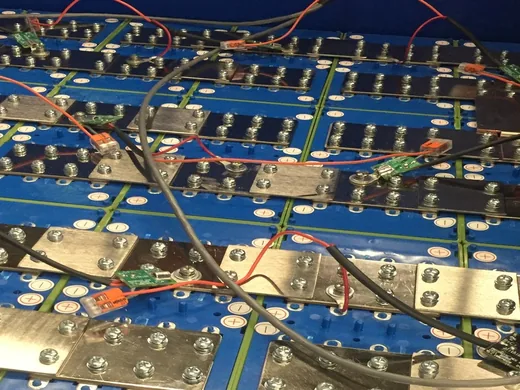
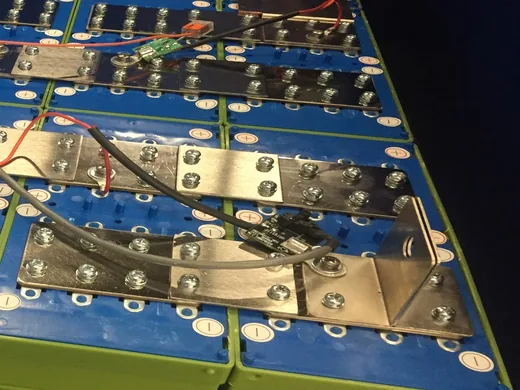
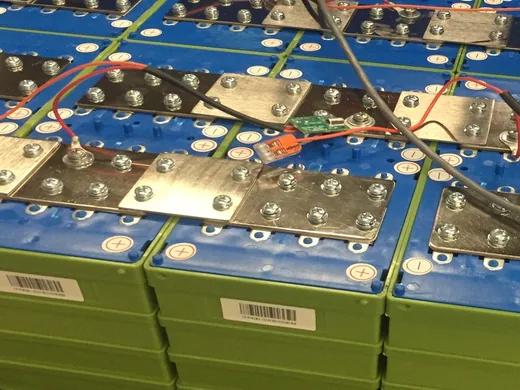
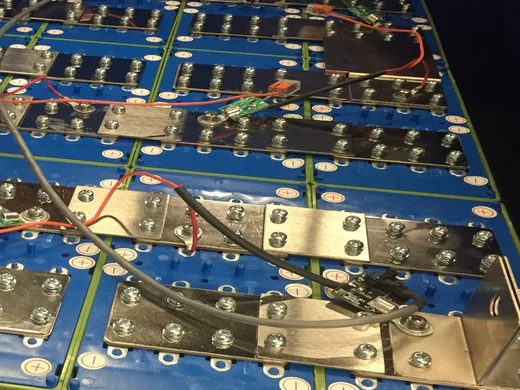
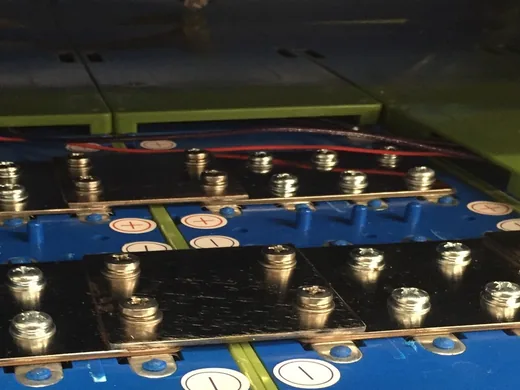
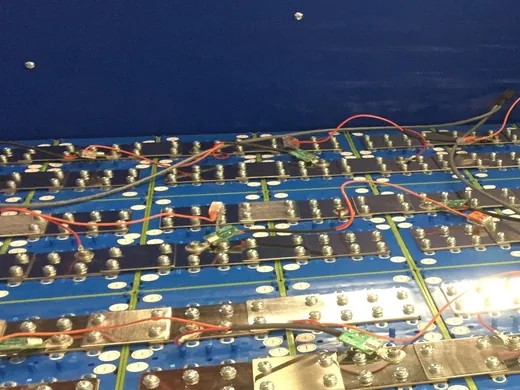
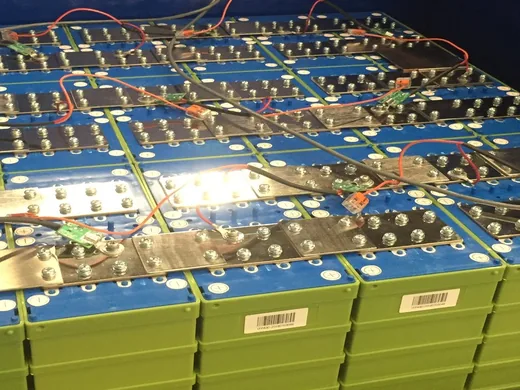
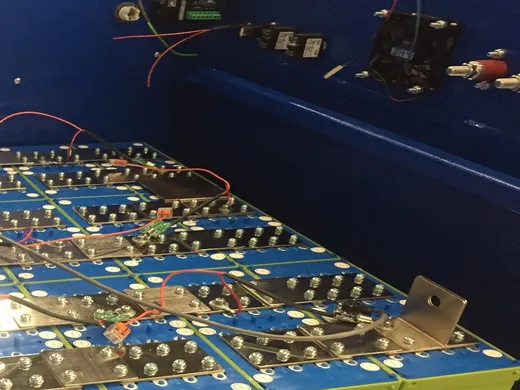
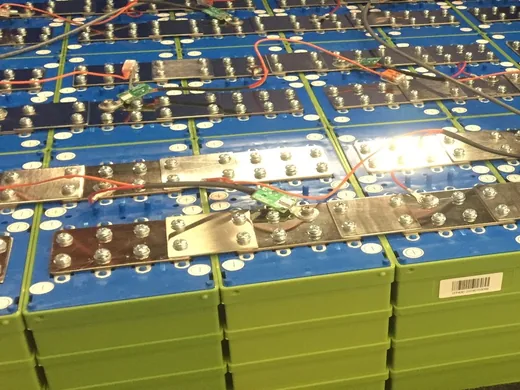
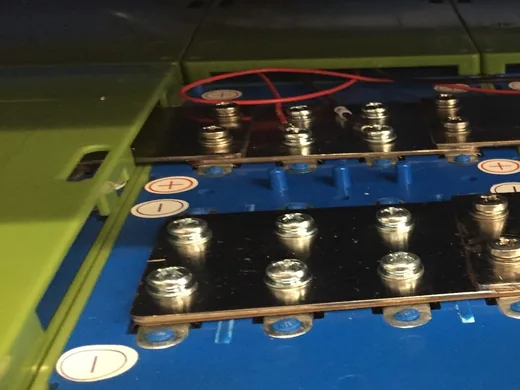
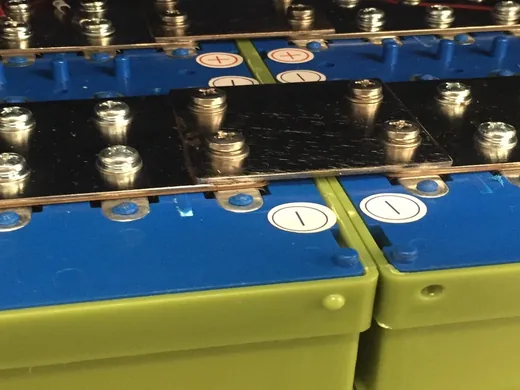
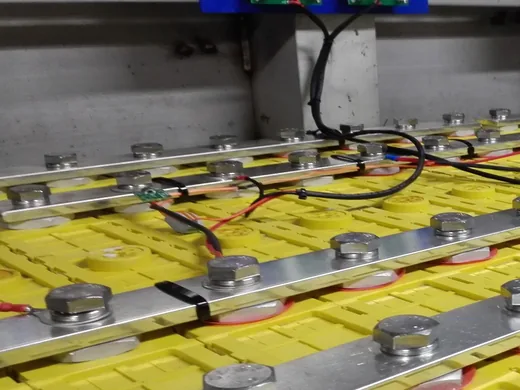
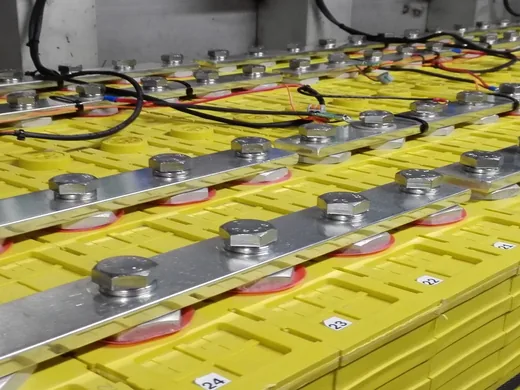
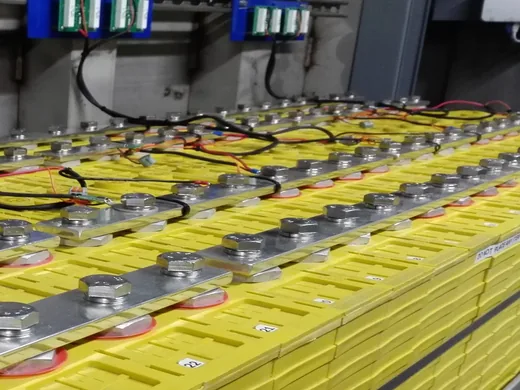
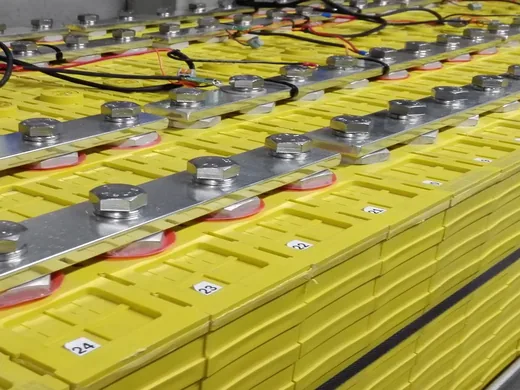
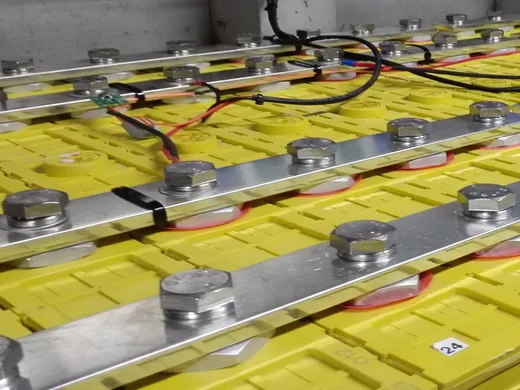
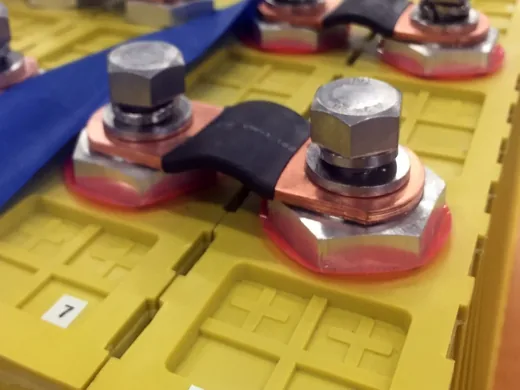
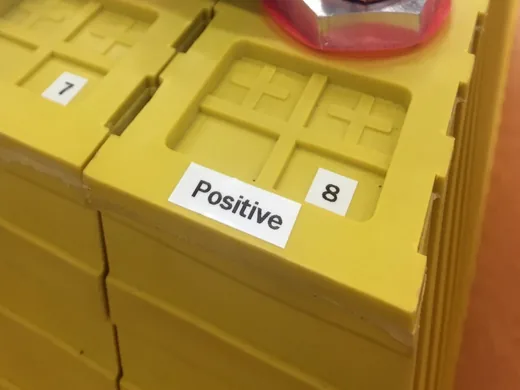
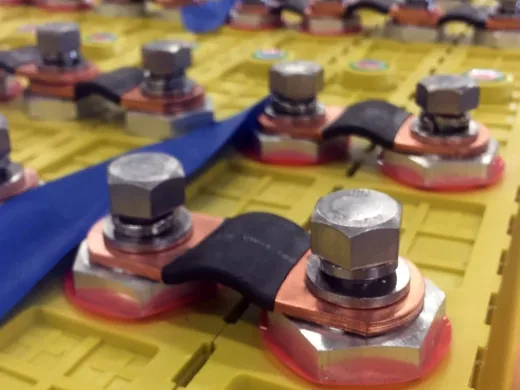
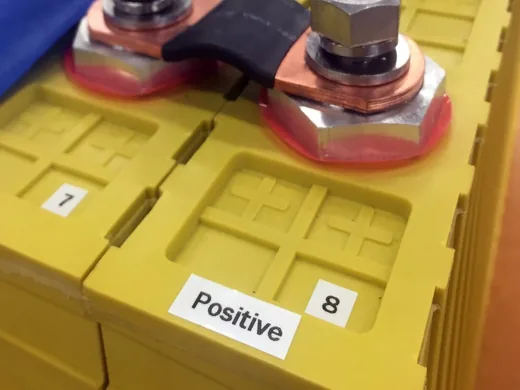
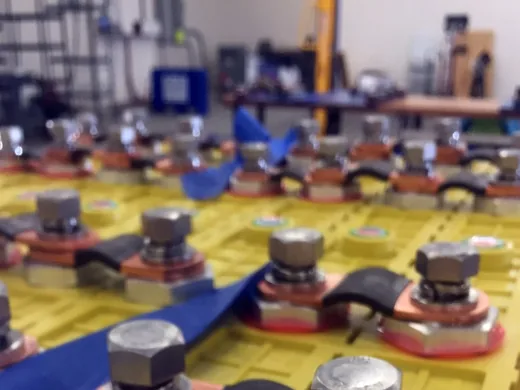
A real series string of large LiFePO4 cells, linked top to top by bus bars, in a utility-scale bank. These are 700-amp-hour cells, far larger than the cells inside a portable power station, shown here as an example of many cells wired in series. A string like this leans on balancing exactly as a small pack does. Each correction just carries far more charge. The image is a workshop photograph.
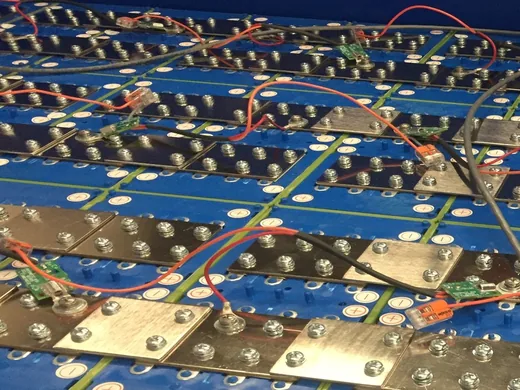
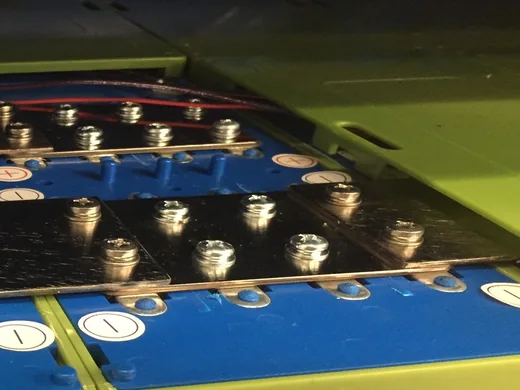
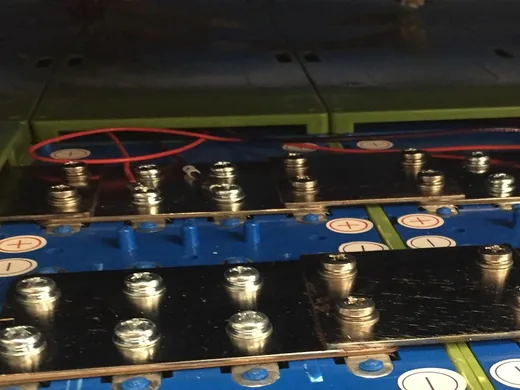
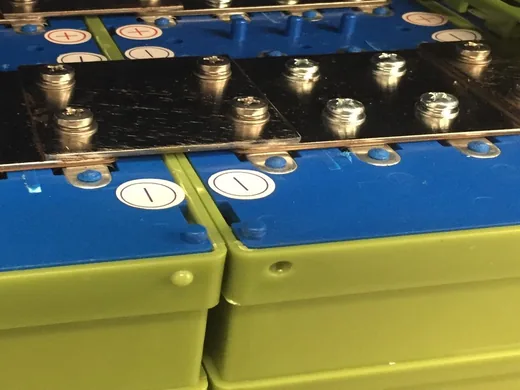
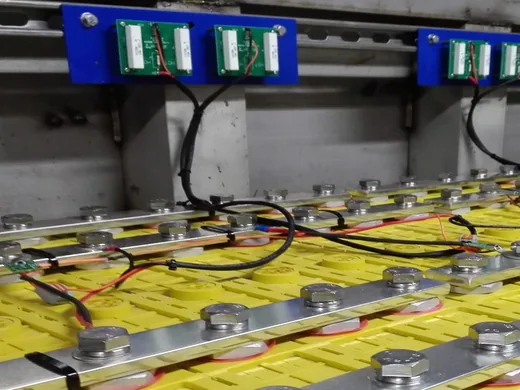
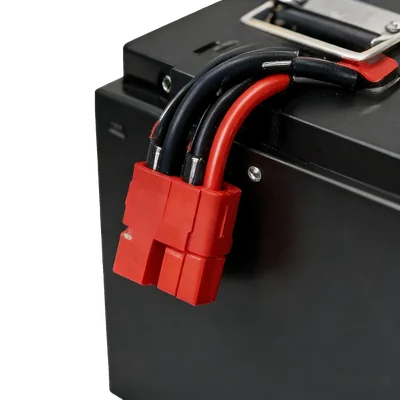
In a finished power station, balancing runs unseen behind the cells. Inside sits a series string of lithium cells, each tapped by the same wires the BMS reads it with. The balancer works through those same taps. Nobody watching the unit ever sees it act; all that shows is the steady runtime and the long life it quietly buys. Open the case and the balancer looks like little: a few small parts on the board beside the cells.
The same taps serve reading and balancing alike. Through one lead per cell, the BMS measures a cell’s voltage and, when needed, routes balancing charge to or from it. Diagnosis and balancing lean on the same wiring, which is why a pack built to balance well is also a pack that reports well. One set of leads, doing double duty, keeps the parts count down and the pack honest about itself.
Scale is what makes balancing matter on a big pack. String sixteen or more cells together, as a large station does, and every cell added is one more that could wander off. The longer the series string, the harder a steady balancer has to work to keep it whole.
On the largest banks, the cells themselves dwarf anything in a portable unit. Utility strings built from cells of several hundred amp-hours apiece lean on balancing just as a small pack does, only with far more charge riding on each correction. The principle holds at every size: keep the cells together, and the whole string behaves as one. Whether the string holds four cells or four hundred, that one rule does not change.
Reading the spec and choosing
Rarely does a spec sheet name its balancing method outright. A few small clues, even so, give it away. A balancing current in the tens of milliamps, or any mention of bleed resistors, suggests the simpler passive design. Jump to hundreds of milliamps or whole amps, or spot the word active, and the design is a redistributive one. Read the number as a measure of how fast a pack can haul its cells back into line; the higher it runs, the harder the string it can keep up with.
Match the method to the life the pack will lead. Sip power and charge gently, and a passive bleed keeps the cells in line at almost no cost. Run heavy loads for hours, or cycle deep day after day, and the extra capacity and lower heat of active balancing start to pay. Many portable stations land somewhere in the middle, their needs set by how the owner runs them from day to day.
Balancing is the quiet discipline that keeps a series pack whole. Cell by cell, day after day, it trims the leaders or lifts the laggards, keeping the whole string in step. A power station that balances its cells well spends all the charge it carries and carries it for years to come.
Frequently asked questions
What is cell balancing in a battery?
Balancing is how a BMS keeps the cells of a series pack charged to the same level. Wired in series, cells slowly drift apart. The weakest one ends up capping how much charge the whole pack can use. Balancing trims the high cells or lifts the low ones. That closes the gap and frees the pack’s full capacity.
How is active balancing different from passive?
Passive balancing bleeds charge off the high cells through a resistor, turning the surplus into heat near the top of charge. Active balancing moves that surplus, carrying charge from the high cells to the low ones, where it stays in the pack. The active method keeps more usable capacity and makes less heat. Its hardware is more complex in return.
Does balancing increase battery capacity?
Balancing adds no capacity to any single cell. It works by unlocking the capacity the cells already hold. An imbalance leaves charge stranded in cells that never fully fill or empty. Bringing those cells back into line turns that stranded charge usable. The pack ends up delivering closer to its rated capacity. None of that comes from a cell growing larger.
Which packs need active balancing?
Large series strings benefit first, since every cell added is another chance for one to drift. A pack cycled deep and often, or pushed to give back every watt-hour, makes the extra capacity and lower heat of active balancing earn their cost. A small pack that drifts little, or charges gently, asks for none of this. A passive bleed keeps it in good order.