Guessing at what two decades do to a panel becomes unnecessary once modules with full records turn up. Three multicrystalline modules from a renewable energy park in Norway carry one of the better paper trails. Installation happened in the summer of 2000, at 100 watts each on the nameplate. Eleven years of outdoor operation followed. The park came down in 2011, with maximum power estimated by then at roughly 90 percent of original. Storage indoors ran another ten years. In 2021 the three modules went under a curve tracer and returned 82.2, 84.1 and 82.1 watts, normalised to standard test conditions. Efficiency had fallen from 13 percent to somewhere near 10.8.
Published measurements on those three modules put the average loss near 0.8 percent a year across twenty calendar years. Reading that figure carefully matters. Only eleven of those years were spent outdoors. The 2011 number was an estimate of about 90 percent taken at decommissioning, while the 2021 numbers came off an instrument and were corrected to standard conditions. Part of the gap between 90 and 83 is real ageing during storage at room temperature. Part of it is the distance between a field estimate and a laboratory measurement. Both readings need stating. A headline of 0.8 percent a year hides which is which.
Eighty-three watts from a panel sold as 100 sounds like a failure to a buyer and reads as ordinary to an engineer. Chemistry inside a laminate carries on running after a panel leaves its factory. What counts is whether the panel still does its job. A 100 watt module delivering 83 watts fills a battery in a fifth more time. Nothing about it is unsafe, nothing has to be thrown away, and its array keeps running. Panels get retired for economic reasons far more often than for electrical ones.
Splitting the loss into three causes
Power out of a panel is the product of three measurable quantities. Open circuit voltage, short circuit current and fill factor multiply together to give maximum power. Fill factor is defined as the fraction of the voltage-current rectangle a panel actually delivers, which makes that product an identity with no approximation in it. Each one degrades for its own physical reason, which turns an IV curve into a diagnosis. On those Norwegian modules short circuit current fell from 6.7 amps to about 5.95, a drop of 11 percent. Fill factor fell from 70 percent to about 66.5, a drop of 5 percent. Open circuit voltage fell from 21.6 volts to about 20.8, a drop of 3.7 percent. Multiply the three survivors back together. Twenty point eight volts times 5.95 amps times 0.665 gives 82.3 watts, landing on the measured figure.
Reading those three drops assigns blame. Short circuit current counts photons reaching the junction. An 11 percent fall means light stopped arriving, which browning encapsulant and delaminated pockets do exactly. Fill factor tracks series resistance in ribbons, solder joints and fingers, and 5 percent buys twenty years of thermal cycling on solder. Open circuit voltage answers to recombination and shunt paths, with 3.7 percent pointing at slow damage around the junction. Optical loss took more than half the total on these panels. A panel losing light is a different repair problem from a panel losing contact. The numbers say which arrived.
Numbers of that kind only compare after correction. Standard test conditions mean 1,000 watts per square metre at a cell temperature of 25 degrees. A panel measured outdoors at 800 watts and 55 degrees reads far below its rating for two reasons having nothing to do with age. Current scales almost in proportion with irradiance. Dropping to 800 watts costs 20 percent straight away. Thirty degrees above the standard costs another 30 times the temperature coefficient, around 12 percent on an older module at 0.40 percent per degree. Multiply 0.80 by 0.88 and 0.70 comes out. A panel reading 70 percent of its rating under those conditions is performing to specification. Owners reporting that a panel lost a third of its output have usually measured it warm and hazy.
What the glass looks like after twenty summers
Encapsulant shows age before anything else does. Ethylene vinyl acetate sits between glass and cells as a clear adhesive. Ultraviolet light breaks acetate groups off the polymer backbone, releasing acetic acid and leaving conjugated double bonds behind. Conjugation absorbs blue light, which is what a browning panel is doing chemically. Acetic acid then sits inside the laminate attacking cell metallisation and ribbon solder. One reaction feeds two failures, optical and electrical, out of a single cause. Modules built before roughly 2005 used encapsulant formulations with weaker ultraviolet stabilisers than current recipes carry. Where the acid goes matters as well. A polymer backsheet breathes slowly, letting acetic acid and moisture diffuse out of the laminate over months. A glass-glass module seals both faces, trapping whatever the encapsulant produces. Manufacturers building glass-glass modules moved to polyolefin encapsulants partly for that reason, since polyolefin has no acetate group to lose. Twenty year old panels almost all pair ethylene vinyl acetate with a polymer backsheet. Ageing of that combination is the best documented case there is.
Delamination follows another route. Adhesion between encapsulant and glass, or between encapsulant and cell, fails where water and heat cycle together. A delaminated pocket holds air, and air against glass reflects light that used to cross into the cell. Surveys of twenty year old multicrystalline fleets have found optical degradation on roughly 90 percent of panels examined. Another survey put heavy encapsulant discolouration on about 40 percent of its modules, with delamination present on nearly all of them while covering under half the surface. Neither number describes a failed panel. Both describe panels working in the low eighties as a percentage of rating.
The back of a panel ages on a schedule of its own. Polyester backsheets chalk, going powdery to the touch as the surface layer erodes. Cracking follows in some product families, running along the cell gaps where the sheet flexes most. Once a crack opens, moisture reaches the ribbons and corrosion starts. Aluminium frames pit in coastal air and grow white oxide bloom, cosmetic until the earthing path through the frame turns high resistance. Junction box adhesive lets go at the corners on plenty of twenty year old panels, leaving the box hanging by its own cables. A visual inspection catches most of that in ten seconds a panel.
Heat gathers where the light stops working
An infrared camera reads the consequences of all of that. Thermography on the Norwegian modules found a spread of about 10 degrees between the warmest and coldest cells across a single panel. Physics behind the spread is plain. A cell converting light into current exports energy. A cell behind a browned or delaminated patch absorbs identical light and converts almost none of it, leaving heat as the only outlet. Warmer polymer degrades faster, the patch spreads, and that cell warms again. Local degradation feeds itself. Even fading is the exception.
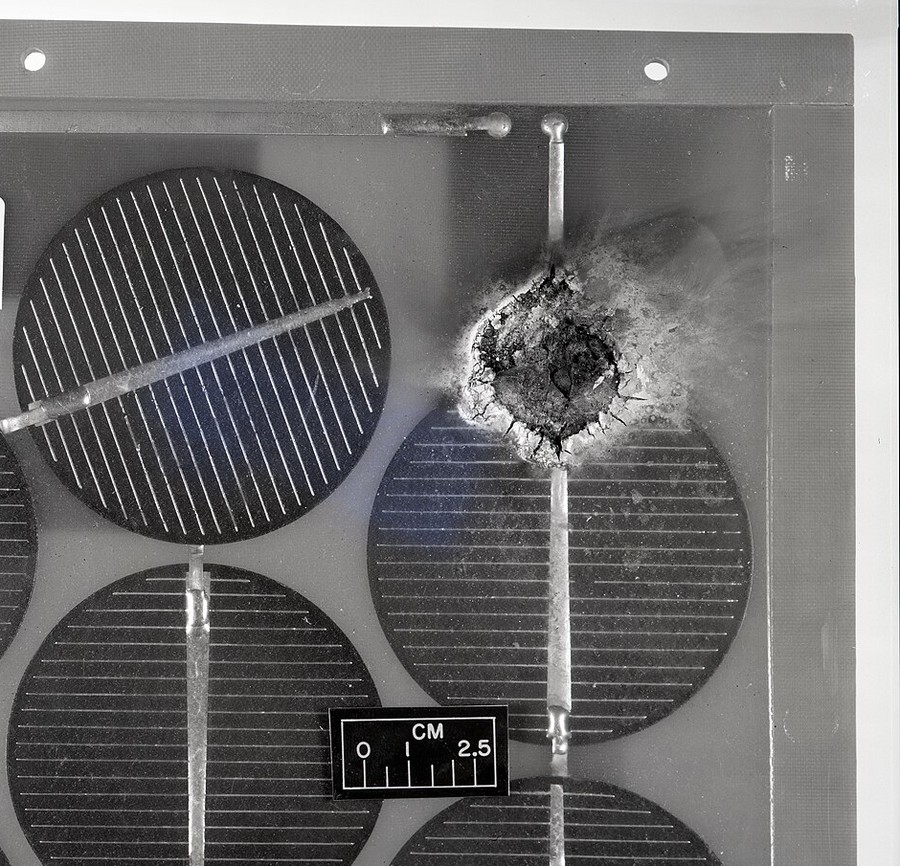
Series wiring turns a weak cell into a heated one. Cells in a string carry identical current, set by the weakest member. A cell no longer able to supply that current gets driven into reverse bias by the others, dissipating power as heat in place of producing it. Bypass diodes exist to stop that, clamping a substring once its voltage reverses. Diodes cover a whole substring of perhaps twenty cells, which leaves room for one degraded cell inside a healthy substring to cook quietly. That mechanism produces the burn marks turning up in failure analysis, with charring around a broken interconnect.
The parts that fail outright
Failure analysis of a module in 1977: a crater burned through the encapsulant where an interconnect ribbon broke, with a centimetre scale for size. Hot spots leave that mark whatever the module’s age. Photo by Donald Huebler for the US government, public domain.
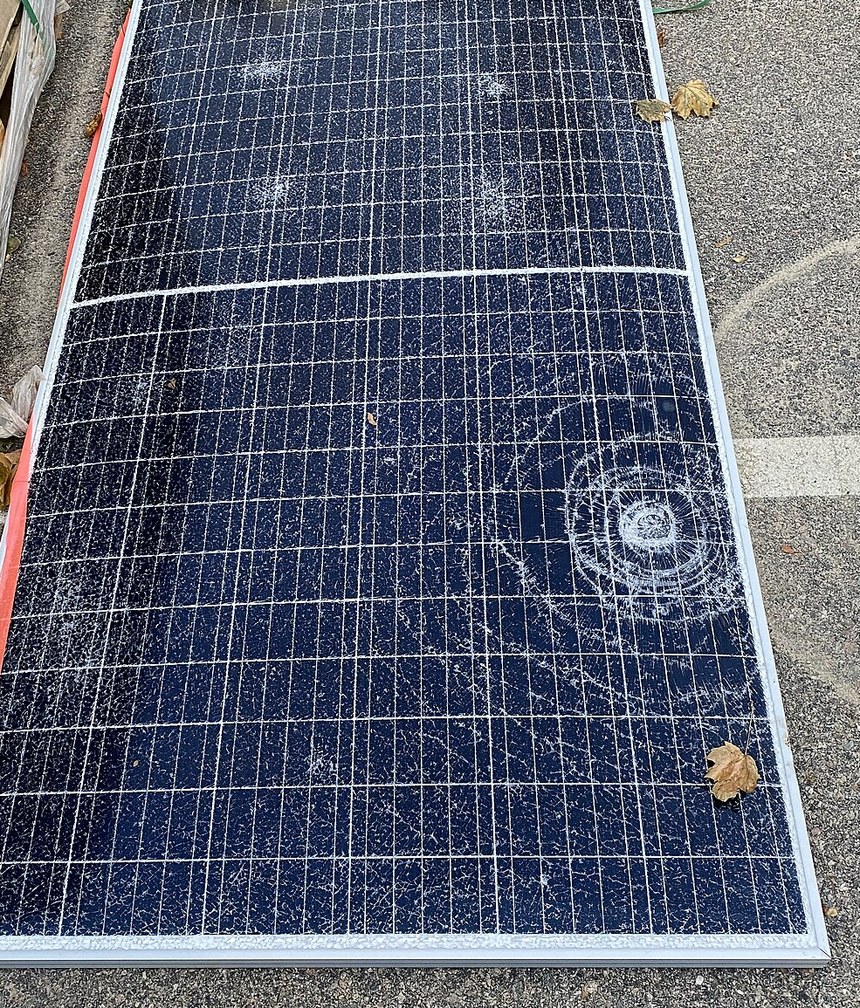
Gradual loss rarely decides when a panel comes off a roof. Discrete failures do that. Each one leaves a signature a person can find. Junction boxes head the list. Adhesive holding the box to the backsheet gives up after fifteen or twenty summers of expansion and contraction, water enters, and terminals corrode. Potting compound inside cracks and shrinks, exposing the connections it was meant to seal. Bypass diodes fail in two directions with opposite consequences. A diode failing short circuits its substring permanently, removing a third of the panel’s voltage while the panel carries on at reduced output. A diode failing open removes shade protection with no visible symptom at all, which nobody notices until a shaded cell burns. Backsheets crack along cell gaps in certain product families, letting moisture into the laminate where it corrodes ribbon solder and raises series resistance. Ribbon corrosion appears on an electroluminescence image as dark fingers spreading out from the busbar. Glass breaks from hail, from thermal shock when cold rain hits a hot panel, from a dropped tool and from mounting clamps overtightened at installation. A shattered module often keeps producing power, since tempered glass holds together inside its laminate while the cells underneath stay connected. Producing power with broken glass is the dangerous case, because water now reaches live conductors while the insulation resistance of a healthy laminate has gone. Frames corrode at the earthing point in salt air. Cable insulation hardens and cracks where a cable has rested on a hot roof surface, and connector contacts pit and heat once their seals age. Mating two different connector families, common on repowered arrays, produces a joint running warm from its first day. Each of these arrives with no warning. Encapsulant browning is the one failure that announces itself slowly. Field data on retired panels reflects that ordering. Modules taken out of service divide into two groups. A large group measured fine and came off because the site was repowered. A smaller group carried a discrete fault. Almost none come off for crossing a degradation threshold. Owners replace panels when the roof needs work or when the inverter dies.
Two twenty-year fleets, two answers
Installations of similar age return very different numbers. Seventy-six polycrystalline modules from an off-grid system on Ratones Island in Brazil came down after more than twenty-two years, a 4.7 kilowatt array that had replaced diesel generation. Testing after decommissioning covered visual inspection, IV curves at one minute resolution, electroluminescence imaging, insulation resistance and drone thermography. Remaining power came in at 87 to 88 percent of original, about 0.4 percent a year at module level. System level loss ran near 0.7 percent a year, with the difference produced by mismatch between modules and by nothing inside the modules themselves. Sixty-eight percent of them passed every test and were approved for reuse.
Two fleets at similar ages landed on 0.4 and 0.8 percent a year. Climate, mounting, encapsulant recipe and cell quality separate them, with no single factor carrying the whole gap. Variation between installations swamps variation between years inside one installation. Any figure quoted for how a panel looks at twenty years describes a distribution with a factor of two across its middle. Buyers reading a single number off a marketing page are reading the centre of that distribution with the width removed. Swiss systems past thirty years have measured between 0.16 and 0.24 percent a year, sitting far below both of these.
Climate alone fails to explain that pair. Norway is cool, Brazil is hot, and faster loss showed up at the cool site. Measurement design covers a good part of the difference. Three modules is a sample, seventy-six is a fleet. One figure mixes a field estimate at year eleven with a laboratory measurement at year twenty. The other comes from a single testing programme applied to every module at once. Product vintage covers more of it. A 100 watt module of 13 percent efficiency from the year 2000 sits two technology generations behind what Brazil had running. Comparing two published degradation numbers means comparing two experiments before comparing two panels.
Testing a panel that old
Tempered glass shattered across a whole module, radiating from one impact point, with the frame and the cells underneath still intact. A module in this state often keeps producing power, which is what makes it dangerous. Photo by Arnold Reinhold, CC BY-SA 4.0.
Two instruments settle most questions about an old panel. A multimeter across the terminals in full sun reads open circuit voltage, which should sit within a few percent of the datasheet figure once corrected for temperature. Voltage well down points at a shorted bypass diode or a damaged cell string. Short circuit current needs a clamp meter or a meter rated for the current, measured with the terminals joined. Current scales almost linearly with irradiance, making a bright clear noon the only fair moment to take it. Compare measured current against the datasheet, scaled by the irradiance at that moment. One number then covers the optical health of the panel.
Safety testing matters more than performance on a panel this old. Insulation resistance measured dry passes on almost anything, since a dry laminate insulates well even with cracks running through it. The test that finds trouble wets the module first. IEC qualification asks for insulation resistance times module area above 40 megohm square metres under a wet leakage test, with the panel in a water bath and voltage applied for two minutes. Field-aged panels passing dry and failing wet turn up often enough to have their own literature. A panel in that state works, produces power and pushes current into its frame whenever it rains.
Electroluminescence imaging finds what an eye cannot. Feeding current backwards through a panel makes the cells emit infrared. A camera with its infrared filter removed photographs the result at night. Cracked regions go dark. Corroded fingers show as dark stripes running out from the busbar. Inactive cell areas appear as black patches with sharp edges. A modified consumer camera and a bench supply do the job on a driveway for the price of an afternoon. Nothing else shows cell-level damage without dismantling the panel.
Results sort old panels into three groups. Panels measuring above 80 percent of nameplate with clean insulation go back into service. Panels with a discrete fault, a dead diode or a wet junction box, get repaired for parts costing very little. Panels with broken glass, failed insulation or dark regions across many cells go for recycling. Sorting runs to perhaps fifteen minutes a panel with the right equipment. Second-life dealers work in container loads for that reason.
Second life or scrap
An old panel misbehaves in a new string. Series wiring drags every module down to the weakest current in the string, which makes mixing a twenty year old panel with new ones a way to waste the new ones. Old panels belong in an array of their own on a charge controller of their own, where matching each other is all they have to do. Voltage matters as much as current. A module from 2000 with 36 cells opens at around 21 volts, sitting nowhere near a modern 144 half-cell module at 45. Combining those in series works electrically and throws away capacity through mismatch. Separate strings on separate MPPT inputs solve it cleanly.
Measured condition of twenty-year-old crystalline modules, and where each figure comes from
Quantity
Figure
Source or arithmetic
Nameplate at installation, 2000
100 watts
mc-Si module, Norwegian park
Estimate at decommissioning, 2011
about 90 percent of original
after 11 years outdoors
Curve tracer measurement, 2021
82.2, 84.1 and 82.1 watts
three modules, normalised to STC
Efficiency
13.0 percent falling to about 10.8
same three modules
Short circuit current
6.7 A falling to about 5.95 A
minus 11 percent, optical loss
Fill factor
70 percent falling to about 66.5
minus 5 percent, series resistance
Open circuit voltage
21.6 V falling to about 20.8 V
minus 3.7 percent, recombination and shunts
Product of the three
82.3 watts
20.8 times 5.95 times 0.665
Cell to cell temperature spread
10 plus or minus 2 degrees
thermography, one panel
Brazilian island fleet at 23 years
87 to 88 percent of original
76 modules, 4.7 kW, off-grid
Module level rate, that fleet
0.4 percent per year
same testing programme
System level rate, that fleet
0.7 percent per year
difference is module mismatch
Approved for reuse
68 percent of modules
visual, electrical and safety tests
Swiss systems past 30 years
0.16 to 0.24 percent per year
six installations
Wet leakage pass criterion
40 megohm square metres
insulation resistance times module area
Glass share of module mass
70 to 76 percent
recycling composition
Aluminium frame share
8 to 13 percent
same
Silicon share
3 to 5 percent
same
Scrap value explains why so many working panels get crushed. Glass carries 70 to 76 percent of a module’s mass, the aluminium frame another 8 to 13, silicon 3 to 5. Recovering the glass is easy and pays almost nothing per panel. Recovering silver out of the fingers pays better per gram and needs chemistry that only works at volume. Transport cost for a 20 kilogram object of low value drives the economics harder than the material content does. An off-grid builder pays more for that panel than a glass recycler does.
What a folding panel looks like at twenty
Twenty year old folding panels barely exist as a category. Portable panels at this size and price arrived alongside lithium power stations after about 2015, which puts the oldest of them near a decade. Anything sold as a twenty year old folding panel comes out of the marine or expedition market. Predictions past ten years for this product class rest on material behaviour. Field records do not exist yet. Portable panels reach twenty years differently, when they reach it at all. Construction is the reason. A folding panel has no tempered glass to break, no aluminium frame to corrode and no roof-mounted junction box baking in place. Front sheet polymer stands where glass would be. PET clouds and yellows under ultraviolet, losing transmission across the whole surface at once, which a folding panel that has spent its life outdoors shows plainly. ETFE holds transmission far longer. Cells inside see less total exposure than any rooftop panel, since a portable panel spends most of its calendar life folded in a bag. Twenty calendar years of weekend use puts less dose on those cells than a roof delivers in two.
What fails is the folding itself. Hinge lines crease the laminate at fixed positions, and cells nearest those lines pick up microcracks from every fold. Stitching on fabric hinges wears through. Cable entry points at the junction box take strain each time the panel gets picked up by its cable. Connectors see a plug cycle every trip, where a rooftop connector sees two in its life. Expecting twenty years out of a folding panel means expecting twenty years out of a hinge, a zip and a connector. Choosing ETFE, storing the panel dry and never lifting it by the cable are the decisions that matter. All of them sit outside the cells.
Common questions
Will a twenty year old panel still charge my power station?
Yes, at roughly 80 to 88 percent of its rated watts. A 100 watt panel putting out 84 fills an identical battery in about a fifth more time. Check that the open circuit voltage still lands inside the charge controller’s input window before connecting anything.
How do I tell whether an old panel is safe?
Look for cracked glass, a hanging junction box, chalked or split backsheet and hardened cable insulation. Any of those means retirement. A dry insulation test passes on almost every panel. The check that finds trouble needs the module wet.
Can I wire old panels together with new ones?
Not in series. The string carries the weakest panel’s current, which wastes the newer ones on every sunny hour. Give old panels their own string and their own MPPT input, where they only have to match each other.
Why does a shattered panel still produce power?
Tempered glass crazes into small pieces held in place by the encapsulant underneath. Cells and ribbons stay connected through it. Output drops a little from scattering. Insulation is what has really failed. That turns the panel into a shock hazard in rain.
Do folding panels last twenty years?
Their cells would. Hinges, stitching, connectors and the front sheet decide the real answer, and PET front sheets clouding under ultraviolet end more portable panels than anything electrical. An ETFE panel stored dry and lifted by its handle in place of its cable stands the best chance.